Marketing wants to feed CRM notes into a generative campaign tool. Legal asks whether customers consented. Product points to the terms of service checkbox from 2019. Nobody mapped which AI customer data consent model applies to this new processing purpose. Confusion here creates regulatory exposure and broken customer trust.
This guide compares consent, contract, legitimate interest, and other lawful bases for feeding customer data into AI customer service and AI chatbots workflows. It is not legal advice; involve counsel for final decisions.
Map each integration point: CRM sync, support desk sidebar, marketing personalization, product in-app assistant. Each point may need different lawful basis and notice layer. A single global "AI privacy paragraph" fails when risk profiles differ.
Train sales and success not to promise AI features customer contracts prohibit. Pre-sales demos using customer data in sandbox assistants need same basis analysis as production. Deal desk checklist should include AI feature flags and basis confirmation.
Withdrawal workflows test in tabletop exercises twice yearly. Exercises reveal CRM flags that fail to propagate, vendors that delay deletion, and agents who re-import data from email archives after withdrawal.
Definitions: Controller, Processor, and Purpose Limitation
You are typically the data controller when you decide why and how customer personal data is processed. The AI vendor is usually a processor acting on your instructions under a DPA. Purpose limitation means you cannot reuse data collected for support tickets to train ad models without a compatible lawful basis and notice.
Each new AI feature is a new purpose in many jurisdictions. Re-scoping requires notice updates, not silent backend changes. Document controller vs processor roles in your RoPA (record of processing activities).
When Consent Is Required vs Alternatives
Consent must be freely given, specific, informed, and withdrawable. It is appropriate when no other basis fits or when law mandates opt-in (e.g., some marketing channels, cookies in the EU, certain sensitive data).
| Lawful basis | Typical AI use | Caveat |
|---|---|---|
| Contract | Features necessary to deliver the service the customer bought | Cannot stretch to unrelated analytics or ads |
| Legitimate interest | Fraud detection, security, modest personalization | Requires balancing test documentation |
| Consent | Optional AI features, marketing, sensitive inferences | Must be easy to withdraw; no bundling with ToS |
Legitimate interest for AI customer service personalization is contested in several EU markets. Document a LIA (legitimate interest assessment) and consider consent for profiling-heavy campaigns.
Practical decision tree
- Is the processing strictly necessary to perform the contract? If yes, document contract basis.
- Is it required by law? Use legal obligation basis.
- Is it optional for the customer? Strong bias toward consent.
- If considering legitimate interest, complete balancing test and offer opt-out where appropriate.
Notice Language Customers Should See
Notices must explain AI processing in plain language: what data, what automated steps, human review or not, retention, and rights. Layer short in-product notices over full privacy policy updates.
- "We use automated tools to draft responses. A human reviews before send."
- "Your messages may be analyzed to improve recommendations. You can turn this off in settings."
- "We do not use your content to train public models." (only if contractually true)
Avoid burying AI disclosures in generic "we may use service providers" paragraphs. Regulators and customers expect specificity in 2026.
Withdrawal and Deletion Workflows
Consent-based processing needs operational withdrawal: toggle in account settings, API flag to stop new inference, deletion requests propagated to vendor within DPA timelines. Map withdrawal to technical actions:
- Stop new data ingestion from that customer into AI pipelines
- Delete or anonymize stored prompts, logs, and fine-tuning rows tied to the customer
- Confirm vendor deletion and refresh retrieval indexes
- Communicate confirmation to the customer
Engineering teams using AI code assistants on customer repos need parallel processes for repo removal and embedding purge.
Records of Processing and Consent Evidence
Maintain records of processing activities that list each AI workflow, lawful basis, categories of data, retention, and subprocessors. Consent-based flows store evidence: timestamp, notice version, channel, and withdrawal events. Regulators request records more often than they request model architecture diagrams.
Product Implementation Patterns
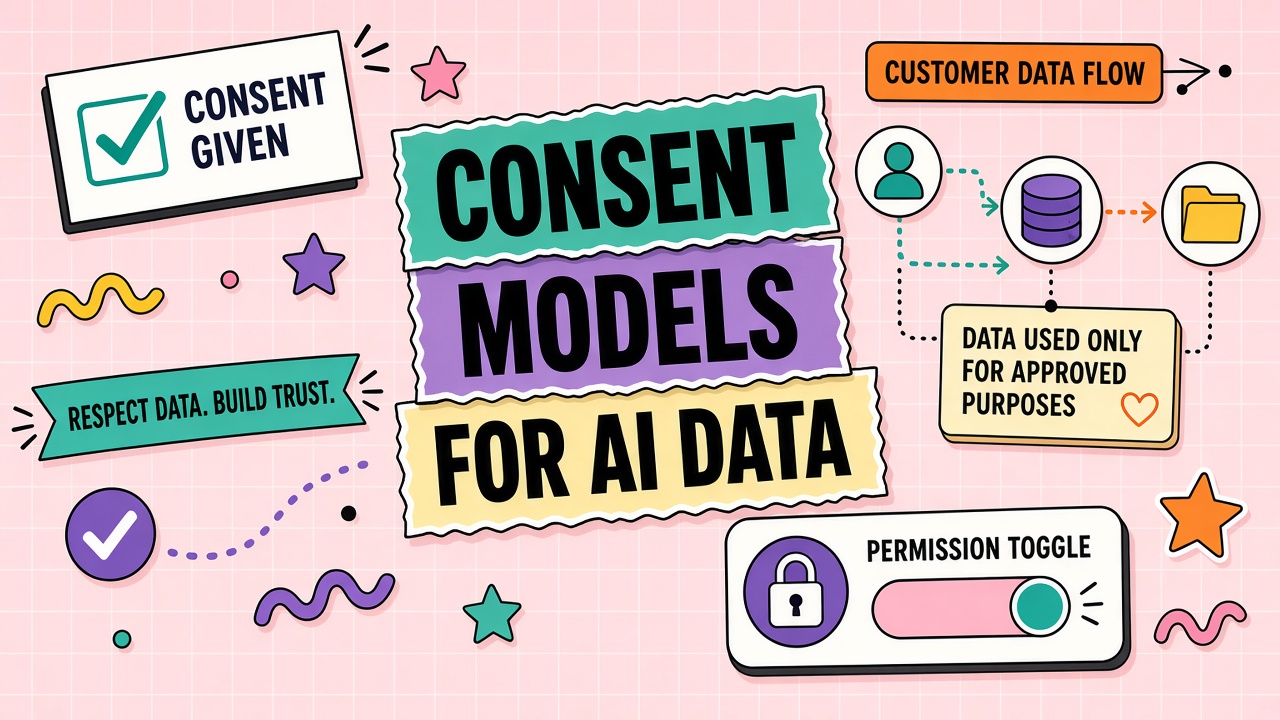
Implement consent toggles at the feature level, not only in privacy policy text. Users enabling AI summarization on support tickets should see a just-in-time notice with link to detail. Engineering flags in CRM prevent re-processing after withdrawal without manual override and audit log.
Records of Consent and Proof
Store consent receipts: timestamp, version of notice, channel, scope toggles, IP or account ID as permitted by law. Consent withdrawal must be as easy as grant. Dark patterns (pre-checked boxes, bundled unrelated features) invalidate consent in many jurisdictions.
For AI customer service use cases, separate consent for email vs profiling vs sharing with ad partners. One mega-checkbox fails regulatory scrutiny in EU and several US states.
Documenting legitimate interest
Complete a written balancing test: your interest, impact on individuals, safeguards (opt-out, minimization). Keep it with the RoPA. Refresh when processing scale or purpose expands.
Processor instructions to AI vendors
Your lawful basis must align with instructions in the DPA. If you rely on consent, vendor cannot use data for product improvement without separate basis. Engineering changes to AI features should trigger legal re-review of basis compatibility.
Granular Consent for AI Features
Bundle consent for unrelated AI features violates specificity principles in many frameworks. Separate toggles for support drafting, marketing personalization, and product analytics let customers withdraw one without disabling core service. Engineering flags must mirror granular notices.
Record consent version strings in application databases so retroactive analysis knows which notice applied. Version drift without migration logic produces withdrawals that do not match stored consent records.
Processor Instructions and DPAs
Lawful basis documentation should align with processor instructions in DPAs. If basis is consent, instructions must prohibit processing beyond consented purposes. Mismatch between customer-facing consent and vendor instructions creates liability on both relationships.
Review vendor feature releases for purpose expansion. New connector that syncs additional CRM objects may require fresh consent or legitimate interest analysis before enablement in production tenants.
Frequently Asked Questions
How does B2B differ from B2C?
B2B may process business contact data with contract or legitimate interest bases more often, but employee and end-user personal data in B2B SaaS still triggers GDPR-style rights. Enterprise customer DPAs may impose stricter consent rules than your default policy.
What about children's data?
Many jurisdictions require parental consent under age thresholds. Do not feed known children's data into general AI tools without specialized legal review and age-appropriate design.
Is continued use of the product implied consent?
Generally no for new AI purposes in GDPR jurisdictions. Re-consent or another valid basis is required when purpose expands materially.
We bought a dataset with emails. Can we use AI on it?
Only if the original collection and your purpose share a valid basis and notice chain. Purchased lists rarely support new AI profiling without fresh consent.
Do we need granular consent per AI feature?
Granularity reduces risk. Bundling unrelated features under one toggle weakens consent validity. Separate toggles for support AI vs marketing AI vs analytics.
Vendor Processor Instructions
Document instructions sent to AI vendors as processor: permitted purposes, prohibited uses, retention limits, training bans. Instructions should match customer notices and internal policy. Drift between what you tell customers and what you instruct vendors creates regulatory exposure.
Periodic attestation from vendor relationship owners confirms processing still matches documented basis after feature additions. New connector that syncs CRM fields may expand purposes beyond original consent or legitimate interest analysis.
Support agents need scripts when customers ask how AI-assisted support uses their data. Scripts should align with privacy notice language and withdrawal steps without improvising legal claims on calls.
Data Minimization in Consent Design
Consent UX should default to minimum data necessary for the AI feature, not maximum CRM sync because integration is easy. Purpose limitation breaks when users consent to a narrow feature but engineering syncs full profiles by default. Product and legal review data fields before launch toggles go live.
Periodic audits sample production prompts and uploads against consent scope. Scope creep from enthusiastic practitioners is a leading cause of basis mismatch findings.
International Variations in Consent Law
Brazil LGPD, Canada PIPEDA, and US state laws differ on opt-in vs opt-out for certain processing. Maintain a matrix mapping each AI feature to basis per region. Product geo-fencing may disable features where basis is unclear until legal approves localized notice.
Contractual necessity in B2B contracts does not automatically justify processing end-user personal data of your customer's customers. You remain responsible for your instructions to processors and for transparency to data subjects where you are controller.
Marketing should not pre-check consent boxes in UI flows. Affirmative action requirements in many jurisdictions prohibit pre-ticked AI features bundled into signup wizards without clear separate acceptance.
Log lawful basis per customer account or segment in CRM so support sees basis before using AI features on tickets. Basis blindness at point of use causes accidental processing after withdrawal or scope change.
International customers may require localized consent flows. Copy-paste English consent into other locales without legal review creates invalid basis claims even when translation looks fluent.
Document consent and alternative basis decisions in release notes for customer-facing AI features so customer success can answer account questions consistently with privacy notices.
Match the Basis to the Feature
Consent models for customer data in AI tools are not one-size-fits-all. Define roles, pick the lawful basis per purpose, write clear notices, and wire withdrawal to deletion. Marketing teams exploring AI customer service and product teams shipping AI features should align on the decision tree before launch, not after the first regulator letter.