TikTok creators lose hours rewriting hooks that flop in the first second, or filming takes that never match the pacing the algorithm rewards. A structured ai workflow tiktok scripts pipeline separates what AI accelerates (pattern matching, beat outlines, shot prompts) from what stays human (your voice, on-camera energy, and platform judgment). The goal is not a robot voiceover. The goal is a repeatable system that gets you to a filmable script faster without breaking TikTok community guidelines, FTC disclosure rules, or your personal brand.
This workflow assumes you already know your niche. AI helps you draft and organize; you approve every line before recording. Pair script drafting with AI chatbot tools for conversational brainstorming and AI code workflows when you automate caption exports, shot list templates, or Notion sync for batch filming weeks.
Define Format, Length, CTA, and Compliance Boundaries
Before any model drafts a word, lock the video format, target length, call to action, and compliance rules in a one-page brief so AI outputs stay inside platform and legal guardrails. TikTok favors vertical video between 15 and 60 seconds for many niches, though educational creators often stretch toward three minutes when retention holds. Your brief states the format (talking head, green screen, stitch, POV), maximum runtime, primary CTA (follow, comment keyword, link in bio), and hard limits on claims, music, and sponsored content.
- Format: talking head, voiceover plus B-roll, duet reaction, or tutorial screen capture.
- Length target: 21 seconds, 45 seconds, or 90 seconds with a retention checkpoint at second three.
- CTA: one action only (save, comment, share, click bio link).
- Compliance: FTC disclosure if gifted or paid, no medical or financial advice without disclaimers.
- Voice notes: three adjectives that describe your tone (direct, warm, skeptical).
| Brief field | Why it matters | Common mistake |
|---|---|---|
| Runtime cap | Keeps scripts speakable in one take | Writing a 90-second script for a 30-second slot |
| Single CTA | Clear viewer action | Follow plus shop plus comment in one video |
| Claim boundaries | Reduces takedown and trust risk | Letting AI invent results or testimonials |
| Music plan | Commercial use rights | Trending sound on a brand deal post |
Platform Constraint Checklist
TikTok community guidelines restrict dangerous acts, regulated products, misleading claims, and undisclosed paid partnerships; bake these limits into your brief as explicit "do not include" lines for the model. Brand deal videos need visible disclosure in the first lines and caption. Health, finance, and political topics trigger stricter moderation. AI does not know your account strike history; you do.
Research Hooks From Comments and Trends
Hook research combines manual signal gathering (your comments, competitor hooks, Creative Center trends) with AI summarization that clusters patterns into testable opening lines. The first one to three seconds decide whether viewers stay. Spend disproportionate time here. Export your last ten high-retention posts and their comment threads. Paste anonymized comment questions into a chat session and ask for five hook angles per question, ranked by curiosity gap.
- Pull top comments from your last 30 days; note repeated questions and objections.
- Save five competitor hooks that earned high shares in your niche (structure only, not verbatim copy).
- Check TikTok Creative Center for rising sounds and hashtags relevant to your topic.
- Ask AI to summarize comment themes and propose hook formulas (mistake, myth, before/after, countdown).
- Shortlist three hooks; record test intros before committing to a full script.
Manual trend judgment still wins. AI may suggest hooks that sound generic or off-brand. Treat model output as a swipe file. You pick the angle that matches what you would actually say on camera. Keep a personal hook library in a spreadsheet: opening line, retention rate, topic, date. Feed winners back into future briefs as examples of your voice.
Hook Formula Patterns That Translate Well
Strong TikTok hooks name the audience, state stakes, or promise a specific payoff within the first sentence. Patterns like "Stop doing X if you want Y," "I wasted $Z before I learned this," and "Three signs you are about to..." give AI clear scaffolding. Avoid hooks that require context from later in the video; mobile viewers scroll before you get there.
Draft Script Beats: Hook, Value, Payoff
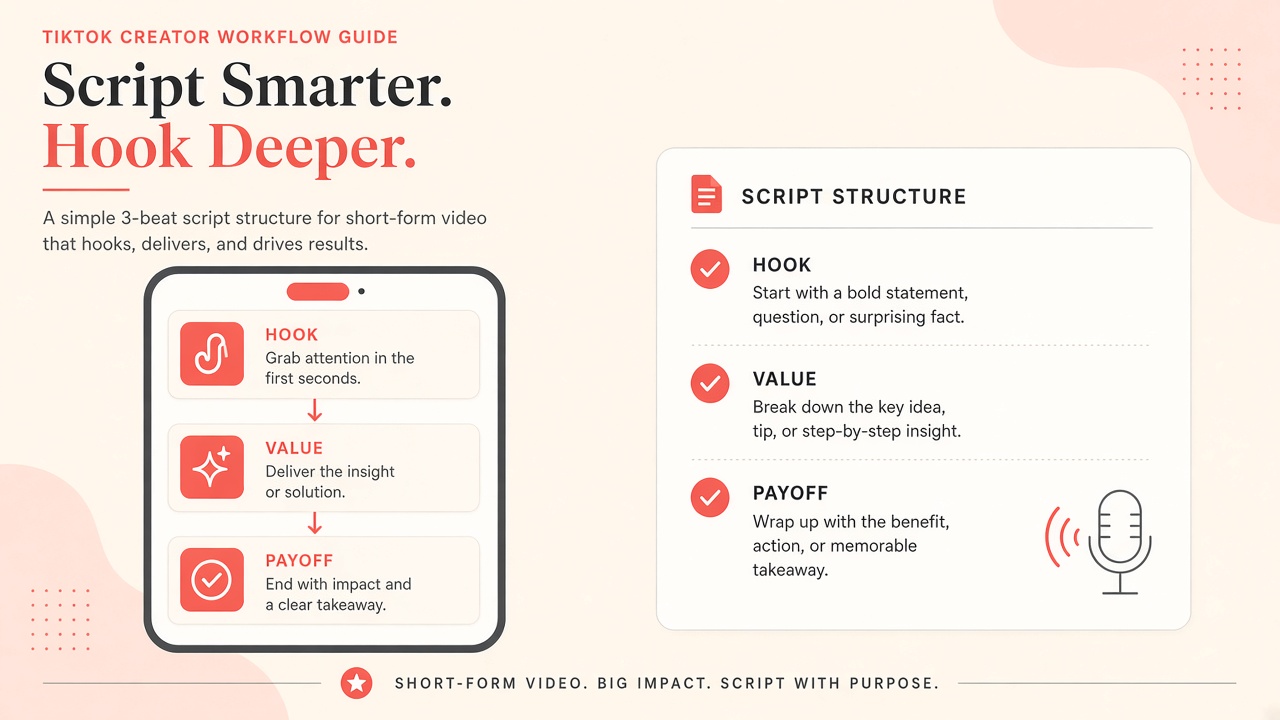
After you pick a hook, AI drafts three to five beats: hook, context, value delivery, proof or demo, and payoff with CTA, each with approximate word counts tied to your runtime target. Short-form scripts are spoken, not essays. Aim for grade-six readability, contractions, and sentences you can deliver in one breath. Prompt the model with your brief, chosen hook, and two examples of your past scripts so cadence stays familiar.
- Beat 1 (hook, 0 to 3 seconds): pattern interrupt plus promise.
- Beat 2 (context, 3 to 10 seconds): why the viewer should care today.
- Beat 3 (value, 10 to 35 seconds): steps, story, or demonstration.
- Beat 4 (proof, optional): result, screenshot, or social proof you can show on camera.
- Beat 5 (payoff plus CTA): recap one line and single ask.
| Beat | 45-second target | AI assist level |
|---|---|---|
| Hook | 1 to 2 sentences | Suggest variants; you choose |
| Value body | 60 to 80 percent of runtime | Outline bullets; you rewrite in voice |
| CTA | 1 sentence | Match your standard closing phrase |
Voice Preservation Steps
Preserve your voice by banning filler phrases the model overuses, requiring first-person lines only you would say, and reading the draft aloud before filming. Common AI tells on TikTok include "In today's fast-paced world," "Let's dive in," and stacked adjectives without specifics. Maintain a personal banned phrase list in your brief. If a line sounds like a corporate blog, cut it or replace with a story from your week.
Shot List and B-Roll Prompts From Script
Once beats are approved, AI converts each beat into a shot list: framing, action, on-screen text, and B-roll prompts so filming day runs on rails. TikTok retention often comes from visual changes every two to four seconds. A talking-head-only script can work, but plan at least one cutaway, text overlay, or prop reveal per value beat.
- Mark A-roll lines you deliver to camera versus voiceover.
- For each beat, specify shot type: close-up, medium, overhead, screen recording.
- Generate B-roll prompts: "hands typing," "before/after split," "product unboxing macro."
- Add on-screen text notes with max character counts for mobile readability.
- Flag beats that need stitch, green screen, or CapCut template before you record.
Export the shot list to your phone notes or filming app. Batch similar B-roll in one session (all screen recordings, all product shots) to reduce setup time. AI can suggest stock-style B-roll ideas; you still verify every clip is yours or properly licensed. Trending templates change monthly; shot lists should reference your actual assets, not generic placeholders.
Caption and Hashtag Pass
After the script and shots are set, run a separate AI pass for caption copy and three to five niche hashtags, keeping disclosure language intact for sponsored posts. Captions support SEO inside TikTok search. Do not let the model invent hashtags you have not verified for relevance and policy risk. Pin a comment with extended CTA or source links when the video makes factual claims.
Review Loop for Authenticity and Disclosure
The final review loop checks voice authenticity, factual claims, FTC and platform disclosure, and speakability on camera before you hit record. AI drafts are starting points. This gate prevents off-brand tone, unverifiable promises, and missing #ad or partnership labels. Read the script at full speed with a timer. If you stumble twice on the same sentence, simplify or split into a part two.
- Voice check: would you send this script to a friend as a voice note?
- Fact check: every statistic, price, and result traceable to your experience or a source.
- Disclosure: spoken and written disclosure present for gifts, affiliates, and brand deals.
- Policy scan: no banned products, dangerous challenges, or misleading before/after claims.
- Retention read: hook lands in three seconds; no long intro before value.
Store approved scripts in versioned folders (brief, draft v1, final, performance notes). After publish, log average watch time and shares next to the hook formula. Feed that data into the next research step. Creators who treat scripts as living documents improve faster than those who generate and forget.
Post-Publish Learning Loop
Seven days after publish, review analytics and annotate what worked: hook variant, runtime, sound choice, and CTA. AI can summarize performance across your last ten posts if you export metrics to a spreadsheet. Use that summary to adjust brief defaults (shorter hooks, stronger CTAs) without abandoning the workflow structure.
Collaboration With Editors and Virtual Assistants
Teams that scale beyond solo creators should keep the brief, hook shortlist, and final script in a shared doc with comment permissions for editors, not full AI autonomy. Virtual assistants can run research steps and format shot lists if the creator approves hooks on video or async voice note. Never outsource the on-camera performance or disclosure judgment. A simple RACI chart (creator owns voice, editor owns cuts, assistant owns scheduling) prevents version chaos when three people touch the same script before filming day.
Frequently Asked Questions
How do I handle trending audio without copyright issues?
Use TikTok's in-app commercial music library for brand and paid content; trending sounds from the general library may be fine for organic posts but risky for ads and sponsorships. Your brief should state "organic only" or "commercial safe" before AI suggests audio pairings. When a trend depends on a specific sound, film the organic version first and create a muted or licensed alternate if the clip will run as a paid ad elsewhere.
What changes when a video is a brand deal?
Brand deal scripts need approved talking points from the client, explicit FTC disclosure in the first lines and caption, and often stricter music and claim rules than organic content. AI should not invent product benefits absent from the brief. Run an extra legal or client approval step before filming. Keep gifted and affiliate disclosures consistent across platforms so viewers trust your labels.
Can I batch film a week of TikToks from AI scripts?
Batch filming works when hooks and shot lists are finalized, outfits and locations are planned, and you record hooks in batches before middle sections. Generate five to ten scripts in one sitting, but film in energy-based clusters: all talking heads, then all B-roll. Change wardrobe or background between logical groups so the feed does not look like one afternoon. Schedule posts across the week rather than dumping ten videos the same day unless your audience data supports it.
Should I tell viewers AI helped write the script?
Platform rules do not universally require AI writing disclosure today, but transparency builds trust when AI shaped most of the script. Many creators add a light line ("script outline with AI, facts checked by me") in caption or pinned comment. Never imply AI-generated personas or fake testimonials. Authenticity policies evolve; check TikTok's current guidance when you publish.
Scripts That Sound Like You, Produced on Repeat
An ai workflow tiktok scripts system wins when format and compliance are defined first, hooks come from real audience signal, beats stay speakable, shot lists make filming efficient, and a human review gate protects voice and disclosure. AI shortens the path from idea to record button; your taste and on-camera delivery still determine whether anyone watches past second three.