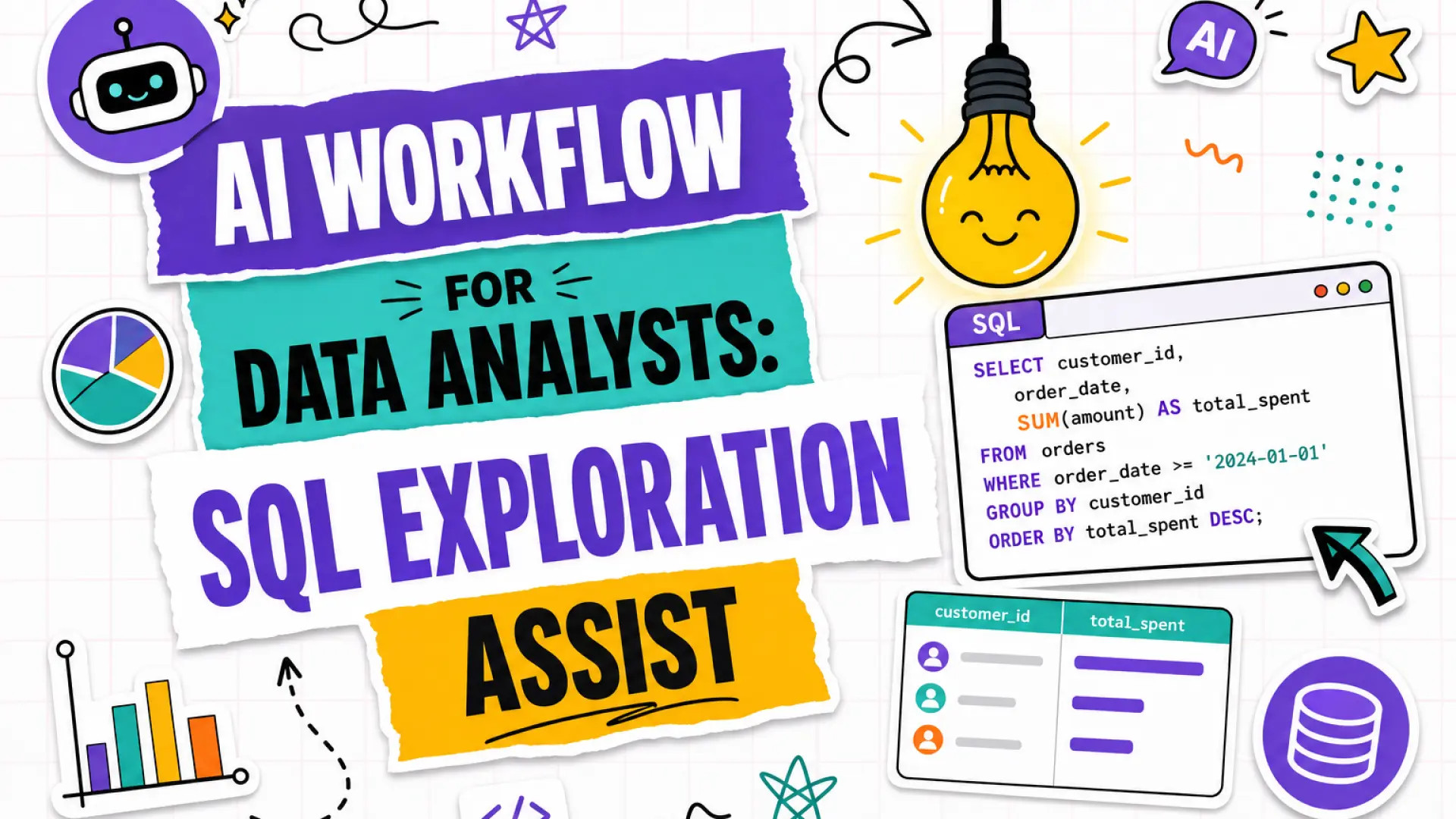
Analysts lose hours writing joins from memory while stakeholders wait for "quick" answers. AI-generated SQL speeds exploration but has sent wrong grain results to executives when nobody validated joins or filters.
An AI workflow for data analyst SQL exploration enforces question definition, explained query drafts, sandbox execution, and peer review before scheduled jobs touch production warehouses. This guide covers the full path. Connect exploration to AI API documentation when queries feed downstream apps and review visualization choices against AI-generated chart pitfalls in dashboards.
Define Question and Grain
No SQL prompt runs until the business question, metric definitions, and row grain are written down. Ambiguous questions produce confident wrong SQL.
- Business question: One sentence the stakeholder can repeat back
- Metric definitions: Numerator, denominator, filters, time window
- Grain: One row per user per day, per order, per session, etc.
- Known tables: Approved datasets from data catalog links
- PII boundary: Columns allowed in this analysis tier
| Question element | Example |
|---|---|
| Question | How many active subscribers canceled in Q1? |
| Metric | Count distinct account_id where status changed to canceled |
| Grain | One row per cancellation event |
| Time zone | UTC event timestamps, report in US Eastern |
AI Draft SQL With Explanations
AI drafts SQL plus plain-language explanation of joins, filters, and assumptions. Analysts read the explanation before running anything.
Prompt package:
- Question and grain doc from prior step
- Table schemas from data catalog (column names and types)
- SQL dialect (BigQuery, Snowflake, Redshift, Postgres)
- Request: query, row count sanity check query, and explanation bullets
Before: Analyst prompts "write SQL for churn" and runs first result against prod.
After: Analyst receives SQL with join diagram in prose and a separate count-distinct validation query.
Run in Sandbox and Validate Joins
Sandbox-first is the rule: every new AI query runs against sampled or dev warehouse before production credentials. Join validation catches fan-out that doubles metrics silently.
Sandbox validation checklist
- Run on sandbox connection with same dialect
- Compare row count before and after each join step
- Validate distinct key counts match expected grain
- Spot-check 20 random rows against source tables
- Compare top-line metric to known dashboard or prior report
- Estimate query cost; add partition filters if scan too large
| Join risk | Detection |
|---|---|
| Many-to-many fan-out | Row count explodes after join; metric inflation |
| Wrong join key | Null rate spike in dimension columns |
| Duplicate dimension rows | Distinct ID count lower than row count |
Peer Review Before Scheduled Jobs
Queries that graduate to scheduled reports or API-fed dashboards need peer review. Reviewer confirms grain, PII handling, and idempotency.
- Review request: Link to question doc, SQL, sandbox results, and prod promotion rationale
- Reviewer checks: Logic, performance, naming, documentation in data catalog
- PII scan: No prohibited columns in SELECT or logs
- Schedule metadata: Owner, alert on failure, cost cap
- Sign-off: Second analyst comment in repo or orchestration tool
Query review checklist
- Question doc attached and still accurate
- Partition and cluster filters present on large tables
- No SELECT * in production jobs
- Comments explain non-obvious business rules
- Rollback plan if metric shifts after deploy
Frequently Asked Questions
How do we handle PII columns?
Use tiered warehouse roles. AI prompts include only columns cleared for analyst tier. Hash or aggregate PII in SQL; never paste row-level PII into external AI tools.
What cost controls apply to exploratory SQL?
Set warehouse statement timeouts, require date filters on event tables, and use sampled tables in sandbox. Review estimated bytes scanned before promoting to daily jobs.
What if AI SQL looks right but is wrong?
Common with subtle filter mistakes. Mandatory reconciliation to a trusted metric and peer review catch most issues. Document wrong patterns in team wiki for prompt tuning.
Which tools support this workflow?
Warehouse-native notebooks, dbt with AI assist, or IDE plugins with schema context. Prefer tools that log queries and keep schema metadata fresh from your catalog.
Exploration Speed Without Production Risk
Data analysts use AI for SQL exploration safely when questions and grain are defined first, sandbox validates joins, and peers review before schedules hit production. The warehouse stays trustworthy when process beats prompt luck.