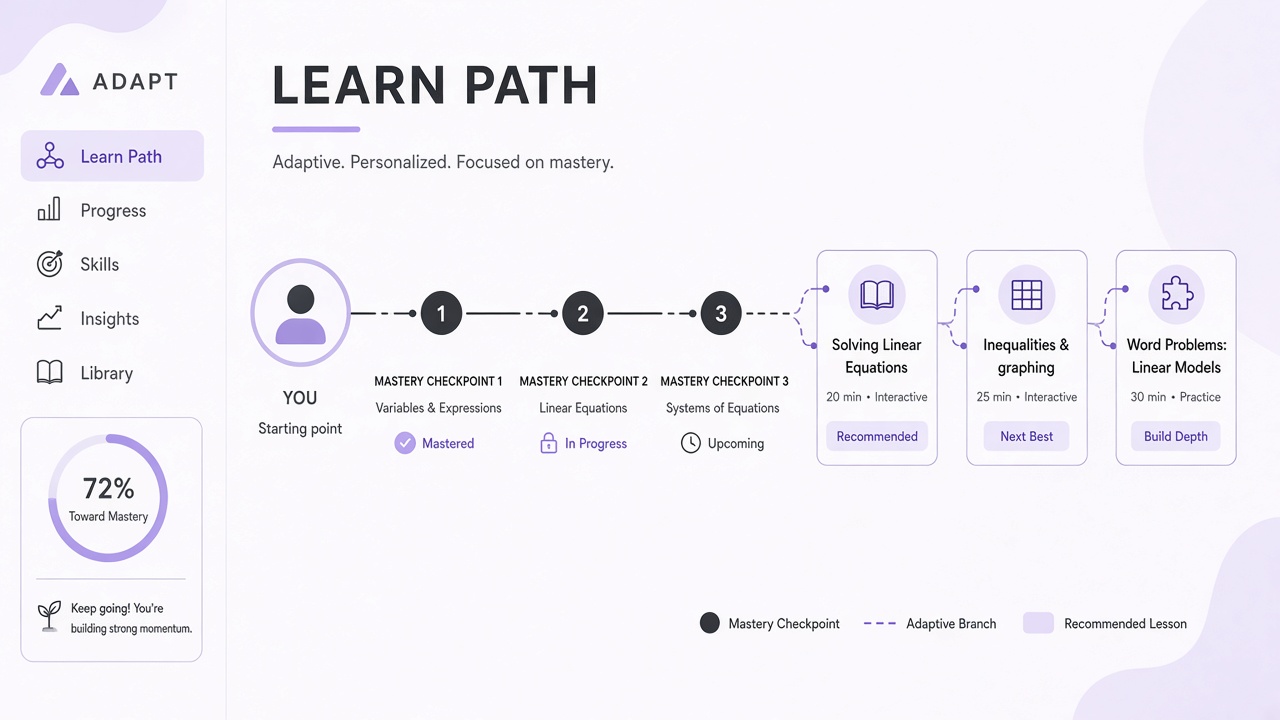
Static textbook sequences fail when one student masters fractions quickly while another needs visual scaffolding. Personalized learning path AI orders lessons, quizzes, and projects from learner profiles built by knowledge tracing, cognitive load estimates, and large language model planners. Systems like GenAL (AAAI 2025) split global reflection from local teaching agents; LPReKL pairs LLM exercise generation with retrieval from real item banks to avoid hallucinated content.
LMS vendors, district CTOs, and tutoring startups must audit whether paths align with standards or merely optimize click-through. Teams evaluating AI chatbot tutors should require item-bank grounding and knowledge tracing feedback loops. More education explainers sit on the EliteAI.tools blog index.
Adaptive learning existed before LLMs through item response theory and Bayesian knowledge tracing. What changed is semantic cold-start: new publisher content with rich text descriptions can enter recommendation pools without months of click logs. The risk is hallucinated practice problems that look pedagogically sound but contain mathematical errors. LPReKL-style generate-retrieve pipelines exist precisely to separate creative planning from inventory-safe delivery. Pxplore GRPO adds explicit goal states so paths optimize toward exam dates or competency badges rather than myopic next-item correctness alone. Knowledge tracing simulators inside LPReKL score candidate paths with promotion metrics before students see a single item, letting planners iterate in software rather than through costly classroom experiments on every sequence variant.
What Personalized Learning Path AI Means in Plain Language
Personalized learning path AI recommends the next learning activities for each student based on mastery estimates, goals, and content semantics rather than fixed grade-level pacing. Paths may span videos, exercises, simulations, and discussions sequenced to close skill gaps without repeating mastered material endlessly.
Classic recommender systems indexed items by ID, struggling when publishers add new content nightly. LLM-based planners read textual item descriptions directly, improving cold-start when logs are sparse, but introducing hallucination risk if exercises are invented instead of retrieved. GenAL's Global Thinking Agent updates macro learner profiles while the Local Teaching Agent recommends items using educational priors and semantic parsing of content text, reporting consistent gains over reinforcement-learning baselines on three real-world datasets at AAAI 2025.
| Component | Function | Example system |
|---|---|---|
| Knowledge tracing | Estimate skill mastery over time | LPReKL evaluator, dual-stream KT |
| LLM planner | Propose next topics in natural language | GenAL Local Teaching Agent |
| Retrieval layer | Map plans to real exercises | LPReKL top-N semantic search |
| Goal modeling | Align paths to long-term objectives | Pxplore learner state rewards |
How the Underlying AI Pipeline Works
The pipeline ingests interaction logs and content metadata, updates latent mastery vectors, proposes candidate sequences, scores them with tracing simulators or reward models, and delivers the next items through LMS APIs with teacher override hooks. Iterative loops refine paths until knowledge promotion scores plateau.
GenAL dual-agent architecture
GenAL's Global Thinking Agent updates macro learner profiles and reflects on recommendation outcomes from historical logs. The Local Teaching Agent recommends items using educational priors and LLM semantic parsing of content text, avoiding brittle item ID embeddings. AAAI 2025 experiments on three real-world datasets report consistent gains over reinforcement-learning baselines with stronger generalization across data distributions and stability under sparse logs.
LPReKL generate-and-retrieve
LPReKL uses an LLM as pedagogical planner to draft contextual reference exercises, then retrieves the top-N semantically similar items from a verified bank so students never receive nonexistent problems. Knowledge tracing simulates mastery after each candidate path, producing a knowledge promotion score that guides iterative refinement until an optimal sequence emerges. This separates creative planning from inventory-safe delivery.
Pxplore goal-driven planning
Pxplore defines structured learner states tied to explicit goals, converts alignment into automated reward signals, and trains policies with supervised fine-tuning plus Group Relative Policy Optimization (GRPO). Deployment on a live learning platform included a 22-student user study reporting improved coherence versus baselines, though scale remains modest compared with district-wide rollouts.
Cognitive load aware dual-stream models
Dual-stream architectures joint-track knowledge states and cognitive load, optimizing paths that keep challenge in a productive band. Published evaluations report about 87.5 percent knowledge prediction accuracy, path quality near 4.4 on 5-point rubrics, and roughly 24.6 percent learning efficiency gains versus baselines in controlled domains, with qualitative reductions in frustration when load spikes triggered easier scaffolding. Efficiency gain measures fewer items or minutes to cross a fixed mastery bar in simulation or A/B tests, not guaranteed classroom hour reductions without teacher adoption.
Human teacher override and standards alignment
Production path generators map every recommended activity to standards identifiers (Common Core, NGSS, local frameworks) so teachers can lock, reorder, or replace AI suggestions before students see them. Override logs become training signal: paths teachers frequently edit indicate model misalignment with classroom norms. Districts should require exportable path rationales citing KT skill estimates, not opaque scores that erode trust during parent conferences.
- Ingest LMS clickstream, quiz results, and optional diagnostic pretests.
- Train or deploy dual-stream KT to maintain per-skill mastery posteriors.
- Run GenAL-style global planner for multi-week scope; local agent for session steps.
- LPReKL generate-retrieve items for weak skills; index teacher-approved content.
- Fine-tune Pxplore GRPO policies on goal completion and delayed test retention.
- Present paths in UI with teacher approval, equity monitoring, and family opt-out.
Real Deployments and Published Evidence
Evidence mixes peer-reviewed benchmarks (ASSISTments-style logs, MOOC datasets) with small live platform pilots. District-wide efficacy trials with randomized control and standardized test outcomes remain rarer than offline metric lifts, a gap buyers should note in vendor RFPs. GenAL AAAI experiments report consistent gains over reinforcement-learning baselines with stronger generalization across data distributions. LPReKL demonstrates that generate-retrieve hybridization reduces hallucinated math items compared to pure LLM planners.
Commercial LMS vendors market AI pathways often without disclosing KT architecture or teacher override rates. MOOC platforms use simpler bandit algorithms for content recommendations. K-12 districts piloting chat tutors should demand confusion matrices disaggregated by demographic subgroup to detect whether path generators steer struggling students into easier but non-standard tracks. Pxplore's 22-student live study illustrates the scale gap between research pilots and district-wide rollouts.
Equity and access considerations
Students without home broadband may not complete LLM-heavy paths that assume always-on devices. Offline-first caches of retrieved items mitigate gaps. English-language LLM tutors may underserve emergent bilingual learners unless generate-retrieve indexes include multilingual corpora validated by bilingual educators. Efficiency gains of 24.6% mean little if only affluent schools deploy dual-stream KT infrastructure.
Corporate upskilling and higher education pilots
Corporate learning teams map skill ontologies to GenAL-style global planners that sequence certifications toward role transitions, while local teaching agents deliver micro-lessons inside Slack or Teams interfaces. Universities running mastery-based calculus or nursing programs use LPReKL retrieve layers to pull verified problem sets from publisher banks rather than trusting raw LLM arithmetic. Higher ed buyers should require learning analytics exports showing which path nodes correlate with delayed exam performance, not only click completion rates that reward shallow engagement.
Limits, Risks, and Ethical Guardrails
Paths optimizing short-term quiz scores may skip writing or collaboration skills hard to measure online. LLM planners without retrieval invent plausible but wrong math problems. Privacy laws restrict cross-student model training on minors' logs. Algorithmic tracking can gate advanced courses prematurely; human teachers need transparency into why a path blocked enrichment.
- Hallucinated content: Pure LLM generation invents false facts in history and science.
- Filter bubbles: Over-personalization narrows exposure to diverse perspectives.
- Surveillance: Fine-grained KT logs enable punitive monitoring of student struggle.
- Teacher deskilling: Unchecked automation erodes professional judgment.
- Goal misalignment: GRPO rewards test prep over conceptual understanding if metrics are narrow.
Ethical guardrails mandate teacher-in-the-loop approval, open standards mapping, subgroup fairness audits, student data minimization, clear labeling of AI-generated materials, and opt-out pathways that do not penalize grades. Vendors should publish when paths use retrieval-only versus generative items so schools assess hallucination risk before procurement.
Who Should Use This and Who Should Wait
Districts with structured item banks, universities running mastery-based programs, and corporate training teams with competency frameworks should pilot GenAL, LPReKL, and dual-stream KT integrations now. Early elementary classrooms without digital literacy baselines should wait for age-appropriate interfaces and stronger child safety filters before deploying unconstrained LLM path generators.
| Organization | Adopt | Wait |
|---|---|---|
| LMS with large item bank | Pilot LPReKL-style retrieve-then-assign | Ship pure LLM paths without bank lookup |
| Corporate upskilling | Use GenAL-like agents on skill ontologies | Skip manager review of goal alignment |
| K12 district | Start with teacher-in-loop adaptive math | Auto-track students without FERPA review |
| Research consortium | Benchmark dual-stream KT 87.5% accuracy | Report efficiency 24.6% in real classrooms |
Frequently Asked Questions
How do systems prevent hallucinated exercises?
LPReKL retrieves real items after LLM planning; GenAL grounds recommendations in catalog text tied to verified IDs when configured. Never show students raw LLM output without inventory check.
Why combine knowledge tracing with LLMs?
LLMs excel at semantic planning but poorly calibrate numeric mastery; KT supplies quantitative promotion scores to iteratively refine paths. Either alone underperforms the hybrid in LPReKL experiments.
Do paths work with sparse interaction logs?
GenAL targets sparse logs via LLM semantic features; cold-start still needs baseline diagnostics or teacher placement tests. Do not promise Netflix-quality personalization on day one.
Will paths cover state standards?
Alignment requires tagging items to standard codes and constraining planners; unconstrained LLM paths may drift from mandated scope and sequence. Audit maps before procurement.
Do teachers lose control?
Best deployments expose recommended paths as drafts with override, lock, and enrichment buttons. Black-box autopilot erodes trust quickly in classrooms.
What efficacy evidence exists?
Offline benchmark gains are strong; large RCTs on standardized tests remain limited, with Pxplore reporting a 22-student live study. Demand pilot data in your population before district contracts.
What does dual-stream KT 87.5% accuracy and 24.6% efficiency mean?
87.5% accuracy is next-response prediction on published benchmarks; 24.6% efficiency gain means fewer items or time to reach a fixed mastery threshold in reported simulations versus single-stream KT baselines. Confirm gains in live district pilots with delayed post-tests, not only immediate quiz completion.
Can a generic chatbot replace path generation systems?
Generic chatbots lack persistent KT state, standards alignment, and multi-agent planning unless integrated with structured backends like GenAL or LPReKL. Treat chat as one interface layer, not the whole adaptive engine responsible for sequencing verified curriculum.
Conclusion
AI personalized learning path generation fuses knowledge tracing with LLM orchestration: GenAL AAAI Global Thinking and Local Teaching agents plan and teach, LPReKL pairs KT with generate-retrieve item pipelines, Pxplore GRPO optimizes goal-driven paths, and dual-stream KT reports 87.5% next-response accuracy with 24.6% mastery efficiency gains in published benchmarks. Deploy with teacher approval, retrieval grounding, subgroup fairness audits, and realistic expectations that lab accuracy does not automatically shorten seat time without adoption support. Path AI amplifies structured adaptive learning; it does not replace standards-aligned curriculum design or human mentorship.