AI coffee bean grading uses high-speed cameras and convolutional or transformer vision models to classify green beans by color, size, shape, and Specialty Coffee Association (SCA) defect types at conveyor speeds that manual cuppers cannot match, while cooperatives still rely on human cupping for final lot acceptance. Recent peer-reviewed work reports 96 to 99 percent grading accuracy on specialty arabica lots with YOLO, Swin Transformer, and lightweight CNN architectures running on edge GPUs or even Raspberry Pi boards. The technology does not replace sensory cupping for flavor profile or buyer contracts, but it standardizes physical screening before beans reach the cupping table. Teams following AI research on agricultural vision or building AI research infrastructure for commodity cooperatives should map which camera architecture fits each washing station budget and export traceability requirement.
SCA Defect Types and Grading Rules
Specialty coffee grading counts primary and secondary defects per 350-gram sample: full black, full sour, fungus damage, severe insect damage, and foreign matter count as primary defects, while partial black, partial sour, floater, immature, and broken beans count as fractions of a defect. Export contracts often specify zero primary defects and fewer than five secondary equivalents for specialty lots. Human graders spread 300 grams on a black mat under calibrated light, picking defects by hand over 15 to 30 minutes per sample. Fatigue, lighting drift, and regional interpretation differences create lot-to-lot variance that buyers dispute at origin.
Computer vision systems encode SCA categories as detection classes. A 2026 YOLOv10 study covering seven SCA defect types reported 99.2 percent mAP@50 with 2.0 ms inference latency per frame on a curated industrial dataset. Broader 15-class detection remains harder: a YOLOv12 Mandheling study reached 84 percent mAP@50 when subtle defects like floaters and light fungus damage blended with healthy bean texture. Cherry pods and obvious insect holes classify reliably; marginal souring and early fungal spots still challenge models trained on limited cooperative data.
Size grading runs in parallel: screen sizes 14 to 20 separate export tiers. Color metrics (whitish immature, pinkish fermentation, dark black) map to HSV or learned embeddings. Density-related floaters often need water-tank pre-sorting before imaging because surface appearance alone misclassifies some internal defects.
| Defect category | SCA weight | Vision difficulty |
|---|---|---|
| Full black / full sour | 1 primary each | Moderate: strong color signal |
| Fungus / insect damage | 1 primary if severe | High on early-stage lesions |
| Floater / immature | Secondary fraction | Moderate with size + color cues |
| Broken / chipped | Secondary fraction | Easier with edge detection |
Camera and Conveyor Architectures
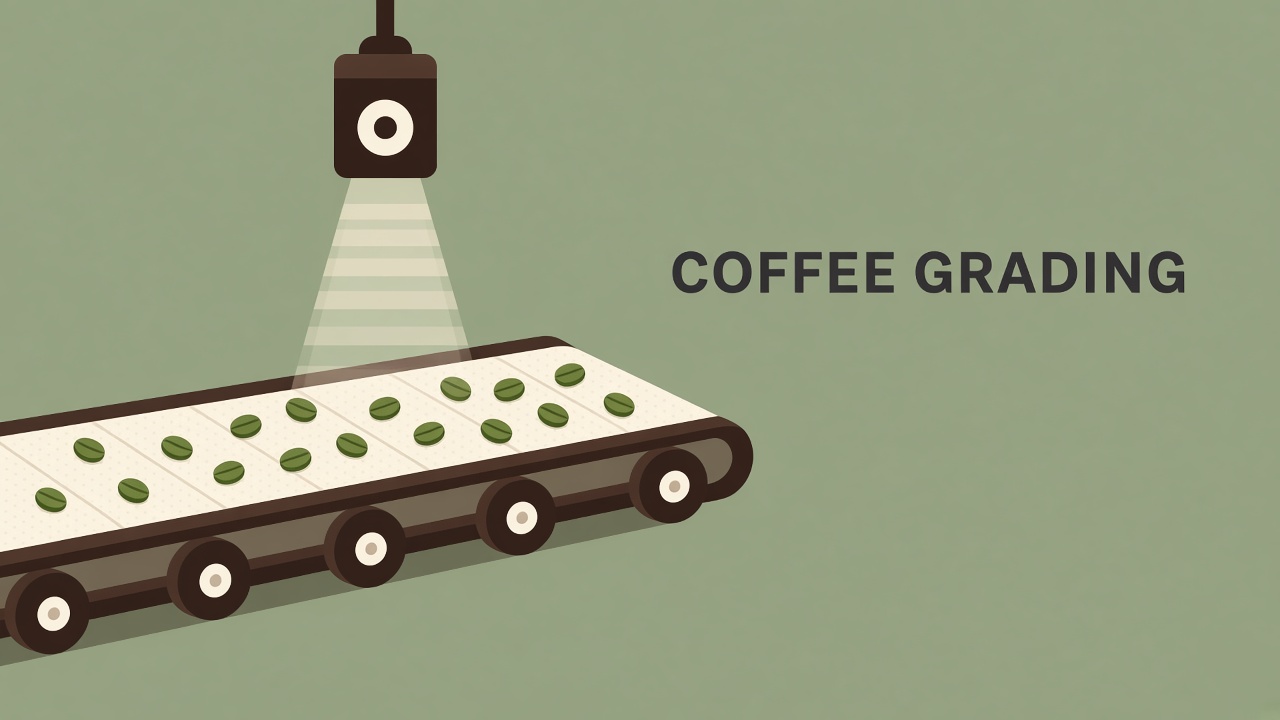
Commercial and pilot systems place line-scan or area cameras above vibrating conveyors, chutes, or rotating drums that separate beans into single layers so each seed appears in frame without overlap. LED ring or dome lighting normalizes color across wet and dry parchment stages. Some mills image beans on 36-bean mosaic trays that mirror official sampling layouts, enabling smartphone-based apps for cooperative QA stations without full industrial lines.
Throughput targets drive hardware choice. Industrial color sorters from Buhler, Satake, and similar vendors have used multispectral cameras for decades; modern retrofits swap rule-based thresholds for deep learning backends while keeping pneumatic ejection. Startup and research rigs pair Basler or FLIR cameras with NVIDIA Jetson modules at 30 to 120 frames per second. Latency budgets under 5 ms per bean are required when air jets reject defects on a fast belt.
Depth and infrared channels help when parchment color hides internal damage. Hyperspectral pilots at research stations separate fermentation stages by moisture-related absorbance, though cost limits deployment at smallholder washing stations. Dust, jute fiber, and uneven moisture remain the dominant noise sources; enclosed hoods and ionized air knives reduce false triggers.
Cooperative Datasets and Model Training
Accurate grading models depend on cooperative-specific datasets because defect appearance varies by cultivar, altitude, processing method (washed vs natural), and local pest pressure. A Swin-HSSAM transformer study on proprietary and public datasets achieved 96.34 percent average grading accuracy across three grade levels and nine defect subdivisions, outperforming ResNet50 and ViT baselines. Transfer learning from Brazilian arabica images underperforms on Ethiopian heirloom lots without fine-tuning on at least 500 to 2,000 labeled beans per defect class.
Data governance matters for farmer groups. Pooling anonymized defect images across co-ops improves model recall while keeping lot identity separate. Mobile capture apps let field officers photograph sample trays and upload to a central labeling queue; expert graders confirm bounding boxes that become YOLO training annotations. Synthetic augmentation (rotation, brightness, synthetic mud splash) expands scarce fungus-damage examples without misrepresenting real defect rates in validation sets.
Edge deployment favors lightweight CNNs and MobileNet variants. One 2025 specialty arabica study reported 99.6 percent specialty-vs-defective classification with a custom lightweight CNN at 10.423 ms TFLite inference on Raspberry Pi 5, making village-level screening feasible before parchment trucks depart for the dry mill.
Cupping Integration and Human Judgment
Physical AI grading screens out defective beans before cupping; sensory evaluation still determines cup score, flavor notes, and buyer premiums that computer vision cannot infer from appearance alone. Specialty buyers pay for acidity, sweetness, and clarity in the cup, not just low defect counts. A lot that passes machine grading with zero primaries can still cup below 80 points if fermentation was uneven. Best practice treats vision output as a gate: beans above a defect threshold never reach the cupping table, saving skilled labor for borderline lots and profile matching.
Traceability workflows link machine rejection logs to lot IDs and farmer delivery receipts. When a cooperative disputes a buyer downgrade, timestamped images of ejected beans provide evidence stronger than handwritten tally sheets. Some exporters run parallel human and machine counts during the first harvest season, calibrating trust before machine-only certificates ship with contracts.
Cuppers should set acceptance thresholds per destination market: EU specialty importers may enforce stricter secondary limits than domestic roasters. AI systems encode those thresholds as configurable defect budgets rather than fixed model outputs, preserving human policy control.
Smallholder Economics and Adoption Path
Smallholder cooperatives adopt grading AI when manual sorting bottlenecks export windows, when defect disputes erode trust with buyers, or when premium differentials justify shared mill equipment amortized across hundreds of members. Capital cost ranges from low-thousands for tablet-based mosaic apps to six figures for pneumatic line sorters. Shared-service models let three to five co-ops fund one dry-mill upgrade, charging per-bag grading fees comparable to outsourced third-party inspection.
Labor savings appear in reduced re-sorting shifts before container loading. A cooperative grading 500 bags per season might redirect two full-time sorters to quality training and farmer extension while machines handle repetitive defect picks. Price premiums for certified specialty lots stabilize when defect rates become measurable and consistent rather than subjective.
Risk remains where electricity is intermittent or technicians are scarce. Cooperatives should prioritize models with offline inference, spare camera modules, and vendor-neutral export formats (CSV defect counts, JPEG archives) so operations continue if cloud labeling pipelines fail mid-harvest.
Export Traceability and Buyer Certification
Export buyers increasingly request machine-graded defect certificates alongside traditional cupping scores because digital logs reduce disputes at origin and destination ports. Specialty Coffee Association protocols still define human sampling for cup quality, but physical defect counts increasingly arrive as CSV exports from optical sorters linked to container seal numbers. Fair Trade and organic certifiers audit whether rejected beans were destroyed or diverted, a step vision systems document with timestamped ejection video clips in advanced installations.
Roasters blending single-origin lots use grading AI at origin to pre-sort microlots before air freight, reserving premium slots for beans that pass both machine defect thresholds and sensory panels. When a lot fails machine screening, farmers receive itemized defect histograms rather than a single rejection notice, enabling targeted drying or fermentation corrections before resubmission.
Seasonal calibration remains essential when harvest weather shifts defect profiles: extended rains increase fungus damage prevalence, requiring model threshold updates before peak export weeks. Blockchain-adjacent traceability pilots hash machine-grading outputs to lot identifiers already tied to farm GPS polygons and mobile-money payments. While not every cooperative needs distributed ledgers, immutable defect logs strengthen negotiations when buyers attempt retroactive discounts citing unspecified quality issues. Open export formats (JSON defect counts, PNG sample trays) ease integration with existing cooperative management software without vendor lock-in.
Frequently Asked Questions
Can AI replace coffee cuppers?
No for flavor and buyer acceptance. AI replaces repetitive physical defect counting. Cupping still determines whether a lot meets specialty sensory standards and contract flavor profiles.
What accuracy should cooperatives expect?
Published studies report 84 to 99 percent detection depending on defect class count and dataset size. Plan a calibration season comparing machine counts to expert human samples before certifying export lots machine-only.
Which architectures deploy on edge hardware?
YOLOv8 through YOLOv12, lightweight CNNs, MobileNet, and Swin Transformer variants all appear in recent literature. Choose based on latency budget, power, and whether detection or whole-bean classification fits the conveyor design.
Does wet vs dry processing affect models?
Yes. Parchment color, moisture, and surface texture differ by process. Train or fine-tune separate model heads per process line, or include process type as metadata during training.
How does grading AI connect to blockchain traceability?
Machine rejection logs and sample images hash to lot IDs that traceability platforms already use for farm GPS and payment records. Vision adds a verifiable quality layer without replacing existing cooperative software.
Where should I follow coffee vision research?
Peer-reviewed venues include Journal of Food Science and Technology, Current Research in Food Science, and SCA research symposia. For broader perception methods, browse AI research on edge vision and agricultural ML deployments.