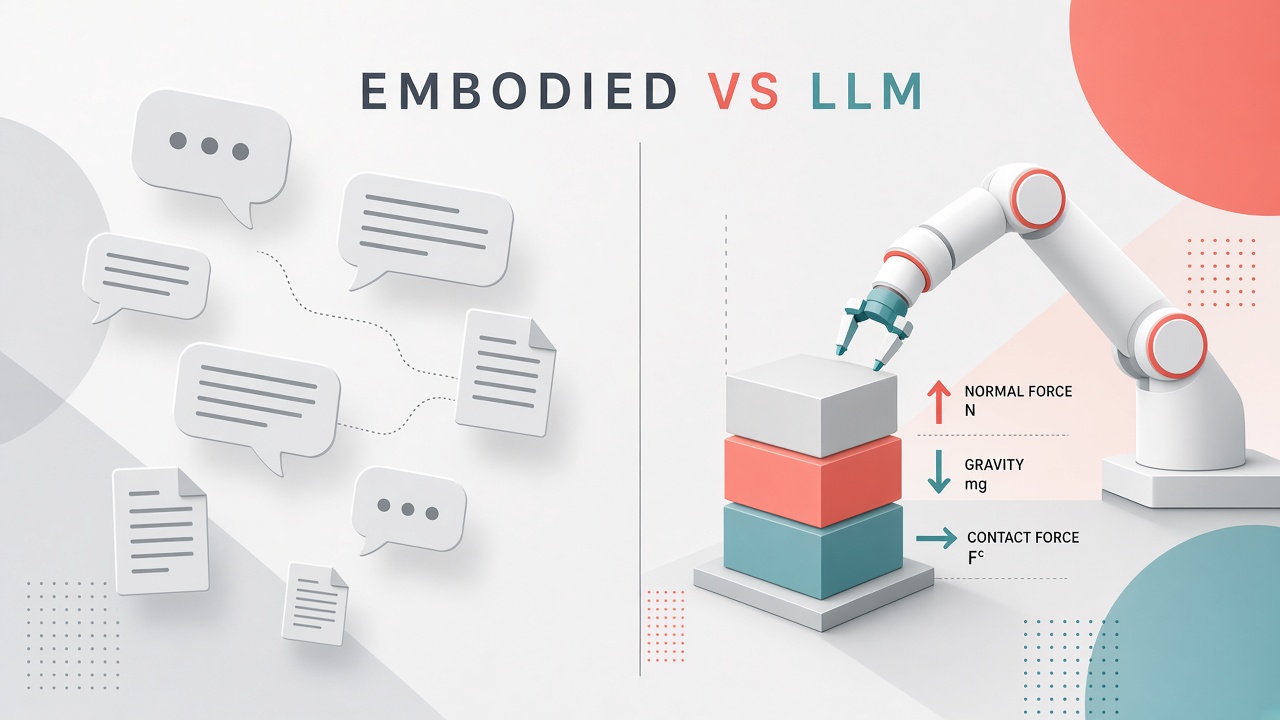
Embodied AI agents perceive and act in physical environments through sensors and actuators; LLM agents reason over text tokens and tool APIs without inherent models of contact, friction, or torque limits unless explicitly grounded in simulation or robot feedback. Vision-language-action (VLA) models such as RT-2, OpenPI, and Qwen-based stacks map images and instructions to motor commands, while world-action models predict visual futures before acting. Pure chat agents excel at decomposition and documentation but fail on tasks requiring millisecond slip response or certifiable collision avoidance. Teams comparing AI research tracks or browsing AI research infrastructure should match agent class to problem: language for workflow orchestration, embodiment for anything that must touch the world.
Language Agents Reason About Text
LLM agents chain prompts, retrieve documents, and call HTTP tools using ReAct-style thought-action loops, but their world state lives in context windows unless connected to live sensors. Code as Policies, Inner Monologue, and SayPlan demonstrate high-level robot task planning from language, yet execution still depends on separate perception and control modules validating each step. Gorilla-style API routers connect LLMs to thousands of functions without guaranteeing physical preconditions (is the gripper empty, is the door latched) unless a runtime checks state.
Enterprise copilots that draft work orders or summarize logs are language agents. They do not need inertia tensors. Treating them as drop-in replacements for motion planners causes failures when textual plans assume perfect grasps or omit obstacle geometry hidden from the prompt.
Tool-use benchmarks for LLMs (API calling accuracy) measure whether the right function was invoked, not whether the robot arm cleared obstacles en route. Robotics benchmarks (LIBERO, RoboTwin, CALVIN) measure embodied success conditioned on physical setup. Conflating leaderboard scores across these domains misleads procurement teams comparing chatbot vendors to automation integrators.
Embodied Agents Model Physics, Contact, and Safety
Embodied agents close the loop with proprioception, force limits, and collision geometry, updating beliefs when reality diverges from prediction within control cycle budgets measured in milliseconds to tens of milliseconds. A manipulator arm must respect joint torque caps, self-collision meshes, and human proximity zones enforced by safety-rated lidar or light curtains. Text-only planners may suggest "pick up the mug" without knowing the mug is full, wet, or behind a glass pane. Embodied stacks fuse depth, tactile slip, and encoder feedback to abort or replan before damage.
World models (video prediction, latent dynamics) let robots imagine action outcomes internally. Cosmos Policy encodes actions as latent frames inside a video diffusion process; Fast-WAM uses video DiT representations as world encoders emitting actions near 190 ms latency. These approaches learn physics regularities from data rather than explicit Newton-Euler equations, but still train on embodied trajectories, not web text alone.
Contact uncertainty dominates manipulation risk: friction coefficients vary with surface moisture, cable stiffness changes when internal wires shift, and stacked boxes settle under load. Embodied agents estimate contact state from force residuals; language agents lack that loop unless instrumented skills return structured state JSON after each physical attempt.
| Dimension | LLM agent | Embodied agent |
|---|---|---|
| State representation | Tokens, JSON tool outputs | Sensors, maps, contact wrenches |
| Time scale | Seconds per reasoning step | Milliseconds for control loops |
| Failure cost | Wrong text, bad API call | Collision, injury, breakage |
| Training data | Internet text, code | Robot logs, sim rollouts |
VLA Vision-Language-Action Models
VLA models unify camera input, natural language goals, and action vectors in one network, often fine-tuned from VLMs, treating control as conditional sequence generation over discretized or continuous motor tokens. RT-2 and successors leverage web-scale semantic priors ("apple" vs "ball") while fine-tuning on robot episodes. OpenPI and pi0.5 provide open VLA checkpoints for manipulation. EmbodiedSkills wraps low-level VLAs in an agent loop that checks skill prerequisites and verifies outcomes after each action chunk, reaching 86.2 percent average success on 50 RoboTwin tasks but only 12.5 percent on memory-dependent RMBench tasks without explicit memory modules.
VLAs inherit VLM hallucinations translated into motion: reaching empty space, mis-identifying mirrored objects, or over-trusting language that conflicts with depth. Post-training with reinforcement learning from human feedback and on-robot failure logs mitigates but does not eliminate embodiment gap.
RT-1 and RT-2 demonstrated internet-scale semantic transfer ("move the Coke can") but still required large in-domain robot datasets per embodiment. Open-source stacks (OpenPI, LeRobot) lower the barrier for labs yet do not remove data collection labor on target hardware. Cross-embodiment generalization (humanoid to arm) remains a research headline more than a turnkey product feature in 2026.
PaLM-E and similar embodied language models fuse sensor tokens into LLM context windows, blurring the boundary between chat and control. Context length limits cap how much lidar or tactile history fits beside instructions; recurrent world-state summaries or external memory modules (as EmbodiedSkills notes for RMBench) become necessary for multi-step tasks like "load dishwasher then start cycle."
When to Combine LLMs with Robotics
Hybrid stacks assign LLMs to task decomposition, tool selection, and human dialogue while low-level VLAs or classical controllers handle contact-rich execution under hard safety constraints. AEROS proposes a single-agent operating architecture with embodied capability modules invoked like skills; Boston Dynamics Orbit 5.2 dispatches Spot when external sensors trigger agentic rules. IFS.ai plus Spot pairs enterprise agentic AI with quadruped sensing. The pattern: language layer plans "inspect pump B if vibration sensor exceeds threshold"; locomotion layer executes stairs and camera aim; VLM inspects the gauge; CMMS records the ticket.
Combine when tasks need semantic flexibility (novel object descriptions) and physical reliability (certified stops). Keep LLMs off the torque loop for human-scale arms unless wrapped in control barrier functions and verified skill libraries. For household chores, language helps parse "put away the clean dishes" but grasp controllers still need tactile feedback plates are wet.
MCP-style tool layers for robotics (Orbit 5.2 API hooks, EmbodiedSkills executable interfaces) let language agents request physical skills with structured arguments while runtime validators enforce preconditions. This is the practical middle ground between brittle hardcoded state machines and unconstrained text-to-motion: skills remain testable units; LLMs remain flexible routers that never directly output joint torques.
Failure Modes of Text-Only Planning
Text-only planners fail on hidden state (drawer contents, liquid fill level), non-prehensile physics (pushing, sliding), timing-dependent dynamics (catching, pouring), and safety envelopes that require geometric reasoning absent from the prompt. LLMs confidently enumerate steps that violate kinematic reachability or require two hands when only one gripper exists. Without closed-loop feedback, errors compound: a mislabeled object in context poisons the entire plan. Simulation grounding (digital twins, physics engines) helps if sim matches reality; otherwise planners overfit idealized physics.
Classic robotics stacks (MoveIt, OMPL, ROS navigation) already embodied before the LLM wave: they consume sensor streams and output trajectories under constraints. Modern discourse sometimes equates embodied AI only with neural policies, but certifiable geometric planners remain mandatory safety backstops in regulated environments regardless of whether an LLM wrote the high-level goal string.
Agentic robotics papers emphasize modular skills with explicit preconditions and postconditions rather than monolithic end-to-end text-to-torque maps. Programs generated by LLMs become auditable artifacts; failures localize to a skill boundary instead of opaque latent states.
Household robot timelines remain conservative: semantic generalization improved faster than contact reliability. Expect language interfaces on warehouse and inspection robots before general home assistants achieve safe daily manipulation without teleoperation fallback.
GRID and agentic robotics frameworks argue intelligence emerges from skill orchestration, not monolithic models. Picking modules trained on millions of grasps, planners trained on layout graphs, and LLM routers selecting among them mirror how production systems already assemble despite marketing claims of "one brain" robots. Document interfaces between modules so teams swap VLAs without rewriting enterprise workflow agents.
Mimic-video and LingBot-VA illustrate world-action models that imagine visual futures before motor commands, reporting sample-efficiency gains over naive VLA baselines in academic benchmarks. Whether test-time imagination is mandatory or representation co-training suffices (per Fast-WAM ablations) remains an open engineering question for deployment teams optimizing latency budgets on warehouse cells.
Regulatory framing differs: LLM copilots fall under software liability and data governance; embodied systems add machinery directives, functional safety standards, and workplace injury risk. Legal review should treat robot motion stacks separately from chat interfaces even when both ship under one product brand.
Frequently Asked Questions
Can ChatGPT control a robot directly?
Only through intermediate APIs and skill libraries that enforce safety checks. Direct token-to-torque without verification is unsafe for production arms and mobile robots.
What is a world model in robotics?
A learned or engineered model predicting how the environment evolves under actions, often via video prediction or latent dynamics, used for planning before motion execution.
Are VLAs the same as embodied AI?
VLAs are one embodied architecture. Classical SLAM, model predictive control, and behavior trees are also embodied when closed-loop with sensors, without any LLM component.
When will home robots use LLM planners?
Voice and task parsing already appear in demos; reliable unsupervised chores need better touch, affordance models, and safety certification beyond 2026 consumer pilots.
Should enterprises start with LLM or VLA pilots?
Start with inspection and structured manipulation where skills are bounded. Use LLMs for work order triage and reporting; use embodied stacks for anything moving in shared human space.
How does EmbodiedSkills fit the landscape?
EmbodiedSkills treats each skill call as a verified execution proposal with prerequisite checks and outcome validation, wrapping replaceable low-level VLAs in an inspectable agent loop.
Where to read embodied AI surveys?
Recent VLA surveys on alphaXiv and agentic robotics design papers from academic and industry labs provide structured reading lists. Continue with AI research coverage on physical agents and world models.
Will embodied AI replace LLM agents?
No. The categories solve different layers: language agents orchestrate information and APIs; embodied agents execute in physics. Future systems stack both with explicit contracts between planning and control, similar to how browsers orchestrate HTTP calls without implementing TCP in JavaScript.