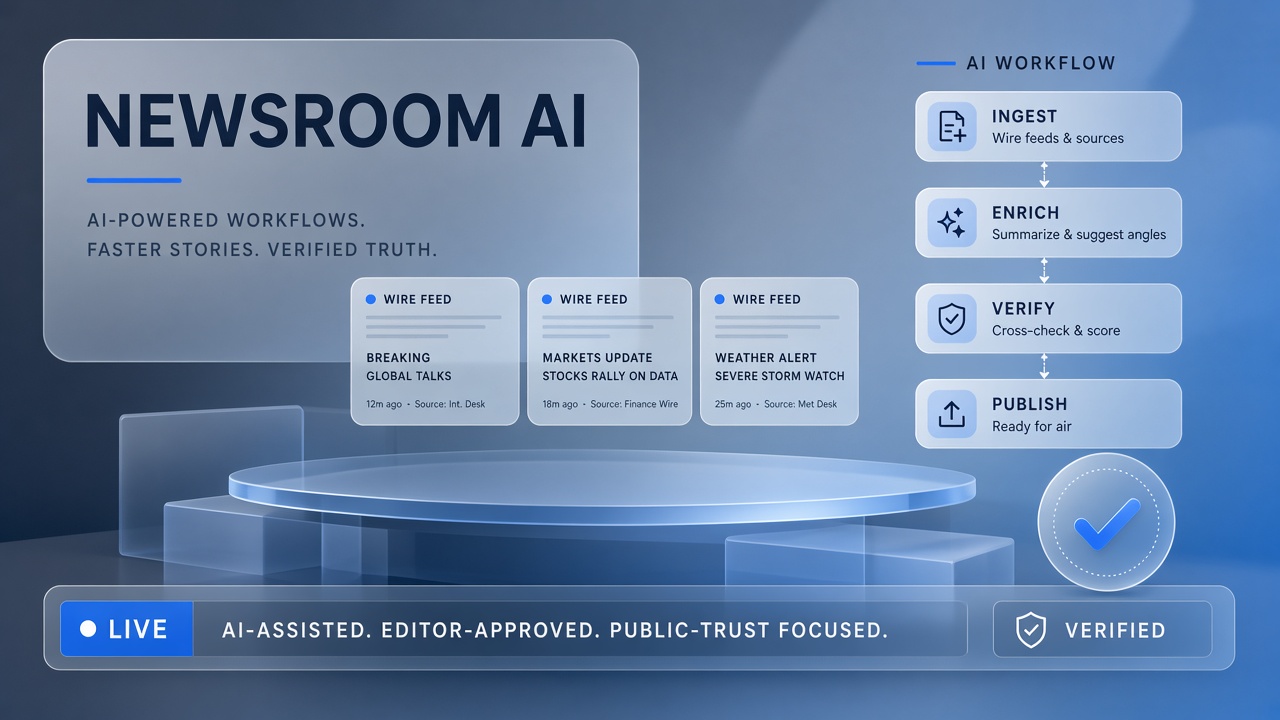
AI broadcast newsroom workflow tools promise faster scripts, sharper graphics, and cleaner wire digests. Broadcast journalists work under second-by-second deadlines, yet accuracy and fairness standards exceed those of most content teams. A wrong lower-third name or unsourced claim damages trust faster than a missed traffic report.
This guide covers wire summarization with attribution, graphics automation guardrails, election and crisis coverage rules, and union alignment. Pair tool research with AI coding tools for automation scripts and AI writing assistant platforms only after your news director signs the editorial AI policy.
Wire Summarization With Source Attribution
AI may condense AP, Reuters, or partner wire copy into briefing notes, but every fact in a broadcast script must trace to a named source the producer can verify. Summaries without inline attribution invite on-air errors when models merge similar stories or drop qualifying language.
- Require source tags on each bullet: wire service, timestamp, and story ID when available.
- Flag conflicting reports explicitly rather than letting the model pick a single narrative.
- Prohibit AI from inventing quotes, casualty counts, or official statements.
- Keep original wire text accessible in the rundown for anchor and producer cross-check.
- Log which model version produced each summary for post-broadcast review.
Newsroom AI scripting tools work best as research accelerators, not final copy generators. Assign a verifying producer to every AI-assisted rundown block before it reaches the anchor desk.
Lower-Thirds and Graphics Automation
Graphics automation can populate lower-thirds, maps, and chyrons from structured data feeds, but spellings, titles, and pronunciation keys need human approval before air. A mislabeled senator or wrong market ticker creates immediate correction obligations and social backlash.
| Graphic type | Safe AI assist | Mandatory human check |
|---|---|---|
| Lower-third names and titles | Draft from approved bio database | Producer confirms spelling and current title |
| Election results boards | Layout from official data feed only | No model-generated vote totals |
| Weather maps and alerts | Caption drafts from NWS text | Meteorologist approves wording and timing |
| Stock tickers and indices | Auto-populate from market data API | Verify halt symbols and after-hours labels |
| Social media pull quotes | Transcription assist only | Editor confirms account authenticity |
Broadcast AI graphics workflow should integrate with your existing MOS and rundown systems. Avoid parallel shadow tools that bypass the graphics operator's preview monitor.
Election and Crisis Coverage Cautions
High-stakes coverage demands slower verification loops, not faster AI drafts. During elections, active shooter events, or natural disasters, models amplify early rumors, misattribute images, and smooth over uncertainty that responsible journalism must preserve.
- Disable auto-publish features; require dual approval for any AI-assisted crisis copy.
- Use fixed language templates for unconfirmed reports: "authorities have not confirmed."
- Never use AI to identify suspects from crowd photos or low-quality video stills.
- Separate election projection graphics from AI narrative; projections follow decision desk rules only.
- Archive all AI inputs and outputs for FCC, union, or internal standards review.
Crisis mode also means psychological safety for staff. AI should reduce repetitive transcription load, not pressure producers to skip verification to beat competitors by thirty seconds.
Union and Editorial Policy Alignment
Newsroom unions and guild contracts increasingly address AI use in writing, editing, and graphics roles. Implement tools only after consultation with labor representatives and an updated editorial policy that defines permitted tasks, credit expectations, and retraining support.
- Publish a one-page staff FAQ on what AI may and may not do in each desk role.
- Guarantee no AI-only layoff targets without retraining paths for affected classifications.
- Credit AI-assisted packages transparently when station policy or union agreement requires it.
- Train managers to evaluate human judgment, not just output volume, in performance reviews.
Editorial policy should reference your correction protocol. When AI contributes to an on-air error, corrections follow the same prominence standards as human mistakes, including social and web updates.
Rundown System Integration
Newsroom AI outputs should land in your existing rundown and MOS environment, not parallel Google Docs that producers forget to sync before air. Integrate summarization APIs with iNews, Inception, or Dalet so anchors see the same verified text in prompter and control room monitors. When integration lags, designate a single human copy-paste role per shift to prevent version drift.
Fact-Checking Desk Coordination
Establish a fact-checking queue for any AI-assisted story touching casualties, elections, court cases, or corporate earnings. Fact-checkers receive the AI summary plus linked primary sources. They do not start from model output alone. Measure correction rate on AI-assisted versus fully manual packages for thirty days before expanding scope.
Editorial Standards Checklist for AI-Assisted Packages
Every AI-assisted broadcast package should pass a five-point checklist before rehearsal: named sources for every factual claim, correct spelling of people and places, disclosure of synthetic elements if any, union and contract compliance for affected roles, and producer sign-off timestamp in the rundown metadata.
| Desk role | AI permitted task | Verification owner |
|---|---|---|
| Assignment editor | Wire digest and story clustering | Assigning editor |
| Producer | Script first draft from approved facts | Executive producer on sensitive topics |
| Graphics | Layout from data feeds | Graphics operator preview |
| Social desk | Transcription and clip timecodes | Social editor before publish |
| Meteorologist | NWS text condensation | Meteorologist on-air responsibility |
Correction Policy When AI Contributes to On-Air Errors
Corrections follow the same prominence standards whether the error originated from a producer, anchor, or AI-assisted draft. Document the error source internally for tool improvement, but do not blame technology on air. Retrain staff on the failure mode: wrong attribution, stale data, or unsourced inference.
Training Journalists on AI Verification
Run monthly drills where journalists identify hallucinated facts in AI-generated briefing notes under deadline pressure. Reward careful verification, not speed alone. Pair junior producers with senior mentors during the first sixty days of AI tool access.
Wire Service Attribution Standards
On-air attribution must name the wire service, match their style guide, and preserve qualifying language such as "according to" and "alleged" where the wire used it. AI paraphrase often strips hedging that protects the station legally. Producers compare AI script lines to wire originals side by side before approval.
Graphics Automation Quality Control
Graphics operators preview every AI-populated lower-third on program monitor before take. Automated chyrons tied to election APIs need manual lock during protest periods when data feeds fluctuate. Maintain a kill switch that reverts to manual graphics when automation error rate spikes.
Election Coverage Protocol
Election night restricts AI to logistics: crew schedules, precinct logistics summaries, and internal research digests. Vote totals, race calls, and winner declarations flow only from the decision desk. AI must not scrape social media for vote counts. Document this protocol in union agreements and vendor contracts.
Sponsored Content Workflow Separation
Sponsored integrations use a separate production system with legal-approved scripts; AI drafts for news and sponsored content must not share the same prompt library. Cross-contamination risks implied news endorsement of paid products. Label sponsored segments in rundown metadata.
Breaking News Protocol for AI Tools
During breaking news, disable auto-publish features on social tools and restrict AI to internal research briefs until a named editor authorizes external copy. Speed matters, but correction cycles cost more trust than a five-minute delay. Maintain a laminated checklist in the control room for interns and weekend crews.
Log every AI-assisted script block in the rundown with editor ID. Post-mortems after major stories review whether AI saved time or introduced risk. Share lessons across sister stations in the group.
Deepfake and Synthetic Media Verification
Establish a verification desk workflow for viral video: source tracing, metadata analysis, and expert callback before air. AI detection tools are advisory; human journalists contact primary sources. Never broadcast synthetic audio of public officials without explicit on-air disclosure and legal approval.
Union Consultation and Role Protection
Negotiate AI language in collective bargaining before enterprise rollout, not after producers discover automated script drafts in their workflow. Address job security, retraining funds, and credit for AI-assisted work. Management transparency builds sustainable adoption.
Live Production AI Guardrails
Live broadcasts require tighter controls than digital-only newsrooms because errors reach audiences in real time without an edit buffer. Producers should treat AI-generated anchor copy like wire copy: verify names, numbers, and locations before prompter load. Graphics automation tied to live data feeds needs a human operator override key on the production switcher.
Train anchors to pause if prompter text contradicts their briefing notes. The anchor remains the final editorial authority on air even when copy passed producer review. Document this in talent contracts and AI policies.
Archival Search and Story Resurfacing
AI search across station archives helps producers find file footage and prior packages, but rights clearance for reused clips still requires human review. Verify talent releases, music licenses, and embargo status before rebroadcast. Automated resurfacing of sensitive historical stories during anniversaries needs managing editor approval.
Bias in Automated Stats Narratives
Sports and election stats narratives generated by AI can embed historical bias in player comparisons or demographic generalizations. Stats desk journalists validate every automated narrative against official league or AP data. Disclose when graphics use predictive models versus actual results.
Newsroom AI Vendor Evaluation
Evaluate vendors on editorial control, audit logs, data retention, and ability to disable features during crisis coverage. Pilot with a single daypart before enterprise license. Include union representatives in vendor demos. Contract for model change notification and exit clauses if editorial standards conflict with vendor defaults.
Implementation Roadmap for Newsroom AI
Roll out newsroom AI in phases: internal research tools first, graphics assist second, script drafting third, and never auto-publish to air without human gate. Each phase needs thirty-day evaluation against editorial standards checklist. News directors report results to group leadership before expanding licenses.
Include IT security review of vendor data handling before any wire content enters cloud AI. Journalists trust tools that protect source relationships and unpublished investigations.
Newsroom AI Governance Board
Establish a cross-functional governance board with news director, legal, IT, union representative, and a senior producer to approve new AI use cases quarterly. The board reviews correction incidents, vendor changes, and training completion. No new AI feature reaches the assignment desk without board sign-off.
Document dissenting opinions when the board approves controversial uses such as automated social clipping. Future editors inherit clear rationale for policy choices.
Correction Transparency When AI Contributes
Internal post-mortems after on-air errors identify whether AI, human, or process failure caused the mistake without scapegoating individual producers. Share learnings in newsroom meetings. Update prompts and checklists rather than banning tools after isolated failures.
Local News AI Ethics and Community Trust
Local stations serve communities that recognize anchors and reporters personally; AI errors feel like betrayal from a neighbor, not a distant network. Invest extra verification time on local crime, school board, and zoning stories where AI lacks training data. Community advisory feedback loops strengthen trust when stations respond to documented errors with transparent corrections.
Group-owned stations should share AI policy templates while allowing local news director customization for market-specific legal and union requirements. Centralized vendor contracts reduce cost but local editorial independence remains sacred. Document variances in group compliance wiki.
Digital-First and Broadcast Sync
Digital editors and broadcast producers must share verified fact sets before AI generates parallel web headlines and on-air scripts. Divergent versions confuse audiences during breaking news. Use a single master fact document updated in real time during crises. Social teams pull from the same source, not separate AI sessions.
Measure time from wire alert to published web story and aired package separately. AI should compress research time, not skip cross-desk verification. Analytics teams compare error rates between AI-assisted and fully manual packages monthly.
News directors should review AI vendor contracts annually for data retention, journalist source protection, and right to export historical prompts when switching vendors. Vendor lock-in complicates policy evolution when editorial standards tighten.
Retain raw wire and AI interaction logs for the same retention period as other newsroom records to support defamation defense and internal investigations. Legal holds apply to AI outputs when litigation is anticipated.
Station groups should audit AI tool usage across owned properties quarterly to prevent policy drift between markets. Central compliance shares findings with local news directors for corrective action.
Frequently Asked Questions
How should newsrooms handle deepfakes and synthetic media?
Treat unverified AV as suspect until proven authentic with forensic tools and source confirmation. Label manipulated or AI-generated content clearly when aired for editorial purposes. Never use synthetic voice or likeness of public figures without explicit disclosure and legal review.
Can AI draft sponsored or paid integration segments?
Sponsored content still requires legal clearance, advertiser approval, and separation from newsroom workflows. AI drafts must not reuse news gathering systems or imply journalistic endorsement. Keep paid segments in a distinct production path with separate approval queues.
Do wire service contracts restrict AI summarization?
Many wire agreements limit redistribution and derivative use; read current terms before piping feeds into external LLMs. Prefer vendor integrations approved by your wire partners or on-premise summarization that keeps content inside licensed environments.
How do you train journalists on AI without lowering standards?
Run tabletop exercises where staff spot hallucinated facts in AI briefs under time pressure. Reward verification behavior in drills. Pair tool training with ethics refreshers on source diversity, privacy, and harm reduction in breaking news.