The six-month pilot missed every success metric. Leadership wants a postmortem slide deck by Friday. Practitioners quietly went back to spreadsheets. Without a structured redesign path, the organization either retries the same tool with hope or bans AI entirely and loses real gains elsewhere.
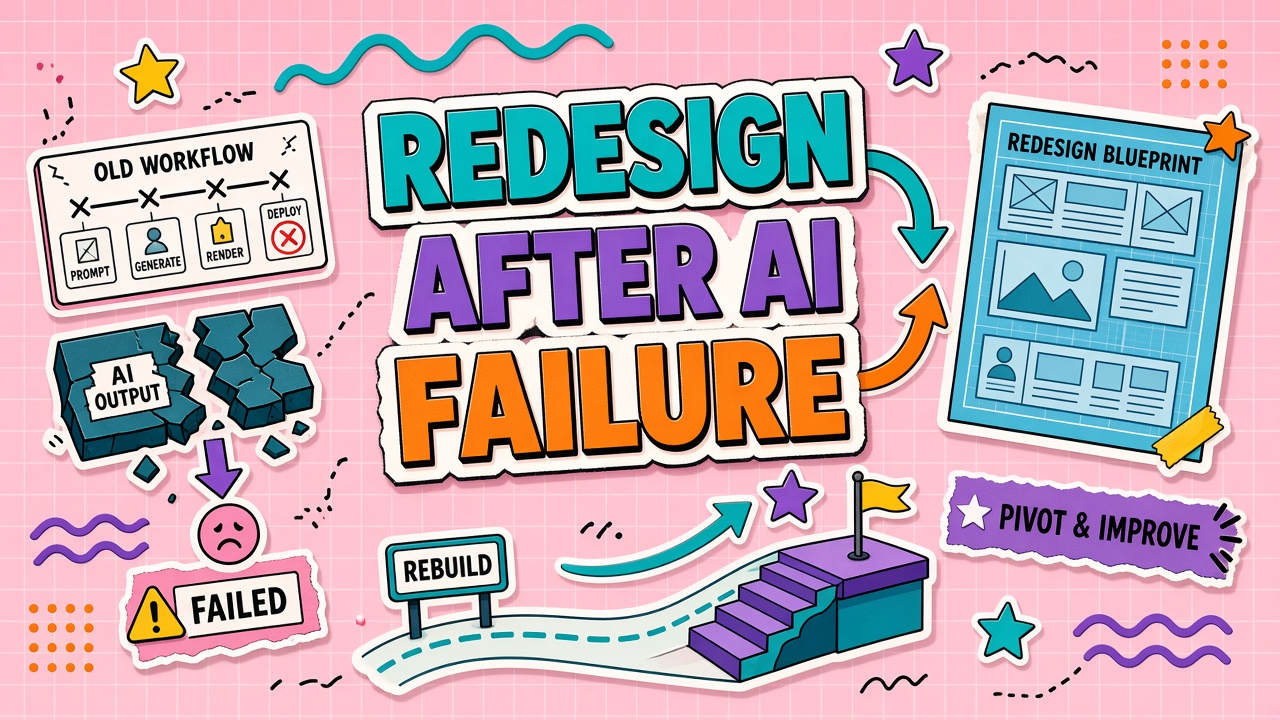
Redesigning workflows after AI pilot failure means capturing failure modes across tool, data, people, and process, then choosing pivot, pause, or manual fallback with updated eval criteria. This guide supports teams using AI productivity tools and automation platforms who need a blameless path forward.
Capture quantitative baseline before redesign starts: handle time, error rate, cost per transaction, customer satisfaction for the manual path. Redesign decisions need comparison points beyond "the pilot felt bad." Baselines also help steering approve budget for a narrower retry.
Assign a redesign owner distinct from the original pilot champion to reduce confirmation bias. The owner reports weekly to steering until the workflow reaches stable state or explicit sunset. Weekly updates prevent silent drift back to failed configuration.
Capture Failure Mode: Tool, Data, People, Process
Classify the failure before proposing solutions. A tool that hallucinates on your domain is different from a team that never adopted training, or a process that required approvals the pilot skipped.
- Tool: Accuracy, latency, integration gaps, vendor stability, cost overruns
- Data: Missing corpus, stale KB, wrong tier uploaded, labeling quality
- People: Skills gap, change resistance, unclear ownership, insufficient review capacity
- Process: Workflow mismatch, compliance gates ignored, success metrics unrealistic
Use a 90-minute retrospective with representatives from each dimension. Document facts (metrics, dates, incidents) separately from hypotheses. Avoid naming individuals as root cause; name system gaps.
Capture timeline facts in order: pilot start, training dates, first incident, metric misses, escalation events. Timelines reveal whether failure was immediate (tool mismatch) or gradual (eval drift after vendor update). Attach screenshots of dashboards and anonymized customer feedback where available.
Separate "what we wished had happened" from "what the pilot design allowed." Process failures often hide in skipped gates: no human review on external sends, missing DPA before real data, or success metrics chosen for vanity rather than risk.
Decide: New Tool, Narrower Scope, or Manual
Three redesign paths cover most situations. Pick one explicitly in steering committee minutes.
| Path | Signals | Next step |
|---|---|---|
| New tool | Workflow fit was right; vendor could not meet eval bar | Re-run selection with updated criteria; shorter pilot |
| Narrower scope | Tool worked in sandbox; failed at scale or risk tier | Limit to internal draft step or one queue |
| Manual | Risk or ROI does not justify automation yet | Document manual SOP; revisit in 6 to 12 months |
Compare alternatives in productivity and automation categories only after scope is redefined; otherwise you repeat the same mismatch with a new logo.
Narrower scope often succeeds when the tool works for internal drafts but fails on customer-facing tone or compliance. Move external send behind human gates while keeping draft assistance. Manual fallback is honorable when risk outweighs incremental efficiency; document the manual SOP so the team does not revert to shadow tools out of frustration.
Update Eval Criteria for Next Attempt
Failed pilots should produce a sharper scorecard. Add must-pass tests that would have caught the failure: multilingual accuracy, SSO requirement, human review time ceiling, or maximum cost per transaction.
- Convert retrospective findings into binary pass or fail eval cases
- Weight criteria by failure severity (customer impact vs internal inconvenience)
- Require sign-off from the same roles that participated in the retrospective
- Publish the scorecard before the next vendor demo cycle
Communicate Outcomes to Stakeholders
Stakeholders need clarity: what stopped, what continues, who owns the redesign, and when the next decision point arrives. A one-page memo beats a 40-slide deck. Include lessons that apply company-wide (for example "no customer PII in pilots without DPA") even when the pilot was local.
Address morale directly. Teams that invested extra hours deserve acknowledgment and a visible path to either fix or exit. Silent failures breed cynicism and more shadow IT.
Executives need one decision recorded: continue redesign, pause AI on this workflow, or reassign ownership. Ambiguous "we are monitoring" messages leave teams in limbo and starve the next pilot of credibility.
Retrospective Agenda Template
Timebox: context and metrics (15 min), timeline of incidents (20 min), categorization tool or data or people or process (20 min), decision on path (15 min), action owners and dates (10 min). Facilitator should not be the pilot's sole champion.
Knowledge Transfer After Failed Pilot
Archive prompts, eval sets, integration configs, and vendor tickets in a read-only repository. Future teams should learn without repeating discovery calls. Tag artifacts with failure mode (tool, data, people, process) for searchability.
Host a 30-minute lunch session for adjacent departments: what we tried, what we learned, what remains approved elsewhere. Failed pilots often produce reusable eval cases and policy clarifications that benefit productivity rollouts company-wide even when this workflow pauses.
Re-Entry Criteria for Future Pilots
Define what must change before the same workflow retries AI: new vendor shortlist, refreshed training, updated DPA, or staffing for review capacity. Re-entry criteria prevent steering committee from approving identical pilots six months later because memories faded.
Pair re-entry with a shorter time box and higher sampling rate on quality review. Teams exploring automation alternatives should prove eval pass rates on historical failure cases before touching production traffic again.
Document budget disposition when pilots fail: sunk licenses, professional services hours, and internal time. Finance and steering need honest numbers to avoid repeating spend on the same workflow without new controls. Transfer unused seats to approved alternatives where contracts allow.
Steering Committee Decision Record
Record redesign path votes in steering minutes with conditions and review dates. Ambiguous "leadership will decide later" entries recreate the uncertainty that caused practitioner cynicism. Minutes become the authority for what is paused, narrowed, or retried.
Vendor Relationship After Failed Pilot
Notify vendors professionally when pilots end without renewal. Vendors may offer engineering support, credits, or roadmap fixes that change the redesign calculus. Document vendor responses in steering packets; do not hide vendor concessions that could salvage narrowed scope.
Conversely, document vendor gaps that disqualify retry regardless of discount. Procurement should capture lessons in vendor scorecards so future selection committees see history beyond feature demos.
Legal and Compliance After Failure
Involve legal when failed pilots processed customer data without intended controls. Remediation may include notification, deletion requests, or regulatory filings beyond internal redesign. Legal timeline runs parallel to technical redesign, not after it.
Document control failures for audit without attributing blame to individuals. Auditors prefer honest gap analysis over polished narratives that omit data handling mistakes during pilots.
Frequently Asked Questions
How do we handle sunk cost pressure?
Frame the decision on forward ROI and risk, not licenses already paid. Steering committee minutes should record why continuing would exceed acceptable risk even if budget remains.
What helps team morale after a public failure?
Celebrate captured learnings, protect teams from blame for vendor gaps, and give a concrete next experiment or honorable manual path. Uncertainty hurts more than a clear stop.
Can we salvage partial success?
Yes. Narrow scope to the workflow that met metrics and sunset the rest. Partial salvage should still update eval criteria for the expanded scope you deferred.
Do we tell customers?
If customers saw degraded AI-assisted service, acknowledge impact and remediation per comms policy. Internal pilot failure without customer exposure may need only internal memo.
Documenting Manual Fallback SOPs
Manual fallback SOPs should live where practitioners work: ticket macros, CRM playbooks, not archived SharePoint folders. Include estimated handle time so capacity planning reflects reality when automation pauses. Test manual paths quarterly even when pilots succeed so skills do not atrophy.
When narrowing scope, update customer-facing help articles that promised broader AI features. External docs that oversell automation create support debt unrelated to model quality.
Compare replacement vendors using eval cases extracted from the failed pilot. Demos without your failure scenarios repeat the same sales theater. Browse productivity options only after the scorecard reflects what broke last time.
Metrics for Redesign Success
Define success metrics for redesign attempts before launch: narrower scope should still show measurable handle time or quality improvement versus manual baseline. Without metrics, steering cannot distinguish slow progress from another silent failure. Review metrics at 30, 60, and 90 days with predefined stop rules.
Share metrics internally at team level even when external customer impact was limited. Transparency rebuilds trust that governance learns from failure rather than hiding it.
Steering should time-box redesign phases so teams do not linger in ambiguous pilot limbo. A 90-day redesign window with explicit go or stop decision prevents morale erosion and continued spend on uncertain workflows.
Capture customer impact separately from internal pilot metrics when redesigning. External impact may require comms and remediation even when internal KPIs looked acceptable. Legal should review customer-facing statements before wide distribution.
Compare redesign options against manual baseline cost annually. Automation that saves little over manual SOP may not justify ongoing vendor spend and risk exposure.
Publish redesign timelines to affected teams so practitioners know when to expect manual processes versus retried automation. Uncertainty drives shadow tool usage faster than explicit pauses with dates.
Link redesign artifacts to continuous improvement backlog so fixes become tracked work items with owners rather than oral promises in retrospective meetings alone.
Fail Forward With Structure
Pilot failure is data when you capture modes, choose a redesign path, tighten evals, and communicate openly. Browse AI productivity and automation options with a scorecard born from the last attempt, not from vendor demos alone.