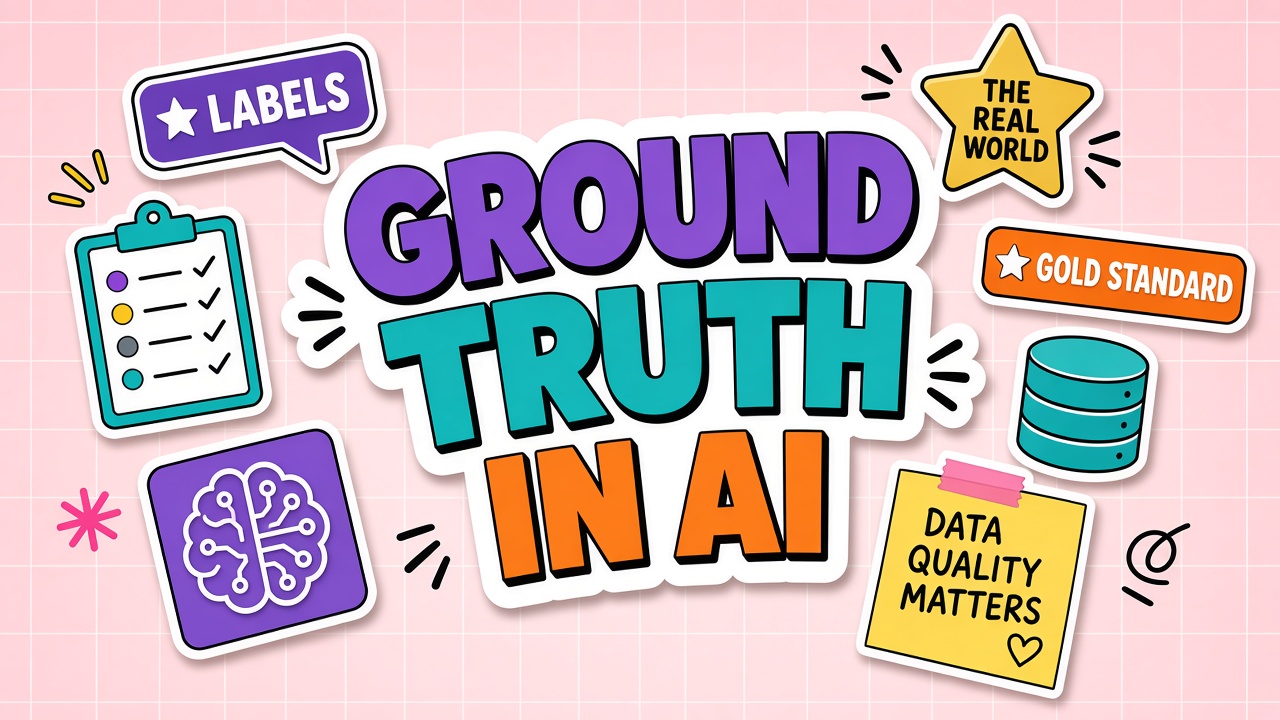
Two reviewers label the same support ticket. One marks it "billing," the other "account access." Your classifier agrees with the first. The customer escalation report says both were wrong: it was a refund policy edge case. Without a resolved reference, every metric arguing about model quality is built on sand. That reference is ground truth.
Ground truth in AI workflows is the authoritative label, reference output, or adjudicated answer used to train models, score eval harnesses, and settle disputes between humans and automation. It is not "whatever the model said last week." It is what your organization agrees is correct for a given input, documented and versioned. Teams deploying AI automation and AI research tools need explicit ground truth practices before scaling labeling, fine-tuning, or customer-facing quality claims.
Labels, Reference Outputs, and Adjudication
Ground truth takes different shapes by task. Labels classify inputs: intent, sentiment, safety tier, document category. Reference outputs are full expected answers: summary text, JSON extraction, translated paragraph, approved image description. When sources disagree, adjudication is the process that produces a single authoritative record.
A standard adjudication workflow
- Dual annotation: Two or more labelers work independently on the same item.
- Agreement check: Automated comparison flags mismatches above a threshold.
- Expert review: A domain specialist or senior annotator resolves conflicts with written rationale.
- Gold record: Final label or reference output is stored with adjudicator ID and timestamp.
- Feedback loop: Disagreement patterns update guidelines, not only individual rows.
Reference outputs for generative tasks are harder than binary labels. Teams use rubrics: "summary must mention dates and dollar amounts," or "extraction must match this JSON schema with these three fields." Partial credit in eval harnesses still anchors to a gold reference, not to the model's previous run.
| Ground truth type | Typical use | Adjudication trigger |
|---|---|---|
| Single label | Spam detection, routing intents | Inter-annotator disagreement |
| Reference text | Summarization, Q&A eval | Multiple valid phrasings; rubric-based merge |
| Structured record | Invoice extraction, CRM field mapping | Field-level conflicts |
| Ranking preference | Search relevance, RAG chunk quality | Tied or inverted order between labelers |
Synthetic vs Human Ground Truth
Synthetic ground truth is generated by rules, simulations, or LLMs with human spot checks. It scales cheaply for bootstrap eval sets and stress tests. Human ground truth comes from trained annotators, employees, or domain experts. It costs more but reflects nuance, locale, and policy interpretation that generators miss.
- Synthetic strengths: Fast coverage of edge cases, programmatically verifiable tasks (math, schema fill).
- Synthetic risks: Model-generated labels inherit model biases; false confidence in circular eval loops.
- Human strengths: Captures subjectivity, cultural context, and tacit business rules.
- Human risks: Annotator drift, inconsistent guidelines, expensive refresh cycles.
Hybrid approaches dominate mature automation programs. Synthetic data seeds thousands of cases; humans adjudicate a stratified sample and all high-risk categories. Research assistants in literature workflows may use synthetic Q&A from papers for recall tests, but citation accuracy gold sets still need expert verification against source PDFs.
Preventing Training Leakage from Gold Sets
Training leakage occurs when examples from your evaluation gold set influence model training, directly or indirectly. Metrics look inflated. Production disappoints. Leakage paths are subtle.
Common leakage patterns and mitigations
- Duplicate rows across train and eval splits: Deduplicate by content hash before splitting.
- Near-duplicate paraphrases: Use similarity thresholds to keep related items in one split only.
- Prompt tuning on the test set: Hold out a untouched "vault" set for final sign-off only.
- Human relabeling using model suggestions: Blind annotators to model output when creating gold labels.
- RAG eval with chunks in the index used for training embeddings: Separate corpora or strict document IDs.
Document split policies in a data sheet: creation date, split assignment, annotator pool, and whether synthetic generation models had access to eval IDs. Compliance reviews for automated decision systems increasingly ask for this lineage.
Refreshing Gold Sets Over Time
Ground truth is not permanent. Products change policies. New user phrasing emerges. Models improve until gold references are outdated wrong answers. Schedule gold set refresh as a operational process, not a one-time project.
Refresh triggers include: policy updates, new locales, significant model upgrades, sustained eval pass rate drift, and
incident postmortems that expose mislabeled historical rows. Retire deprecated cases rather than silently editing in place.
Version gold sets (support-gold-2026-Q3) so harness runs remain comparable within a quarter.
Practical refresh protocol
- Sample live failures and near-misses monthly for human relabeling.
- Cap set size growth; prune redundant cases that no longer discriminate between model versions.
- Re-adjudicate borderline items when guidelines change, with changelog notes.
- Run overlap studies when swapping annotator vendors to calibrate quality.
- Align refresh cadence with product releases and regulatory review cycles.
Research teams exporting benchmarks should publish gold set version hashes so external comparisons cite the same artifact.
Measuring Annotator Quality Before It Becomes Ground Truth
Gold sets inherit annotator quality. Run onboarding exams with known-answer items before granting production label access. Track per-annotator agreement rates against adjudicated rows. Pause annotators who drift below threshold until they retrain on updated guidelines. Vendor swaps require overlap periods where both old and new teams label the same slice; compare kappa scores before cutting over.
Guideline documents are living artifacts. Each policy change should version the guideline PDF or wiki page and note which gold rows require re-review. Silent guideline edits without re-adjudication are a common source of "model regressed" reports that are actually label definition changes.
Operationalizing Ground Truth in AI Tool Stacks
Ground truth lives in a store your harness, training pipeline, and analytics agree on: database tables, parquet files in object storage, or labeling platform exports. Avoid parallel spreadsheets. Single source of truth reduces "eval says pass, business says fail" meetings.
Link each production incident ticket to a gold case ID when possible. Incidents become regression anchors. Link each model release to eval results against the active gold version. Releases without recorded eval against current gold should not ship to regulated workflows.
Dashboards should show gold set coverage: which product areas have fewer than N adjudicated cases, which locales are underrepresented, and which incident categories lack regression anchors. Coverage gaps predict where the next production surprise will appear. Investing in ground truth for high-traffic intents first yields better ROI than uniform thin labeling across every long-tail query.
Frequently Asked Questions
How do you handle subjective tasks where multiple answers are valid?
Use rubrics that define acceptable variation, multiple reference answers, or scorer ranges instead of exact string match. Adjudication documents why several phrasings pass. Report inter-annotator agreement (Cohen's kappa or similar) alongside model metrics so stakeholders see label noise explicitly.
Does ground truth need to be localized per region?
Yes for customer-facing automation in multiple markets. Tax, privacy, and tone rules differ. Maintain locale-specific gold subsets or locale tags on shared items. Eval pass rates reported globally often hide failures in one language.
When are domain experts required instead of general annotators?
Use domain experts for medical, legal, financial, and engineering content where mistakes carry liability. General annotators handle broad intent classification after expert-written guidelines. Expert time is expensive; reserve it for adjudication and guideline authorship, not every row.
What ratio of synthetic to human gold is reasonable?
There is no universal ratio. Synthetic can dominate low-risk format checks; human gold should dominate safety, compliance, and customer-visible generative quality. Never report headline accuracy from synthetic-only sets without human calibration on a fixed anchor sample.
Can we use model output as ground truth to save cost?
Only for non-critical auxiliary tasks with human audit sampling. Using the same model family to label and evaluate creates circular bias. If you bootstrap labels with a model, adjudicate a meaningful subset with blind human review before calling the set gold.
Trust Starts with What You Call True
Ground truth is the foundation under labels, eval scores, and training claims. Build adjudication into your workflow, mix synthetic scale with human authority, guard against leakage, and refresh gold sets as the product evolves. Without that discipline, automation metrics and research benchmarks optimize for numbers that do not survive contact with real users.
The teams that ship reliable AI treat ground truth as a managed asset: versioned, owned, and debated openly when subjectivity is part of the job, not hidden behind a single accuracy percentage.