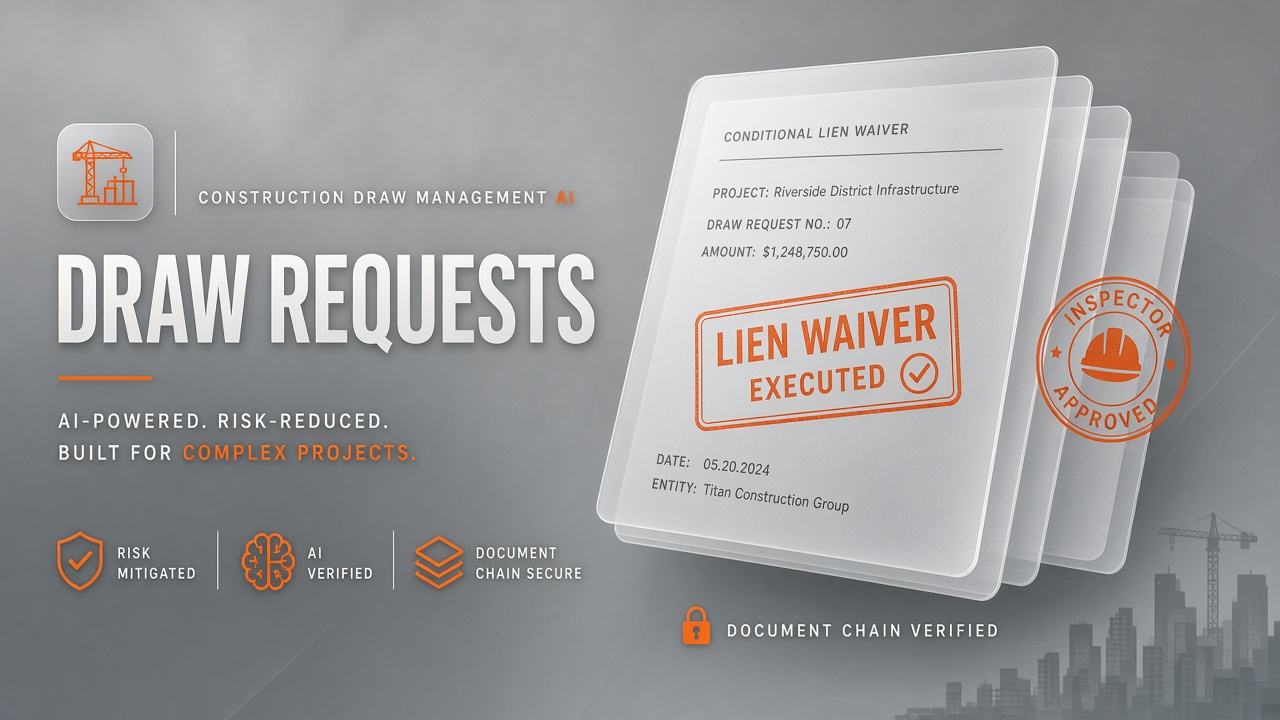
Every construction loan draw is a document puzzle: AIA G702 and G703 pay applications, subcontractor invoices, conditional and unconditional lien waivers, inspector sign-offs, change order logs, and lender-specific policy checks. Teams spend days assembling packets and lenders spend hours reconciling line items. Artificial intelligence now targets this paperwork-heavy niche because the workflow is bounded, rules-heavy, and measurable. This guide explains why AI construction draw management is attracting vertical AI builders, how document rules shape automation design, and what parallel-run validation looks like before lenders trust machine review. For broader context on workflow automation, see AI automation tools and AI productivity platforms reshaping back-office work.
Draw Workflow Pain: Why Lenders and GCs Feel the Bottleneck
Construction draw requests stall when document packets arrive incomplete, lien waivers mismatch payment amounts, or AIA G703 line totals fail to tie to the approved schedule of values. A single missing conditional waiver from a tier-two subcontractor can delay funding by a week. General contractors chase signatures while project managers reconcile retainage. Lenders re-key invoice data into spreadsheets because every GC formats packets differently.
The pain is volume plus variance. A mid-size lender reviewing fifty active construction loans may process hundreds of draw packages annually. Each package can contain dozens of PDFs in inconsistent layouts. Human reviewers become the constraint: experienced analysts leave, training replacements takes months, and policy drift creeps in when busy teams skip secondary checks.
Developers and owners feel the downstream cost. Delayed draws stall subcontractor payments, which triggers lien risk and jobsite tension. The workflow is not glamorous, but it controls cash velocity across the entire project chain. That operational gravity makes draw management a prime target for agentic systems that execute checks instead of merely suggesting them.
Document Rules That Govern Every Draw Package
Draw packages follow de facto standards anchored in AIA G702 (application and certificate for payment) and G703 (continuation sheet), with lien waivers, certificates of insurance, and inspection evidence completing the lender-ready bundle. Rabbet and industry practitioners note that missing or incomplete lien waivers remain the top cause of draw rejections nationwide. Conditional waivers cover the current draw period; unconditional waivers follow confirmed payment. State-specific waiver language adds another compliance layer.
| Document | Purpose | Common failure mode |
|---|---|---|
| AIA G702 / G703 | Pay application and schedule of values | G703 totals do not tie to G702 |
| Lien waivers | Release lien rights per draw period | Missing sub-tier conditional waivers |
| Invoices | Support billed line items | Amounts mismatch SOV lines |
| Inspection reports | Verify work-in-place progress | Stale or unsigned inspector forms |
| COIs | Confirm insurance coverage | Expired certificates at funding date |
Lender policies layer on top of industry forms. Some require stored materials documentation above a dollar threshold. Others mandate a waiver summary log on every submission. HUD and FHA loans add prescriptive checklists beyond commercial norms. Automation must encode these policies as executable rules, not generic document classification alone. SuperConstruct and similar compliance engines block non-conforming pay apps at status transitions, illustrating how hard gates reduce rework.
Why Agentic AI Fits Draw Automation
Draw review is a multi-step verification workflow with clear pass/fail criteria, making it well suited to agentic AI that cross-references documents, flags exceptions, and produces audit trails. Unlike open-ended copilots that draft prose, draw agents reconcile structured fields: invoice amounts against G703 lines, waiver dates against draw periods, inspection percentages against billed progress.
Built Technologies' AI Draw Agent exemplifies the pattern. The system reviews invoices, lien waivers, and inspection photos, matches draws to approved budgets, checks lender policies, and outputs compliance summaries. Early adopters report package review in under three minutes for routine draws, with human teams focusing on flagged exceptions. MightyBot and River apply similar logic for lenders and project finance teams, extracting fields from heterogeneous PDFs and linking every conclusion to source pages.
The automation fit improves when vendors treat lender SOPs as code. Policy-as-code means the same draw rules execute identically on draw one and draw forty, with logged evidence for regulators and internal audit. Agents operate in assist, audit, or automate modes so institutions scale throughput without surrendering approval authority on high-risk packages.
Extraction vs Judgment
Field extraction from scanned invoices and waivers is largely automatable; legal determinations on lien enforceability and title exceptions remain human-gated. River explicitly flags waiver gaps without claiming legal conclusions. Buyers should demand source-linked outputs so reviewers jump from a flagged waiver to the exact PDF page, not a black-box score.
Retainage, Change Orders, and Stored Materials
Draw automation must reconcile retainage held per contract, change order allocations against revised schedules of values, and stored materials documentation when lenders fund off-site inventory. These line items cause more reconciliation disputes than base progress billing because policies vary by loan agreement. Agents that only validate header totals on G702 miss subs billed above revised SOV lines after an unapproved change order. Mature platforms cross-reference change order logs, inspection photos for stored materials, and prior draw history so retainage release math stays consistent across the loan life.
Vendor Landscape in 2026
Built targets lenders with AI Draw Agent and policy-as-code review; Rabbet and SuperConstruct emphasize package completeness standards; MightyBot and River serve lenders and project finance teams with packet ingestion and exception packaging. Selection depends on whether you fund loans, manage GC billing, or assemble owner-side submissions. Lender-first tools prioritize credit policy encoding; GC-first tools prioritize waiver chasing and invoice-to-SOV mapping. Hybrid capital providers may need both perspectives integrated through APIs rather than duplicate manual exports.
Parallel-Run Validation Before Full Automation
Lenders should run AI draw review in parallel with human analysts for multiple draw cycles, comparing approval recommendations, exception lists, and funding amounts before granting automate mode on routine packages. Parallel runs surface policy gaps where the agent misreads retainage rules or mis-maps change order allocations. They also build trust with credit committees skeptical of model-based approvals.
- Shadow mode: AI reviews every packet; humans decide funding without seeing AI output initially, then compare results offline.
- Advisory mode: Analysts see AI recommendations and exception packages alongside manual review, accepting or overriding each flag.
- Exception-only human touch: Clean packages auto-approve within policy bounds; analysts handle flagged draws only.
- Full automate with audit sampling: High-volume routine draws flow automatically; QA samples a percentage monthly.
Metrics to track during parallel runs include false positive rate on exceptions, missed waiver gaps caught only by humans, average turnaround time, and draw rejection rate after funding. A rising rejection rate post-automation signals policy encoding errors, not model drift alone.
The Labor TAM Argument Behind Construction Draw AI
Construction draw management is sized incorrectly when analysts count only construction software spend; the real budget sits in analyst labor, outsourced review, and delay costs tied to slow funding. A lender may spend modestly on draw tracking software while employing a team of construction credit analysts whose fully loaded cost dominates. Vertical AI vendors price against labor hours recovered and funding velocity gained, not per-seat SaaS alone.
General contractors and owners face parallel labor costs: project accountants assembling packets, AP staff chasing waivers, and executives intervening when subs threaten liens. Automation that collapses packet prep from days to hours attacks a labor line, not a software line. That reframing explains investor interest in niche players like Built, Rabbet, MightyBot, and River despite a modest apparent software TAM.
Expansion path follows workflow depth. A product that starts by flagging missing waivers can grow into full draw assembly, lender portal submission, and ERP reconciliation. Each layer captures more of the labor budget and deepens switching costs through audit history and policy libraries.
Frequently Asked Questions
What is construction draw management?
Construction draw management is the process of requesting, reviewing, and approving periodic loan disbursements during a build, backed by pay applications, lien waivers, inspections, and budget reconciliation. Lenders release funds only when documentation proves eligible work-in-place and lien risk is controlled.
Do AI tools replace AIA G702 and G703 forms?
No. AI tools extract, validate, and reconcile data from AIA forms; the forms remain the contractual structure on most commercial construction loans. Automation reduces manual re-keying and math errors, not the underlying pay application standard.
Can AI determine if a lien waiver is legally sufficient?
AI can flag missing signatures, amount mismatches, and stale dates; attorneys and title professionals still adjudicate legal sufficiency and state-specific requirements. Treat AI output as a completeness checklist, not a legal opinion.
What does Built's AI Draw Agent automate?
Built's agent verifies invoices, lien waivers, inspections, and budget alignment against lender policies, producing compliance reports with evidence links. Humans retain approval authority on exceptions and high-risk projects.
How long should parallel-run validation last?
Most lenders run parallel validation across at least two to three draw cycles per active loan type before expanding automate mode, adjusting duration based on exception disagreement rates. Complex ground-up projects may require longer shadow periods than tenant improvement loans.
Who benefits most from draw automation?
High-volume construction lenders, hybrid capital providers, and large GCs with recurring draw cycles see the fastest ROI because document variance amortizes across many packages. Small owners with occasional draws may prefer lighter checklist tools over full agent deployments.
How do inspection sign-offs fit automation?
AI compares inspector progress percentages to billed G703 lines and flags overbilling; inspectors still sign reports and lenders still accept inspector credentials per loan agreement. Photo evidence from jobsites may supplement third-party inspection forms when policies allow.
Does draw AI integrate with ERP and loan systems?
Enterprise deployments post approved draw amounts to loan servicing and accounting systems; integration depth varies by vendor and should be validated during procurement, not assumed from marketing demos. Built and peer platforms advertise ERP connectivity for funded draws and compliance reporting.
Implementation Checklist for Lenders and GCs
Successful draw automation starts with policy documentation, sample packet libraries, and stakeholder alignment across credit, operations, and legal before any model training. Collect two years of representative draw packages including rejections. Encode waiver thresholds, retainage rules, and inspector requirements as testable rules. Assign a construction credit lead to adjudicate agent-human disagreements during parallel run. Publish internal SLAs for exception turnaround so automation does not shift bottleneck from review to escalation queue without staffing adjustments.
Conclusion
Construction draw management is exploding as a vertical AI niche because the workflow combines painful document variance with strict, auditable rules. AIA pay applications, lien waivers, and inspection evidence form a bounded problem that agentic systems can execute end to end while humans handle exceptions. Lenders should validate through parallel runs, encode policies as code, and measure success against labor and funding velocity, not software seats alone. Pair draw automation with broader AI automation strategy and AI productivity gains across back-office teams. The niche is overlooked because spreadsheets hide the labor cost; the opportunity is real because every delayed draw has a price.