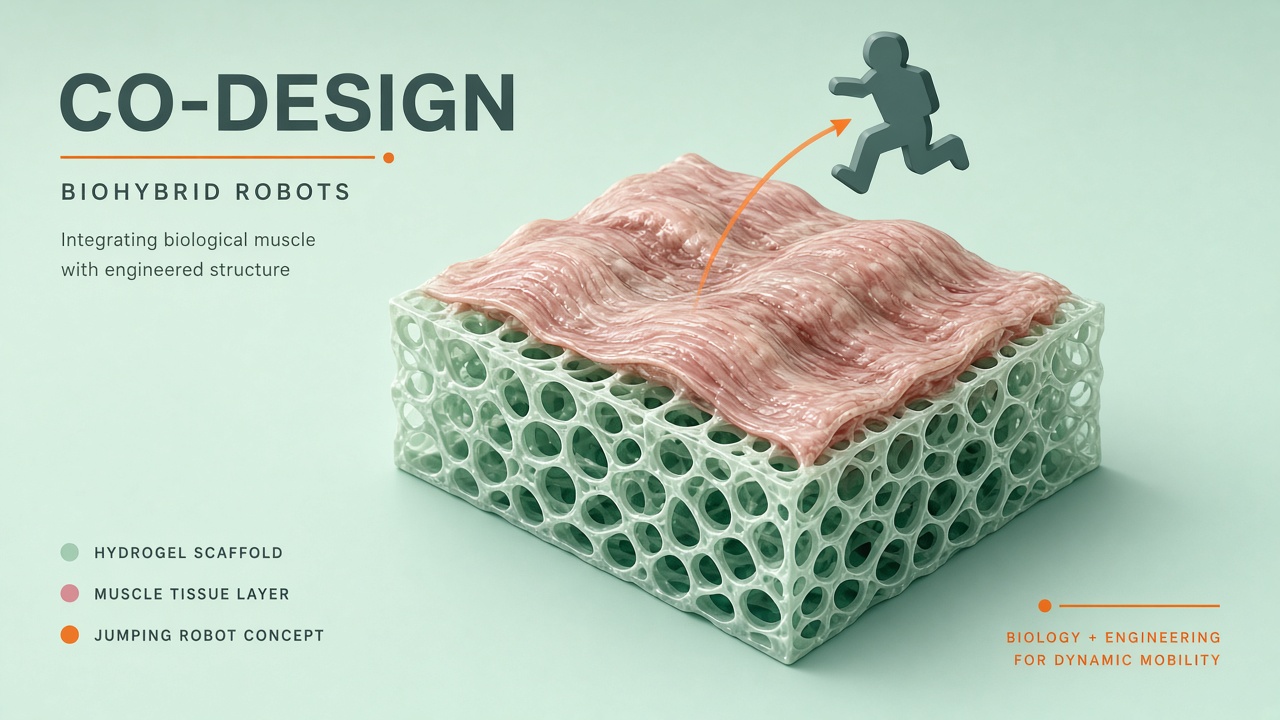
Biohybrid robots promise soft machines that heal, adapt, and move with biological compliance. For years, progress focused on making muscle tissue contract harder while treating plastic scaffolds as passive holders. A September 2026 Nature Communications study argues that mindset misses half the problem. Muscle and scaffold must be co-designed as a unified mechanical system. Researchers at ETH Zurich and collaborators modeled volumetric muscle-scaffold distributions in simulation, evolved geometries with multi-objective algorithms, then fabricated microgrooved hydrogel bilayers that achieved up to an eleven-fold increase in range of motion. The same actuators powered robots that jump, swim, walk, and grip. For teams tracking AI research in embodied systems or AI design optimization pipelines, the paper is a template for computational biology meeting robotics fabrication.
Muscle-Scaffold Co-Design: The Problem Being Solved
Biohybrid actuators fail when muscle contracts against scaffolds that waste force on slip, delamination, or stiff regions that resist large deformations. Prior skeletal muscle robots often used ring or pillar geometries because differentiation protocols demanded them, not because simulation showed those shapes maximize locomotion. Cardiac muscle films suit swimming jellyfish mimics; bulk skeletal muscle suits jumping and gripping if the passive partner transmits force efficiently through a continuous interface.
The co-design pipeline treats each voxel in a soft-body model as empty space, passive scaffold, or active muscle. Evolutionary search discovers bilayer architectures where muscle and hydrogel thickness ratios, groove patterns, and interface continuity jointly maximize angular or linear displacement per contraction cycle.
Evolutionary Optimization Pipeline
Researchers combined soft-body finite-element simulation with the NSGA-II multi-objective evolutionary algorithm to search volumetric muscle-scaffold layouts without assuming thin-film or ring geometries upfront. NSGA-II maintains a Pareto front balancing range of motion against material volume and fabrication constraints. Topology optimization experiments on 10-by-10 grids converged toward bilayer patterns: active muscle layers paired with passive hydrogel layers separated by void or interface regions that amplify bending.
- Simulate: Model unified muscle-hydrogel mechanics in a voxelized soft-body framework.
- Evolve: Run NSGA-II to maximize range of motion across candidate volumetric layouts.
- Refine: Apply targeted parameter sweeps on groove depth, hydrogel stiffness, muscle fraction.
- Fabricate: Integrate C2C12 skeletal muscle with microgrooved PEGDA/GelMA hydrogel scaffolds.
- Validate: Measure displacement, then mount actuators in multi-modal robot demonstrators.
Supplementary materials show scaffold stiffness strongly affects maturation: too-soft hydrogels yield poor muscle alignment; optimal compositions (for example, 15% PEGDA M.W. 700 plus 5% GelMA) improved fabrication yield from roughly fifty percent to eighty-five percent in later process iterations, enabling broader robot demonstrations.
Performance Gains and Robot Demonstrations
Optimized bilayer bioactuators achieved up to eleven times greater range of motion than previous designs with similar muscle volume, enabling diverse locomotion and manipulation on centimeter scales. Demonstrators included jumping platforms, swimming soft robots, walking crawlers, and gripping manipulators built from modular actuator units. Scalability came from assembling multiple optimized units rather than enlarging a single monolithic muscle block.
| Robot behavior | Actuator role | Co-design benefit |
|---|---|---|
| Jumping | Rapid large deformation | High throw distance from optimized bilayer snap |
| Swimming | Rhythmic fin bending | Efficient force transmission through grooved interface |
| Walking | Alternating limb motion | Modular units with phased stimulation |
| Gripping | Controlled closure | Large curvature from volumetric muscle allocation |
Compared with earlier bilayer jellyfish-inspired designs using xolography-printed hydrogels, this work optimizes geometry before fabrication rather than hand-tuning ring muscles around pillars. The simulation-to-fabrication loop is the methodological advance teams can reuse even when muscle cell lines or hydrogel recipes change.
Fabrication: Microgrooves and Yield
Microgrooved hydrogel scaffolds align differentiating muscle fibers and create mechanical anisotropy that simulation predicts before casting molds. Hydrogel A (20% PEGDA M.W. 575 plus 5% GelMA) proved too soft, producing poorly aligned actuators at maturation. Hydrogel B (15% PEGDA M.W. 700 plus 5% GelMA) matched simulation stiffness targets and became the production recipe. Process iteration raised successful actuator yield from about fifty percent to eighty-five percent, which the authors note was necessary to demonstrate jumping, swimming, walking, and gripping on one co-design family.
Confocal microscopy confirmed C2C12 spreading along grooves within twenty-four hours of seeding. Delamination at the muscle-scaffold interface was a primary failure mode in non-optimized bilayers; co-design reduced interfacial slip by distributing stress across a continuous volumetric bond rather than a thin adhesive line. Teams importing this pipeline should budget time for hydrogel stiffness calibration before scaling robot assemblies.
Application Paths and Engineering Limits
Near-term applications include soft robotics research platforms, micro-manipulation in wet environments, and educational demonstrators of computational tissue engineering. Medical implants powered by engineered muscle remain distant: sterility, immune response, long-term vascularization, and control interfaces are unresolved. Industrial deployment faces the same lifespan constraints as other living actuators, measured in days to weeks without perfusion breakthroughs.
Computational co-design accelerates iteration before expensive cleanroom and cell-culture work. Teams can export simulation constraints to CAD for microgrooved molds, reducing guesswork in hydrogel composition. The approach also applies to pillar geometries as a comparative case in the paper, showing the optimizer rediscovers familiar motifs when they are truly optimal rather than forbidding them by assumption.
Ethical Questions
Living robots raise animal cell sourcing, waste disposal, and public acceptance issues parallel to other biohybrid systems. C2C12 mouse myoblast lines avoid fresh animal dissection per device but still depend on biological materials with laboratory animal research heritage. Transparent communication about cell sources, lifespan, and non-military research goals helps prevent sensational misreadings.
As co-design pipelines merge with AI-driven generative CAD, reviewers should ask whether optimized morphologies remain interpretable and manufacturable, or whether simulation overfits to idealized material properties. The ETH team addressed part of this by iterating fabrication yield and reporting failed stiffness regimes in supplementary figures.
Modular Assembly and Scaling
Jumping, swimming, walking, and gripping demos used modular actuator units rather than one monolithic muscle block. That modularity mirrors reconfigurable soft robotics in silicon-actuated systems: swap actuator segments, retune stimulation phase, and reuse bodies across gaits. Co-design at the unit level simplifies replacement when individual muscle constructs fatigue after days in culture, a maintenance pattern biological robots must plan for unlike motor swaps on conventional platforms.
For readers cross-referencing AI research on embodied intelligence, the Katzschmann group contribution is primarily a fabrication-aware optimizer, not a learned control policy. Stimulation timing and robot morphology emerge from mechanics co-evolved with tissue volume rather than from reinforcement learning on a digital twin alone, though future work may close that loop once simulation fidelity matches maturation variability.
Pillar Geometries as Baseline
The paper uses pillar-based muscle rings as a comparative baseline to show the optimizer can rediscover familiar geometries when they are truly optimal, not because the search space excludes them. That control experiment matters for reviewers skeptical that co-design merely rediscovers bilayers by construction. Parameter sweeps on pillar layouts demonstrate incremental gains still fall short of volumetric bilayer performance at equal muscle volume, supporting the eleven-fold range-of-motion claim.
Stimulation and Control Gaps
Demonstrators rely on external electrical stimulation patterns tuned after fabrication. Co-design optimizes morphology, not closed-loop controllers learned from camera feedback. Integrating sensors and adaptive stimulation with optimized actuators remains open work. Buyers comparing biohybrid hype to mature quadruped robots should expect control stacks to lag mechanical co-design by several research cycles.
Open-access publication in Nature Communications allows robotics and tissue engineering labs to reproduce simulation parameters before committing to cell culture work, aligning with how open protein design stacks lowered barriers in computational biology over the past five years.
Hydrogel stiffness tuning alone moved fabrication yield from roughly fifty to eighty-five percent in reported process iterations, illustrating that co-design gains depend on fabrication feedback loops, not simulation-only iteration.
Frequently Asked Questions
What is muscle-scaffold co-design?
Co-design optimizes the three-dimensional distribution of living muscle and passive hydrogel scaffold together, rather than growing muscle on a predetermined static frame. Simulation and evolutionary algorithms search layouts that maximize motion per contraction.
Which algorithm did researchers use?
The study used NSGA-II, a multi-objective evolutionary algorithm, within a soft-body simulation framework. Voxel grids represent muscle, scaffold, or empty space during search.
How large were performance improvements?
Optimized bilayer actuators showed up to an eleven-fold increase in range of motion compared with previous biohybrid designs of similar muscle volume, according to the Nature Communications publication (DOI s41467-026-77655-1).
Can these robots jump and swim?
Yes. The same co-designed actuator family powered separate demonstrators for jumping, swimming, walking, and gripping tasks, illustrating versatility beyond a single locomotion mode.
Is this ready for commercial robots?
Not yet. Actuators rely on lab-cultured muscle with limited lifespan and external stimulation infrastructure. The paper establishes a design pipeline for research acceleration, not a product roadmap for shipping warehouses or hospitals.
How does this connect to AI design tools?
Evolutionary optimization and voxelized soft-body simulation mirror generative design workflows in mechanical engineering, but fitness functions target biological motion rather than static load bearing. Teams using AI design suites for CAD can treat the published pipeline as a parallel stack where finite-element cells replace mesh faces and NSGA-II replaces gradient descent when gradients are unavailable across tissue maturation noise.
Who led the Nature Communications study?
Authors include Aiste Balciunaite, Mike Y. Michelis, Miriam Filippi, Pablo Paniagua, Oncay Yasa, and Robert K. Katzschmann, reporting volumetric co-optimization of muscle and hydrogel scaffolds published September 11, 2026 in Nature Communications (s41467-026-77655-1). The work unifies soft-body simulation, NSGA-II search, and microgrooved hydrogel fabrication for centimeter-scale bioactuators.