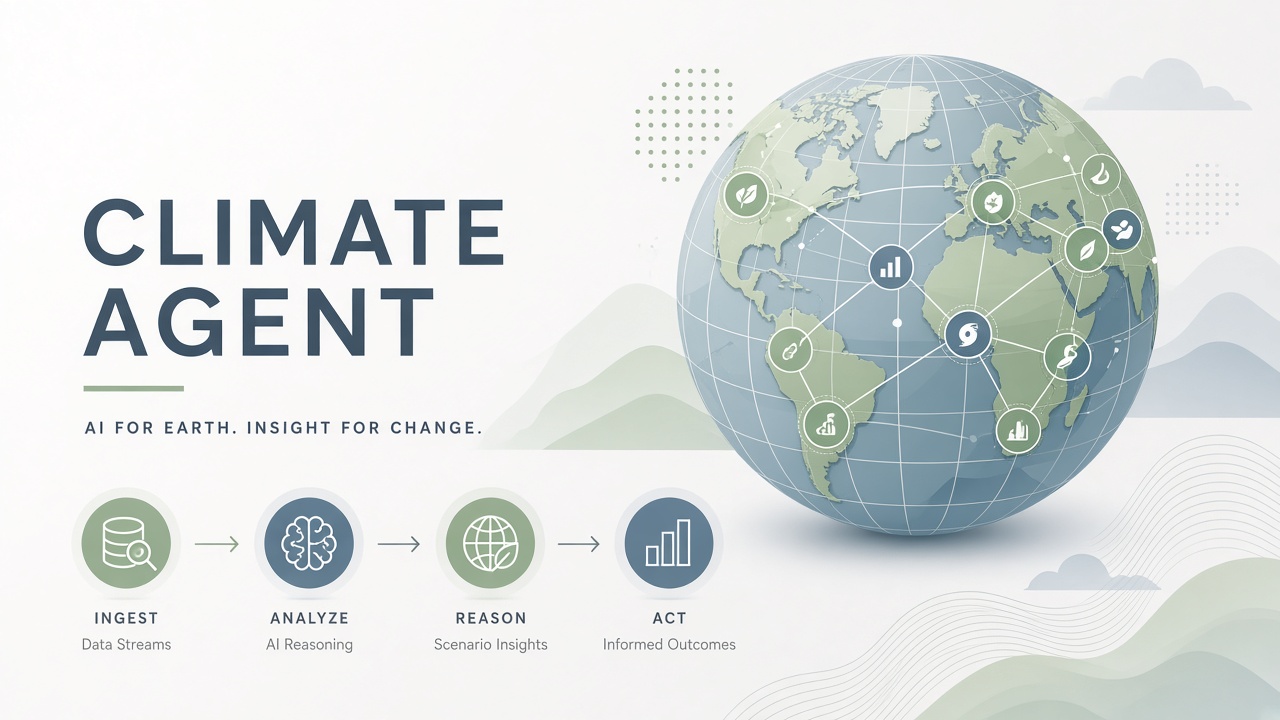
Climate science runs on fragmented datasets that span the atmosphere, ocean, cryosphere, and land surface. A July 2025 preprint introduces EarthLink, a self-evolving multi-agent system from OpenEarthLab that accepts natural language and automates planning, code generation, data analysis, and physical interpretation across more than five petabytes of cross-disciplinary Earth science archives. In expert evaluations on core climate tasks, authors report proficiency comparable to a junior researcher. When tasked with discovering precursors of the Atlantic Niño, EarthLink autonomously proposed a wind-thermocline mechanism and built hindcast models with temporal correlation skill near 0.46 at an eight-month lead. For readers tracking AI research applied to planetary systems or browsing popular AI tools, EarthLink illustrates how agentic workflows may shift scientists from manual execution to hypothesis supervision.
Why Earth Science Needs Integrated Agents
Earth science discovery is bottlenecked by data volume and siloed expertise, not by a lack of physical theory. CMIP6 ensembles, reanalysis products, satellite retrievals, and in situ moorings each live in different formats, APIs, and community conventions. A single research question, such as whether a climate model captures ENSO diversity or how Atlantic sea surface temperature anomalies evolve, can require Python for extraction, domain-specific libraries for regridding, and expert judgment to interpret anomalies against established indices. Junior scientists spend weeks on plumbing before testing ideas. Senior scientists cannot scale exploratory analyses across every model and variable of interest.
General-purpose coding assistants help with syntax but lack curated Earth science tool libraries, physical consistency checks, and reproducible recipe templates for tasks like bias diagnosis or model-observation comparison. EarthLink targets that gap by embedding specialized agents for planning, recipe generation, diagnostics, and result analysis within a dialogue-driven interface accessible at earthlink.intern-ai.org.cn. The system is designed to evolve: users refine workflows in conversation, and modular agents extend capability over time rather than resetting context on each query.
The OpenEarthLab GitHub repository lists bias diagnosis, future projection, physical mechanism discovery, multi-model evaluation, and climate change attribution as headline use cases. Each maps to repeatable recipe templates the planner can invoke or extend. That library differentiates EarthLink from chatbots that regenerate generic pandas scripts without domain-aware defaults for regridding, calendar alignment, or CF-compliant metadata that CMIP6 consumers expect.
Planning, Code, and Physical Reasoning Loop
EarthLink runs a closed loop where a planning agent decomposes a scientific question, a coding agent executes analysis scripts, and an interpretation agent links outputs back to physical mechanisms. Unlike a single-shot LLM answer, the pipeline emits intermediate scripts, figures, and reasoning steps for human audit. Scientists can inspect generated code, rerun with modified parameters, or redirect the planner when a variable choice looks wrong. That transparency matters in climate science, where a mis-specified index or wrong sign on a regression can produce plausible but wrong conclusions.
Reported capabilities include bias diagnosis in CMIP6 models, future climate projection analysis, multi-model ensemble comparison, and climate change attribution workflows. For ENSO diversity, EarthLink implemented established Central-Pacific versus Eastern-Pacific classification logic from the literature and reproduced characteristic spatial patterns when prompted with those methods. For periodicity analysis, it generated custom code beyond its existing tool library and identified the canonical two-to-seven-year ENSO band. These examples show the agent combining library recipes with on-the-fly code synthesis when the question exceeds prebuilt templates.
| Agent role | Function | Scientist oversight point |
|---|---|---|
| Planner | Breaks question into analysis steps | Validate variable and region choices |
| Recipe / code | Generates executable Python workflows | Review scripts before publication runs |
| Diagnostics | Computes indices, correlations, maps | Check units and baseline periods |
| Interpretation | Links statistics to mechanisms | Judge physical plausibility |
Expert Evaluation on Climate Tasks
Authors benchmarked EarthLink against expert rubrics on large-scale climate tasks and report performance aligned with a junior researcher's proficiency, not parity with senior specialists on every subtask. The preprint (arXiv:2507.17311, posted July 2025) emphasizes model-observation comparison and climate change understanding as core evaluation domains. Tasks require cross-variable reasoning, correct use of community datasets, and interpretable outputs suitable for manuscript figures. The system integrates data from CMIP6, reanalysis, and observational products referenced in the paper's methodology sections.
Self-evolving behavior appears when users iterate: failed analyses trigger replanning, alternative estimators, or expanded predictor sets. That iterative refinement mirrors how graduate students learn a workflow, except the agent retains modular recipes for reuse. The GitHub repository OpenEarthLab/EarthLink documents installation, agent architecture, and example prompts for bias diagnosis and projection studies. Independent reviewers should still treat proficiency claims as study-specific until broader blind evaluations appear in peer-reviewed venues.
Autonomous Atlantic Niño Precursor Discovery
Given an open-ended prompt to find Atlantic Niño precursors at an eight-month lead, EarthLink tested regression, random forest, and gradient boosting models using Atlantic wind and subsurface predictors, reaching temporal correlation coefficient (TCC) skill near 0.46 in hindcasts. That exceeds persistence and ENSO-only comparators but falls short of the paper's stated target above 0.5 at that lead. The agent's analysis suggested Indo-Pacific teleconnections contributed minimally at this lead time, pointing instead to Atlantic-internal dynamics: autumn westerly wind anomalies, equatorial Kelvin-wave adjustment, subsurface heat content memory in November, and spring Bjerknes feedback amplification toward the June-August ATL3 peak.
The proposed mechanism chain is physically coherent but remains a hypothesis generated within the agent workflow, not yet independently replicated in operational forecasting centers. Hindcast correlations reported in public summaries range roughly from 0.36 to 0.46 depending on predictor set and regularization. Tree models and multivariate linear regression using September-November wind-stress and thermocline slope precursors performed best among the agents' candidates. Authors note that focused enhancement of thermocline-slope and coastal precursors could plausibly lift eight-month skill toward or above 0.5, but that path is prospective, not demonstrated in the current release.
Atlantic Niño predictability at multi-season leads remains an active research frontier in operational centers. EarthLink's value in the case study is workflow autonomy: predictor screening, model comparison, and mechanism narrative emerged without a human specifying every regression term. Whether the proposed SON-November wind and thermocline slope precursors enter operational suites depends on prospective validation, not hindcast correlation alone. Treat the agent's TCC near 0.46 as an internal benchmark improvement, not a forecast service ready for public release.
Limits and Scientist Oversight
EarthLink accelerates exploratory analysis but cannot replace peer review, data stewardship, or accountability for published claims. LLM-based agents can hallucinate library functions, mislabel variables, or overfit hindcasts when predictor search is unconstrained. The Atlantic Niño case is instructive: skill improved over naive baselines yet missed a pre-specified threshold, and the exact production model backbone for some runs is not fully transparent in public materials. Scientists must treat agent outputs as draft hypotheses requiring independent verification, sensitivity tests, and comparison with established literature predictors such as Atlantic warm water volume and equatorial wind indices documented in prior seasonal forecast studies.
Data access constraints remain: five petabytes of integrated archives still require credentials, compute quotas, and ethical use of restricted observational products. Journal policies on AI-assisted analysis are evolving; transparent logging of prompts, code, and intermediate figures, which EarthLink emphasizes, aligns with emerging reproducibility expectations. For teams evaluating similar AI research copilots, the division of labor is clear: humans own question framing, causal claims, and publication ethics; agents handle repetitive integration and first-pass statistics.
Replication workflows should archive EarthLink prompts alongside CMIP6 model versions and observational product vintages because climate indices shift when reanalysis systems update. A precursors study rerun on ERA5 versus an older reanalysis may yield different correlation rankings even when agent code executes correctly. Funding agencies evaluating agent infrastructure should budget for compute and storage at scales comparable to traditional postdoctoral projects, not assume LLM API costs alone cover petabyte-adjacent workflows.
Frequently Asked Questions
What is EarthLink?
EarthLink is a self-evolving multi-agent AI system for Earth and climate science introduced in arXiv preprint 2507.17311 (July 2025) by OpenEarthLab collaborators. It automates planning, coding, analysis, and physical interpretation from natural language prompts across large Earth science datasets.
How does EarthLink compare to junior researchers?
Authors report expert evaluation scores comparable to junior researcher proficiency on selected large-scale climate tasks such as model-observation comparison. That does not imply equivalence on every specialized subfield, field campaigns, or theoretical derivations.
What did EarthLink find about Atlantic Niño?
When tasked with precursor discovery at an eight-month lead, EarthLink identified Atlantic wind-thermocline pathways and built hindcast models with TCC skill near 0.46, above persistence but below a stated 0.5 target. ENSO indices contributed little at that lead in the agent's analysis.
Can EarthLink access all climate data?
The system integrates more than five petabytes of cross-disciplinary archives in principle, but practical access depends on user credentials, compute resources, and dataset licensing. Not every observational product is publicly downloadable without registration.
Do journals accept EarthLink analyses?
Policies vary by publisher. EarthLink logs scripts and intermediate outputs to support reproducibility, which aligns with emerging disclosure norms. Authors remain responsible for verification, independent replication, and accurate attribution of AI assistance in manuscripts.
How do I try EarthLink?
A public interface is linked from the project site and GitHub repository OpenEarthLab/EarthLink. Researchers should start with benchmark tasks from the paper, compare agent outputs against manual analyses, and document prompts and code for any publication-bound workflow.
Earth science graduate programs may eventually treat agent literacy like programming literacy: reading agent-generated code, spotting unit errors, and designing guardrail prompts. Until standardized curricula exist, labs should pilot EarthLink on low-risk exploratory tasks before delegating manuscript-critical analyses. Comparing agent outputs with manual reanalysis on identical CMIP6 subsets builds institutional trust faster than adopting proficiency claims from vendor demos alone.
Funding agencies comparing EarthLink to general coding agents should require reproducible benchmarks on identical CMIP6 subsets with frozen data vintages. Proficiency claims mean little if agents cannot rerun analyses when libraries update. Transparent logging of prompts and scripts is the minimum bar for grant-supported climate workflows in 2026.