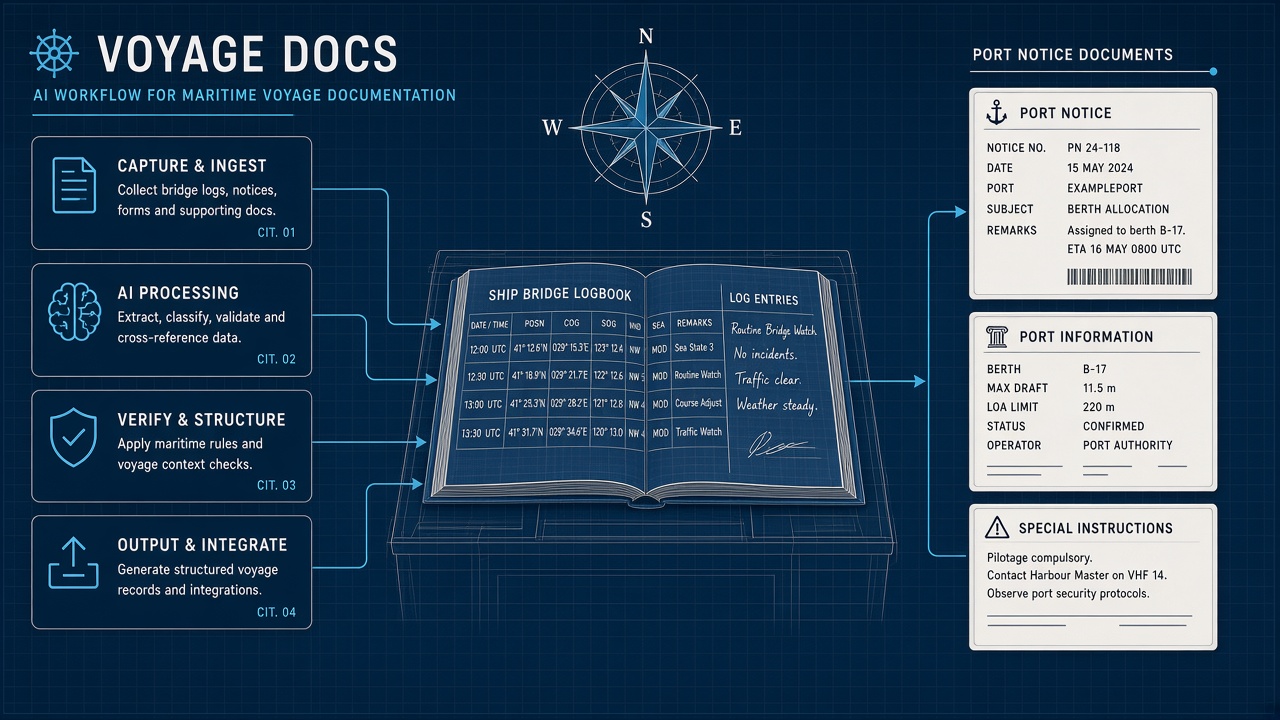
A single port call can produce dozens of overlapping records: noon reports, engine room logs, pilot exchange forms, bunker delivery notes, and PSC deficiency lists. Officers spend hours reconciling the same voyage facts across systems before anyone signs a safety filing. An ai workflow maritime documentation pipeline ingests those source documents, produces structured summaries with inline citations back to log line numbers, cross-checks against flag state and SOLAS requirements, and routes every draft through certified officer review before anything enters an official record. AI accelerates reading and first-draft assembly; the Master, Chief Engineer, and DPA retain authority over what gets filed.
This guide fits fleet operators, ship managers, and compliance teams on cargo, tanker, and offshore vessels. Pair summarization with AI code tools when you build custom ingestion scripts for ECDIS exports or VDR extracts, and AI chatbot interfaces when crew ask plain-language questions about prior voyage events, always with source links visible in the response.
What Maritime Voyage Documentation Includes
Maritime voyage documentation spans bridge logs, engine room records, port and terminal notices, inspection reports, and compliance checklists that together prove safe navigation, environmental compliance, and crew certification status for a given voyage leg. Treating these as one corpus for AI summarization requires clear document-type boundaries so the model does not merge legally distinct records.
- Bridge logs: course, speed, weather, navigational warnings, watch handover notes, ECDIS alarm summaries.
- Engine room logs: fuel consumption, machinery status, running hours, lube oil analysis references, blackout events.
- Port notices: pilot boarding times, berth allocation, terminal safety bulletins, local regulation reminders.
- Inspection records: PSC findings, class survey observations, internal SMS audits, ISM non-conformity reports.
- Compliance checklists: MARPOL record book entries, ballast water exchanges, garbage and sludge disposal logs.
- Crew and certificate records: STCW endorsements, medical fitness, work-rest hour logs per MLC 2006 limits.
| Document type | Typical author | Retention driver | AI summary role |
|---|---|---|---|
| Deck log / bell book | OOW, Master | SOLAS V/28, flag state | Timeline of navigational events |
| Engine log | Duty engineer | ISM Code, class rules | Machinery status narrative |
| Port notice of readiness | Agent, terminal | Charter party, SOF | Berth and cargo window facts |
| PSC inspection report | Port State Control | ISM, MARPOL, STCW | Deficiency list with codes |
| MARPOL record book | Chief Officer / Engineer | MEPC resolutions | Disposal event cross-reference |
Digital record book platforms approved under MEPC 312(74) for oil record books and MEPC 369(80) for ballast water already structure many fields. AI summarization works best when it reads those structured exports plus unstructured PDFs from agents, not when it tries to replace the signed logbook entry itself.
Summarization With Source Citations
Every AI-generated voyage summary must cite the source document ID, page, and line or timestamp so officers can verify claims in seconds during PSC interviews or internal audits. Uncited summaries are briefing notes only; they should never flow into official filings without human verification against originals.
- Assign stable IDs at ingest:
DECK-2026-03-14-1430,ENG-2026-03-14-0800,PORT-SIN-AGENT-0042. - Chunk long logs by watch period (four to six hours) so citations stay narrow and searchable.
- Require inline citation format: [DECK-2026-03-14-1430, line 12] after each factual claim in the draft.
- Flag low-confidence extractions (handwritten scans, poor SATCOM fax quality) for mandatory human read.
- Store prompt version, model ID, and input hash alongside each summary for reproducibility.
| Summary section | Required citations | Officer action |
|---|---|---|
| Voyage timeline | Deck log timestamps, AIS corroboration | Master confirms sequence |
| Fuel and emissions | BDN, engine log, noon report | Chief Engineer signs |
| Port events | SOF, pilot forms, agent emails | Chief Officer reviews |
| Incidents and near-misses | SMS report, VDR extract if applicable | DPA escalation mandatory |
Speech-to-text tools on the bridge can feed raw observations into structured entries before summarization runs. Volteo Wayship and similar platforms report fourfold faster capture versus manual typing when crew narrate observations that ASR converts to tagged log lines. The AI summary layer sits downstream of that structured capture, not upstream of officer sign-off.
Cross-Check Against Regulatory Requirements
After summarization, run automated cross-checks against flag state rules, SOLAS chapters, MARPOL annexes, and STCW work-rest limits so missing entries surface before Port State Control or class surveyors find them. Cross-check output is a deficiency alert list, not a substitute for statutory compliance software certified by the Administration.
- Map checklist items to regulation references: SOLAS V/28 deck log fields, MLC rest hour minimums (10h/24h, 77h/7d).
- Compare summary claims against certificate expiry database: STCW endorsements, medical, flag endorsements.
- Validate MARPOL entries against port disposal receipts and incinerator running hours.
- Flag gaps: noon report without matching engine fuel figure, pilot on board time missing from deck log.
- Generate PSC-ready gap report ranked by detention risk (ISM, MARPOL, STCW categories).
| Regulation | Cross-check target | Typical AI alert |
|---|---|---|
| STCW 2010 / digital certs (2025) | Crew matrix vs watch schedule | Expired endorsement on bridge watch |
| MLC 2006 rest hours | Work-rest logs vs actual rotations | Under 10 hours rest in 24h window |
| MARPOL Annex I / VI | ORB entries vs BDN sulfur content | Disposal without matching port receipt |
| ISM Code | Non-conformity closure dates | Open NC past corrective action deadline |
IMO amendments MSC.541(107) allow electronic STCW certificates from January 2025 with the same legal weight as paper. Cross-check workflows should accept QR-verified digital credentials alongside scanned PDFs. Platforms like E-CMS and Binnacle AI parse certificate fields via OCR and alert 60 to 90 days before expiry, which pairs naturally with voyage summary generation before crew changes.
Officer Review and Amendment Trail
Certified officers must review every AI draft, amend incorrect extractions, and apply a digital or wet signature before the summary enters operational use, with a versioned trail showing who changed what and when. The Master and Chief Engineer are legally responsible for log accuracy; AI assists reading, not signing.
- Route drafts to role-based queues: navigational sections to Master/OOW, machinery to Chief Engineer.
- Require explicit approve, amend, or reject actions; rejection sends back to source with officer notes.
- Lock approved sections; reopened sections get new version numbers, not silent overwrites.
- Record approver certificate number, rank, and UTC timestamp on each signed block.
- Escalate incident summaries to DPA before distribution to charterers or insurers.
| Review stage | Responsible officer | SLA target |
|---|---|---|
| AI draft generated | System (automated) | Within 30 minutes of ingest |
| Section review | OOW / duty engineer | Same watch period |
| Final approval | Master / Chief Engineer | Before next port call |
| Shore distribution | Fleet manager / DPA | After onboard sign-off only |
Retention and Audit Readiness
Retain original source documents, AI prompts, draft versions, officer amendments, and final signed summaries for the period required by flag state and charter party, typically three to five years for voyage records and longer for pollution-related entries. Audit readiness means an inspector can reconstruct any summary claim back to a signed log line without relying on AI memory.
- Store immutably: original PDFs, structured exports, each summary version, approval metadata.
- Export audit bundles: chronological index, cited sources, cross-check results, officer sign-offs.
- Separate retention tiers: operational summaries (1 year), PSC-related (3+ years), MARPOL (per MEPC guidance).
- Test restore quarterly: pull a random voyage from archive and verify citation links resolve.
- Document data residency if crew PII or VDR data crosses jurisdictions via cloud sync.
| Record class | Typical retention | Audit artifact |
|---|---|---|
| Signed logbooks | Flag minimum, often 3 years | Original or approved digital equivalent |
| AI summary drafts | Match parent voyage file | Version history with citations |
| Cross-check reports | Until deficiencies closed + 1 year | Alert log with resolution notes |
| PSC correspondence | Life of vessel or sale + 1 year | Deficiency codes and closure proof |
Shore-Side Fleet Dashboards and Charterer Briefings
Approved voyage summaries feed shore-side fleet dashboards and charterer briefings only after onboard officer sign-off, so shore teams see the same cited facts the bridge team validated, not raw AI drafts. Fleet managers use these packs to answer charterer queries about delays, bunker ROB, and PSC outcomes without calling the Master mid-watch.
- Push signed summaries to fleet portal via API after Master approval; block pre-approval drafts from shore view.
- Tag summaries by voyage leg, charter party reference, and cargo type for filtered search across the fleet.
- Charterer-facing exports strip crew PII and internal SMS notes; include only cited operational facts.
- Alert shore DPA when cross-check flags STCW rest hour violations or open PSC deficiencies before next port.
- Compare AI summary turnaround time against manual briefing prep to justify license cost at fleet review.
| Shore consumer | Summary slice | Access control |
|---|---|---|
| Fleet operations | Full signed pack with citations | Internal SSO, role-based |
| Charterer | Delay, cargo, port timeline only | Time-limited secure link |
| Insurer / P&I | Incident section if triggered | DPA approval required |
| Port agent (next call) | Arrival draft, crew change list | Encrypted email or portal |
Workflow Implementation Steps
Roll out maritime AI documentation in phases: pilot one vessel and one document class, measure officer time saved and citation accuracy, then expand to full voyage packs with shore-side fleet dashboards. Rushing full automation before officers trust citations creates more rework than manual logs.
- Week 1-2: Inventory document sources per vessel; map APIs, email inboxes, and manual uploads.
- Week 3-4: Pilot deck log summarization on one route; officers score citation accuracy weekly.
- Month 2: Add cross-check rules for STCW rest hours and certificate expiry on that vessel.
- Month 3: Extend to engine logs and port notices; integrate with existing SMS non-conformity tracker.
- Month 4+: Fleet rollout with standardized summary templates and PSC gap report format.
Frequently Asked Questions
Do flag state rules allow AI-assisted voyage summaries?
Most flag states regulate the accuracy and retention of official logbooks, not the internal tools officers use to draft briefing summaries, provided the signed logbook remains the legal record of truth. Confirm with your DPA and Administration whether AI-generated text may appear in digital record books that carry class approval. When in doubt, treat AI output as a working draft until an officer signs the underlying log entry.
How do SATCOM bandwidth limits affect document ingestion?
Queue large PDF scans and VDR extracts for shore sync when bandwidth exceeds 256 kbps, and run summarization on compressed text extracts onboard only when latency stays under five minutes. Crew should not wait on satellite links for AI drafts during critical navigational periods. Batch uploads at noon reporting windows or in port with fiber backhaul. OCR on low-resolution faxed agent documents often fails; flag those for manual entry rather than forcing a bad summary.
Can AI summarize logs written in multiple languages?
Multilingual voyage packs are common on international crews; configure the pipeline to preserve original-language citations while producing officer-facing summaries in the working language of the bridge team (often English). Never translate statutory phrases or PSC deficiency codes without human review. Mixed-language port notices from Asian and European agents need language detection at ingest so citations point to the correct source paragraph, not an auto-translated paraphrase.
How does this help before Port State Control?
PSC preparation benefits most when cross-check reports surface missing MARPOL entries, expired STCW endorsements, and open ISM non-conformities before the vessel enters the port limits, not after the inspector boards. Run the gap report 24 hours before ETA and assign closure tasks to the responsible officer with cited source lines. AI cannot predict which documents PSC will request, but a complete cited summary reduces scramble time when the inspector asks for rest hour records or last oil record book page.
Will AI replace traditional ship logbooks?
Class-approved digital record books are replacing paper in many fleets, but officer sign-off and regulatory field requirements remain; AI summarizes and cross-checks, it does not eliminate the human accountability chain. MEPC-approved electronic ORBs and similar systems already validate fields at entry. AI adds a comprehension layer on top, not a bypass around SOLAS record-keeping duties.
Keep Officer Authority at the Center
A practical ai workflow maritime documentation practice classifies logs, notices, and inspections separately, summarizes with inline source citations, cross-checks against STCW, MARPOL, and flag rules, routes every draft through officer review with versioned amendments, and archives originals for audit. AI reduces reading load across dense voyage packs; certified officers retain signing authority over safety filings. Pilot on one vessel before fleet-wide rollout, and measure citation accuracy against PSC interview scenarios before trusting summaries at charterer-facing briefings.