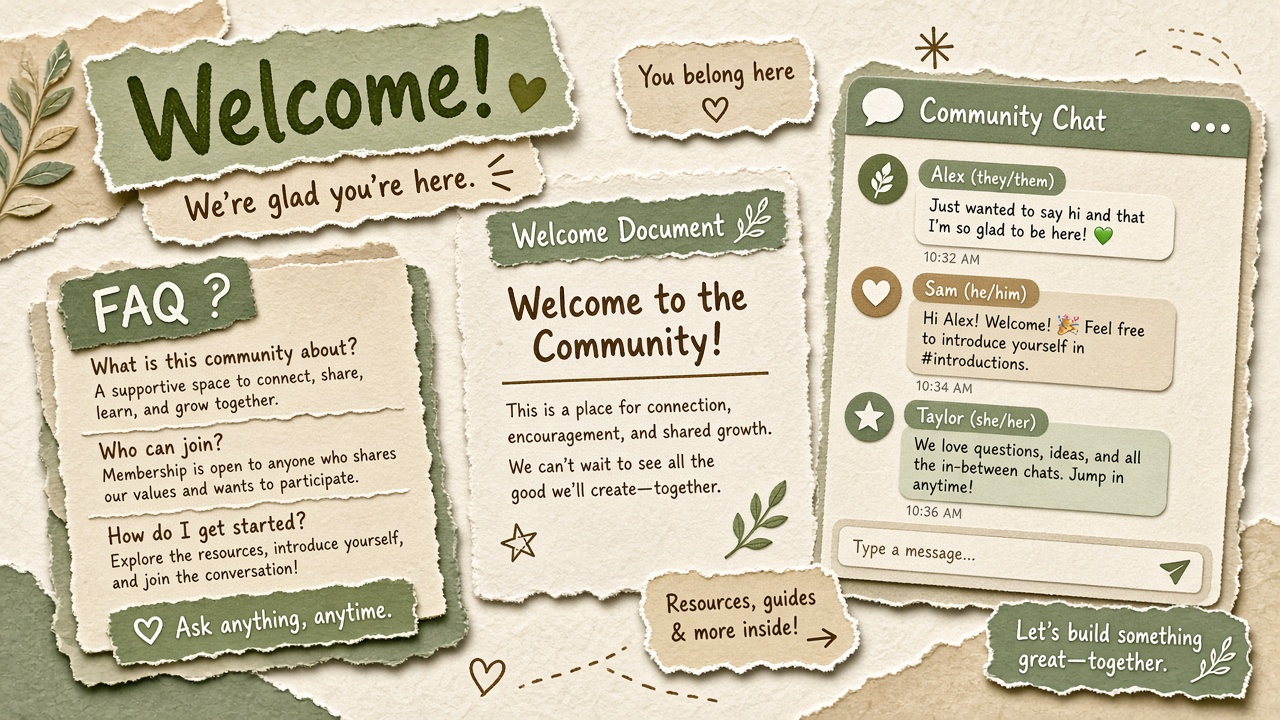
Paid communities drown in repeat questions about billing, access, events, and moderation while members expect faster answers than public comment sections allow. An ai workflow membership community faq pipeline collects questions from tickets and chats, drafts FAQ and onboarding docs, applies tier-specific answers, and publishes only after human review. AI accelerates documentation; you own policy accuracy and moderation boundaries members trust with their money.
This guide fits Patreon, Discord memberships, Circle, Skool, and custom LMS communities. Draft FAQ clusters with AI chatbot tools and polish prose with AI writing assistants, always verifying billing and legal language before posting to paid spaces.
FAQ Intake From Tickets
Export recurring support questions from email, help desk, and community mod logs weekly, cluster by theme, and rank by frequency and revenue risk before drafting FAQ entries. Intake discipline prevents FAQ docs that answer rare edge cases while ignoring the top ten billing confusion threads.
- Tag tickets: billing, access, events, content, moderation, technical.
- Weekly export: question text anonymized, tier if known, resolution note.
- Cluster similar phrasing; count occurrences over 30 and 90 day windows.
- Flag questions needing legal review (refunds, data, minors).
- Queue top clusters for FAQ draft; deprioritize one-off anomalies.
| Theme | Typical question | Priority |
|---|---|---|
| Billing | "When am I charged after upgrading?" | High |
| Access | "Where is the course link?" | High |
| Events | "Replay available for tier X?" | Medium |
| Moderation | "Why was my post removed?" | Medium |
Onboarding Doc Structure
New member onboarding docs follow a fixed structure: welcome and values, how to get value in week one, where to find content, how to ask for help, and tier comparison so members orient without opening five pinned messages. AI drafts sections from your intake clusters; creators verify tone and accuracy.
- Welcome: what the community is, what it is not, code of conduct link.
- Quick start: three actions in first 24 hours (intro post, resource, event RSVP).
- Navigation map: channels, course library, calendar, support path.
- Tier table: what each level includes with upgrade path.
- FAQ excerpt: top five questions with links to full FAQ page.
| Section | Target length | Update trigger |
|---|---|---|
| Welcome | 150 to 250 words | Rebrand or mission shift |
| Quick start | Bullet list, 5 to 7 items | New flagship resource launch |
| Navigation map | Screenshot plus links | Platform or channel restructure |
| Tier table | Comparison table | Pricing or perk change |
Tier-Specific Answers
FAQ entries that differ by membership tier (event access, office hours, download rights) use explicit tier columns or conditional paragraphs so members do not assume perks they have not purchased. Ambiguous tier language drives refund requests and public complaints.
- Tag each FAQ row: all tiers, tier A only, tier B and above.
- Use tables for perk comparisons instead of buried prose exceptions.
- Link to checkout upgrade path when answer is "available on tier X."
- Grandfathering rules: document legacy tier names if platform migrated.
- Review tier answers after every pricing experiment.
| Perk | Base tier | Premium tier |
|---|---|---|
| Monthly live Q&A | Watch only | Submit questions live |
| Resource downloads | Selected templates | Full library |
| DM support | Not included | 48 hour response SLA |
Moderation Boundaries in FAQ
Publish clear moderation boundaries in FAQ: acceptable topics, self-promo rules, harassment response, and appeal process so mods enforce consistently and members know consequences before they post. AI can draft neutral policy language; legal review applies for serious conduct terms.
- List allowed vs discouraged post types with examples.
- Self-promo: frequency, channels, disclosure requirements.
- Strike or warning system: what triggers timeout vs ban.
- Appeal email or form with expected response time.
- Cross-link code of conduct full document for edge cases.
Update Cadence and Changelog
Schedule monthly FAQ reviews and maintain a public changelog for policy updates so returning members see what changed instead of discovering new rules through moderation surprises. An ai workflow membership community faq without changelog erodes trust during tier migrations.
- Monthly: scan ticket tags for new top-five clusters.
- Quarterly: full onboarding doc read-through with fresh member tester.
- Changelog entry: date, section, summary, link to diff or announcement post.
- Pin changelog in community for 7 days after material policy change.
- Archive superseded FAQ PDFs with version numbers for dispute reference.
| Cadence | Activity | Owner |
|---|---|---|
| Weekly | Ticket cluster export | Community manager |
| Monthly | FAQ add or revise top issues | Creator plus CM |
| On pricing change | Tier table plus changelog | Creator |
AI Draft Review Checklist
Before publishing AI-drafted FAQ text, verify billing dates against payment processor settings, confirm tier names match live checkout, and remove any hallucinated perks or refund promises. Paid community FAQ errors convert directly into chargebacks.
- Fact check numbers, dates, and URLs manually.
- Read aloud for warmth; AI policy tone can sound cold.
- Test onboarding path with a test account at each tier.
- Mods receive summary of what changed before members see it.
Escalation Paths and SLA Language
FAQ and onboarding docs state when members should use search, community channels, email support, or billing portal, plus realistic response times per tier so expectations match team capacity. Vague "we are here to help" language increases duplicate tickets; explicit paths reduce mod burnout.
- Map question type to channel: billing to portal, tech to email, social to community.
- Publish SLA by tier: community support 72h, premium 48h, VIP same business day if offered.
- Define escalation: unresolved after SLA, member replies with ticket ID to priority inbox.
- Holiday and launch freeze windows documented so SLA pauses are fair.
- Mods link FAQ escalation section when closing duplicate threads politely.
| Issue type | First step | Escalation |
|---|---|---|
| Password reset | Self-serve link in FAQ | Email if platform bug |
| Refund request | Read refund policy FAQ | Billing form with order ID |
| Harassment report | Mod report tool | Private email to lead mod within 24h |
Searchable FAQ Delivery
Host FAQ on a searchable page or pinned wiki with anchor links per question so mods paste deep links in replies instead of retyping answers. Structure headings as actual member questions for search and GEO extractability.
- H3 per question: full natural language ("How do I cancel?").
- Short answer first sentence bolded, details follow.
- Related questions cross-linked at bottom of each entry.
- Bot or auto-reply suggests FAQ link when keyword match in ticket.
Localization and Accessibility for FAQ
When communities serve global members, plan FAQ localization workflows with human review for billing and legal sections, and structure pages with headings screen readers can navigate. Machine translation alone risks wrong refund language; tier-specific tables need per-locale verification.
- Translate high-traffic FAQ entries first (billing, access, cancellation).
- Keep English master; note translation date and reviewer on each locale page.
- Use semantic heading hierarchy; avoid FAQ text embedded only in images.
- Link localized checkout help to correct currency and tax FAQ where applicable.
Member Feedback Loops for FAQ
Add a lightweight "Was this helpful?" control on FAQ pages and quarterly ask in community for missing topics so documentation evolves from member signals, not only support ticket lag. Positive feedback confirms AI-drafted answers landed; negative feedback queues human rewrites.
- Thumbs up or down per FAQ entry with optional comment field.
- Monthly report: lowest-rated entries get priority rewrite.
- Community poll: "What should we document next?" with mod-curated options.
- Celebrate contributors when their suggested FAQ ships (with permission).
- Cross-link new FAQ entries in welcome channel when material questions spike.
| Feedback signal | Action | Owner |
|---|---|---|
| High helpful rate | Pin link in mod macros | Community manager |
| Low helpful rate | Rewrite with member comment context | Creator |
| Repeated same ticket | New FAQ plus onboarding link | Support lead |
Mod Macros Linked to FAQ
Train mods to reply with deep links to FAQ anchors instead of paraphrasing policy from memory, and refresh macro text whenever changelog entries ship. Consistent macro language reduces contradictory answers across time zones and volunteer mod shifts.
- One macro per top-five ticket theme with FAQ URL and anchor hash.
- Quarterly macro audit: links still valid, tone matches current voice guide.
- New mods shadow experienced mods using macros before solo shifts.
Seasonal and Launch FAQ Sprints
Before launches, price changes, or live events, run a focused FAQ sprint: predict top twenty questions, draft answers with AI, legal-review billing lines, and publish forty-eight hours before the announcement. Proactive FAQ reduces launch-day mod overload and chargeback spikes when perks change.
- Brainstorm questions from past launches and competitor member complaints.
- Draft cluster answers; creator records two-minute Loom for complex tier migrations.
- Pin launch FAQ thread; unpin after thirty days or when ticket volume normalizes.
- Post-mortem: which predicted questions never appeared (trim next sprint list).
Frequently Asked Questions
Can I let AI post FAQ answers directly in chat?
Use AI to draft and suggest links, but avoid unsupervised auto-replies in paid communities until answers are verified and escalation paths to humans are clear. Wrong billing auto-replies damage trust faster than slow human replies.
How long should onboarding be?
Members should complete orientation in under ten minutes: scannable bullets, one tier table, and links to deep FAQ for edge cases. Long essays go unread; progressive disclosure wins.
Patreon and Discord FAQ sync tips?
Maintain one source-of-truth doc and link from both platforms; duplicate conflicting copies cause tier confusion when perks differ by integration. Note which platform handles billing vs access.
How does FAQ help reduce chargebacks?
Clear refund windows, upgrade proration, and cancellation steps in FAQ set expectations before purchase and give support a single cited answer during disputes. Align FAQ with actual processor policy text.
Answer Once, Review Always
A sustainable ai workflow membership community faq practice intakes tickets into clusters, structures onboarding docs, writes tier-specific answers, documents moderation boundaries, and publishes changelogs on a fixed cadence. AI drafts speed; human review protects revenue and trust. Export this week's support tags and draft the next three FAQ entries before they hit ticket number fifty.