Gravitational wave detectors measure spacetime strain thousands of times smaller than a proton diameter. LIGO Hanford and Livingston interferometers record glitches from ground motion, scattered light, actuator ringing, and environmental couplings that can mimic or mask astrophysical signals. The first confident binary black hole merger, GW150914, required extraordinary vetting to exclude instrumental origin. Machine learning now classifies glitch morphologies (Gravity Spy), subtracts non-stationary noise with witness-sensor CNNs (DeepClean), and separates signal from artifacts with U-Net autoencoders (DeepExtractor) achieving about 0.9 percent waveform mismatch versus BayesWave baselines that may take an hour. Coherence-based spectral line mitigation reports roughly 89 percent and 77 percent reduction in identified lines in H1 and L1 during commissioning-era tests. Readers following AI research for scientific computing or popular AI tools for signal processing should understand how cleaning pipelines affect detection confidence.
Why Glitches Threaten Detection
Transient noise bursts overlap the frequency band of compact binary inspirals (tens to hundreds of hertz) and can produce coherent excess in matched-filter searches if they resemble template waveforms. Glitches are not Gaussian: heavy-tailed noise violates assumptions behind some statistical significance estimates. Analysts maintain veto catalogs excluding time-frequency regions contaminated by known classes. Missing a veto loses sensitivity; over-vetoing discards real astrophysical events. AI LIGO glitch removal aims to subtract repeatable glitch structure while preserving merger phase information in the strain channel.
Multi-messenger astronomy raises stakes. A gravitational wave alert paired with a gamma-ray burst or optical kilonova confirms astrophysics; a glitch masquerading as signal wastes follow-up telescope time. Cleaning pipelines must operate with documented latency for low-latency alerts sent to partner observatories within minutes of trigger.
LIGO Strain and Witness Channels
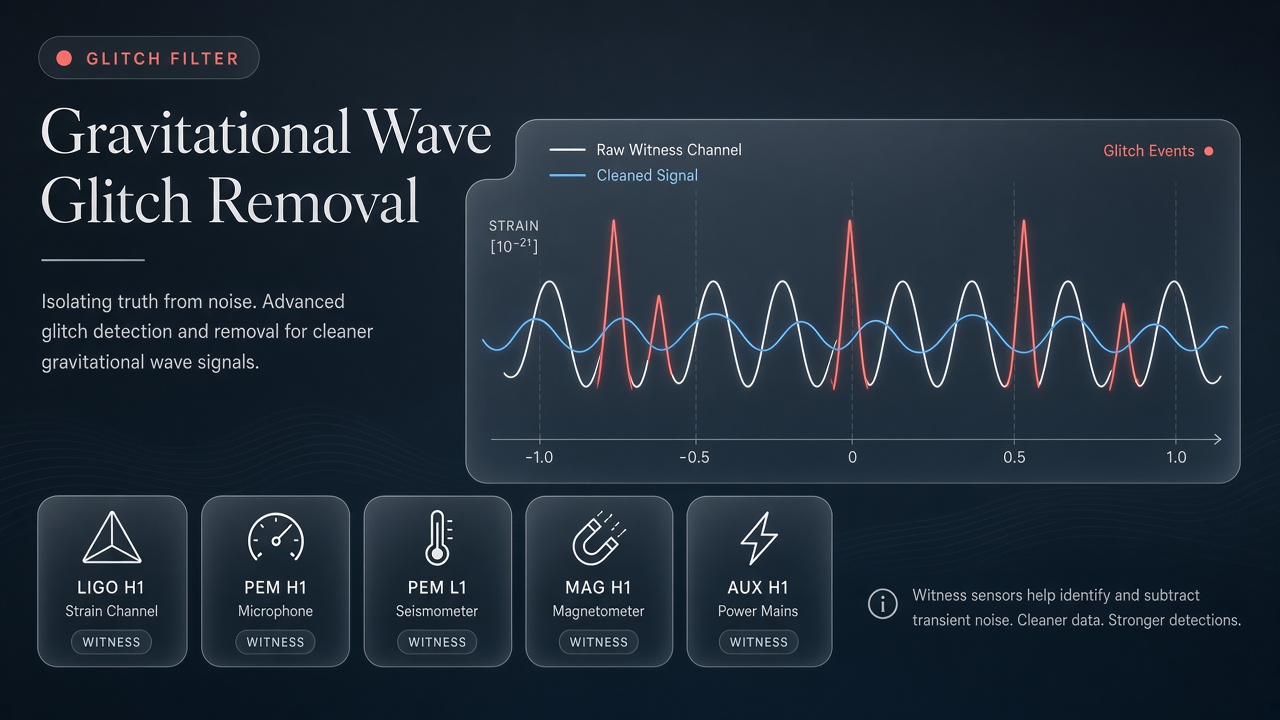
The primary h(t) strain channel records differential arm length; hundreds of auxiliary witness sensors monitor seismic motion, acoustic pickup, laser power fluctuations, and control loop errors correlated with glitches. Machine learning models learn transfer functions from witnesses to strain contamination. When a glitch appears simultaneously on correlated sensors, subtracting the predicted component from h(t) reduces non-astrophysical energy. Witness topology differs between Hanford and Livingston, so models train per observatory with transfer learning where appropriate.
| Method | Approach | Reported performance |
|---|---|---|
| Gravity Spy | Citizen science plus CNN glitch classes | Thousands of labeled morphologies |
| DeepClean | CNN maps witnesses to strain subtraction | ~1 to 2 s latency for online use |
| DeepExtractor | U-Net separates signal vs glitch | ~0.9% mismatch vs BayesWave ~1 hr |
| Coherence line mitigation | Spectral lines in H1/L1 | ~89% / ~77% line reduction cited |
Gravity Spy Glitch Classification
Gravity Spy crowdsourced labels from volunteers and experts to train convolutional networks on time-frequency spectrogram tiles, naming glitch families such as blips, koi fish, and whistle morphologies. Classification supports veto decisions and guides instrumental fixes at the source (optical table damping, scatter baffling). When a new glitch type emerges after hardware changes, active learning loops add examples to retrain models. Open data releases let external groups benchmark classifiers on identical tiles, improving reproducibility across LIGO-Virgo-KAGRA observing runs.
Glitch classes correlate with environmental variables: wind speed, ocean microseism, local construction. Regression models predict glitch rate for scheduling sensitive searches during quiet periods. AI does not replace mechanical upgrades; it prioritizes engineering effort on dominant families subtractable from strain.
DeepClean Witness Subtraction
DeepClean trains convolutional neural networks to predict strain contamination from aligned witness sensor stacks, subtracting the estimate in near real time with roughly 1 to 2 second latency suitable for low-latency alert pipelines. Latency matters: offline BayesWave cleaning can take an hour per event, adequate for publication-grade waveforms but slow for prompt electromagnetic follow-up. DeepClean targets operational windows where subtracting stationary glitch templates before matched filtering reduces false alarm rate without biasing merger recovery when no glitch is present.
Validation injects simulated signals into cleaned data to measure recovery efficiency and phase error. Over-subtraction that eats astrophysical content is unacceptable; teams monitor overlap with injected waveforms across mass and spin parameters representative of expected populations.
DeepExtractor and BayesWave Comparison
DeepExtractor uses U-Net architectures to denoise strain segments, reporting about 0.9 percent mismatch against reference waveforms compared to BayesWave Markov chain Monte Carlo cleaning that achieves similar quality in roughly an hour. Speed enables batch reprocessing of entire observing runs when glitch models improve retroactively. BayesWave remains a gold standard for uncertainty quantification on individual events; DeepExtractor trades explicit posterior sampling for throughput. Hybrid workflows run DeepExtractor first, BayesWave on marginal candidates.
GW150914's discovery path relied on careful exclusion of instrumental lines and glitches; modern runs face higher event rates from increased sensitivity, making automated cleaning essential. Parameter estimation pipelines consume cleaned strain; systematic errors from mis-subtracted glitches propagate to Hubble constant tensions and population astrophysics studies.
Spectral Lines and Coherence Mitigation
Narrow spectral lines from calibration artifacts and environmental resonances concentrate power that confuses searches; coherence-based methods identify lines present in strain and witnesses, subtracting coherent components. Published commissioning-era results cite roughly 89 percent reduction of identified lines in LIGO Hanford and 77 percent in Livingston, improving stationarity for stochastic background searches. Lines drift with temperature; trackers update frequencies over weeks. ML augments traditional notch filters by learning line sidebands and harmonics.
Virgo and KAGRA join international networks; glitch morphology differs by site geometry. Transfer learning from LIGO-trained models accelerates Virgo commissioning. Open Science Center releases include cleaning provenance metadata so downstream cosmology groups audit processing versions.
Matched-filter searches correlate strain data with template waveforms from binary merger simulations. Glitches that accidentally resemble templates generate triggers requiring human or automated vetoes. Gravity Spy labels teach networks what blips, whistles, and scattered-light artifacts look like in time-frequency space. Veto databases exclude contaminated intervals from statistical significance sums, protecting statements about detection rates and merger rates as sensitivity improves each observing run.
Witness sensors surround each interferometer: seismometers, microphones, magnetometers, and channels monitoring laser power and alignment control signals. DeepClean CNNs learn mappings from witness stacks to strain contamination, subtracting predictions with roughly one to two second latency suitable for low-latency alert streams. Offline BayesWave MCMC cleaning achieves similar waveform fidelity in about an hour per event, excellent for publications but slow for electromagnetic follow-up partnerships expecting prompts within minutes of a trigger.
DeepExtractor U-Net denoising reports about 0.9 percent mismatch against reference waveforms, enabling batch reprocessing when glitch models improve retroactively across entire observing runs. GW150914's 2015 announcement required excluding instrumental explanations with extraordinary care; today's higher event rates make manual scrutiny per trigger impossible without ML-assisted triage. Parameter estimation consumes cleaned strain; systematic mis-subtraction would bias inferred masses, spins, and distance measures feeding cosmology debates.
Spectral lines from calibration tones and environmental resonances concentrate narrowband power confusing stochastic background searches. Coherence-based mitigation identifying lines present in both strain and witnesses achieved reported reductions near 89 percent in Hanford and 77 percent in Livingston during commissioning-era studies. Lines drift with temperature; trackers must update over weeks. ML augments classical notch filters by learning harmonics and sidebands that pure frequency lists miss.
International networks add Virgo and KAGRA sites with distinct glitch populations and witness layouts. Transfer learning from LIGO-trained models accelerates commissioning at new detectors. Open data releases include cleaning version metadata so downstream analyses remain reproducible. AI LIGO glitch removal is therefore a community infrastructure problem: classifiers must generalize across hardware upgrades without hiding astrophysical signals behind aggressive subtraction tuned only to reduce analyst workload.
Frequently Asked Questions
Could a glitch fake GW150914?
Extensive vetting at the time ruled out instrumental origin with high confidence, including coincidence between Hanford and Livingston and waveform consistency with binary black hole templates. Modern pipelines apply stricter automated cleaning learned from years of glitch taxonomy.
What is a witness sensor?
An auxiliary channel measuring environmental or instrumental degrees of freedom correlated with strain noise but not carrying astrophysical signals. DeepClean learns mappings from witnesses to subtract glitches.
Is DeepClean used online?
Research prototypes target 1 to 2 second latency for low-latency streams; production integration depends on observing run validation. Offline reprocessing is common for catalogs.
How does Gravity Spy help?
It labels glitch morphologies for veto databases and engineering diagnosis. Classifiers speed human review of millions of transients flagged in data quality studies.
Does cleaning remove real signals?
Poorly tuned subtraction can. Pipelines test on injected simulations to bound signal loss. Conservative modes preserve sensitivity at the cost of leaving some glitches.
Why compare to BayesWave?
BayesWave provides slow, interpretable MCMC glitch removal with uncertainty. DeepExtractor approximates quality in seconds to minutes, enabling scale across many triggers.
AI gravitational wave glitch removal sits between instrumentation and astrophysics. Gravity Spy links human pattern recognition to scalable labels. DeepClean exploits witness redundancy for fast subtraction. DeepExtractor accelerates waveform fidelity checks that once blocked same-day multi-messenger campaigns. Coherence mitigation tames stationary lines that stochastic searches cannot ignore. Together they protect discoveries like GW150914 from being drowned in instrumental noise as event rates climb in fourth observing runs.
Teams publishing in AI research venues increasingly release open weights and injection challenge datasets so classifiers do not overfit one observing run's glitch population. Detection significance quoted in papers assumes documented cleaning versions; readers comparing GW catalogs should check processing notes as carefully as astrophysical parameters.
Low-latency public alerts partner with electromagnetic observatories hunting optical counterparts to neutron star mergers. Cleaning latency directly affects whether telescopes point before optical emission fades. DeepClean's sub-two-second target exists in that operational context, not only for offline papers. When cleaning fails, partners may slew to false coordinates, wasting scarce dark-time hours on major facilities.
Stochastic background searches integrate months of strain data searching for persistent superposition of unresolved mergers. Non-stationary glitches and unmitigated spectral lines inject excess power that mimics cosmological signals. Coherence mitigation and Gravity Spy vetoes therefore protect not only individual event claims but also constraints on early-universe physics derived from population-level analyses across observing runs.
Injection campaigns hide simulated mergers into real noise with known parameters so cleaning pipelines report recovery efficiency and bias on mass and distance estimates. A subtraction scheme that removes 99 percent of glitches but attenuates five percent of astrophysical signals would distort merger rate calculations. LIGO-Virgo-KAGRA collaborations publish these recovery metrics alongside each observing run's data release notes.
Citizen scientists who classified Gravity Spy tiles contributed labels that became training data for production veto tools, demonstrating participatory quality control at scale. Similar human-in-the-loop review remains necessary when autoencoders flag rare morphologies absent from historical catalogs, especially after cryogenic or vacuum system maintenance changes detector noise profiles overnight.
Third-generation detectors planned for the 2030s will lower strain noise floors further, increasing trigger rates and tightening latency requirements on cleaning pipelines. Methods validated on current observing runs must scale to higher data volumes without introducing phase errors that would bias tests of general relativity in strong-field merger signals. Transfer learning from years of Gravity Spy labels provides a head start, but each hardware upgrade demands fresh witness-to-strain calibration campaigns.