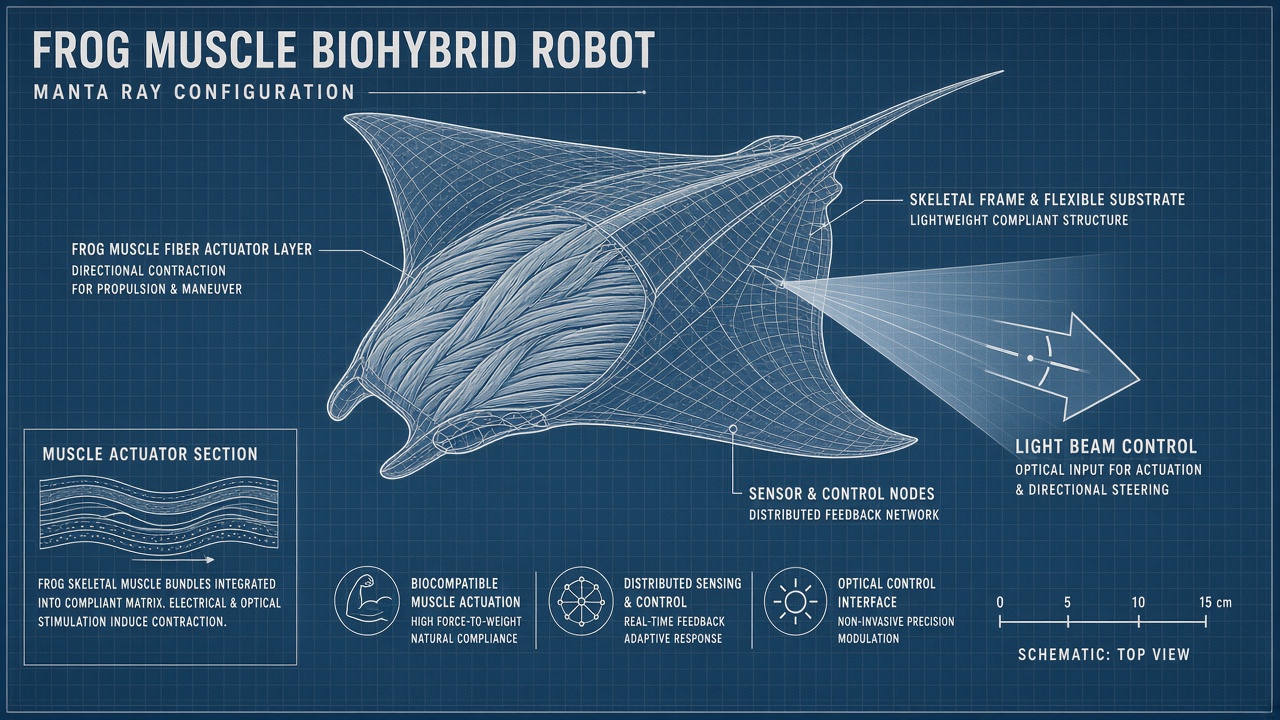
In August 2026, researchers at the Shenyang Institute of Automation (SIA), Chinese Academy of Sciences, published a swimming robot shaped like a manta ray. The fins did not move because of electric motors. They moved because of isolated skeletal muscle taken from a bullfrog leg. Near-infrared light shone on photovoltaic panels mounted on the robot's back, generating tiny electrical pulses that stimulated the muscle nerves and triggered contractions. The result is one of the fastest relative speeds ever reported for a muscle-driven biohybrid swimmer, and a vivid example of how AI video and robotics audiences encounter living-tissue engineering at the intersection of biology and AI research hardware narratives.
What Scientists Built
The biosyncretic manta ray robot couples native bullfrog (Rana catesbeiana) gracilis muscle to a soft polymer body, with bilateral actuators steered by wireless light-to-nerve stimulation. Biosyncretic here means merging living tissue with synthetic structure into a single functional system. The robot measures roughly five centimeters in length, carries about five grams of payload, and swims with fin strokes modeled on manta ray locomotion. The work appeared in Advanced Functional Materials on August 13, 2026.
Prior biohybrid swimmers often relied on lab-engineered muscle sheets that contract weakly or require physical tethers for electrical stimulation. The SIA team chose intact isolated muscle with highly ordered fiber architecture, arguing that native tissue outperforms many reconstructed equivalents on force density and responsiveness.
Muscle Performance Stats
Under optimized electrical stimulation (1 Hz, 5 V, 10 ms pulses), the isolated gracilis muscle produced a stable contractile force of 6.5 newtons, peaking at 9.4 newtons under extreme conditions. In straight swimming, the robot averaged 0.54 body lengths per second (about 2.7 cm/s), with instantaneous peaks near 2 body lengths per second. The authors report the highest relative average forward speed for a skeletal muscle-driven biohybrid robot to date. Turning radius stayed within 0.8 body lengths, unusually tight maneuverability for muscle-powered platforms.
| Metric | Reported value | Context |
|---|---|---|
| Stable contractile force | 6.5 N | 1 Hz, 5 V, 10 ms stimulation |
| Peak force | 9.4 N | Extreme stimulation parameters |
| Average swim speed | 0.54 BL/s | Straight-line locomotion |
| Peak swim speed | ~2 BL/s | Instantaneous maximum |
| Turning radius | < 0.8 BL | Left/right steering |
| Payload capacity | ~5 g | While swimming |
Light Control System: How It Works
Control uses 808-nm near-infrared laser light, gallium arsenide (GaAs) solar cells on the robot dorsum, and platinum electrodes that deliver nerve-stimulating pulses to each muscle. This is not optogenetics: the muscle tissue is not genetically modified to respond to light directly. Light hits the photovoltaic modules, which convert photons to electricity. A small circuit boosts voltage, then electrodes stimulate the nerve on the muscle surface, triggering contraction.
Bilateral control enables straight swimming, left and right turns, circular cruising, and U-turns. An operator illuminates the left or right photovoltaic panel selectively, biasing contraction timing between the two fin actuators. The robot has no wire tether, but it still depends on an external laser source for energy and command signaling during experiments.
Why Near-Infrared?
Water absorbs visible light strongly. Near-infrared penetrates aquatic environments more effectively, allowing offboard laser control while the robot swims. GaAs cells were chosen for conversion efficiency at 808 nm. Future versions may integrate onboard energy storage to reduce dependence on external illumination.
Lifespan Limits and Maintenance
Isolated muscle maintained electro-contractile responsiveness for up to eleven days in culture tests and reliably powered the robot for about seven days of continuous operation. Those timelines define the practical mission window today. Unlike metal motors, biological actuators fatigue, necrose, and require nutrient media or vascularization strategies for longer missions.
- Day 1 to 7: Reliable swimming performance in reported experiments.
- Day 8 to 11: Muscle remains electrically responsive in vitro, with declining robot reliability.
- Beyond ~11 days: Tissue viability drops without advanced perfusion or tissue engineering.
Corresponding author Dr. Chuang Zhang noted future work targeting longer tissue survival, softer electrodes for gentler stimulation, and onboard energy storage. For now, the frog-muscle robot is a proof of principle, not a deployable underwater vehicle.
Payload and Environment Constraints
The five-gram payload capacity reported in Advanced Functional Materials implies room for sensors or sampling tools on future biosyncretic swimmers, but only within the muscle fatigue window. Saltwater versus freshwater chemistry, temperature, and microbial contamination affect tissue longevity independently of control electronics. Any deployment narrative must separate laboratory tank demos from open-ocean missions, which would require vascularized muscle or hybrid motor backup beyond current capabilities.
Comparison With Motor-Driven Soft Robots
Electric motor soft robots achieve longer mission life and simpler control interfaces but lack the compliance and force density native muscle offers at millimeter scales. The frog-muscle manta ray trades weeks of operation for biomechanical fidelity and a stimulation method researchers hope to translate toward nerve repair models. Motor fins would swim longer yet teach less about integrating living actuators into untethered platforms.
For audiences comparing biohybrid headlines to conventional AI video robotics demos, the distinguishing metric is not peak speed alone but speed per gram of biological actuator under wireless command. The SIA team reports record relative velocity for skeletal muscle drivers specifically, a niche leaderboard that matters to tissue engineers more than to warehouse automation vendors.
Media Coverage vs Mechanism
Popular summaries sometimes describe the robot as "optogenetic" because light controls motion. The accurate mechanism is photoelectric: GaAs cells convert 808-nm laser light into nerve-stimulating current. Clarifying that distinction helps educators and journalists avoid misleading comparisons to optogenetics experiments that require genetically modified channelrhodopsin expression in neurons.
Supplementary videos and institutional press releases from CAS emphasize medical nerve stimulation spin-offs alongside swimming metrics, framing the robot as a biomechanics testbed rather than a product prototype for consumers or defense contractors evaluating autonomous underwater vehicles.
Recorded peak speeds near two body lengths per second occur under burst conditions; sustained cruising averages 0.54 body lengths per second. Reporting both numbers avoids overstating endurance when translating research metrics into headline claims about "fastest muscle robots."
Ethics of Biological Actuators
Using animal-derived muscle in robots raises animal welfare, consent, and categorization questions distinct from conventional electromechanical engineering. The muscle comes from bullfrogs, animals already used in food and laboratory contexts, but integrating living tissue into machines blurs lines between biological experiment and robotic product. Institutions should apply animal research ethics review even when projects are framed as robotics rather than pure biology.
Public communication matters. Headlines about "frog-powered robots" can sensationalize legitimate biomechanics research or trigger backlash that misrepresents scientific goals. Researchers emphasize validating native muscle as a high-performance actuator and developing wireless stimulation methods applicable to medical nerve repair models, not building consumer cyborg products.
Sourcing and Disposal Practices
Teams should publish tissue sourcing protocols alongside performance metrics so reviewers can assess animal welfare compliance. Muscle isolation from bullfrogs implies euthanasia and dissection procedures governed by institutional animal care committees. At end of experiments, biological waste requires biohazard disposal distinct from electronic scrap recycling. Transparency on these steps separates serious biohybrid labs from stunt engineering demos.
Longer term, engineered human muscle constructs would raise additional consent and dignity considerations. Documentation should scale with tissue complexity before any group transitions from amphibian muscle to mammalian or human-derived actuators for public-facing robots.
Frequently Asked Questions
Is the frog-muscle robot optogenetic?
No. Optogenetics modifies cells to respond to light directly. This robot uses near-infrared light on GaAs solar cells to generate electrical nerve stimulation. The bullfrog muscle is unmodified native tissue.
How fast does it swim?
The robot averaged 0.54 body lengths per second in straight swimming, with peaks near 2 body lengths per second. At roughly 5 cm body length, average speed is about 2.7 cm/s. Authors describe this as the highest relative average speed reported for skeletal muscle-driven biohybrid robots.
How long does the muscle last?
Muscle stayed responsive up to eleven days in culture and reliably actuated the robot for about seven days. Mission duration is limited by tissue viability, not battery cycles.
Does it need a wire?
There is no electrical wire tether. Control and partial energy delivery come from an external near-infrared laser aimed at onboard photovoltaics. Fully autonomous operation would require embedded power and control systems not yet demonstrated.
Why use frog muscle instead of motors?
Native skeletal muscle offers high force density, soft compliance, and biological adaptability researchers want to study for next-generation soft robots and nerve stimulation therapies. The project validates muscle as an actuator platform, not a replacement for conventional motors in industrial robotics.
Where was the research published?
The work appeared in Advanced Functional Materials on August 13, 2026, from the Shenyang Institute of Automation, Chinese Academy of Sciences. Corresponding author Dr. Chuang Zhang led the wireless photoelectric stimulation architecture paired with bullfrog gracilis muscle actuators.
What is biosyncretic robotics?
Biosyncretic robotics merges living tissue with synthetic bodies into one functional system, as opposed to robots that only mimic biology with conventional actuators. The term signals intentional integration of muscle viability, nutrient requirements, and stimulation interfaces into mechanical design from the start rather than bolting tissue onto a finished chassis as an afterthought.