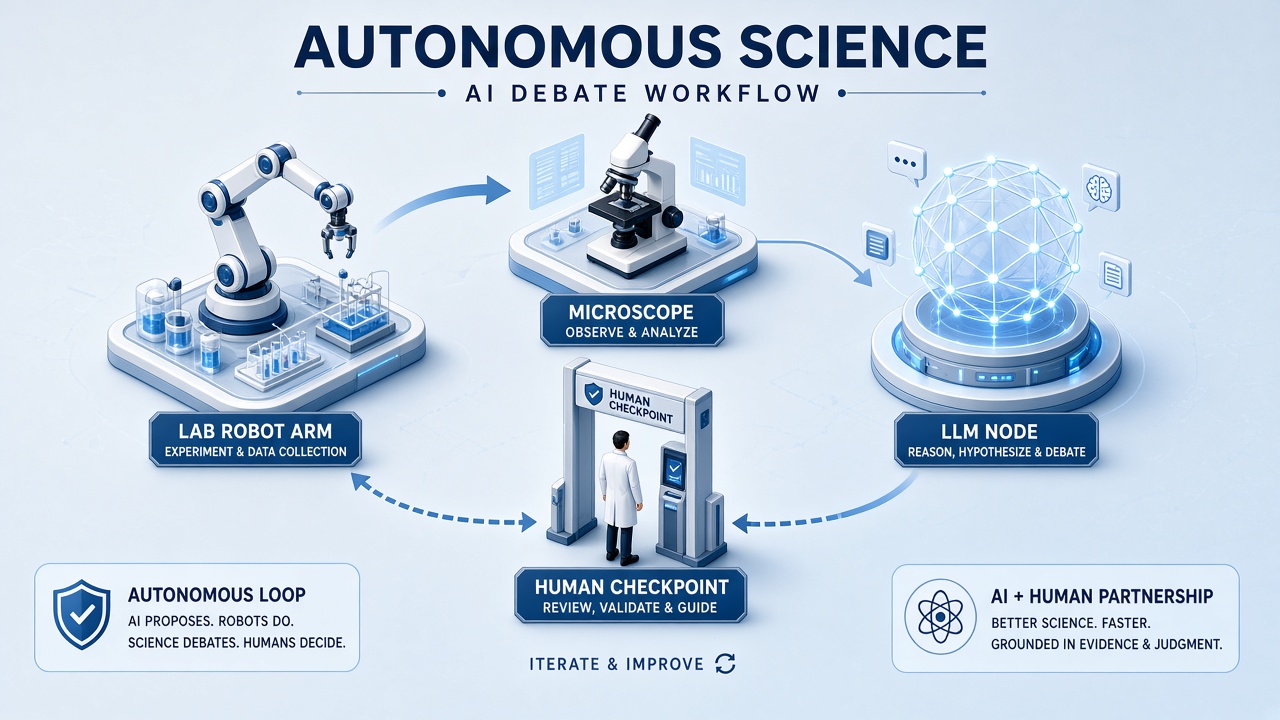
Headlines in 2026 ask whether AI can run the scientific method end to end. MatBrain screened 30,000 crystal structures in 48 hours. Robin, a multi-agent biology system from FutureHouse, proposed ripasudil for dry age-related macular degeneration and analyzed follow-up RNA sequencing. AutoDiscovery at the Allen Institute surfaced immune patterns in breast cancer subtypes that challenged a long-standing label. Math agent swarms report novel lemmas in combinatorics. Each case automates a slice of discovery, yet peer review, replication, and instrument calibration still sit with human institutions. This article maps levels of automation, where hypothesis generation helps, why validation remains the bottleneck, and what reproducibility demands from AI research and AI automation claims. The balanced headline for 2026: agents compress discovery cycles; humans still convert validated evidence into trusted knowledge.
Levels of Automation in Science
Autonomous science in 2026 spans five levels: literature synthesis, hypothesis proposal, experimental planning, data analysis, and closed-loop iteration with lab execution, but full autonomy without human gates remains rare outside narrow benchmarks. Most published systems operate at levels one through four while humans run wet labs, approve budgets, and sign manuscripts. Treating "AI did science" as a binary claim obscures which step was automated and which still required credentialed judgment.
| Level | Activity | 2026 examples | Human role |
|---|---|---|---|
| 1. Synthesis | Literature search and summarization | Crow, Falcon, Owl agents | Verify citations, spot omissions |
| 2. Hypothesis | Novel mechanism or candidate proposals | AutoDiscovery surprisal LLM, Robin | Prioritize testable claims |
| 3. Planning | Assay selection, simulation design | MatBrain Mat-T1 tool orchestration | Safety, ethics, resource approval |
| 4. Analysis | Interpret omics, structures, stats | Finch agent, Mat-R1 reasoning | Challenge confounders, p-hacking |
| 5. Closed loop | Iterate hypotheses from new data | Robin therapeutics cycle | Run experiments, interpret failure |
Hypothesis Generation: What Changed
Hypothesis generation improved because agents combine literature models with domain tools instead of free-form guessing, but generated hypotheses still require explicit falsifiability tests. AutoDiscovery uses surprisal-based large language models to flag biomedical patterns that contradict dominant labels, such as immune signatures in invasive lobular carcinoma previously treated as immune-cold. The framework searches for statistical surprise relative to background expectations, then surfaces candidate mechanisms for human follow-up. MatBrain proposes crystal candidates by calling Mat-MCP tools for structure retrieval and property prediction, with Mat-R1 evaluating plausibility. Robin integrates Crow and Falcon for literature and Finch for omics analysis, then proposes drug candidates like ripasudil, a clinically used Rho kinase inhibitor not previously linked to dry age-related macular degeneration in the literature Robin searched.
Math-focused agent swarms represent a parallel track. Multiple LLM instances explore lemma candidates, critique each other, and refine proofs under human-defined rules. Progress is real in bounded formal domains with checkable answers. Transfer to messy empirical science is slower because ground truth is noisy and experiments are expensive. Hypothesis generators excel at combinatorial search over known building blocks; they struggle when the missing variable is an unmeasured confounder or a flawed assay.
The Validation Bottleneck
Validation remains the bottleneck because AI can propose thousands of candidates but only physical experiments, independent replication, and statistical power determine which proposals become knowledge. MatBrain identified 38 promising materials from 30,000 structures; lab synthesis and catalytic testing still decide utility. Robin's ripasudil finding moved through in vitro assays and RNA sequencing proposed by the agent, but humans executed plates, managed cell lines, and interpreted batch effects. AutoDiscovery hypotheses demand cohort validation on held-out clinical datasets before changing treatment labels.
Teams adopting AI automation for R&D should budget validation throughput, not just GPU hours for generation. A common failure mode is generating more hypotheses than the lab can test, then cherry-picking positive outcomes. Pre-register which metrics will falsify an AI-proposed mechanism. Reserve synthesis slots for negative controls suggested by the agent, not only top-ranked winners. Validation discipline separates discovery assistance from autonomous science claims.
Reproducibility Crisis and Agents
AI agents can worsen reproducibility when workflows hide stochastic prompts, undocumented tool versions, or selective reporting of agent trajectories, unless teams publish configs, seeds, and full action logs. The reproducibility crisis in science predates LLMs: underpowered studies, flexible analysis, and publication bias. Agents add opaque reasoning chains and vendor model updates that shift outputs week to week. Robin's open-source release with example trajectories is the exception pattern others should copy. Log which model weights, retrieval corpora, and tool endpoints each run used.
Independent replication should include re-running agent pipelines on frozen snapshots, not only repeating wet-lab steps. If MatBrain ranks structures differently after a Mat-T1 checkpoint update, the scientific claim attaches to a moving target. Pin versions, containerize toolchains, and separate exploratory agent runs from confirmatory pipelines reviewed under stricter locks. Journals will increasingly ask whether the "author" was an agent stack and which human verified each intellectual step.
Peer Review and Institutional Gates
Peer review still adjudicates whether AI-assisted claims meet evidentiary standards, and institutions retain responsibility for authorship, ethics, and conflict disclosure when agents contribute hypotheses or analyses. Nature's Robin paper underwent conventional review despite automated hypothesis generation. MatBrain appeared in Nature Machine Intelligence with human authors accountable for claims. Reviewers now ask whether training data overlapped evaluation sets, whether agents accessed embargoed literature, and whether statistical tests were suggested after peeking at results. Funding agencies add questions about autonomous experimentation safety.
Peer review is slow relative to agent speed, creating a temporal gap where preprints and social media amplify preliminary agent outputs. Readers should distinguish "agent proposed X" from "X is true." Institutional gates also include biosafety boards, IRB oversight for human data, and export controls on dual-use chemistry agents like Phoenix-style synthesis planners. Full autonomy without these gates is not credible in regulated domains regardless of benchmark scores.
Case Studies: MatBrain, Robin, and AutoDiscovery
MatBrain demonstrates lightweight dual-model collaboration: Mat-R1 (30B) for materials reasoning and Mat-T1 (14B) for tool execution via Mat-MCP, trained with reinforcement learning for multi-step workflows. Published catalyst design runs generated 30,000 candidates in 48 hours with reported large reductions in human-active screening time. The system does not replace DFT validation or bench testing; it compresses search.
Robin orchestrates specialized agents in a therapeutics loop: literature agents propose mechanisms and drugs, humans run assays, Finch analyzes results, Robin proposes follow-up experiments such as RNA sequencing that revealed ABCA1 upregulation. The cycle completed in roughly 2.5 months with a small human team, a timeline FutureHouse argues would traditionally take far longer. Biology remained in the loop at every experimental step.
AutoDiscovery applies surprisal LLMs to challenge domain assumptions, exemplified by immune signal detection in invasive lobular breast carcinoma. The scientific value is reframing hypotheses humans might not prioritize because labels ossify. AutoDiscovery does not autonomously treat patients; it redirects research attention toward testable subtypes.
Agent Swarms and Integrity Parallel
Multi-agent science stacks raise integrity questions parallel to single-model bias: agents can reinforce each other's errors if critique steps are shallow or reward flashy novelty. Swarms that vote on lemmas or drug targets need adversarial roles with access to negative evidence, not only cooperative refinement. FutureHouse open-sourced Robin trajectories partly to allow external inspection of where agents ignored contradictory papers. MatBrain's dual-model split between Mat-R1 analysis and Mat-T1 execution encodes a similar check: planning entropy and reasoning entropy differ, reducing conflation of tool calls with domain conclusions.
Research funders should require agent logs akin to lab notebooks. Without them, reproducibility audits cannot reconstruct why ripasudil rose above other kinase inhibitors. The validation bottleneck is partly intellectual: humans must design critiques agents cannot shortcut. That is why autonomous science in 2026 remains lab-in-the-loop despite impressive headline cycles measured in weeks instead of years.
Funding and Incentive Alignment
Grant incentives still reward novel positive findings over replication of agent-generated negatives, which skews autonomy narratives toward success stories. Funders can require open trajectories, preregistered validation plans, and reporting of how many agent proposals failed in the lab. Journals can ask authors to separate human intellectual contributions from agent steps using CRediT-style taxonomy extensions. Without incentive reform, autonomous science press releases will outpace the boring replication work that confirms or refutes them. Teams piloting Robin-class workflows should pair every demo with a written validation plan before executive sponsors extrapolate to full laboratory autonomy.
Frequently Asked Questions
Can AI do science without humans?
Not credibly in 2026 for high-stakes empirical claims. Agents automate search, proposal, and analysis, but humans still run instruments, approve ethics, and sign papers. Formal math subfields show tighter loops with machine-checkable proofs, yet human mathematicians still validate significance.
What is the strongest autonomy evidence?
Robin's end-to-end therapeutics loop with experimental validation and MatBrain's large-scale materials screening with tool orchestration are among the strongest published examples. Both keep humans executing lab work and accountable for conclusions.
Do agent swarms replace peer review?
No. Swarms accelerate idea generation and internal critique, but external peer review tests generalizability, conflicts of interest, and methodological rigor agents cannot self-enforce. Swarm consensus is not a substitute for independent replication.
Where do math agents fit?
Math agents operate where verification is cheap relative to search: formal proof assistants and combinatorial lemmas. Empirical sciences face costlier verification, so math autonomy claims do not transfer directly to biology or materials without qualification.
How should labs start?
Automate literature synthesis and analysis first. Add hypothesis generation with logged trajectories. Keep experimental execution human-gated until validation throughput matches generation volume. Pin model and tool versions for any result intended for publication.
Is AutoDiscovery autonomous science?
AutoDiscovery autonomously surfaces surprising patterns in curated datasets. Human scientists design follow-up studies, validate cohorts, and interpret clinical implications. It automates hypothesis prompting, not clinical decision-making.
Policy makers asking "can AI do science?" should specify domain and automation level. Materials screening, oncology hypothesis loops, and combinatorial math each expose different failure modes. A balanced 2026 answer: AI automates search and proposal at scale; humans still own instruments, ethics, and the peer-reviewed sentence that converts a candidate into a fact. Treat agent demos as accelerators for expert judgment, not replacements for it.
Will 2027 look different?
What about AutoDiscovery vs Robin?
AutoDiscovery emphasizes surprisal-driven pattern discovery in existing biomedical datasets, challenging labels like immune-cold carcinoma subtypes. Robin emphasizes closed-loop therapeutics with new experimental data feeding the next agent iteration. Both automate intellectual steps but target different validation paths: cohort reanalysis versus fresh assays. Neither removes human accountability for claims that reach patients or policy.
Procurement teams comparing AI automation vendors should ask which automation level each product actually delivers, request trajectory logs from pilot runs, and budget validation capacity before scaling hypothesis generation. Autonomous science headlines sell faster than replication infrastructure, but replication infrastructure determines what counts as knowledge in medicine, materials, and every field where mistakes carry physical cost. Readers evaluating vendor demos should ask what failed in the last pilot, not only which candidate succeeded on slide three.