Most AI rollouts fail in the first week, not the first quarter. Accounts get created before anyone agrees on which workflow is in scope, which data may enter the vendor system, or who owns the decision memo. By Friday, half the team has tried the tool on random tasks while skeptics conclude the project is another executive fad.
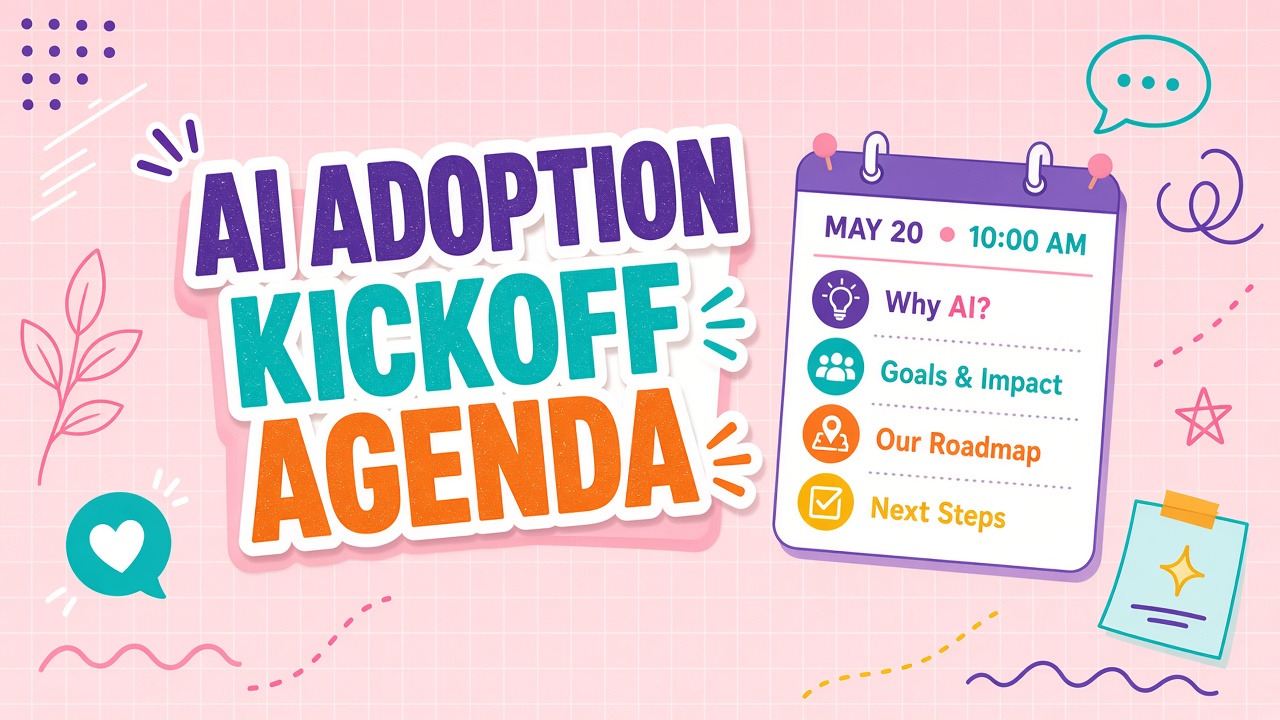
An AI tool adoption kickoff fixes that in one hour. You align sponsors, practitioners, IT, and security on a single workflow, capture decisions in a log, and assign week-one artifacts before passwords are issued. This guide provides a pre-read checklist, a minute-by-minute agenda with owners, and follow-up deliverables. Review candidates in AI productivity tools and AI chatbot tools after the kickoff decisions, not during slide one.
Pre-Read: Workflow Map and Risk Tier
Send pre-read materials forty-eight hours before the meeting. Attendees should arrive with the same picture of current-state work, not discover scope live. The pre-read is short: one workflow map, one risk tier label, and three baseline numbers if available.
Pre-read pack contents
- Workflow statement: Verb-first name, trigger, output destination, weekly volume.
- Current-state map: Steps today, tools already involved, pain points, median time if known.
- Risk tier: Low (internal drafts), medium (customer-visible with review), high (regulated or PII-heavy).
- Data boundary draft: Allowed inputs, redaction rules, prohibited sources.
- Candidate tools: Two to three finalists max, or a shortlist link for post-kickoff eval.
| Risk tier | Kickoff must decide | Required attendee |
|---|---|---|
| Low | Sandbox data rules, pilot owner, success metrics | Workflow owner, 2 practitioners |
| Medium | Review checkpoints, customer-facing guardrails | Plus manager approver |
| High | Legal or security sign-off path, exception logging | Plus security or compliance delegate |
One-Hour Agenda Minute by Minute
Run the kickoff in sixty minutes with a hard stop. Assign a facilitator who is not the vendor and a note-taker who publishes the decision log within two hours. Remote teams share screens on the workflow map, not the tool demo.
| Time | Topic | Owner | Outcome |
|---|---|---|---|
| 0-5 min | Purpose and non-goals | Executive sponsor | One workflow in scope; no org-wide mandate today |
| 5-15 min | Walk current-state map | Workflow owner | Agreement on pain point and baseline |
| 15-25 min | Data rules and risk tier | Security or IT delegate | Allowed inputs documented |
| 25-35 min | Success metrics and pilot length | Workflow owner | Two to four metrics with thresholds |
| 35-45 min | Roles: pilot participants, admin, champion | Facilitator | Named people, not teams |
| 45-55 min | Skeptic concerns and integration needs | Practitioners | Top three blockers with owners |
| 55-60 min | Week-one artifacts and next meeting | Facilitator | Dated action list published today |
Defer product demos to a separate session unless the kickoff must choose between two finalists on integration grounds. Chat-heavy workflows may reference AI chatbot patterns in the metrics section, but the kickoff decides the job, not the logo.
Decisions Captured: Tools, Data Rules, Metrics
Every kickoff ends with a decision log. Copy this format into your wiki or ticket system. Ambiguity here becomes shelfware within two weeks.
Decision log template
- Workflow in scope: Single sentence, linked map.
- Pilot window: Start date, end date, decision meeting date.
- Tool selection status: Selected vendor, or eval complete by date X.
- Data rules: Allowed, prohibited, redaction, retention.
- Success metrics: Metric, baseline, adopt threshold, reject threshold.
- Participants: Names and weekly time commitment.
- Admin and billing owner: Single name for SSO and renewal.
- Escalation path: Quality failure, security question, executive override.
| Decision | Good example | Avoid |
|---|---|---|
| Metrics | Median total work time drops 20% with critical failure below 2% | "Increase AI usage" |
| Data rules | Public help articles only; no ticket attachments | "Use good judgment" |
| Scope | Weekly newsletter draft from product bullets | "All content tasks" |
Follow-Up Artifacts Due in Week One
Week one produces evidence, not enthusiasm. Assign due dates on the kickoff call. Missing artifacts delay account creation, which is a feature when data rules are still vague.
Week-one checklist
- Day 1: Decision log published; calendar invites for pilot syncs.
- Day 2: Admin provisions enterprise workspace; SSO if required.
- Day 3: Baseline captured on three recent jobs (time, rework notes).
- Day 4: Prompt or template v1 in shared library; QA checklist attached.
- Day 5: First real task logged; mid-pilot sync scheduled for day 7.
Teams exploring broader stacks should still finish week-one artifacts for one workflow before browsing AI productivity categories for adjacent jobs. Expansion without a closed pilot memo repeats kickoff failures at scale.
Kickoff Invite and Attendee Template
Copy this invite block into your calendar event description. Replace bracketed fields before sending. A clear invite reduces no-shows and prevents vendors from joining uninvited.
- Title: AI adoption kickoff: [workflow name] pilot
- Duration: 60 minutes, hard stop
- Pre-read due: [date], link to workflow map and risk tier
- Required: Workflow owner, [names], facilitator, note-taker
- Optional: Executive sponsor (first five minutes only unless high risk)
- Out of scope: Vendor demo, org-wide rollout decision, account creation
Sample decision log snippet
Publish something this concrete within two hours of adjournment:
| Field | Example value |
|---|---|
| Workflow | Draft tier-one replies from public ticket text |
| Pilot dates | Mar 3 to Mar 17; decision memo Mar 18 |
| Metric | Median total work time down 15%; CSAT within 0.3 points of baseline |
| Data allowed | Subject and last public reply only; no attachments |
| Owner | Jordan Lee (workflow), Sam Ortiz (admin) |
Handling Executives, Skeptics, and Remote Teams
Executives should sponsor and remove blockers, not choose prompt wording. Give them one metric and one decision date. Skeptics are valuable when invited early: ask them to name failure modes and assign them a checkpoint role. Remote teams need shared docs and async comment windows on the pre-read; do not rely on hallway alignment.
Facilitation tips
- Start on time even if executives are late; respect practitioner schedules.
- Park tool debates with "captured in eval owner action."
- End with read-back of names on each action.
- Record only if policy allows; publish written notes regardless.
Week-One Sync Agenda (Day 7)
Schedule a thirty-minute sync one week after kickoff. This is not a second kickoff. Review logs, not vibes.
- Baseline vs early tasks (10 min): Compare first five logged jobs to pre-pilot baseline.
- Blockers (10 min): Access, data policy, integration, quality; one owner per blocker.
- Mid-pilot adjustments (5 min): Prompt or checkpoint tweaks only; no scope expansion.
- Decision preview (5 min): On track, at risk, or early reject signal for sponsor.
Chat-centric pilots should log whether practitioners reached for AI chatbot tools voluntarily or only when reminded. Voluntary use by day seven predicts renewal better than login totals.
Post-Kickoff Communication Snippets
Send these messages on kickoff day so alignment survives the meeting notes. Customize tone for your culture; keep the decisions verbatim.
Sponsor broadcast (Slack or email)
"We kicked off a two-week pilot on [workflow]. Success means [metric threshold]. This is not org-wide rollout yet. Questions go to [champion or owner], not vendor support. Pre-read and decision log: [link]."
Participant instructions
- Log every real task in the shared pilot sheet from day one.
- Use only approved data types listed in the decision log.
- Flag critical failures immediately to the workflow owner, not only at sync.
- Do not expand scope to adjacent jobs without a new kickoff decision.
Frequently Asked Questions
Can we run a kickoff before choosing a tool?
Yes. The kickoff defines workflow, data rules, metrics, and roles. Tool selection can be a week-one artifact with a fixed eval deadline. Do not issue accounts until data rules and metrics are written.
Who must attend vs optional?
Required: workflow owner, at least two weekly performers, facilitator, note-taker. Required for medium or high risk: security or compliance delegate. Optional: executives after minute five unless risk tier is high. Vendors stay out of decision capture.
How is kickoff different from training?
Kickoff sets scope and decisions. Training teaches the documented procedure after decisions exist. Training without kickoff produces skilled users working on the wrong workflow.
We have five workflows. One kickoff or five?
One kickoff per pilot workflow. You may hold a single executive briefing on the program, but practitioners need focused scope. Parallel pilots need parallel owners and separate decision logs.
How do we run kickoff across time zones?
Async pre-read comments for twenty-four hours, then a forty-five minute live session at the overlap hour. Publish decision log with explicit "silent assent" deadline for async approvers. Never skip the written log.
Kickoff Failure Modes to Name Out Loud
Spend five minutes in the kickoff naming how similar rollouts failed locally. Honest failure stories reduce repeat mistakes more than vendor success slides.
- Scope creep on day three: Fix with written non-goals in the decision log.
- Metrics chosen after results: Fix with thresholds captured before account creation.
- Security surprise in week two: Fix with risk tier and delegate in the room.
- Executive demo tasks only: Fix with requirement to log real production inputs.
- No decision date: Fix with pilot end on the calendar before adjournment.
Send the decision log link again in the sponsor broadcast so late joiners cannot claim they never saw scope boundaries. Consistency between kickoff notes and day-one messages prevents scope arguments in week two.
The Bottom Line
Run a one-hour AI adoption kickoff with pre-read workflow map and risk tier, a minute-by-minute agenda, a decision log covering tools, data rules, and metrics, and week-one artifacts with named owners. Accounts come after decisions, not before. That discipline separates pilots that renew from AI chatbot experiments that fade by week three.