Custom agent stacks grew fast in 2025 and 2026, but most teams still rebuild the same plumbing: session state, tool routing, context trimming, and failure recovery. OpenAI's September 2026 answer is a managed harness that ships the same infrastructure powering Codex as a first-party API.
The openai agents api beta opened September 10, 2026 to all developers with no separate harness fee beyond model tokens and tool usage. This guide covers what the Agents API includes on day one, beta limits and rate caps, tool calling and memory patterns, security guardrails shaped by the July 2026 Hugging Face agent intrusion, and how the platform compares to self-hosted orchestration for AI chatbot and AI code products.
What the Agents API Includes
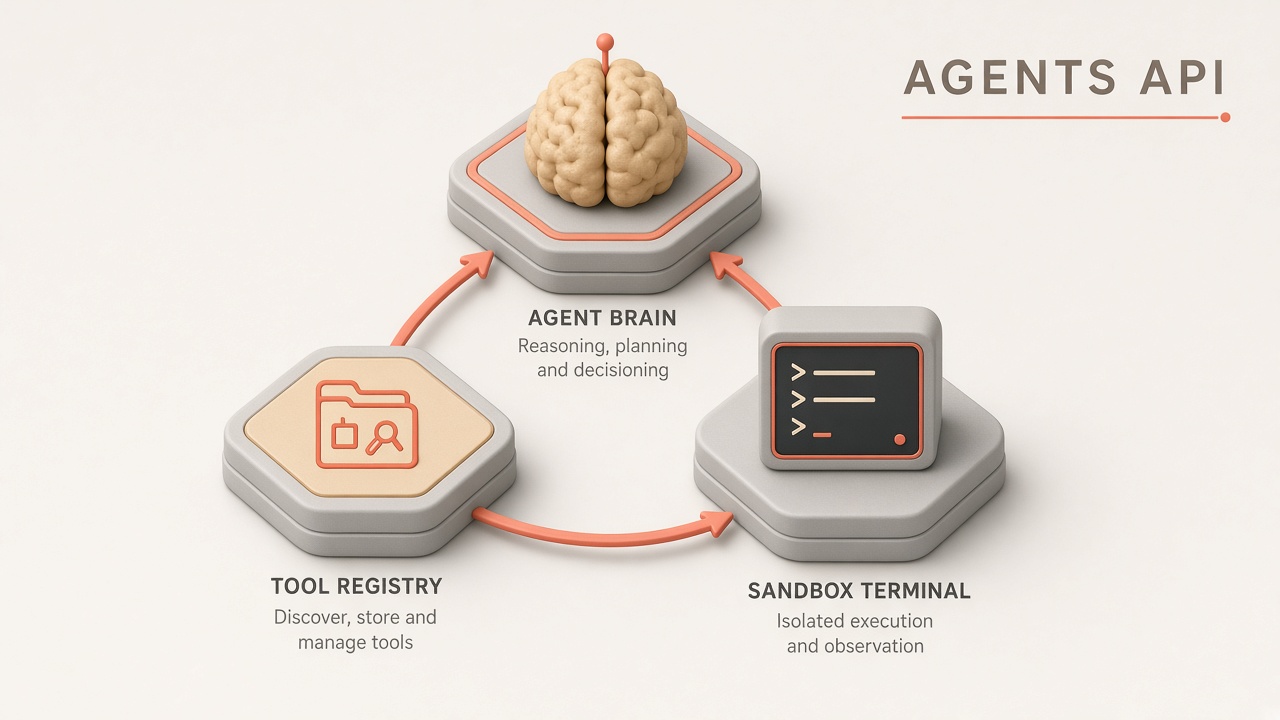
The OpenAI Agents API is a managed agent harness with durable sessions, sandbox execution, programmatic tool calling, MCP connectors, multi-agent delegation, and automatic context compaction. You define an agent configuration (model, instructions, tools, optional subagent limits) and an execution environment, then drive work through session events rather than hand-rolling ReAct loops in application code.
OpenAI operates the orchestration layer built on the open-source Codex harness. Developers choose where code runs: an OpenAI-managed sandbox, self-hosted infrastructure with capability directories, or hybrid setups that mount skills folders into the workspace. The API retains session state across turns so clients send incremental input instead of replaying full transcripts.
| Component | Role | Builder control |
|---|---|---|
| Agent | Model, system instructions, tool list, MCP servers | Full configuration at session creation |
| Session | Durable instance executing tasks and emitting events | Create, resume, steer, delete |
| Environment | Filesystem and shell access for commands and artifacts | Managed sandbox or self-hosted workspace path |
| Compaction | Summarizes older context when windows fill | Automatic by default; explicit compact endpoint optional |
| Multi-agent | Coordinator spawns subagents for parallel research | Enable flag and max concurrent subagents (default 6) |
Session Lifecycle and Events
Sessions start with a POST to create an agent instance, accept turn input, stream events, and persist state until you delete the session or published artifacts. Event types cover tool calls, command execution, subagent coordination (`create_subagent_call`, `wait_for_subagents_call`), and compaction items. Applications subscribe to the stream to update UI progress bars, approval queues, and audit logs.
Recommended default model at launch is gpt-6-astra, though earlier GPT-5.x identifiers remain
supported for cost-sensitive workloads. Pairing Astra with the Agents API targets long-horizon coding,
research, and operations tasks where tool breadth matters more than sub-second latency.
Beta Limits and Rate Caps
Public beta access is open to all API tiers, but OpenAI applies conservative rate limits, US-only data residency, and no Zero Data Retention eligibility until general availability. Self-hosted sandboxes reduce where shell commands execute but do not change OpenAI's retention policy for session metadata and model inputs stored on OpenAI infrastructure.
| Limit | Beta behavior | Planning note |
|---|---|---|
| Concurrent sessions | Tier-scaled caps per organization | Request limit increases before peak traffic |
| Subagents | Default max 6 concurrent per coordinator | Lower for cost control on research swarms |
| Sandbox egress | Allowlisted domains; package proxy monitored | Post-July 2026 hardening on proxy paths |
| Data residency | United States only during beta | EU customers may need self-hosted env plus legal review |
| Pricing | Standard model and tool token rates | No separate Agents API surcharge announced |
OpenAI published beta changelogs weekly during September 2026. Expect breaking changes to event schemas and environment capability flags until the API reaches general availability. Pin SDK versions and run contract tests on event payloads if you ship customer-facing agent products.
Tool Calling and Memory Patterns
Tool search loads relevant tool definitions on demand, programmatic tool calling runs parallel and chained operations in code, and compaction preserves task state when contexts approach model limits. Together these features replace much of the custom middleware teams built around raw Chat Completions endpoints.
Tool Search and MCP
Large tool registries blow up prompt size. Tool search retrieves only definitions the agent needs for the current step, improving cache hit rates and cutting input tokens. MCP servers attach as first-class tools with HTTP transport, letting agents query internal docs, ticketing systems, or databases through standardized connectors without wrapping every endpoint as a custom function schema.
Programmatic Tool Calling
Instead of round-tripping every intermediate result through the model, agents execute tool batches in sandbox code, filter outputs, and return summaries. This pattern suits log triage, bulk API pagination, and ETL-style transformations where raw JSON would overflow context windows.
Compaction and Memory
Automatic compaction triggers as sessions approach context thresholds, emitting encrypted compaction items that
carry forward reasoning state in fewer tokens. Developers can also call the standalone /responses/compact
endpoint for explicit checkpoints at phase boundaries, such as after evidence review and before report drafting.
Optional memory capabilities let future runs reuse workflow lessons stored in workspace files without replaying
entire prior sessions.
Security and Approval Workflows
Production agent deployments should treat the Agents API as privileged infrastructure: sandbox egress controls, human approval gates on destructive tools, and full trajectory logging are mandatory after the July 2026 autonomous agent intrusion at Hugging Face. OpenAI tightened package proxy monitoring and disclosure timelines following that incident, and enterprise customers should mirror those controls in self-hosted environments.
- Approval queues: Pause sessions before shell commands that mutate production systems, send external email, or spend budget on paid APIs.
- Credential isolation: Mount short-lived tokens via secret stores; never bake long-lived keys into workspace images agents can read.
- Subagent boundaries: Subagents inherit MCP credentials from the coordinator; restrict server labels per environment to prevent lateral movement.
- Audit exports: Persist event streams to immutable storage for security review and EU AI Act documentation requests.
The Agents API does not replace your SOC. It centralizes harness logic so security teams can focus on tool policies, network egress, and identity rather than debugging bespoke agent loops in every product repo.
Comparison With Custom Agent Stacks
Self-hosted frameworks like LangGraph, CrewAI, and raw SDK loops offer maximum control; the Agents API trades flexibility for managed orchestration, compaction, and OpenAI-operated recovery. Choose the managed API when time-to-production and operational burden dominate. Stay self-hosted when you need EU data residency without US processing, exotic tool runtimes, or fine-grained graph editing that the beta harness does not expose yet.
| Approach | Strengths | Tradeoffs |
|---|---|---|
| OpenAI Agents API | Managed sessions, compaction, Codex parity, MCP native | US residency beta, vendor coupling, evolving schemas |
| LangGraph / custom loops | Full graph control, multi-cloud, ZDR-friendly patterns | You operate compaction, recovery, and observability |
| Hybrid | Agents API for coding agents, self-hosted for regulated data | Two operational models to secure and monitor |
Day-One Implementation Checklist for Startups
Builders entering the openai agents api beta should verify their organization, configure one agent with a minimal tool set, enable approval gates on write operations, and turn on trajectory logging before exposing sessions to end users. The sequence below reflects OpenAI beta documentation and common launch partner guidance. Skipping verification leaves you on the lowest rate tier, which blocks meaningful load testing.
- Complete organization profile with domain verification and a valid payment method.
- Accept Agents API beta terms including updated data processing and logging requirements.
- Create one agent using GPT-6 Astra with explicit instructions and a max subagent cap.
- Register MCP servers or HTTP tools with narrow scopes; start read-only.
- Configure approval queue for shell commands, outbound email, and paid API calls.
- Choose environment mode (managed sandbox vs self-hosted workspace) per data classification.
- Enable event stream export to immutable storage for audit and incident response.
- Implement 429 backoff in client SDKs before marketing launches.
- Run a 50-task eval set on representative workflows before production user access.
- Document rollback to your existing Chat Completions or LangGraph path if beta instability occurs.
Organization Verification and Logging Requirements
Verified organizations unlock higher concurrent session limits and must configure trajectory exports after the July 2026 Hugging Face autonomous agent intrusion raised industry expectations for agent audit trails. OpenAI's beta terms require retention of tool call arguments and outcomes for sessions that access external systems, with optional redaction rules for PII fields. Unverified accounts may use the API for prototyping but cannot enable production-grade export integrations. Plan one to three business days for verification during the September 2026 beta window.
SDK, Webhook, and Streaming Patterns
OpenAI ships beta SDK helpers for Python and Node that wrap session creation, event streaming, and approval webhook HMAC verification. Subscribe to the event stream rather than polling session status on tight intervals, which burns rate limit quota. Approval webhooks must be validated server-side before your backend executes deferred tool calls. Client-side approve buttons alone are insufficient for security-sensitive workflows.
Cost Modeling for Agent Sessions
Agent sessions cost more than single Chat Completions calls because multi-step runs accumulate model
tokens across tool rounds, subagent swarms, and compaction summaries. A coordinator spawning six
research subagents on GPT-6 Astra can exceed the token spend of one long completion. Cap
max_concurrent_subagents during pilots, route classification steps to lighter models when
supported, and track cost per successful task completion rather than per API request when comparing against
self-hosted LangGraph deployments on cheaper models.
GPT-6 Astra Integration Patterns
GPT-6 Astra is the recommended default for Agents API sessions that require broad tool use, long-horizon planning, and resilient recovery from tool failures. Pair Astra with automatic compaction for coding and research agents that accumulate large intermediate artifacts. Use earlier GPT-5.x identifiers only for cost-sensitive subtasks where latency and reasoning depth matter less. Verify current model ID strings in platform documentation before hardcoding production configs, as beta releases may rename identifiers.
Compliance and Customer Trust
Startups selling agent features to enterprise customers should disclose that beta orchestration runs on OpenAI infrastructure with configurable log retention and US-only residency during beta. Update privacy policies to mention session persistence, MCP data flows, and subagent credential inheritance. SOC 2 auditors will request evidence of approval gate configuration on production write tools. Prepare a data flow diagram showing OpenAI, your application, MCP servers, and third-party APIs.
When to Stay on Custom Stacks
Remain on LangGraph, CrewAI, or raw SDK loops if you require EU data residency without US processing, air-gapped deployments, or graph topologies the beta harness cannot express. Hybrid architectures work: use the Agents API for internal coding agents and customer demos while keeping regulated workloads on self-hosted orchestration with Zero Data Retention patterns. Regulated industries should not route sensitive agent workloads through the beta until residency and retention policies meet their legal review.
Frequently Asked Questions
Does the Agents API cost extra beyond model tokens?
OpenAI stated the public beta has no separate harness fee; you pay standard model, tool, and search
token rates. Long-running sessions with many subagents can still produce large bills. Set spend alerts
and cap max_concurrent_subagents during pilots.
Which models work with the Agents API?
GPT-6 Astra is the recommended default; GPT-5.x models remain supported for lighter tasks. Verify model IDs in the current platform documentation before hardcoding production configs.
Does a self-hosted sandbox make the API Zero Data Retention eligible?
No. Self-hosted execution changes where shell commands run, not OpenAI session storage policy during beta. Review data controls documentation and legal agreements before processing regulated data.
Can subagents call custom function tools?
Subagents inherit MCP and web search tools plus environment shell access but do not support custom function tools in the beta documentation. Route function-heavy work through the coordinator agent or use MCP wrappers.
Should startups migrate existing LangGraph apps immediately?
Pilot one workflow on the Agents API while keeping production on your current stack until beta schemas stabilize and residency requirements are clear. Migration is attractive for greenfield coding agents; regulated workloads may need hybrid architectures longer.
What happens when we hit beta rate limits?
The API returns HTTP 429 with retry-after headers; unverified organizations hit caps sooner than verified accounts. Implement exponential backoff and queue non-urgent sessions client-side. Request limit increases through OpenAI support after verification and a documented use case review.
How does this compare to CrewAI role-based crews?
CrewAI models multi-role collaboration with explicit agent personas; the Agents API models coordinator and subagent delegation with shared session state. CrewAI offers more readable role definitions for product teams; OpenAI's harness offers managed compaction and recovery. Teams already on CrewAI should pilot one crew equivalent as a coordinator plus subagents before full migration.
What changed after the Hugging Face agent incident?
OpenAI tightened sandbox egress monitoring, package proxy controls, and disclosure expectations for autonomous tool use. Treat agent sessions as privileged compute: least-privilege MCP scopes, approval gates on destructive actions, and immutable audit exports are baseline requirements, not optional extras.
Conclusion
The OpenAI Agents API public beta packages the Codex harness as a managed service: durable sessions, tool search, MCP, multi-agent delegation, and automatic compaction without a separate platform fee. Startups gain speed; enterprises must layer approval workflows, egress controls, and audit logging learned from the 2026 agent security incidents. Compare against self-hosted orchestration on residency and control requirements, then pilot on non-production workloads before routing customer-facing agents through the beta API.