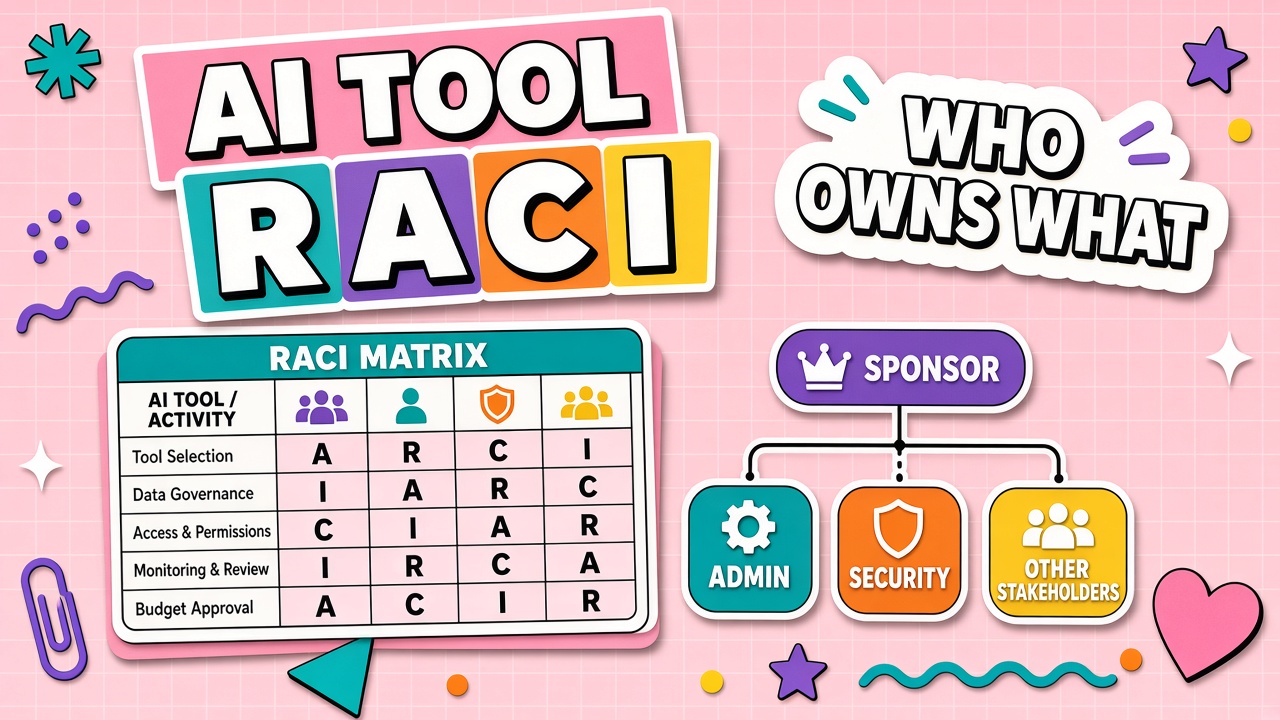
Enterprise AI adoption stalls when everyone is consulted and nobody is accountable. Procurement waits on security. Security waits on legal. Legal waits on the business sponsor. Practitioners sign up for trials while the committee schedules another alignment meeting.
An AI tool RACI matrix assigns Responsible, Accountable, Consulted, and Informed roles for selection, rollout, configuration, policy, and incidents. This guide adapts RACI basics to AI tooling with role definitions, decision rights, escalation paths, and procurement alignment. Compare candidate platforms in AI productivity tools and AI automation tools only after the intake owner and security delegate are named on the matrix.
RACI Basics Applied to AI Tools
Responsible (R) does the work. Accountable (A) owns the outcome and is exactly one person per activity. Consulted (C) provides input before decisions. Informed (I) receives updates after decisions. AI tooling spans activities traditional IT RACI charts omit: prompt library governance, model change review, and usage monitoring.
Publish the matrix where intake forms and runbooks live. Update it when org structure changes or when a major vendor enters the stack.
Roles: Sponsor, Admin, Champion, User, Security
- Executive sponsor (A on strategy): Funds program, sets risk appetite, resolves cross-department conflict
- AI program admin (R on operations): Maintains approved tool list, intake queue, and vendor relationships
- Workflow champion (R on adoption): Owns training, prompt libraries, and workflow metrics for a function
- Practitioner user (R on daily use): Follows policy, reports incidents, contributes templates
- Security delegate (A on control baseline): Approves data tiers, SSO, logging, incident response
- Legal and privacy (C on contracts and DPIA): Reviews terms, disclosures, regulated use cases
- Procurement (R on commercial terms): Negotiates export, deletion, and renewal windows
Decision Rights: Purchase, Config, Policy
| Decision | Accountable | Responsible | Consulted |
|---|---|---|---|
| New tool purchase | Business sponsor | Procurement + program admin | Security, legal, IT |
| Production configuration | Program admin | IT / MLOps | Security, workflow champion |
| Team policy update | Sponsor or delegate | Program admin | Legal, champions |
| Exception for restricted data | Security delegate | Requesting manager | Legal, privacy |
| Tool sunset | Workflow champion | Program admin | Finance, security |
Escalation Paths for Incidents
Define triggers and routes before incidents occur. Data exposure routes to security delegate within one hour. Customer-facing quality failure routes to workflow champion and comms lead. Vendor outage routes to program admin and procurement for SLA credit. Each path names backup approvers when primary roles are unavailable.
Test escalation annually with a tabletop exercise: walk one hypothetical leak and one model behavior regression from detection to resolution log.
Aligning RACI With Procurement
Procurement owns commercial negotiation but not workflow fit. Embed RACI in intake: no vendor signature until Accountable sponsor, security Consulted sign-off, and export or deletion clauses verified. Renewal reviews reconfirm the same roles so orphaned tools do not auto-renew without an owner.
Sample RACI Activities for AI Tooling
Beyond purchase and config, assign RACI for: tool intake triage, prompt library approval, model change notification review, usage exception requests, quarterly access audits, vendor renewal recommendation, and sunset execution. Unowned activities default to the busiest person, which is not a strategy.
RACI for incident response
Data leak: Security accountable, program admin responsible for vendor contact, legal consulted, executive sponsor informed within defined SLA. Quality incident affecting customers: Workflow champion accountable for remediation, practitioners responsible for pause, comms consulted. Document these rows before the first pager.
Onboarding new tools into RACI
Every approved tool gets a row in the tool registry: Accountable sponsor, Responsible admin, workflow champions by department, security classification, renewal date, and sunset owner. RACI without a registry decays within one reorg.
RACI Across the Tool Lifecycle
Intake: business sponsor accountable, practitioner responsible for use case brief, security consulted. Evaluation: program admin responsible for scorecard, procurement consulted on terms. Rollout: workflow champion responsible for training, IT responsible for SSO. Operations: program admin responsible for license hygiene, finance informed on renewals. Sunset: workflow champion accountable for migration success, security consulted on deletion proof.
Lifecycle RACI prevents the common gap where purchase has owners but nobody owns year-two optimization or exit.
Communication matrix companion
Pair RACI with a communication matrix: event type, channel, audience, cadence, and template owner. Incident severity two might page security and email sponsors within one hour; routine renewal might inform finance monthly only. RACI without communication paths still leaves people surprised.
Frequently Asked Questions
How often should the RACI matrix update?
Review quarterly and after reorgs, major acquisitions, or entry of a company-wide copilot platform. Version the document and notify Informed roles of changes affecting intake or incident routing.
Who owns tools shared across departments?
Assign one Accountable business sponsor for the primary use case and secondary champions per department. Shared admin configuration stays with program admin; department metrics stay with local champions.
Is RACI enough without a governance committee?
RACI clarifies daily decisions. A lightweight committee (monthly, thirty minutes) resolves escalations RACI cannot and updates strategy. Avoid committees that replace named Accountable roles with group ambiguity.
Does a two-hundred-person company need full enterprise RACI?
Scale down roles, not accountability. One sponsor, one admin, champions per function, and security consult on intake may suffice. Missing security Consulted on purchase is where small enterprises get burned.
RACI Workshop Agenda (90 Minutes)
Minutes zero to fifteen: explain RACI rules and show blank matrix. Fifteen to forty-five: fill rows for intake, purchase, config, incident, and sunset with sticky notes per role. Forty-five to seventy: resolve conflicts where multiple Accountable or none assigned. Seventy to eighty-five: publish v1 and assign matrix owner. Eighty-five to ninety: schedule quarterly review and link intake form.
Invite sponsor, security, procurement, one champion per major function, and IT admin. Skip large all-hands; working session beats consensus theater.
Output lives in the wiki with change log. Email Informed roles with link only; they do not edit v1 live.