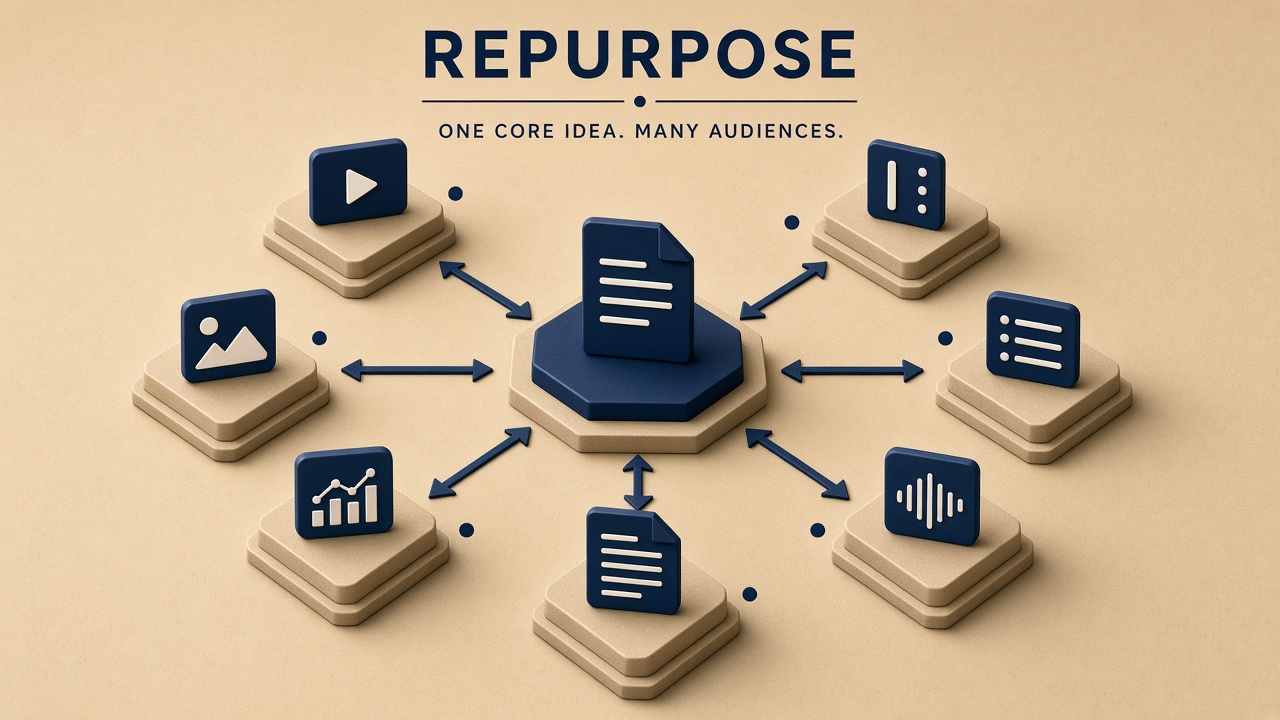
Creators who copy-paste the same caption across YouTube, LinkedIn, TikTok, and Instagram train algorithms and audiences to ignore half their feed. Smart repurposing adapts one core idea per platform: different hooks, lengths, visuals, and CTAs while saving production time. An ai content repurposing workflow starts with an anchor asset (long video, essay, or thread), applies platform-native adaptation rules, uses AI for outlines per channel, staggers publishing to avoid duplication flags, and reviews performance by platform monthly. AI accelerates adaptation drafts; you own strategy, authenticity, and what ships when.
This guide fits solo creators and small teams publishing three or more channels. Pair the matrix with AI code tools when you automate transcript pulls, timestamp exports, or scheduling CSVs, and AI automation workflows when you route approved snippets to queue tools without auto-posting unreviewed copy.
Choose Anchor Asset (Video, Essay, Thread)
Pick one anchor asset per repurposing cycle: a long-form video, a newsletter essay, or a flagship thread, then derive every derivative from that source so messaging stays coherent without being identical. Cross platform content ai planning fails when you anchor on a weak idea because AI makes weak ideas faster, not better.
- Score candidate anchors: depth (teaches something), proof (examples, data), and shelf life (evergreen vs news).
- Prefer anchors with existing transcript or long text to feed downstream prompts.
- Name the single thesis in one sentence before spawning derivatives.
- Tag anchor with content pillar (tutorial, opinion, case study) for matrix row lookup.
- Archive anchor URL and version date when you update the source later.
| Anchor type | Best derivatives | Production note |
|---|---|---|
| Long video | Shorts, clips, carousel steps, blog recap | Needs transcript with timestamps |
| Newsletter essay | LinkedIn post, thread, podcast outline | Watch paywall excerpt limits |
| Twitter or X thread | Carousel, Short talking head, blog expansion | Expand examples for long formats |
Platform-Native Adaptation Rules
Each platform row in your matrix defines format, tone, length, visual style, CTA, and anti-duplication rules so derivatives feel native, not syndicated spam. A repurpose long to short ai pipeline respects these rules in prompts; editors enforce them on final copy.
- YouTube long: depth, chapters, end screen CTA to related video.
- YouTube Shorts or TikTok: hook in 1 second, one tip, vertical reframing required.
- Instagram carousel: save-oriented steps, minimal on-slide text.
- LinkedIn: professional framing, first-person story or lesson, document or text post.
- Newsletter: exclusive angle or extra example not posted elsewhere same week.
| Platform | Tone shift | Anti-duplication rule |
|---|---|---|
| TikTok | Casual, spoken contractions | New hook line, not description paste |
| Outcome-led for professionals | No identical opening paragraph as blog | |
| Visual-first, scannable | Unique carousel hook slide | |
| Direct address, one CTA | Bonus tip or template not on social |
AI Assist for Outlines Per Platform
Feed the anchor transcript or essay into separate prompts per platform row, requesting outlines only (hook, beats, CTA), not final publish-ready spam across every channel at once. Creator batch content workflow teams run prompts in parallel; one editor approves all outlines before drafting or filming derivatives.
- Master prompt inputs: thesis sentence, anchor text, platform rules from matrix.
- Output format: hook, three beats, CTA, suggested visual note.
- Short-form prompts cap spoken words (e.g., 120 words for 45 second Short).
- Carousel prompts output slide headlines only until storyboard approval.
- Store approved outlines in one doc linked to anchor ID for traceability.
Batch production week: Monday outlines, Tuesday short-form filming, Wednesday carousel design, Thursday LinkedIn and newsletter drafts, Friday schedule and QA. AI fits between steps; humans batch similar tasks to reduce context switching.
Scheduling and Stagger to Avoid Duplication Flags
Stagger derivative publishes across days and rewrite openings so no two platforms receive identical text within the same 48 hour window, especially when cross-posting tools are involved. Algorithms and audiences both penalize mirror posting; stagger also lets you test hooks on one platform before adapting winners.
- Publish anchor first unless teaser strategy demands Shorts before long video.
- Wait 24 to 72 hours between channels with overlapping audiences.
- Change hook, examples, and CTA per platform even when core thesis matches.
- Disable auto-sync from YouTube to Twitter if it posts identical titles.
- Log publish timestamps in matrix spreadsheet for audit.
| Derivative | Suggested lag after anchor | Variation requirement |
|---|---|---|
| Short clip | Same day to 1 day (teaser OK) | New hook, vertical crop |
| Carousel | 2 to 4 days | Step framing, not transcript paste |
| LinkedIn post | 3 to 5 days | Workplace angle or client story |
| Newsletter bonus | 5 to 7 days | Exclusive checklist or template |
Performance Review by Platform
Monthly, score each anchor's derivatives by platform-specific metrics (watch time, saves, clicks, replies) and update matrix rules when a format consistently underperforms despite strong anchors. Repurposing without review repeats low-yield work.
- Tag every post with anchor ID in analytics spreadsheet or UTM campaign field.
- Compare Short hooks: which opening line drove highest completion rate?
- Compare carousels: saves per reach vs LinkedIn comments per impression.
- Retire matrix rows that fail three cycles unless strategic for presence only.
- Feed winning patterns into next month's AI prompt examples.
Fatigue Signals
Declining engagement on derivatives while anchor performance holds steady often means audiences recognize recycled packaging; increase variation depth or reduce frequency. AI cannot fix audience fatigue from identical framing; change the entry angle or pause a platform row temporarily.
Batch Production Calendar Template
Map each anchor to a two-week batch calendar with fixed slots for outline day, film day, design day, caption day, and staggered publish days so repurposing becomes a factory rhythm instead of ad hoc panic. A creator batch content workflow calendar visible to the whole team prevents two derivatives landing on the same morning because nobody checked the matrix.
- Week 1 Monday: anchor publishes or records; transcript ready by Tuesday.
- Week 1 Wednesday: AI outlines for all platform rows; human approval Thursday.
- Week 1 Friday: batch film Shorts and talking-head cutdowns.
- Week 2 Monday to Tuesday: carousel and thumbnail design.
- Week 2 Wednesday to Friday: staggered publishes per lag column.
| Calendar slot | Owner | Output artifact |
|---|---|---|
| Outline batch | Creator plus AI | Approved outline doc per platform |
| Film batch | Creator | Raw clips folder tagged by anchor ID |
| Design batch | Designer or creator | Carousel exports and Short covers |
| Schedule batch | Creator or VA | Queue with staggered timestamps logged |
Anti-Duplication Rules Deep Dive
Anti-duplication means more than rewriting synonyms: change hook structure, example industry, visual layout, and CTA type while keeping the thesis intact so each post earns standalone value. Cross platform content ai prompts should include a "forbidden phrases" list pulled from the anchor title and first paragraph to block lazy copy-paste.
- Banned: identical first 120 characters across any two platforms.
- Banned: same thumbnail or carousel slide 1 image without crop or text change.
- Required: at least one platform-specific example (LinkedIn client story, TikTok trend reference).
- Required: different CTA type per platform when possible (save vs comment vs subscribe).
- Optional: newsletter exclusive worksheet not mentioned on social until email sends.
Teams using repurpose long to short ai pipelines should run a simple diff check: paste caption pairs into a text compare tool before schedule. If similarity exceeds your threshold, rewrite the hook manually. Automation can flag; humans rewrite.
Matrix Maintenance Quarterly
Every quarter, retire platform rows that underperformed three cycles, add rows for new channels you are testing, and update tone rules when brand voice evolves. A static matrix from 2024 produces 2026-sounding off-brand Shorts. Store matrix version numbers on each anchor ID so you know which rules produced which batch.
Team Roles and Approval Gates
Define who approves outlines, who publishes, and who owns analytics review so AI drafts never skip human gates because "the intern scheduled it." Solo creators still benefit from a self-approval checklist before queue.
- Gate 1: anchor thesis approved before any derivative prompts run.
- Gate 2: outline approval per platform before full script or caption draft.
- Gate 3: legal or sponsor compliance on branded derivatives only.
- Gate 4: final QA on links, disclosures, and anti-duplication diff.
- Gate 5: publish plus log timestamp in matrix spreadsheet.
| Role | Owns | Does not own |
|---|---|---|
| Creator | Thesis, on-camera, final publish approval | Blind auto-post without review |
| Editor | Clips, captions from approved outlines | Changing sponsor claims |
| VA or scheduler | Queue per stagger rules | Rewriting hooks for "variety" |
Frequently Asked Questions
Do platforms penalize repurposed content?
Platforms penalize low-effort duplication and engagement bait more than thoughtful adaptation; identical video files with no edits fare worse than re-edited clips with new hooks and captions. Follow each platform's spam and repetitive content guidelines. The matrix anti-duplication rules exist to keep you on the safe side of native content expectations.
Should I translate derivatives for other markets?
Translate only when you can support that audience ongoing; AI translation plus human review works for captions and carousels, but tone and cultural references need local editor pass. Stagger translated posts further to avoid flooding global followers with near-simultaneous language variants.
How do I avoid content fatigue when repurposing aggressively?
Cap derivatives per anchor (for example four to six pieces max), reserve newsletter or community exclusives, and skip a platform row when you have nothing new to add. Not every anchor needs every platform. Quality matrix rows beat full-grid checkbox completion.
What if I update the anchor after derivatives shipped?
Log anchor version dates; update or pin comments on derivatives when factual errors change, and batch refresh carousels or posts with outdated stats rather than silent drift. AI can diff old and new anchor text for changed claims; humans approve corrections and republication schedule.
One Idea, Many Native Formats
A mature ai content repurposing workflow chooses a strong anchor, enforces platform-native rules, batches AI outlines per channel, staggers publishing to avoid duplicate spam patterns, and reviews performance by platform. AI multiplies adaptation speed; your matrix and judgment keep each post worth watching. Build the spreadsheet this week with one anchor and four platform rows, then expand after the first monthly review.