You upload a product manual, connect a help center, or sync a SharePoint library. The chatbot answers confidently about features that never appeared in the model's public training data. Sometimes the answer cites page numbers. Sometimes it invents a policy that sounds plausible but does not exist in your files. That gap between grounded answers and confident hallucinations is usually a retrieval problem, not a model size problem.
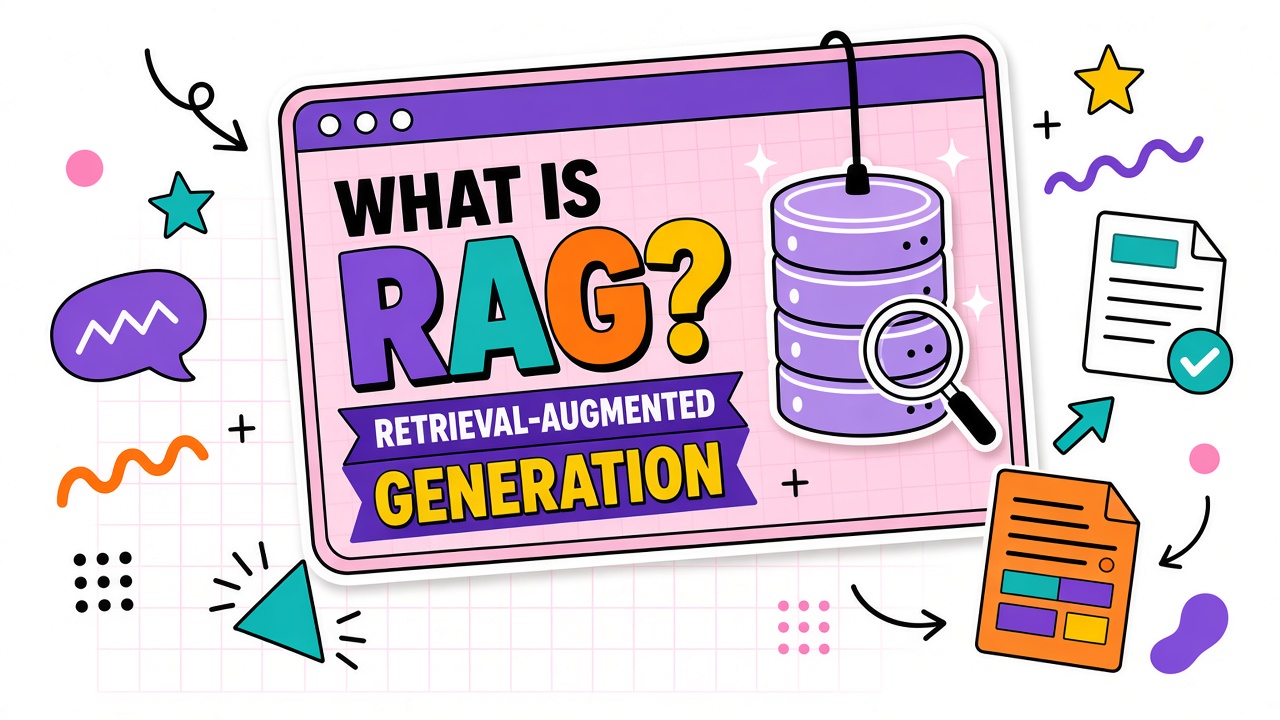
Retrieval-augmented generation (RAG) is an architecture that connects a large language model to external documents at query time. Instead of relying only on knowledge frozen during training, a RAG system searches your corpus, pulls the most relevant passages, and injects them into the prompt before the model writes a response. AWS, Databricks, and most enterprise AI vendors now ship managed RAG stacks because the pattern is the default way to ground LLMs on private data without retraining. This guide explains what RAG does, when it outperforms a bigger model alone, how commercial tools implement retrieval pipelines, known failure modes, and the vendor questions that separate production-ready systems from demos. Browse AI chatbot tools and AI research assistants with this framework before signing an annual contract.
What RAG Does: Retrieve, Then Generate
RAG splits work into two coordinated phases. During indexing (offline), documents are parsed, split into chunks, converted into vector embeddings, and stored in a searchable index. During inference (online), the user's question triggers a retrieval step that finds the top matching chunks, followed by a generation step where the language model answers using both its general capabilities and the retrieved text.
The model itself is not retrained when your documents change. You update the index. That separation is why RAG is cheaper and faster to maintain than fine-tuning for most knowledge-base use cases. The knowledge lives outside model parameters and is consulted fresh on every query.
The RAG pipeline in six steps
- Ingest: Connectors pull documents from wikis, PDFs, tickets, databases, or cloud storage.
- Chunk: Long files split into passages (often 256 to 1,024 tokens) with optional overlap.
- Embed: An embedding model converts each chunk into a numeric vector for similarity search.
- Index: Vectors and metadata (source URL, access level, last modified date) land in a vector database.
- Retrieve: At query time, the question is embedded and matched against the index. Hybrid search may combine vector similarity with keyword matching (BM25).
- Generate: Retrieved passages are inserted into the prompt. The LLM produces an answer, often with citations back to source documents.
Production systems frequently add a reranking step between retrieval and generation. A cross-encoder model rescores the initial candidate set with higher precision, keeping the most relevant evidence from being buried under loosely related chunks.
What RAG is and is not
- RAG is: A runtime architecture that grounds LLM output in external, updatable documents.
- RAG is: A cost-effective alternative to fine-tuning when knowledge changes frequently.
- RAG is: A pattern that enables citations, access control at retrieval time, and domain-specific answers.
- RAG is not: Guaranteed factual accuracy. The model can still misread or miscombine retrieved passages.
- RAG is not: The same as enterprise search. Search returns links; RAG synthesizes a natural-language answer.
- RAG is not: A replacement for data governance. Bad source documents produce bad answers regardless of model size.
When RAG Beats a Bigger Model Alone
Scaling to a larger context window or a more capable foundation model does not automatically solve private-knowledge questions. A bigger model still cannot see documents it was never given. RAG wins when your use case depends on proprietary, current, or domain-specific information that is impractical to encode through training alone.
| Scenario | Bigger model alone | RAG approach |
|---|---|---|
| Internal HR policy questions | Guesses from general training data | Pulls current policy PDF, cites section |
| Product docs updated weekly | Stale knowledge cutoff | Re-index on publish, answers reflect latest release |
| Customer support over ticket archive | Cannot access private tickets | Retrieves similar resolved cases at query time |
| Legal or compliance Q&A | High hallucination risk on specifics | Grounds answer in approved clause library |
| General creative writing | Often sufficient without retrieval | Adds little value unless style references needed |
RAG also beats fine-tuning for many buyers on cost and iteration speed. Fine-tuning rewrites model weights and requires retraining cycles when content changes. RAG swaps or refreshes an index. For a 10,000-page knowledge base that updates daily, that operational difference matters more than marginal gains from a larger parameter count.
Common RAG Architectures in Commercial Tools
Vendor implementations share the same skeleton but differ in connectors, chunking defaults, rerankers, and governance layers. Understanding these variations helps you compare products that all advertise "chat with your data."
Naive (single-pass) RAG
The simplest pattern: embed the query, retrieve top-k chunks, stuff them into the prompt, generate once. Many SMB chatbot products ship this as the default. It works for small, clean corpora. Quality drops when documents are long, tables are dense, or questions require information spread across multiple sections.
Hybrid retrieval RAG
Combines dense vector search with sparse keyword search (BM25). Databricks and other enterprise platforms recommend hybrid retrieval because pure semantic search misses exact matches: error codes, SKUs, version numbers, and rare entity names. Results from both paths merge through reciprocal rank fusion before reranking.
Agentic and multi-hop RAG
Instead of one retrieval call, an agent decomposes complex questions into sub-queries, retrieves for each, and synthesizes. This pattern dominates 2026 enterprise agent products. It handles questions like "Compare our Q3 refund policy with what we told Enterprise customers in the April webinar" that no single chunk can answer. Cost and latency rise with each hop.
Graph-augmented and structured RAG
Some tools layer knowledge graphs or SQL connectors alongside vector indexes. Structured retrieval excels when relationships matter: org charts, product hierarchies, entitlement rules. The LLM may route factual lookups to a database and narrative synthesis to vector search within the same session.
Managed platforms vs build-your-own stacks
Amazon Bedrock Knowledge Bases, Microsoft Copilot Studio, Google Vertex AI Search, and Databricks Mosaic AI each bundle ingestion, embedding, retrieval, and generation behind a managed API. Open-source stacks (LangChain, LlamaIndex, Haystack) offer more control but push indexing, monitoring, and evaluation onto your team. Buy managed when time-to-production and compliance certifications matter. Build when you need custom chunking, exotic data sources, or tight cost optimization at scale.
Limits: Stale Indexes, Chunking Errors, and Citation Gaps
RAG reduces hallucinations but does not eliminate them. Most production failures trace to retrieval quality, not generation quality. A capable LLM cannot fix irrelevant chunks in the prompt.
Stale or incomplete indexes
If ingestion lags behind publishing, the model answers from outdated content confidently. Ask vendors about sync frequency, delete handling, and whether partial updates re-embed entire documents or only changed sections.
Chunking and parsing errors
PDF tables split mid-row. Code blocks lose function boundaries. Headers detach from body text. Poor parsing upstream produces chunks that embed poorly and retrieve badly. Test with your messiest real documents, not sanitized marketing PDFs.
Citation gaps and attribution failures
Some products cite sources that do not support the claim. Others retrieve correctly but the model paraphrases without linking. Evaluation should measure retrieval recall and answer faithfulness separately. A high citation count means little if the cited passage does not contain the stated fact.
Access control at retrieval time
Enterprise RAG must filter chunks by user permissions before they reach the prompt. A retriever that ignores ACL metadata can surface confidential HR data to the wrong employee. Verify that permission filters apply at search time, not only at the UI layer.
Questions to Ask Vendors About Their RAG Stack
Use this checklist during demos and security reviews. Vague answers on indexing or evaluation are red flags.
- Which embedding model do you use, and can we swap it? Embedding quality sets the ceiling on retrieval accuracy.
- Do you support hybrid search and reranking out of the box? Single-pass semantic search is often insufficient for technical corpora.
- How often does the index refresh, and what triggers a re-sync? Staleness breaks trust fast on policy and product content.
- How do you chunk PDFs, HTML, and structured data differently? One-size chunking fails on tables and code.
- Where are embeddings stored, and in which regions? Data residency requirements apply to vectors as well as source files.
- How do you enforce document-level permissions during retrieval? Critical for multi-tenant and enterprise deployments.
- What evaluation metrics do you report? Look for retrieval recall, answer faithfulness, and latency percentiles, not vanity accuracy scores.
- Can we export retrieval logs for debugging? You need visibility when answers go wrong in production.
- What happens when retrieved context exceeds the context window? Compression, summarization, and truncation strategies differ widely.
- Is our data used to train foundation models? Separate indexing infrastructure from model training opt-outs.
Frequently Asked Questions
What is the difference between RAG and fine-tuning?
RAG retrieves external documents at query time and leaves model weights unchanged. Fine-tuning updates model weights on your data during a training job. RAG is faster to update when documents change. Fine-tuning can instill style, format, or task behavior that retrieval alone cannot. Many production systems combine both: fine-tune for tone and tool use, RAG for factual grounding.
How is RAG different from enterprise search?
Enterprise search returns ranked links and snippets. RAG feeds retrieved passages to a language model that synthesizes a direct answer in natural language, often with inline citations. Search is better when users want to browse sources. RAG is better when users want a concise answer without reading ten documents.
Do long context windows make RAG obsolete?
No. Stuffing an entire corpus into a million-token window is expensive, slow, and still vulnerable to lost-in-the-middle attention effects where the model ignores middle sections. RAG selects only relevant passages, reducing cost and improving focus. Long context complements RAG by holding more retrieved chunks and conversation history, not by replacing selective retrieval.
How accurate is RAG compared to a human expert?
Accuracy varies by corpus quality, retrieval tuning, and question complexity. RAG performs well on factual lookups over well-structured documentation. It struggles with nuanced judgment, conflicting sources, and questions that require tacit knowledge not written down. Treat RAG output as a draft that benefits from human review on high-stakes decisions.
Is RAG expensive to run?
Costs include embedding and storage for indexing, per-query retrieval compute, and LLM generation tokens for the augmented prompt. For large corpora, indexing is a one-time or periodic cost; per-query cost scales with retrieved chunk count and model tier. RAG is typically far cheaper than fine-tuning and retraining cycles for frequently updated knowledge bases.
Choosing RAG-Ready Tools With Confidence
RAG is the standard architecture for grounding AI on private, current documents without retraining foundation models. The pattern is mature enough that most serious AI chatbot and research assistant products either ship RAG natively or integrate with vector stores you control. Success depends less on model brand and more on ingestion quality, hybrid retrieval, permission-aware search, and honest evaluation. Ask the vendor questions above, test with your noisiest real documents, and measure retrieval and generation quality separately before you trust answers on customer-facing or compliance workflows.