Campaign critiques often arrive as scattered Slack threads, marked-up PDFs, and verbal notes from a review session that designers interpret differently on Monday. Creative directors need a repeatable way to evaluate work against brief, brand system, and channel constraints without flattening the craft into generic feedback.
An AI workflow for creative director campaign critiques turns intake into structured critique dimensions, supports working sessions with draft talking points, and tracks revisions against agreed feedback. Taste and creative vision remain human-owned. This guide targets agency and in-house creative leads running multi-asset campaigns. Use AI research tools for audience and category context and AI video platforms only where your client contracts allow asset analysis.
Why Structure Matters for Creative Critique
Unstructured critique produces inconsistent revisions because teams cannot tell which notes are mandatory versus exploratory. AI helps creative directors label feedback by dimension (strategy fit, craft, legal, channel) before the working session. Structure does not replace intuition; it makes intuition legible to designers, producers, and account teams.
- Every critique references the approved brief version and objective.
- Feedback separates must-fix items from nice-to-have experiments.
- Channel-specific notes stay tied to format specs, not personal preference alone.
- Client-facing language is drafted separately from internal craft notes.
Intake Creative Assets and Brief
Begin each critique cycle with a single intake package: creative brief, brand guidelines, asset links, media plans, and prior round feedback. AI processes text briefs and structured metadata reliably; visual judgment still requires the creative director's eye on layouts, motion, and typography.
- Confirm brief version, KPIs, mandatories, and exclusions in writing.
- Collect assets by channel: key visuals, copy decks, storyboards, rough cuts.
- Attach legal and regulatory guardrails for regulated categories.
- Log round number and deadline so revision scope stays bounded.
- Note which assets are AI-generated internally and require disclosure review.
| Intake item | AI-assisted use | Creative director owns |
|---|---|---|
| Creative brief | Extract objectives and mandatories checklist | Strategic alignment call |
| Copy deck | Flag length overruns per placement | Tone and voice final call |
| Key visual | Summarize composition notes if described in text | Hierarchy, craft, and taste |
| Video rough cut | Transcript for dialogue and supers check | Pacing, performance, and emotional arc |
Brief Ambiguity Resolution
When the brief conflicts with the media plan, stop AI drafting and resolve with strategy lead before critique. AI will harmonize contradictions in plausible-sounding prose that sends designers in the wrong direction. Document the resolution in the intake package header.
Draft Structured Critique Dimensions
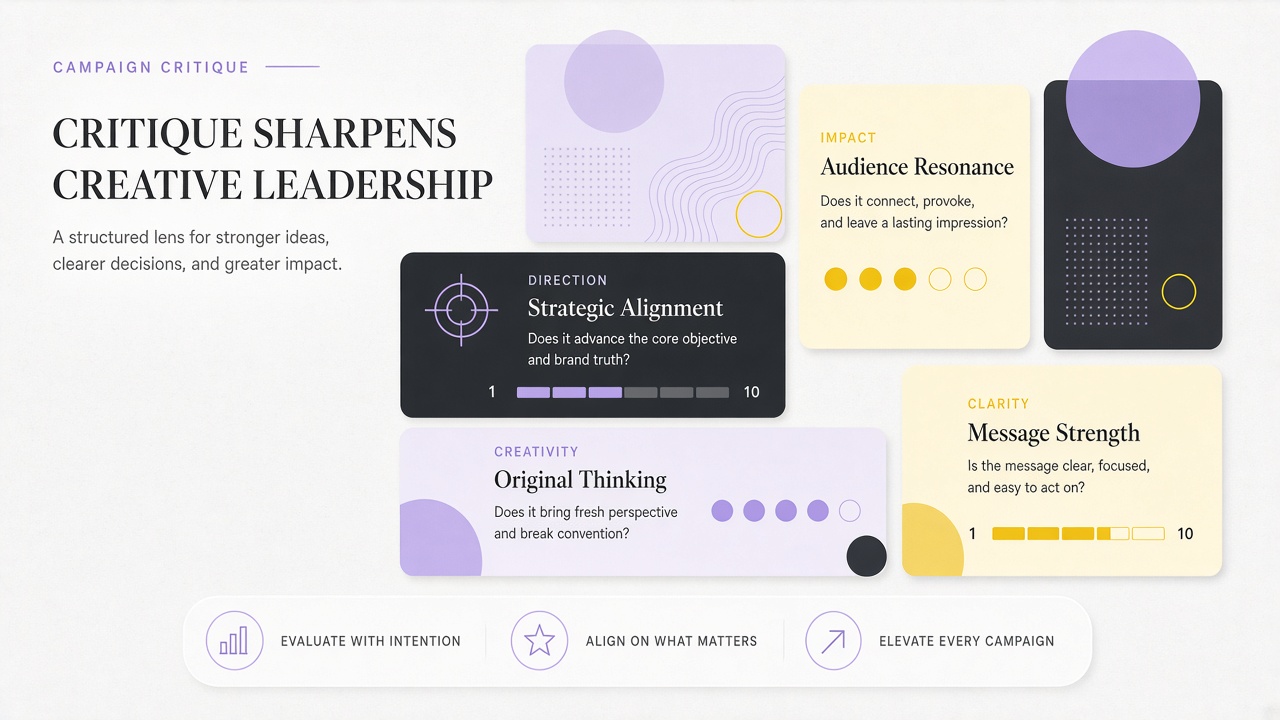
Creative directors define critique dimensions up front: strategic fit, audience resonance, brand system compliance, craft quality, channel feasibility, and legal risk. AI drafts bullet observations per dimension from the intake package and any written annotations. The director edits every bullet for accuracy and priority before sharing.
Example dimension prompts for AI (director validates all output):
- Strategic fit: Does the concept deliver the brief's single-minded proposition?
- Audience: Will the primary segment recognize themselves without insider knowledge?
- Brand system: Logo, color, typography, and motion rules per guidelines PDF.
- Craft: Composition, retouching, typography detail, and art direction consistency.
- Channel: Safe zones, durations, file weights, and localization headroom.
- Legal: Claims substantiation, talent rights, and category regulations.
Research Context Without Copying Trends
Research tools can summarize category conventions and competitor campaigns from public sources to stress-test differentiation. Use summaries for internal debate, not as directives to mimic rivals. The creative director decides whether standing out or fitting in serves the brief.
Team Working Session to Finalize
Run a timed working session where the creative director walks the team through AI-organized dimensions, captures live decisions, and marks which notes are binding for the next round. AI-generated bullets are agenda items, not the final critique memo. Conversation resolves tradeoffs that models cannot weigh.
- Share dimension doc 24 hours before session when possible.
- Design lead responds to craft notes; strategy lead owns brief-fit disputes.
- Account documents client-sensitive phrasing for external readouts.
- Director records decisions: approved, revise, or kill per asset.
- Assign owners and due dates for every binding revision.
| Session output | Owner | Delivered to |
|---|---|---|
| Binding revision list | Creative director | Design and production |
| Client-safe summary | Account lead | Client review call |
| Legal flags | Legal or regulatory | Copy and claims team |
Video Critique Specifics
For motion work, combine director notes with timecoded comments; AI transcripts help catch supers and legal lines but not performance nuance. When teams use AI video generation in the pipeline, flag disclosure and talent replacement policies before client presentation.
Track Revisions Against Feedback
Each revision round maps back to binding feedback IDs so teams do not reopen settled decisions or miss mandatory fixes. AI can diff copy decks and summarize what changed between v2 and v3; the creative director confirms whether changes satisfy the note or need another pass.
- Number every binding note in the critique memo (C-101, C-102).
- Designers reference note IDs in change logs and Figma comments.
- Director spot-checks high-risk notes personally before client share.
- Close notes only when evidence is attached: screenshot, link, or file.
- Escalate scope creep when new rounds introduce unstated objectives.
Revision Round Limits
Define round limits in the statement of work; AI tracking makes overrun visible early. When feedback reopens killed territories, the director routes conversation to account and strategy rather than burdening production with unlimited exploratory rounds.
Client Presentation Readiness
Separate internal craft critique from client presentation narratives. AI can draft client-facing rationales from approved strategic bullets; the creative director polishes story flow and removes jargon. Never send raw AI critique language that references internal debates or competitor names without clearance.
Feedback Tone for External Audiences
Client feedback should sound collaborative: what works, what we are refining, and what we need from them. Internal bluntness stays in the working session doc. Account and creative director align on a single voice before emails go out.
Cross-Functional Critique Roles
Account, strategy, production, and legal each contribute lenses the creative director synthesizes. AI can route intake comments to the right dimension bucket, but directors resolve conflicts when strategy wants boldness and legal wants caution. Document the resolution in the binding memo so production does not receive contradictory Slack threads.
Localization and Market Critique
Global campaigns need per-market critique dimensions: cultural nuance, regulatory copy, and format norms. AI drafts locale checklists from brief mandatories; regional creative leads validate humor, idioms, and casting choices. Never ship AI-translated headline options to clients without native creative review.
Post-Launch Retrospective
After launch, compare performance readouts to pre-launch critique predictions. AI can summarize which binding notes correlated with stronger engagement versus which were subjective preferences. Feed lessons into the next campaign intake template without blaming individuals for exploratory ideas killed early.
Tooling and Asset Management
Link critique memos to Figma, Frame.io, or DAM version IDs so designers open the exact asset referenced in each note. AI-generated change summaries are useless when file names drift between rounds. Creative operations should enforce naming conventions before directors run structured critique cycles at scale.
Inclusive and Accessible Critique
Add accessibility and representation dimensions to every campaign critique: contrast ratios, caption requirements, casting diversity against brief audience, and readable type at mobile sizes. AI can check copy length against specs but cannot judge whether imagery stereotypes or excludes. Directors flag these issues before legal review when regulated industries apply.
Frequently Asked Questions
How should creative directors use AI before client presentations?
Use AI to organize talking points, anticipate likely client questions from the brief, and draft slide headlines from approved strategy. Do not generate new creative concepts on the way to the meeting. Present work the team stands behind; AI supports narration, not last-minute concept swaps.
What is a fair revision policy when AI speeds up internal critique?
Faster internal critique should not automatically mean more client rounds unless the contract allows it. Use saved time for craft refinement within the agreed round count. Track note closure rates to show clients disciplined progress between reviews.
Can junior creatives run AI critique drafts without a director?
Juniors may prepare intake packages and first-pass dimension bullets; a creative director must approve before feedback reaches designers or clients. Untrained AI output often sounds authoritative while missing brand nuance. Use preparation as a learning exercise with director annotations.
How do we critique campaigns that include AI-generated assets?
Add dimensions for disclosure, uncanny risk, rights clearance, and brand fit specific to synthetic media. Legal may require labeling. The director judges whether AI assets meet craft standards or need human finish passes before air.
Clear Critique, Stronger Campaigns
Creative directors scale thoughtful feedback when intake is complete, critique dimensions are structured, working sessions finalize binding notes, and revisions trace to agreed IDs. AI organizes the conversation; taste and vision stay human.