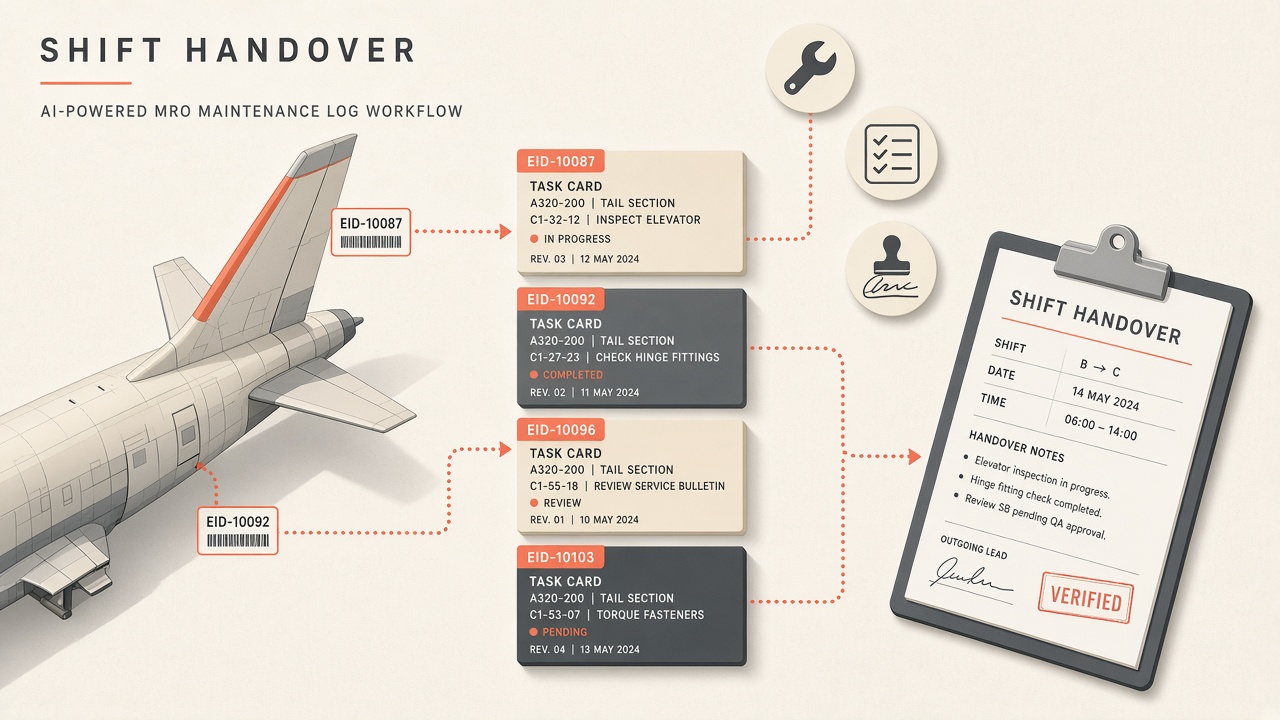
A busy line maintenance station can close fifty work orders in a single shift. Each entry carries ATA chapter codes, part numbers, torque values, and inspector stamps spread across electronic tech logs, paper task cards, and MRO system screens. The incoming shift lead needs a five-minute picture of open defects, awaiting parts, and aircraft released to service, not a scroll through hundreds of raw log lines. An ai workflow aviation maintenance logs pipeline ingests approved log exports, produces structured handover summaries with traceable entry IDs, and blocks operational use until a certifying staff member signs the summary. AI accelerates comprehension; licensed mechanics and inspectors retain release authority.
This guide fits Part 145 repair stations, airline line maintenance teams, and CAMO organizations managing mixed fleets. Use AI chatbot interfaces for plain-language queries against signed summary indexes (always with entry ID links), and AI writing assistant tools only for drafting internal shift notes that still require human technical review before they touch the aircraft record.
Maintenance Log Ingestion Boundaries
Define exactly which maintenance records enter the AI summarization pipeline: released tech log entries, closed work orders, and inspector-approved non-routine cards, while excluding draft entries, unsigned defect reports, and personally identifiable technician notes not meant for handover. Boundary rules prevent the model from summarizing unaudited text as if it were airworthy fact.
- Include: signed ELB/ETL exports, closed task cards in the MRO system, AD/SB compliance closure records.
- Exclude: open work orders, pending engineering disposition, quarantined parts lists, HR performance notes.
- Redact: passenger names, medical details, security-sensitive airport codes when summaries leave the station.
- Timestamp gate: only entries with valid electronic signature per FAA AC 120-78B or EASA AMC 145.A.55.
- Source lock: ingest read-only snapshots; never write back to the authoritative MRO database from the AI layer.
| Record type | Ingest for AI? | Reason |
|---|---|---|
| Signed tech log defect + rectification | Yes | Airworthy record, inspector validated |
| Open pilot write-up awaiting inspection | No | Not yet verified defect |
| Closed base maintenance work package | Yes | Release to service documented |
| Draft shift notes in chat | No | Informal, unsigned, non-record |
| AD compliance tracking export | Yes | Structured regulatory status |
Platforms like OASES Lumina (September 2025) and Trax eMRO expose maintenance data through web-native APIs with offline mobile capture. Ingestion should pull from those system-of-record exports, not from screenshots or copy-pasted chat fragments that lose signature metadata.
Part 145 repair stations operating under EASA or FAA oversight should document the ingestion boundary list in their quality manual appendix. When auditors ask whether AI summaries appear in the aircraft record, the answer should be explicit: summaries are derivative briefing documents stored separately from the tech log, linked by entry ID, and signed by shift leads for internal use only unless your competent authority approves broader distribution.
Summary Structure for Incoming Shift
Shift handover summaries should follow a fixed template so incoming leads scan aircraft status, open items, and release blockers in under three minutes without reading raw log prose. Consistent section order trains crews to find critical defects first and administrative notes last.
- Aircraft on station: tail number, location, total open defects count, next scheduled departure.
- Released last shift: work completed, certificate of release references, any limitations (MEL/CDL items).
- Open defects: priority sorted (AOG, grounding, deferrable), ATA chapter, estimated parts ETA.
- Awaiting inspection: work done but unsigned, inspector name if assigned, expected sign-off time.
- Parts and tooling: rotable status, borrowed tools, special equipment still on aircraft.
- Safety and quality: occurred reportables, FOD checks, hangar movement notes.
| Handover section | Max length target | Priority signal |
|---|---|---|
| AOG / grounding items | Top of summary, no limit | Red flag, push notification |
| Open defects by aircraft | 3 lines per defect max | ATA chapter + status |
| Completed releases | Bullet list | CRS number reference |
| Shift admin notes | 5 lines total | Low, bottom of doc |
OASES DocuMentor and similar documentation assistants target this layer: natural language questions against structured maintenance history, not replacement of the tech log entry itself. The handover summary is a derived view; the signed log line remains authoritative.
Link Summaries to Source Entry IDs
Every bullet in an AI handover summary must hyperlink or reference the original MRO entry ID, tech log line number, and work order number so incoming staff can open the full record in one click during pre-flight checks. Summaries without IDs are hallway conversation, not maintenance documentation.
- Standardize ID format:
WO-2026-88421,ELB-N12345-2026-03-14-07,NR-ATA32-004. - Embed IDs inline: "Hydraulic leak deferred per MEL 29-XX [ELB-N12345-2026-03-14-07, WO-2026-88421]."
- Reject AI output that omits IDs on factual claims; rerun with stricter prompt or smaller chunk size.
- Map IDs to deep links in eMRO, Trax, OASES, or Sorveyor when the platform supports URL schemes.
- Archive the ID map JSON alongside the summary PDF for audits five years later.
| Summary claim | Required traceability | Verifier action |
|---|---|---|
| Defect deferred | ELB line + MEL reference + inspector stamp | Incoming lead opens ELB |
| Part installed | WO + part serial + certification tag scan | Compare serial in MRO |
| AD compliance closed | AD tracking ID + accomplishment stamp | CAMO cross-check |
| Aircraft released | CRS number + releasing inspector license | Verify in system of record |
Human Sign-Off Before Operational Use
Outgoing shift leads or certifying staff must review, correct, and electronically sign handover summaries before the incoming shift treats them as operational truth, matching FAA AC 120-78B and EASA requirements for maintenance record integrity. AI drafts are pre-read aids; only humans authorize dispatch decisions based on maintenance status.
- Outgoing lead reviews full summary against MRO dashboard for the same aircraft tail numbers.
- Amendments logged with reason code: AI misread handwriting, part ETA changed, new AOG since generation.
- Electronic signature binds name, license number, rating, and UTC timestamp to the approved version.
- Incoming lead acknowledges receipt; unresolved questions trigger direct ELB review, not summary trust alone.
- Block auto-distribution to operations/flight dispatch until sign-off completes.
| Sign-off role | Authority | Cannot delegate to AI |
|---|---|---|
| Outgoing shift lead | Summary accuracy attestation | Release to service |
| Certifying inspector | CRS and return-to-service | Any airworthiness decision |
| Incoming shift lead | Acknowledgment of handover | Accepting unknown defects |
| CAMO engineer | Continuing airworthiness review | AD extension approvals |
Integration With MRO Systems Cautiously
Connect AI summarization to MRO platforms through read-only APIs and scheduled exports, never as a write path into work orders or tech logs, until your quality system documents the interface and regulators accept the data flow. Trax eMRO, OASES Lumina, Sorveyor, and Oxmaint each expose different integration surfaces; treat AI as a downstream analytics layer.
- Phase 1: nightly CSV/JSON export to summarization bucket; manual trigger for shift change.
- Phase 2: webhook on work order closure events; regenerate summary section for affected aircraft only.
- Phase 3: embedded handover panel inside MRO UI via iframe or API, still read-only from AI service.
- Validate: compare AI open-defect count to MRO dashboard count every shift; alert on mismatch.
- Document interface in SMS quality manual; include failure mode when AI service is unavailable (fallback to manual handover template).
| Integration pattern | Risk level | Recommended phase |
|---|---|---|
| Read-only API export | Low | Phase 1 pilot |
| Event-driven refresh | Medium | After 30-day accuracy baseline |
| AI write-back to WO notes | High | Not recommended without formal approval |
| Natural language query (ASK OASES style) | Medium | Phase 2 with citation enforcement |
Agentic AI modules announced by Trax Pro-Series and similar vendors target procurement and planning agents inside the MRO core. Handover summarization should stay narrower: compress signed records for humans, not autonomously close work orders or alter airworthiness status.
Sorveyor and similar inspection platforms already generate audit packages with full traceability in seconds. Position your AI handover layer as the shift-change complement to those audit exports: faster for daily ops, not a replacement for authority-facing compliance bundles. When integration teams propose write-back from AI into work order notes, route the request through quality and IT security review before any pilot begins.
MEL, CDL, and Deferred Defect Tracking in Summaries
Handover summaries must surface every active MEL, CDL, and deferred defect with expiry countdown, operational limitations, and the exact ELB line that authorized the deferral, because incoming crews dispatch aircraft based on this status view. AI should never paraphrase a limitation; copy the MEL reference verbatim and link to the inspector stamp.
- List active deferrals first: MEL item number, category, expiry date or flight cycle limit, installed placards.
- Cross-check MRO deferral tracker against ELB; alert when counts disagree.
- Include CDL items with structural inspection intervals and next due date.
- Flag deferrals expiring within the incoming shift window as top-priority bullets.
- Document any crew briefing notes about operational workarounds (alternate flaps, reduced thrust) with source IDs.
| Deferral type | Summary must include | Common AI error |
|---|---|---|
| Category B MEL | Item ref, expiry, ops limitation | Omitting cycle-based expiry |
| CDL structural | Panel location, inspection interval | Confusing CDL with cosmetic damage |
| Awaiting engineering | Disposition status, engineer name | Marking open item as closed |
| Repeat defect | Prior WO references, trend flag | Treating as new isolated event |
Rollout and Quality Metrics
Measure handover summary quality by ID link accuracy, open-defect count match rate, and incoming shift survey scores before expanding from one hangar line to the full station. Target 98% ID resolution on sampled shifts and zero instances where an unsigned defect appeared as closed in the summary.
- Week 1: Manual template only; establish baseline handover duration (typically 15 to 25 minutes).
- Week 2-4: AI drafts with mandatory outgoing lead edit; log every correction category.
- Month 2: Automated ingest from one MRO export; nightly accuracy audit on 10% random shifts.
- Month 3: Electronic sign-off workflow; integrate acknowledgment from incoming lead mobile app.
- Quarter 2: Second station replication using documented playbook and correction taxonomy.
Frequently Asked Questions
Does Part 145 allow AI-generated maintenance summaries?
EASA Part 145 and FAA Part 145 regulate the content and integrity of maintenance records, not the internal shift briefing tools technicians use, provided summaries are clearly marked as derivative and the signed tech log remains the legal record. Include AI-assisted handover in your quality system documentation. Notify your competent authority if summaries flow to operators or dispatch systems outside the repair station. UK CAA maintains equivalent acceptance post-Brexit.
What digital signature standard applies to signed handovers?
FAA AC 120-78B requires electronic signature systems to uniquely identify the signatory, prevent unauthorized use, timestamp entries, and detect post-signing alterations; EASA AMC 145.A.55 sets parallel requirements for maintenance release documentation. Handover sign-off is a lower criticality than CRS release, but use the same identity controls. Oxmaint and similar CMMS modules architect signatures against AC 120-78B criteria. Do not use generic email "approval" clicks as aviation sign-off.
How should AI prioritize defects in the handover summary?
Sort by operational impact first (AOG, grounding, no-MEL dispatch), then by ATA chapter and age, using MRO system priority fields rather than AI judgment about severity. The model should read the priority flag your inspectors already set, not invent risk rankings from free-text descriptions. Mis-prioritized hydraulic versus cosmetic defects erode trust faster than a long summary.
Does the workflow differ for base maintenance versus line stations?
Line maintenance handovers focus on same-day dispatch blockers and open pilot write-ups, while base maintenance summaries span multi-day work packages, major inspections, and component shop status with longer retention and more ATA chapters per aircraft. Configure separate templates: line template caps at one page per tail number; base template groups by work package ID and includes percent-complete metrics from the MRO scheduler. Do not run the line template against a C-check hangar without adjusting section depth.
What happens when technicians work offline on the hangar floor?
Offline ELB capture on mobile apps syncs when connectivity returns; queue summarization until signed entries land in the MRO system of record, never from cached draft text alone. FAA AC 120-78 and EASA offline guidance expect encrypted local stores with conflict resolution on reconnect. Generate the handover summary only after sync confirms signature manifests for all included entries.
Traceability Beats Brevity
A practical ai workflow aviation maintenance logs practice draws clear ingestion boundaries, structures shift handovers for scanning speed, links every claim to source entry IDs, requires human sign-off before operational use, and integrates with MRO systems through read-only paths until quality approval expands scope. AI compresses dense log reading; certifying staff retain airworthiness authority. Pilot one line station, measure ID accuracy and defect count match for thirty shifts, then scale with the correction taxonomy your outgoing leads already use when they fix AI drafts.