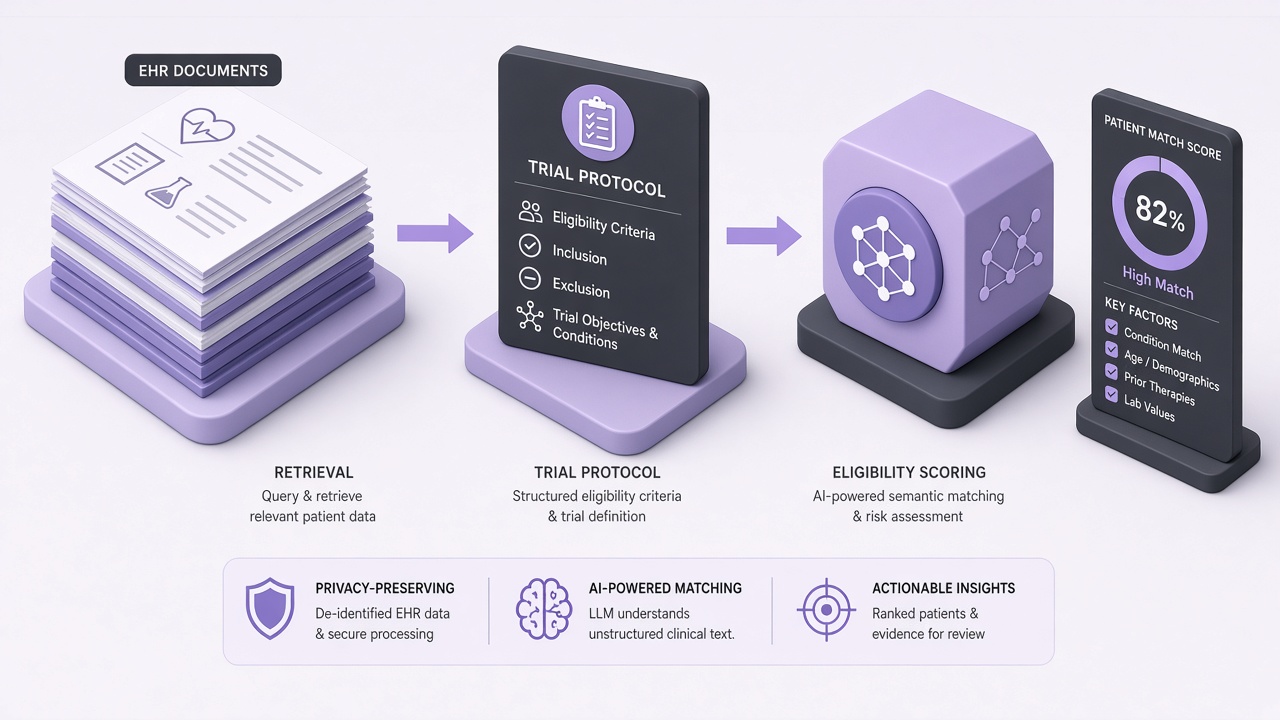
An oncology coordinator spends forty-five minutes reading a single patient's chart against a phase 3 immunotherapy protocol. The trial excludes prior anti-PD-1 exposure unless discontinued more than twelve weeks ago, requires measurable disease per RECIST 1.1, and lists seventeen exclusion criteria buried in unstructured clinician notes. Meanwhile, eligible patients never hear about the study because manual screening cannot keep pace with accrual targets. Clinical trial matching AI uses large language models and retrieval pipelines to interpret electronic health records against free-text eligibility criteria, rank candidate trials, and generate natural-language justifications for coordinator review. Automation accelerates pre-screening; qualified staff must confirm enrollment decisions.
Cancer center informatics leaders and contract research organizations evaluating recruitment platforms should compare fine-tuned domain models against general-purpose APIs on real charts, not synthetic benchmarks alone. Teams exploring AI chatbot interfaces for patient-facing trial finders need separate validation from backend matching engines. Additional health AI articles appear on the EliteAI.tools blog index.
What Clinical Trial Matching AI Means in Plain Language
Clinical trial matching AI refers to software that reads patient medical records and trial protocols to estimate whether a patient likely meets inclusion and exclusion criteria, then surfaces ranked trial options for human confirmation. Traditional matching relied on structured data queries (ICD codes, lab values) that miss nuances written only in progress notes, such as prior therapy timing, performance status narratives, or comorbidity severity. Large language models (LLMs) can ingest free-text criteria directly from ClinicalTrials.gov listings and compare them against retrieved EHR passages, reducing brittle rule-engine maintenance.
The task has two directions: trial-centric screening (which patients fit this protocol?) and patient-centric discovery (which trials fit this patient?). Most 2024 systems emphasize patient-centric flows for oncology and rare disease, where accrual bottlenecks cost sponsors months and patients lose therapeutic options. Accuracy is measured at criterion level (did the model correctly judge each inclusion line?) and patient level (is the overall eligibility decision correct?).
| Matching layer | Input format | AI advantage |
|---|---|---|
| Structured EHR | Labs, codes, medications | Fast filters for hard thresholds |
| Unstructured notes | Oncology, pathology, imaging reports | LLM semantic interpretation |
| Trial criteria | Free-text inclusion/exclusion | No manual rule encoding (PRISM) |
| Ranking | Retrieval scores + eligibility votes | Two-stage trial pre-filtering |
How the Underlying AI Pipeline Works
Modern clinical trial matching stacks combine trial retrieval, passage extraction from long patient records, criterion-by-criterion LLM evaluation, and explainable justification generation before coordinators review final matches. Longitudinal charts may span hundreds of pages; naive prompting of entire records exceeds context windows and raises cost. Two-stage retrieval first embeds patient summaries and trial descriptions to shortlist candidate protocols, then runs detailed eligibility prompts only on the top matches.
PRISM and OncoLLM on real-world EHRs
PRISM (Patient Records Interpretation for Semantic clinical trial Matching), published on arXiv and in peer-reviewed form (PMC11519882), presents an end-to-end pipeline evaluated on real-world oncology EHRs and trials from a United States cancer center. The system ingests free-text inclusion and exclusion criteria without rule-based preprocessing, retrieves relevant clinical passages, and scores eligibility. Experiments compare GPT-4, GPT-3.5, and a fine-tuned smaller model called OncoLLM. OncoLLM outperforms GPT-3.5 and approaches GPT-4 and qualified medical doctor performance while remaining small enough to host on private infrastructure, addressing HIPAA and data residency concerns. This is among the first large-scale empirical evaluations on genuine clinical notes rather than synthetic cohorts alone.
TrialGPT and zero-shot NEJM AI pipeline
A NEJM AI study on zero-shot clinical trial patient matching (doi:10.1056/AIcs2400360) reports state-of-the-art results on the 2018 n2c2 cohort selection challenge, the largest public benchmark for trial matching. The system evaluates unstructured clinical text against free-text inclusion criteria using prompting strategies and a two-stage retrieval pipeline that reduces tokens processed by up to one third while maintaining performance. Manual screening can take roughly one hour per patient; automated pipelines aim for order-of-magnitude speed improvements. Clinicians rated natural-language justifications coherent in 97% of correct eligibility decisions and 75% of incorrect ones, highlighting that fluent explanations can mask wrong conclusions.
2024 scoping review landscape
A 2025 scoping review of LLM patient-trial matching (PMC12169815) screened 2,357 studies and included 24, with 21 published in 2024 alone. Most systems used patient-centric matching; OpenAI GPT models dominated, though fine-tuned alternatives grew. Core components included eligibility criteria processing, patient data processing, retrieval augmentation, and matching modules. Reported gains in accuracy and scalability coexist with challenges: performance variability across diseases, limited explainability for wrong answers, and heavy reliance on synthetic or small real-world datasets in early papers.
| Component | Function | Risk if misconfigured |
|---|---|---|
| Retrieval | Shortlist trials and note passages | Missed eligible trial entirely |
| Criterion evaluator | Per-line yes/no/missing | False exclusion on ambiguous labs |
| Aggregator | Patient-level eligibility vote | Criterion accuracy higher than patient accuracy |
| Explainer | Natural-language rationale | Persuasive but wrong justifications |
Typical coordinator workflow with AI assist
- Ingest active trial portfolio from ClinicalTrials.gov or internal protocol management system.
- Index de-identified or consented patient charts with secure LLM hosting inside hospital firewall when possible.
- Run nightly batch matching for new patients and new trials; push ranked lists to coordinator dashboard.
- Coordinator reviews criterion-level outputs and supporting passages; resolves "missing data" flags with chart chase.
- Physician confirms medical eligibility; patient signs informed consent before enrollment.
- Log AI version and human override for quality assurance and model drift monitoring.
Real Deployments and Published Evidence
Academic cancer centers and venture-backed recruitment startups deploy LLM matching in pilot workflows, with strongest evidence from oncology real-world EHR evaluations and n2c2 benchmark leadership. PRISM demonstrates that domain fine-tuning on institution-specific notes can match physician screeners while keeping inference on-premises. NEJM AI zero-shot systems show benchmark gains and meaningful time savings in simulation, though prospective randomized trials measuring accrual rates and time-to-enrollment are still emerging.
Pharmaceutical sponsors integrate matching APIs into site feasibility tools to predict enrollment velocity. Rare disease programs benefit when semantic search finds patients whose diagnoses are documented in narrative form but coded incorrectly. Multimodal extensions incorporate imaging reports and genomic test results as retrieval sources. Performance at criterion level often exceeds patient-level accuracy, meaning coordinators must not trust a single aggregate "eligible" badge without line-by-line review.
Limits, Risks, and Ethical Guardrails
Clinical trial matching AI can exclude patients when notes omit relevant history, hallucinate supporting evidence, or inherit biases from training data that underrepresent minorities and rural populations. Sending PHI to third-party cloud LLMs requires business associate agreements and often hospital IRB review. Incorrect exclusion denies access to potentially life-extending trials; incorrect inclusion wastes coordinator time and risks protocol violations.
- Missing data: Notes may not document prior lines of therapy clearly; models should flag uncertainty rather than defaulting to exclude.
- Automation bias: Coordinators may trust fluent LLM justifications without verifying source passages.
- Regulatory: Matching software is typically decision support, not autonomous enrollment; sponsors remain responsible for protocol adherence.
- Equity: Patients at hospitals with sparse digitization benefit less from EHR-based matching.
- Version drift: Model updates can change eligibility scores without explicit change control.
Who Should Use This and Who Should Wait
High-accrual oncology centers, integrated delivery networks with mature EHR documentation, and CROs running multi-site feasibility should pilot LLM matching with oncologist-in-the-loop review. Small community sites with limited informatics staff should wait for managed services with proven local validation. Patients should not self-enroll based on consumer trial finders without coordinator confirmation.
| Stakeholder | Recommendation | Guardrail |
|---|---|---|
| Cancer center | Deploy PRISM-style on-prem fine-tuned LLM | Benchmark against physician gold standard |
| Sponsor CRO | Use retrieval matching for feasibility | Do not treat output as enrolled count |
| Coordinator | Review criterion-level flags daily | Override and log all disagreements |
| Patient | Ask care team about trial options | Verify eligibility with study staff |
Frequently Asked Questions
Can AI enroll patients without a coordinator?
No. Matching AI pre-screens charts; informed consent, physician attestation, and protocol compliance require human study staff.
How does OncoLLM compare to GPT-4 for trial matching?
PRISM experiments report that fine-tuned OncoLLM beats GPT-3.5 and approaches GPT-4 and physician performance on real oncology EHRs while enabling private hosting.
What is the n2c2 cohort selection challenge?
The 2018 n2c2 shared task provides the largest public benchmark for clinical trial eligibility classification from synthetic-clinical-style records, used to compare zero-shot LLM pipelines in NEJM AI research.
| Evaluation level | What it measures | Clinical implication |
|---|---|---|
| Criterion-level | Each inclusion line correct? | Often higher accuracy than patient-level |
| Patient-level | Overall eligible correct? | Decision coordinators must verify |
| Justification quality | Human rating of explanations | Fluent text can hide errors |
Can hospitals send charts to cloud LLMs?
Only with BAAs, de-identification, or on-premise models; PRISM emphasizes OncoLLM private hosting precisely because oncology notes are highly sensitive.
Does matching AI work outside oncology?
Rare disease and neurology trials benefit from semantic note search, but evidence bases are thinner than oncology; local validation is essential.
Why do wrong matches still get coherent explanations?
NEJM AI reported clinicians found 75% of incorrect decisions still had coherent justifications, so coordinators must verify cited passages, not narrative fluency alone.
Conclusion
Clinical trial matching AI applies retrieval-augmented large language models to free-text protocols and real electronic health records, with PRISM and OncoLLM demonstrating physician-competitive screening on oncology charts and zero-shot NEJM AI pipelines leading public benchmarks. The 2024 scoping review surge confirms rapid adoption alongside persistent risks of missing data, automation bias, and persuasive wrong explanations. Centers that deploy on-prem fine-tuned models, log overrides, and measure accrual outcomes can shorten pre-screening labor; those treating LLM badges as enrollment authorization will expose patients and sponsors to protocol errors.