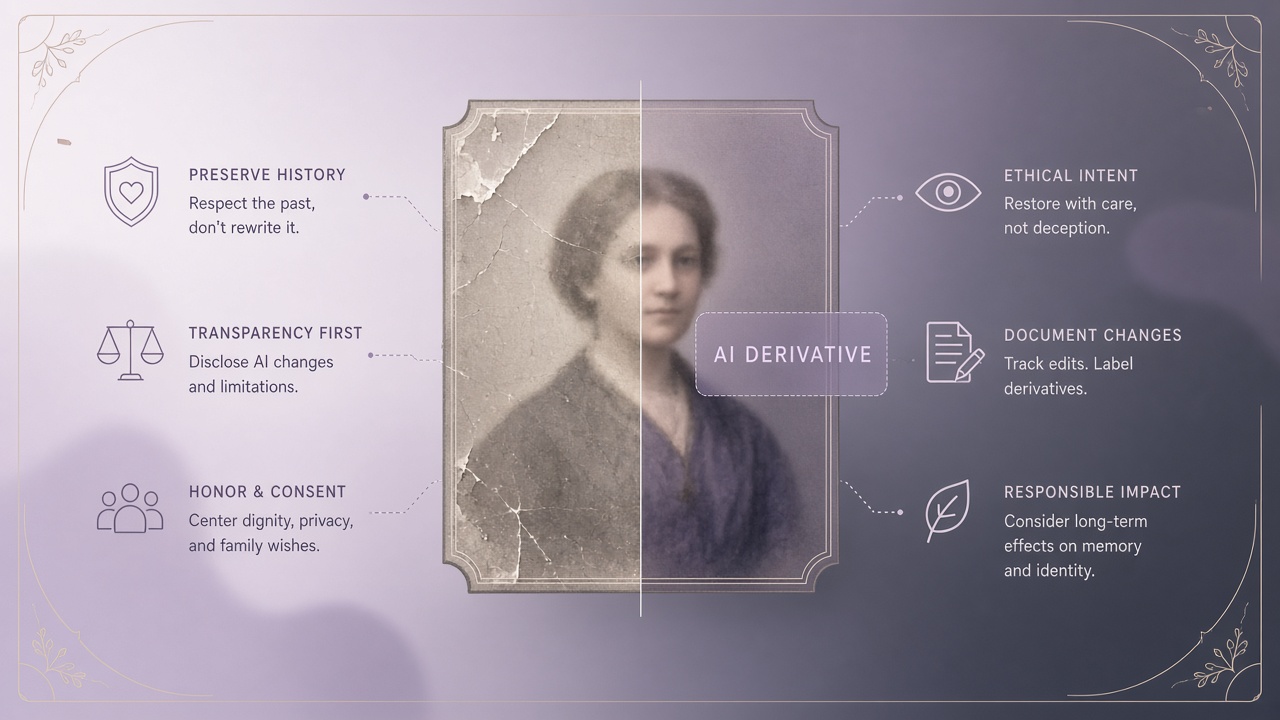
AI family photo restoration ethics require treating GFPGAN-style face repair and automatic colorization as interpretive derivatives, not recovered facts: restoration reconstructs missing facial detail from statistical priors, while colorization invents hues the camera never captured. Families love seeing great-grandparents clearly for the first time, yet archivists warn that unlabeled AI outputs can mislead descendants about eye color, uniform shades, and skin tone. Responsible practice preserves the original scan, documents every generative step, and reserves the unaltered file as primary evidence. Hobbyists exploring AI image generator apps or comparing popular AI tools should read vendor terms on training data and commercial reuse before gifting framed prints.
Damage Types Restoration Fixes
Mechanical damage includes scratches, creases, mold staining, and emulsion lift; chemical fading shifts contrast; digital noise appears after cheap phone re-photography of prints. Traditional conservators inpaint tears using pigment matched to surviving emulsion. AI tools accelerate denoising, dust removal, and contrast recovery across entire scans in minutes. Face-specific models like GFPGAN v1.3 target blurred or low-resolution portraits where human features are the emotional center of the heirloom.
GFPGAN leverages generative adversarial priors learned from large face datasets. Version 1.3 produces more natural skin than earlier releases but may slightly shift identity on very low-quality inputs, a documented trade-off in the project's model zoo. Version 1.2 sharpens aggressively and can look over-processed for archival purposes. Neither version recovers pixels that were never captured; they predict plausible anatomy.
Generative Fill and Hallucination Risks
When large missing regions are filled with generative models, the software invents buttons, wallpaper patterns, or background crowds that look authentic but are fiction. Severely damaged wet-plate collodion plates with emulsion separated from glass are especially risky: AI will paint convincing scenery into blank areas. For genealogical evidence, deliver the unmodified scan alongside any enhanced derivative and mark which zones were synthesized.
GFPGAN can normalize distinctive features toward dataset averages. Unusual nose shapes, asymmetric eyes, or culturally specific adornments may soften. Relatives who knew the person can spot subtle wrongness even when casual viewers feel delighted. Compare outputs across model versions and strength settings before choosing a holiday gift print.
| Technique | What it preserves | Ethical risk |
|---|---|---|
| Dust and scratch removal | Underlying tonal information | Low if edges stay faithful |
| GFPGAN face restore | General likeness | Identity drift on tiny faces |
| Generative inpainting | Visual plausibility only | Invented objects and scenery |
| AI colorization | Luminance detail if done second | False history for clothing and flags |
Ethics of Colorizing Unknown Hues
Monochrome photography never recorded color; models like DDColor predict chroma channels from luminance using training distributions that skew toward modern Western palettes. Academic critics note that popular colorization can reinforce nostalgic whiteness and authenticity myths, presenting speculative tinting as recovered memory. Military uniforms, regimental facings, and wedding saris carry genealogical meaning; guessing wrong erases cultural specificity.
Workflow order matters: restore faces and neutralize paper yellowing before colorization so detail is not painted twice. If a specific hue matters, consult written records, surviving textiles, or relatives before trusting the model. Side-by-side displays of monochrome and colorized versions communicate uncertainty better than color alone.
Labeling AI Alterations for Descendants
Genealogy educators recommend a transparency pyramid: untouched scans at the base, non-generative adjustments in the middle, and fully AI-enhanced or colorized derivatives at the top, trusted least for evidentiary claims. Embed metadata where formats allow: "Face restored with GFPGAN v1.3, March 2026" beats a vague "edited" note. For shared online trees, upload the scan as the primary media item and link enhanced versions as supplemental files. Printed gifts should include a caption card explaining generative steps.
When using multimodal AI image generator chat tools, avoid uploading identifiable minors or living persons unless privacy policies explicitly protect family data. Commercial services may train on uploads unless you opt out.
Metadata and File Naming Conventions
Consistent filenames such as smith-wedding-1952_scan.tif versus smith-wedding-1952_gfpgan-v13_colorized.jpg prevent descendants from mixing evidence tiers years later. IPTC keywords should include restoration software, model version, operator, and date processed. Cloud albums that auto-enhance uploads silently destroy provenance unless you disable enhancement pipelines or maintain parallel folders labeled originals and derivatives.
Printing services may apply their own sharpening and skin smoothing on top of your AI output, compounding identity drift. Request soft-proof PDFs and disable automatic beauty filters at checkout. For funeral programs and memorial slideshows, default to the highest-resolution scan with gentle tonal correction only unless the family explicitly votes for colorization after viewing samples.
Commercial Services vs DIY Apps
Consumer apps promise one-tap miracles; professional archivists charge for condition reports, reversible edits, and provenance documentation. DIY suits sentimental sharing on phones. Commissioned work suits estate settlements, museum loans, and legal disputes where chain of custody matters. Ask vendors whether they retain copyright on outputs and whether restorers manually mask generative regions.
Open-source stacks (GFPGAN, Real-ESRGAN, DDColor) give technical users control over strength parameters and local masking. Cloud APIs trade control for convenience. Neither removes the ethical obligation to label results.
Legal disputes over estate photos occasionally hinge on whether an enhanced image was presented as evidence of appearance at a specific date. Lawyers increasingly ask for RAW scans and processing logs. Families planning elder care or inheritance discussions should store both sentimental derivatives and forensic originals to avoid future disagreements about what grandparent really looked like in 1942.
Archive Ethics and Provenance
Museum and archive ethics treat photographs as evidentiary objects whose chain of custody, chemical process, and physical damage tell historical stories worth preserving. Aggressive inpainting that removes foxing or water stains without documentation can erase clues about storage conditions during wars or displacements. Scholars studying visual culture warn that colorization marketed as time travel collapses the distance between past and present, encouraging viewers to forget that monochrome was an aesthetic and economic choice, not an accident of history.
When families donate AI-enhanced prints to local historical societies, curators increasingly request the untouched scan as the accession and treat colorized versions as access copies labeled derivative. This mirrors practices around audio restoration: noise reduction is noted in catalog records so researchers know what they hear is not the raw groove.
Skin Tone and Representation Risks
Colorization models trained predominantly on modern datasets may lighten or darken skin unpredictably, imposing contemporary beauty norms on ancestors who lived under different photographic chemistry and studio lighting. Black and white film responded differently to melanin levels; naive colorization can misrepresent community heritage at reunions where elders recognize subtle wrongness even when younger relatives feel awe. Consult living family before publishing colorized portraits of deceased relatives in public obituaries or Wikipedia biographies.
GFPGAN's identity drift interacts with representation: smoothing distinctive facial structure can homogenize relatives across generations in composite albums. Side-by-side galleries that include the scan, conservative restoration, and optional colorization teach viewers to read images critically rather than consume the flashiest file as truth.
Tattoos, military ribbons, and religious garments carry identity markers that generative models invent when pixels are missing. Never use AI to reconstruct obscured insignia for veterans' displays without documentary proof. Uniform collectors and reenactment groups have rejected colorized portraits that assigned incorrect regimental colors, causing emotional harm at memorial events.
Batch-processing entire shoeboxes tempts families before reunions, but uniform settings across photos with different damage profiles produce inconsistent quality. Group portraits need conservative global contrast before face models run, or background relatives receive uneven sharpening. Children in motion blur may be "fixed" into faces that never existed; skip those frames or crop individuals manually.
Heirloom albums stored in attics often carry handwritten captions on margins; photograph those notes before scanning and store them as companion JPEGs. AI cannot read ink through glare, and captions sometimes correct wrong assumptions in later family lore. When colorizing, preserve caption text layers outside the image frame so provenance travels with the file bundle shared on USB drives.
Genealogy software thumbnails sometimes auto-crop to faces, hiding uniform details researchers need. Upload full-frame scans as master files and let the software generate crops. Wikimedia Commons and similar archives reject heavily colorized uploads without clear labeling; read each site's derivative work policy before donating AI-enhanced scans of notable ancestors.
Siblings may disagree about whether colorization honors or distorts memory. Family councils at reunions can vote on display rules: scans only on the ancestry wall, colorized versions in private chat groups, and no generative edits on official church or cemetery displays without unanimous consent from descendants who share copyright interest in the original print.
Practical Restoration Workflow
Start archival: high-resolution TIFF scan, color target if possible, multiple exposures of glossy prints to defeat glare.
- Store the raw scan read-only in three locations.
- Apply global tonal correction without generative models.
- Run conservative face restoration on cropped portraits only.
- Decide whether colorization serves the family story or misleads it.
- Export derivatives with descriptive filenames and README notes.
- Share comparisons at reunions so elders can veto inaccurate details.
Frequently Asked Questions
Should AI invent missing tattoo or jewelry detail?
No. If ink or jewelry is illegible in the scan, leave it ambiguous rather than hallucinating designs that descendants may treat as fact. Manual inpainting with family confirmation is the only ethical path for culturally significant marks.
How accurate are uniform colors on soldiers?
Regimental colors vary by year and theater; AI colorization without unit research is unreliable for military genealogy. Cross-check service records, pension files, and regimental histories before printing color portraits for memorial displays.
What metadata should accompany shared files?
Record scanner settings, date processed, software version, generative model name, and operator initials in IPTC or sidecar JSON. Future researchers need to know which pixels were observed versus synthesized.
Is it ethical to gift AI-restored prints?
Gifts are welcome when recipients understand the image is enhanced and the original scan remains available. Pair framed colorized prints with a USB drive containing the untouched scan and a short process note.
Do museums accept AI-restored submissions?
Accredited archives generally require reversible, documented conservation; heavy generative restoration usually fails acquisition standards. Offer scans first; propose AI only as access copies clearly marked derivative.
Should you post AI colorized ancestors on social media?
Caption every post with AI disclosure and link to the original scan when possible so shares do not strip context. Relatives who object to public colorization should have veto power over identifiable likenesses.
How strong should GFPGAN settings be?
Start at the lowest strength that clears blur; increase only until relatives confirm likeness, then stop. Version 1.3 favors natural skin but trades sharpness; choose version based on whether the print will be wallet-sized or poster-sized.
What about AI animated portrait videos?
Deepfake-style animations that blink and nod go beyond restoration into performance; disclose them clearly and avoid implying the ancestor actually moved on camera. Many families find animations delightful for slideshows but inappropriate for legal or historical archives.