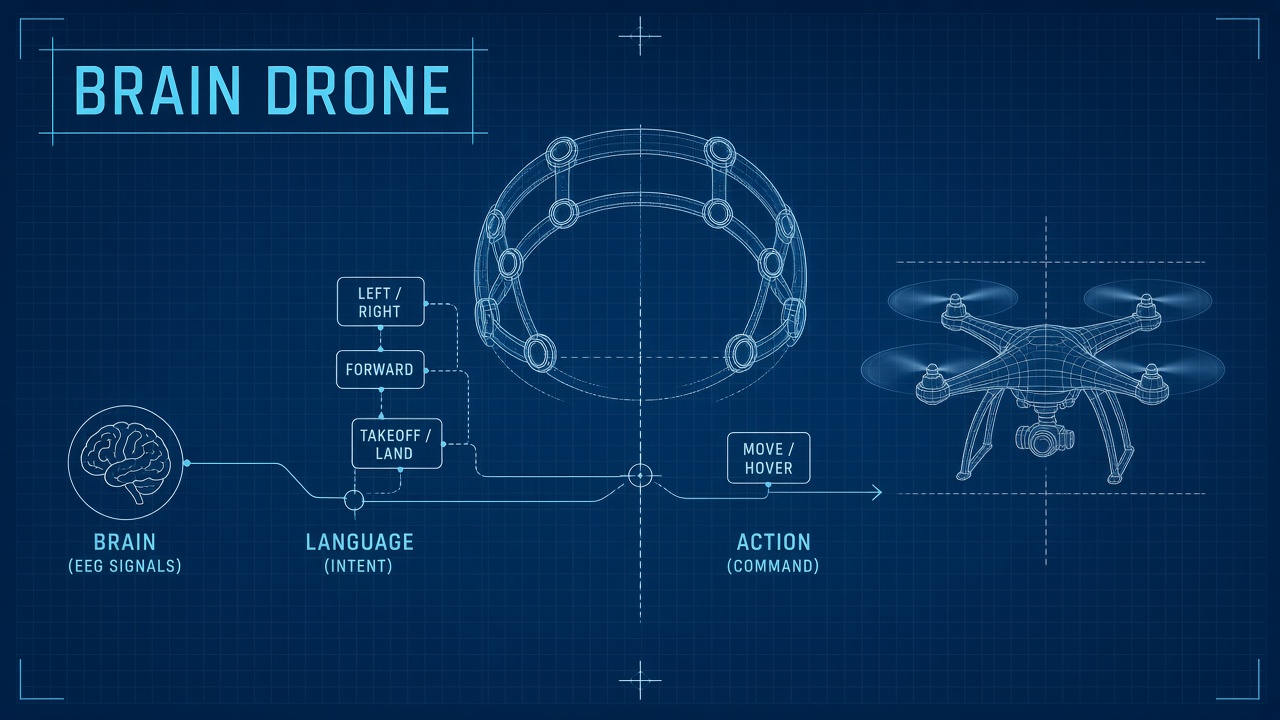
Brain-Language-Action (BLA) models use natural language to condition how motor-imagery EEG states map to robotic actions, letting four distinguishable brain classes control a larger action space without training new neural categories. A proof-of-concept BLA for drone flight (arXiv:2608.28967) encodes 250 Hz, 22-channel, 3.5-second EEG windows into brain tokens, projects them into Qwen3-0.6B embedding space, and autoregressively generates three-token flight commands. Across 840 language-defined mappings between four neural states and seven validated action sequences, subject-specific models reached 90% per-token accuracy in offline evaluation. This is not yet real-time drone flight, but it reframes EEG robotics as a language-conditioned control problem. Readers in AI research on brain-computer interfaces or browsing AI research tools should treat BLA as a scaling strategy for noisy non-invasive signals.
Why Direct EEG-to-Action Scaling Fails
Classic EEG-based robot control trains a classifier on N motor-imagery classes and maps each class to one fixed action, so expanding the action menu requires collecting new distinguishable brain states, which becomes impractical beyond a handful of commands. Motor imagery of left hand, right hand, feet, and tongue produces modest separability in scalp EEG. Environmental noise, electrode drift, and day-to-day nonstationarity further erode margins. Each additional action class demands more training data and often worse accuracy for all classes.
Fine-grained drone control might need yaw adjustments, altitude holds, and compound maneuvers numbering in the dozens. Training separate motor imagery patterns for every maneuver is unrealistic for most users, especially those with motor disabilities who might benefit most from BCIs. BLA sidesteps the bottleneck by holding the neural classifier at four reliable states while language instructions remap those states to different flight sequences per session or context.
Language conditioning borrows from multimodal AI: vision-language models map images to captions; BLA maps brain tokens plus instruction text to action tokens. The instruction might read which motor imagery class corresponds to "ascend", "descend", "rotate clockwise", or "hover" for the current mission profile. Pilots switching from indoor practice to outdoor filming remap bindings without recollecting EEG calibration data, analogous to rebinding keyboard shortcuts in flight simulator software.
The combinatorial argument is quantitative: four reliably classified neural states alone support only four fixed actions in direct BCIs. Seven validated action combinations permuted across four neural assignments yield 840 distinct control schemes. Language specifies which permutation is active, letting the LLM stage disambiguate context that raw EEG cannot encode.
Two-Stage BLA Training Pipeline
BLA training splits into brain-encoder pretraining on four-class motor imagery, then joint fine-tuning of the encoder, brain-to-language projection MLP, and Qwen3-0.6B on language-conditioned action generation. Stage one evaluates candidate EEG encoders (EEGNet variants, EEG-Inception, Conformer-style architectures) on the BCI Competition IV Dataset 2a, a standard four-class motor imagery benchmark. The winning EEG-Inception encoder converts each window into five 128-dimensional brain-token embeddings.
Stage two inserts a multilayer perceptron that projects each 128-dimensional token into Qwen3-0.6B's 1024-dimensional token embedding space. The language model autoregressively predicts a structured three-token drone action sequence conditioned on both brain embeddings and natural-language mapping instructions. Fine-tuning runs 30 epochs with batch size 16, learning rate 10^-3, and a 10% held-out subject-specific evaluation split (random seed 2025). Four subjects (1, 3, 7, and 8) with strongest encoder performance received complete BLA models.
| Stage | Input | Output |
|---|---|---|
| Encoder pretrain | 22-ch EEG, 3.5 s, 250 Hz | Five 128-d brain tokens; 4-class MI label |
| Brain-to-language projection | Brain tokens | 1024-d vectors in LLM embedding space |
| BLA fine-tune | Brain tokens + mapping instruction text | Three-token drone action sequence |
Language-Defined Control Mappings
Each mapping assigns the four neural states to an ordered subset of seven validated flight action combinations, yielding P(7,4) = 840 permutations that language instructions specify at runtime. Seven action combinations cover the drone maneuver vocabulary used in the study (takeoff, directional moves, rotations, and landings expressed as three-token sequences). A natural-language prompt tells the model which neural class triggers which maneuver for the current session. Switching mappings changes control semantics without retraining the EEG encoder on new motor imagery patterns.
Authors validated all 840 mappings in the Webots robotics simulator using the Mavic 2 Pro drone template, confirming each structured action sequence executes as a legal flight command. Simulation verified action-space feasibility only; it was not part of BLA training loss. This separation keeps evaluation honest: high token accuracy reflects language-conditioned decoding, not physics-aware reinforcement learning inside the loop.
Motor Imagery Datasets Used
The proof-of-concept relies on BCI Competition IV Dataset 2a, nine subjects performing cued motor imagery of left hand, right hand, feet, and tongue with 22 EEG channels at 250 Hz. Dataset 2a is widely used for benchmarking motor imagery decoders, enabling comparison with EEGNet and related architectures. Subject-specific training respects inter-subject variability; cross-subject BLA transfer is not reported as a primary result. Consumer headsets with fewer channels or different montages would require retraining and likely lower encoder accuracy before BLA fine-tuning could succeed.
Accuracy vs Traditional BCI Classifiers
Traditional four-class motor imagery pipelines output a single class label per window; BLA adds a second stage that must predict three action tokens per command, achieving 90% per-token accuracy averaged across the four subject-specific models. Per-token accuracy is stricter than single-label classification because an error on any of three tokens mis-specifies the maneuver. Compare against encoder-only four-class accuracy on Dataset 2a for a fair baseline; the paper reports EEG-Inception as the strongest encoder family among candidates tested.
BLA does not claim superiority over invasive BCIs or high-channel research rigs. It demonstrates language conditioning as a combinatorial multiplier on top of a modest non-invasive class count. Hybrid systems could pair BLA with adaptive spellers or error correction if token error rates remain too high for safety-critical flight.
Encoder architecture search compared multiple families before selecting EEG-Inception for the complete BLA stack. Subject-specific training respects that motor imagery topographies differ across individuals: sensorimotor rhythm suppression patterns for imagined right-hand movement vary in spatial distribution. Four subjects (1, 3, 7, 8) showed strongest encoder metrics and received full BLA fine-tuning; other Dataset 2a subjects may need longer calibration or alternative paradigms before BLA fine-tuning succeeds.
Three-token action sequences structure the LLM output vocabulary, constraining generation to valid drone command grammars rather than free-form natural language that would be impossible to execute on a flight controller. Structured outputs mirror tool-calling patterns in LLM agents, but here tools are motor primitives validated in Webots simulation.
Latency, Training Time, and Accessibility
The published BLA study is an offline batch evaluation on stored EEG trials, not closed-loop real-time drone control; deployment would add encoder inference, LLM token generation, and wireless telemetry latencies that the paper does not benchmark in physical flight. Fine-tuning 30 epochs on subject-specific splits is modest by deep learning standards but still requires labeled EEG sessions per user. Motor imagery BCIs demand users who can reliably produce class-specific imagery, which excludes some neurological conditions unless alternative paradigms (P300, SSVEP) replace motor imagery in future BLA variants.
For users with motor disabilities, BLA's promise is remapping a stable small set of intentional brain states to many assistive actions via voice-readable mapping instructions, potentially reducing recalibration when switching tasks (wheelchair mode versus communication mode). Realizing that promise needs user studies measuring mental fatigue, mapping comprehension, and error recovery in real environments.
Qwen3-0.6B keeps joint fine-tuning computationally tractable compared with multi-billion-parameter models, important if future deployments target edge devices paired with consumer EEG headsets. Joint optimization of encoder, projection MLP, and LLM allows brain representations to align with token prediction loss rather than stopping at four-class accuracy alone. Whether smaller LLMs generalize to novel mapping instructions not seen during fine-tuning remains an open evaluation gap in the published offline study.
Safety-critical drone operation would require hardware kill switches, geofencing, and human override regardless of BCI accuracy. BLA research sits at the proof-of-concept stage: offline trials, simulated physics, no human pilot in the loop during live flight. Translating 90% per-token accuracy into acceptable maneuver error rates demands domain-specific risk analysis beyond aggregate accuracy metrics.
Future BLA variants could swap motor imagery for steady-state visual evoked potentials (SSVEP) or P300 spellers if users cannot perform imagery reliably. Language conditioning would remain: the LLM stage maps whichever small neural alphabet is reliable into larger action vocabularies. Cross-paradigm BLA is speculative but follows the same scaling logic that motivated the original drone proof-of-concept on Dataset 2a.
Comparison with traditional CSP-LDA motor imagery pipelines on Dataset 2a provides context: linear methods peak around 70-80% four-class accuracy in literature summaries, while deep encoders squeeze additional margin needed before BLA language fine-tuning. Weak encoders would collapse BLA token accuracy regardless of LLM capacity, making stage-one architecture search non-optional.
Dataset 2a uses cue-aligned trials in a laboratory setting with minimal environmental distraction. Real drone operation introduces wind, auditory alarms, and visual clutter that increase EEG artifact load. Future field studies must quantify whether BLA mappings remain stable when users are not seated in shielded rooms wearing gel-based caps. Dry electrode consumer headsets add another accuracy layer before language conditioning delivers practical benefit outside research labs. Hybrid BCIs that fuse EEG with eye tracking or jaw clench EMG may stabilize control channels before BLA language expansion becomes practical for assistive technology pilots.
Frequently Asked Questions
Does BLA fly real drones today?
No. Evaluation used offline EEG trials and Webots simulation for action validation. Physical drone tests with live EEG streaming are future work requiring safety protocols, fail-safe overrides, and latency optimization.
What language model does BLA use?
Qwen3-0.6B (Qwen Team technical report, arXiv:2505.09388), fine-tuned jointly with the brain encoder and projection MLP. Smaller models reduce on-device deployment cost relative to multi-billion-parameter LLMs.
What are the 840 mappings?
Assignments of four distinct neural states to ordered selections of four maneuvers drawn from seven validated flight action combinations: 7 x 6 x 5 x 4 = 840 permutations. Language prompts tell the model which assignment is active.
Will consumer EEG headsets work?
Unlikely without retraining. The study uses 22 research-grade channels and subject-specific calibration. Consumer devices with dry electrodes and fewer sensors typically achieve lower motor imagery accuracy than laboratory caps.
How long is user training?
Dataset 2a sessions are standardized competition recordings; real users need multiple imagery practice blocks before encoder pretraining converges. BLA adds mapping-familiarization so users understand which imagery state triggers which maneuver under the current language instruction.
Can BLA help people with motor disabilities?
Potentially, if users can produce consistent motor imagery or if future versions swap paradigms. Language remapping could reduce the cognitive load of learning many distinct brain patterns. Clinical assistive deployment remains speculative pending safety testing and regulatory review.
Where is the BLA paper published?
"Brain-Language-Action (BLA) Models: Language-Conditioned EEG for Robotics Control" (arXiv:2608.28967). The work connects AI research on embodied agents with non-invasive neural interfaces.