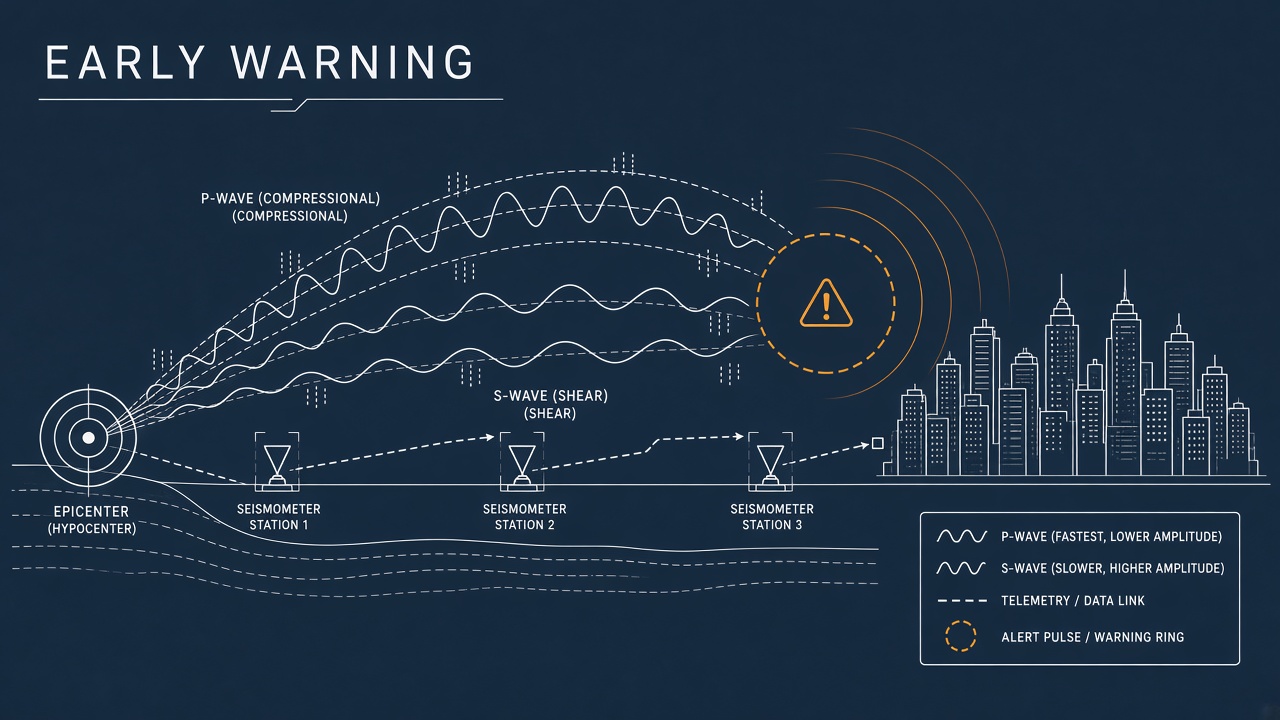
Earthquakes send two main wave types through the ground. P-waves (primary compressional waves) arrive first and cause little damage. S-waves (secondary shear waves) follow more slowly and produce the violent shaking that collapses shelves and stresses buildings. Earthquake early warning (EEW) systems detect P-waves on distributed seismometers, estimate location and magnitude in seconds, and push alerts before S-waves reach distant cities. Machine learning is entering this pipeline through faster phase picking, fiber-optic arrays, and smartphone crowdsensing, while operational systems like ShakeAlert still rely on physics-based source estimators refined over decades. This explainer covers warning time budgets, network design, false-alarm reduction, and what phone apps can realistically deliver. Followers of AI research and readers browsing popular AI research topics will see where neural networks complement, rather than replace, seismological algorithms proven in real events.
Physics of Warning Time Budgets
Warning time equals the gap between P-wave detection at sensors and S-wave arrival at the user, minus processing and delivery latency; near-epicenter populations often receive zero seconds. P-waves travel roughly 4 to 7 kilometers per second in crustal rock; S-waves travel about half that speed. A city 100 kilometers from the hypocenter might gain 10 to 20 seconds if algorithms finish quickly. Japan's Meteorological Agency issues public alerts when P-waves are detected at two or more of roughly 4,200 seismometers nationwide. Cell broadcast pushes messages to millions of phones in affected areas within about 2 to 3 seconds after processing begins, though people very close to the fault still shake before any alert arrives.
The December 5, 2024 Mw 7.0 Offshore Cape Mendocino earthquake tested the U.S. West Coast ShakeAlert system. EPIC, ShakeAlert's point-source algorithm, produced its first solution 15 seconds after origin time with initial magnitude M 5.6 and location error about 10 kilometers from the ANSS catalog epicenter. FinDer contributed finite-fault geometry at 18 seconds. Roughly five million alerts reached cell phones in California and Oregon. Maximum warning before intensity 6+ shaking ranged from about 5 to 55 seconds depending on distance, according to USGS performance analysis published in 2025. Offshore events with sparse near-source stations remain hard: location error and magnitude growth dominate the first tens of seconds.
Distributed Sensor Networks
EEW quality scales with station density, telemetry latency, and diversity of data types including GNSS geodesy and undersea cables. ShakeAlert Version 3 went live for public alerting in California, Oregon, and Washington on March 18, 2024. It integrates seismic algorithms EPIC and FinDer with geodetic GFAST peak ground displacement (PGD) data so large ruptures update magnitude estimates faster than P-wave amplitude alone. Four redundant processing centers (Pasadena, Moffett Field, Berkeley, Seattle) issue messages when magnitude and predicted shaking cross thresholds.
Japan layers additional methods. The Integrated Particle Filter (IPF) updates source parameters as waves arrive. PLUM (Propagation of Local Undamped Motion) predicts shaking intensity without waiting for full hypocenter convergence, which proved critical during the January 1, 2024 Noto Peninsula Mj 7.6 earthquake. The first public warning issued 6 seconds after initial P-wave detection, focused on northern Ishikawa Prefecture. A broader warning followed 27.1 seconds later when strong shaking observations triggered PLUM, reaching prefectures hundreds of kilometers away according to Earth, Planets and Space (2025). Dense offshore networks like Japan's seafloor observation system improve timing for coastal megathrust events where land stations sit far from the hypocenter.
| System / region | Primary detection logic | Typical public alert channel |
|---|---|---|
| ShakeAlert (U.S. West Coast) | EPIC point source, FinDer finite fault, GFAST-PGD | Wireless Emergency Alerts, Android Earthquake Alerts |
| JMA EEW (Japan) | IPF hypocenter updates, PLUM intensity prediction | Cell broadcast, TV, apps, industrial auto-shutdown |
| SASMEX (Mexico City) | Coastal network P-wave triggers for distant subduction | Sirens, radio, dedicated receivers |
| Research: dEPIC + DAS | ML phase picker on fiber-optic strain arrays | Experimental; pairs with EPIC in Monterey Bay tests |
ML False-Alarm Reduction Techniques
Machine learning most often improves P-wave picking and classifying noise, while magnitude and location fusion still use seismological inversions tuned to limit over-alerting. ShakeAlert's decision module suppresses messages below magnitude and shaking intensity thresholds because false alarms erode public trust faster than missed distant events. EPIC requires P-wave arrivals from at least four stations and publishes initial solutions within about 4 to 6 seconds for crustal earthquakes in dense networks, per BSSA Version 3 performance papers (2025).
Research systems push ML further. dEPIC (DAS Earthquake Point-source Integrated Code), described in Scientific Reports (2025), applies GPU-accelerated neural phase pickers to distributed acoustic sensing on fiber-optic cables, then grid-searches event location and magnitude. It can run standalone or exchange solutions with operational EPIC for Monterey Bay scenarios. Smartphone crowdsensing projects like MyShake at UC Berkeley use phone accelerometers as supplemental sensors; ML classifies human motion versus seismic transients. Phones will not replace broadband seismometers for magnitude 7 events, but they extend coverage in urban gaps and validate shaking maps after the fact.
Public Alert Apps and School Drills
Delivery latency matters as much as detection: cell broadcast, proprietary OS pipelines, and institutional auto-actions must fire within the few-second budget. U.S. Android Earthquake Alerts and Wireless Emergency Alerts distribute ShakeAlert-powered messages when predicted shaking exceeds configured MMI levels. Japan trains students to duck under desks when phones vibrate with EEW tones; railways and factories wire automatic brakes and shutdowns. Mexico City's SASMEX emphasizes coastal early detection because the capital sits on lake bed sediments that amplify waves from distant subduction zones, buying tens of seconds that near-fault Los Angeles suburbs might not receive for local ruptures.
Drills teach protective actions: drop, cover, hold on, not running outdoors where facades shed debris. EEW is not prediction of future earthquakes; it is rapid characterization of earthquakes already underway. Aftershock sequences may trigger additional alerts. Users should enable location services required by their platform and understand that silent mode overrides vary by carrier and OS version.
Mexico City and Global EEW Systems
Mexico's SASMEX network targets subduction earthquakes along the Pacific coast, giving Mexico City up to roughly 60 to 90 seconds of lead time for distant large events while offering little warning for nearby crustal breaks. Coastal seismometers detect P-waves from Guerrero and Oaxaca segments, then sirens and radio alerts propagate faster than S-waves crossing hundreds of kilometers inland. The capital's lake-bed amplification makes even moderate distant events feel severe, so false alarms carry political cost and systems tune thresholds accordingly.
Taiwan, South Korea, Italy, and Romania operate or pilot variants with different station densities and delivery channels. Common design principles persist: redundant telemetry under 2 seconds for most stations (ShakeAlert Cape Mendocino analysis noted network latencies under 2 seconds for the majority of contributing sites), multi-algorithm fusion, and explicit public education that alerts are not predictions. International visitors should enable local phone settings rather than assuming a home-country earthquake app works abroad.
Limits for Very Close Epicenters
Inside the S-wave shadow near the rupture, physics forbids meaningful warning; ML cannot violate wave travel times. ShakeAlert performance studies for the 2022 M 6.4 Ferndale earthquake reported 0 to 23 seconds of warning at locations experiencing MMI 6 shaking, with zero seconds common at the strongest shaking nodes. Offshore hypocenters add location uncertainty that delays magnitude growth, as Cape Mendocino demonstrated. Geodetic integration in Version 3 specifically targets under-estimated large magnitudes during the first few seconds of rupture propagation.
Frequently Asked Questions
Does ShakeAlert predict earthquakes before they start?
No. ShakeAlert detects P-waves from earthquakes that have already begun and estimates how shaking will spread. Short-term prediction of arbitrary future quakes remains unsolved. EEW is a real-time characterization problem, not clairvoyance.
How much warning is enough to matter?
Even 5 to 10 seconds helps individuals take cover, slows trains, isolates gas lines, and pauses surgery. Industrial installations target automated responses at 2 seconds after alert receipt. Japan's multi-decade culture of drills amplifies the value of short windows.
What changed in ShakeAlert Version 3?
Version 3 incorporated geodetic GFAST-PGD data into operational alerting starting March 18, 2024, alongside EPIC and FinDer seismic modules. BSSA papers in 2025 document expected performance gains for large earthquakes where rapid magnitude growth is critical.
Where does machine learning fit today?
ML improves phase picking on fiber DAS arrays (dEPIC), denoises accelerometer feeds, and supports research on Bayesian priors in EPIC updates. Operational West Coast alerting still centers on EPIC, FinDer, and GFAST with rule-based decision modules, not end-to-end black-box predictors.
Why are false alarms so costly?
Repeated over-alerts cause alert fatigue, leading people to disable notifications before the event that matters. Systems therefore trade sensitivity for specificity, especially in urban noise environments. Spurious triggers from single stations, industrial blasts, or telemetry glitches are filtered through multi-station consistency checks.
What is the ShakeAlert decision module?
The decision module issues ShakeAlert messages only when combined magnitude and predicted shaking intensity cross configured thresholds. It sits after EPIC, FinDer, GFAST-PGD, and the solution aggregator merge source parameters. Tuning this layer balances lives saved against false alarm rates that erode compliance over years of benign triggers.
Do aftershocks trigger new warnings?
Yes, if they exceed alerting thresholds. Aftershock sequences can produce multiple messages in minutes. Public education distinguishes mainshock protective actions from ongoing vigilance. Magnitude estimates may update as rupture evolves, which is why Japan issues revised EEW updates until shaking subsides.
Smartphone Crowdsensing and MyShake
UC Berkeley's MyShake and similar apps turn phone accelerometers into supplemental sensors when devices are stationary on tables or nightstands. Classifiers distinguish seismic shaking from walking or vehicle vibration. Crowdsourced detections cannot drive public alerts alone because phone density and orientation vary, but they enrich rapid intensity maps after triggering and help researchers locate ruptures where fixed networks are sparse. Privacy policies should clarify whether anonymized waveform snippets leave the device and how long they are retained. Future ShakeAlert revisions may incorporate research on Bayesian priors in EPIC and expanded station integration noted in 2025 BSSA performance papers, gradually moving proven ML components from testbeds into operations without sacrificing the transparency seismologists demand. School districts that wired ShakeAlert-powered public address systems, as during the December 2024 Cape Mendocino event, demonstrate how institutional playbooks convert seconds into organized shelter-in-place rather than panic.
AI earthquake early warning extends a mature geophysical service: shave seconds off detection and delivery, classify noise on novel sensors, and fuse diverse data streams. It does not repeal wave physics. ShakeAlert Version 3's geodetic integration and Japan's PLUM intensity forecasting show how hybrid algorithms save lives when networks are dense and societies rehearse responses. For adjacent sensing topics, see AI research articles linked from popular AI research collections. Install official alert channels for regions you live in or travel through, and rehearse protective actions so the first real warning meets muscle memory rather than confusion about what the phone vibration means.