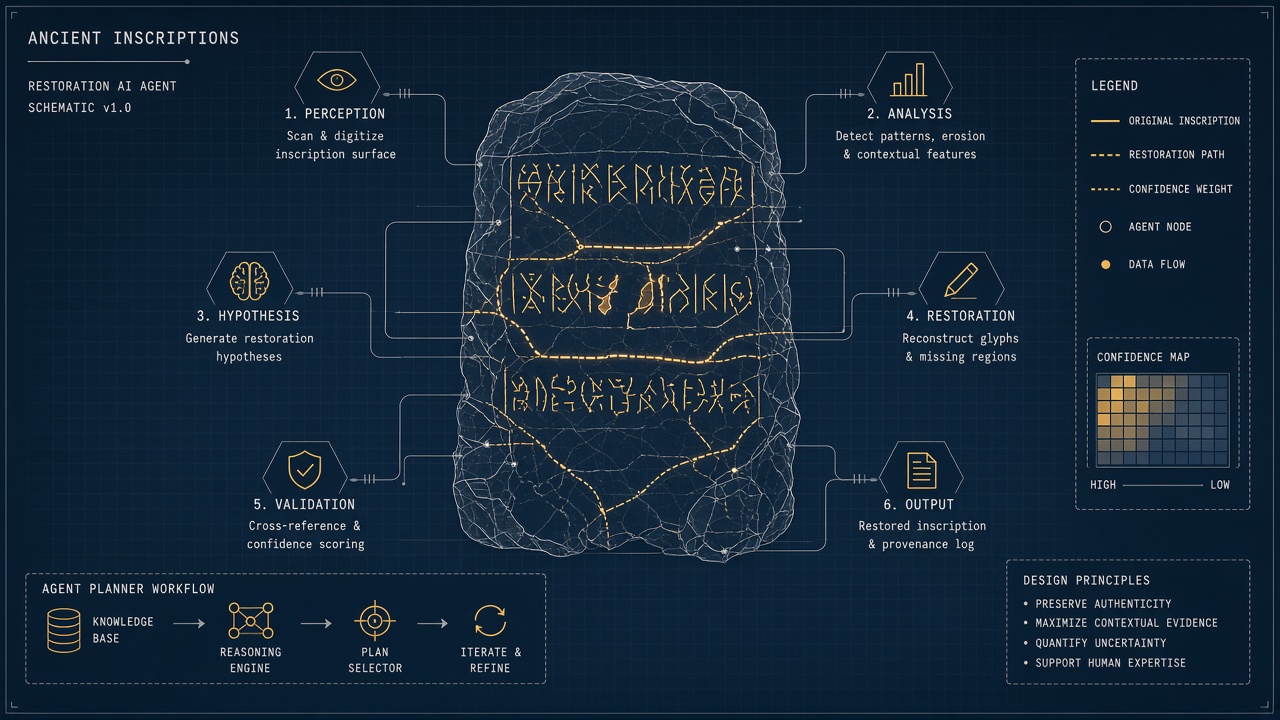
EpiAgent is a CVPR 2026 agent-centric system that restores degraded ancient Chinese inscriptions by looping through Observe, Conceive, Execute, and Reevaluate stages, with a Kimi-K2 planner coordinating denoising, stroke completion, font imitation, and historical text retrieval. Unlike rigid patch-based pipelines, EpiAgent mirrors how human epigraphers alternate between visual inspection, paleographic reasoning, and tool use. The approach reports stronger generalization across slight, middle, and severe degradation tiers on the CIRI benchmark than general-purpose image editors such as SeedEdit-3.0 and LucidFlux. Teams following AI research on agentic cultural heritage or AI research infrastructure for multimodal planning should treat EpiAgent as a reference architecture for expert-level digital epigraphy.
Limits of Patch-Based Restoration
Single-pass inpainting models excel at local texture fill but fail when erosion, cracking, and ink loss corrupt both glyph shape and semantic content on stone rubbings and stele photographs. Ancient inscriptions couple visual degradation with textual ambiguity: a missing stroke may correspond to multiple historically valid characters. Convolutional denoisers trained on synthetic scratches often hallucinate modern typefaces or simplified characters that violate period script conventions. General foundation models marketed for text image editing lack strategic sequencing; they cannot decide when to consult a historical corpus before attempting stroke synthesis.
EpiAgent authors benchmark against SeedEdit-3.0 and LucidFlux, noting that powerful generative editors still struggle with coupled noise and semantics on real rubbings. Quantitative gaps on character recognition and normalized edit distance metrics validate the need for domain orchestration rather than bigger diffusion checkpoints alone. Patch models also ignore provenance: a restored glyph without documented reasoning is unusable in museum publication pipelines that require audit trails.
Environmental factors compound the problem. Moisture, lichen, and deliberate defacement create heterogeneous damage patterns within a single line of text. Lighting variation across field photographs introduces shadows that patch networks misread as ink. Agent systems can branch: first classify degradation type, then route to specialized sub-tools instead of forcing one network to handle all failure modes.
Human Epigrapher Workflow Mimicry
EpiAgent operationalizes the deliberative workflow of professional epigraphers who observe rubbings, conceive hypotheses from parallel texts, execute restoration strokes, and reevaluate results against paleographic rules. The central planner, implemented with the Kimi-K2 agentic language model, formulates restoration as hierarchical planning over degraded image I and degradation factors D, aiming for output Î that maximizes textual authenticity and visual fidelity. The loop continues until a stopping criterion is met, not after a fixed number of diffusion steps.
Human teams rarely restore in one sitting. An epigrapher might photograph a stele, compare rubbings in a library, consult a specialist on seal script variants, then return with revised stroke proposals. EpiAgent encodes that rhythm: Observe collects multimodal signals from hybrid generalist-specialist modules plus a historical corpus; Conceive drafts restoration strategy; Execute invokes tool APIs; Reevaluate scores results and may trigger another cycle. This mirrors collaborative studio practice more closely than autonomous inpainting.
Self-reflection modules let the planner critique intermediate outputs against rubric dimensions such as stroke continuity, character retrieval confidence, and style period consistency. When reevaluation fails, the agent revises tool selection rather than accepting the first plausible fill. That behavior is difficult to replicate with static pipelines that lack explicit reasoning state.
| Stage | Agent action | Human parallel |
|---|---|---|
| Observe | Multimodal analysis, damage typing, corpus lookup | Field survey, rubbing comparison |
| Conceive | Plan tool sequence and character hypotheses | Draft reading notes, consult colleagues |
| Execute | Denoise, complete strokes, imitate period font | Ink reconstruction, digital tracing |
| Reevaluate | Score fidelity, loop or finalize | Peer review, publication vetting |
Multimodal Tool Orchestration
EpiAgent integrates specialized restoration tools for denoising, stroke completion, font imitation, and character retrieval, with the planner deciding invocation order based on observed damage. Generalist modules handle broad visual understanding while specialist modules target script-specific stroke rules. Historical experience accumulates across sessions, letting the system reuse successful patterns on similar stele types. Expert feedback channels allow human epigraphers to inject corrections that reshape subsequent planning steps.
Tool orchestration distinguishes agent restoration from monolithic models. A severe crack might require denoising before character retrieval; a faint rubbing might skip aggressive denoise to preserve stroke edges. The planner can also query parallel inscriptions in the historical corpus when local evidence is ambiguous, similar to how scholars cite known exemplars from the same dynasty. Code is available at github.com/blackprotoss/EpiAgent for reproducibility.
Authors explored replacing the restoration toolkit with Qwen-Image-Edit and found tradeoffs in controllability versus raw generative power. Domain-specific toolchains plus planning outperformed naive substitution, reinforcing that heritage tasks need curated capabilities rather than general editors alone. Multimodal analysis modules feed structured summaries to the planner, reducing hallucinated tool calls.
Generalization Across Degradation Types
On CIRI test splits stratified into slight, middle, and severe damage, EpiAgent maintains performance leads across visual and textual metrics, suggesting the agent loop adapts strategy to degradation severity. Supplemental CVPR 2026 results show consistent gains over competing methods at each tier. Qualitative figures illustrate preserved calligraphic style fidelity even when large regions are missing. Synthetic and real-world test partitions help separate memorization from robust reasoning.
Generalization matters because museum digitization backlogs mix conditions within one collection. A pipeline tuned only on light noise fails on flood-damaged rubbings. Agent reevaluation provides a built-in sanity check: if stroke completion produces characters outside the expected script period, the loop can reject and retry with different retrieval constraints. That adaptive behavior is central to the EpiAgent inscription restoration story for practitioners evaluating production deployment.
Transfer to non-Chinese scripts remains an open research question. The Observe-Conceive-Execute-Reevaluate scaffold is script-agnostic, but tool weights and corpora are Chinese-centric in the published work. Institutions with Greek, Sanskrit, or Mayan corpora would need parallel historical databases and paleographic rule sets before claiming parity.
Evaluation metrics on CIRI combine normalized edit distance for recovered text with perceptual scores for visual continuity. Teams benchmarking competing systems should report both axes: a readable but visually anachronistic restoration misleads exhibition designers, while a pretty rubbing that invents wrong characters misleads historians. EpiAgent authors stratify test severity so buyers of heritage software can see whether gains hold on flood-stained rubbings rather than only laboratory scratches.
Compute cost scales with loop iterations. Severe damage may trigger four or more Execute-Reevaluate cycles, multiplying GPU minutes per stele. Budget-conscious archives can cap iterations and route only high-priority artifacts through full agent treatment while using lighter denoisers on bulk inventory photography. Hybrid staffing models pair junior digitization technicians who trigger runs with senior epigraphers who approve final layers.
Provenance and Colonial Holdings Ethics
Automated restoration of inscriptions removed during colonial campaigns raises questions about who authorizes digital repair, how outputs are labeled, and whether enhanced legibility accelerates contested repatriation debates. Many steles in European and North American museums lack community consent for aggressive reconstruction that implies definitive readings. EpiAgent outputs should be published as scholarly hypotheses with uncertainty bands, not as restored originals suitable for tourism marketing without descendant nation review.
Open release of weights and code benefits reproducibility but can enable unsupervised edits on sacred or restricted texts. Governance frameworks should require institutional review boards for agent-assisted restoration on materials under indigenous stewardship. Metadata should record planner decisions, tool invocations, and human overrides to support later audit if political or legal challenges arise.
Digital restoration must not substitute for physical conservation funding. Agent polish on a rubbing cannot replace climate control for the underlying stone. Partnerships with source communities should precede public-facing character claims, especially when readings affect territorial or religious narratives tied to inscription content.
CVPR 2026 visibility will likely spur commercial heritage vendors to market agent wrappers around generic LLMs. Buyers should demand published CIRI-equivalent benchmarks and side-by-side epigrapher preference studies before licensing. A planner that loops without domain tools may look agentic yet reproduce the same hallucinations as one-shot inpainting.
Production deployment for museums should version-control each Observe-Conceive-Execute-Reevaluate trace. When a stele reading later faces challenge, curators can replay which historical corpus passages influenced a stroke proposal. That audit trail distinguishes agent restoration from opaque generative fills that leave no reasoning log. Batch processing rubbings for a entire dynasty collection may queue overnight on GPU clusters while human reviewers tackle flagged low-confidence lines during business hours.
Integration with existing digital humanities stacks typically exports restored layers as SVG overlays atop IIIF image servers. Scholars toggle between raw field photos, intermediate denoise passes, and final hypothesized characters without overwriting archival masters. EpiAgent inscription restoration therefore fits preservation-first workflows where the original bitmap remains immutable and all edits live in derivative layers with Creative Commons or institutional license tags.
Frequently Asked Questions
Is EpiAgent open source?
Yes. The authors released code at github.com/blackprotoss/EpiAgent alongside the CVPR 2026 paper. Dataset access may require separate agreements depending on museum partners.
Can EpiAgent restore 3D scanned steles?
The published system targets 2D inscription photographs and rubbings. Feeding orthographic renders from photogrammetry is possible, but native mesh-aware planning is not demonstrated in the paper.
How does EpiAgent compare to general image editors?
Benchmarks show general editors struggle with coupled degradation on ancient text. EpiAgent wins on recognition and edit-distance metrics by orchestrating domain tools iteratively.
Should museums use agent restoration for tourism displays?
Only with clear labeling that views are computational hypotheses. Consult source communities and epigraphers before presenting restored text as authoritative in public galleries.
What planner model does EpiAgent use?
The central planner is implemented with Kimi-K2, an agentic large language model that issues tool calls and reevaluation prompts across the restoration loop.
Does EpiAgent work on non-Chinese scripts?
Not out of the box. The architecture transfers, but corpora and specialist tools in the release focus on Chinese inscription traditions.
Where should I follow agentic heritage research?
CVPR and digital humanities venues publish adjacent work. For broader agent orchestration trends, browse AI research coverage on multimodal planners and cultural heritage tooling.