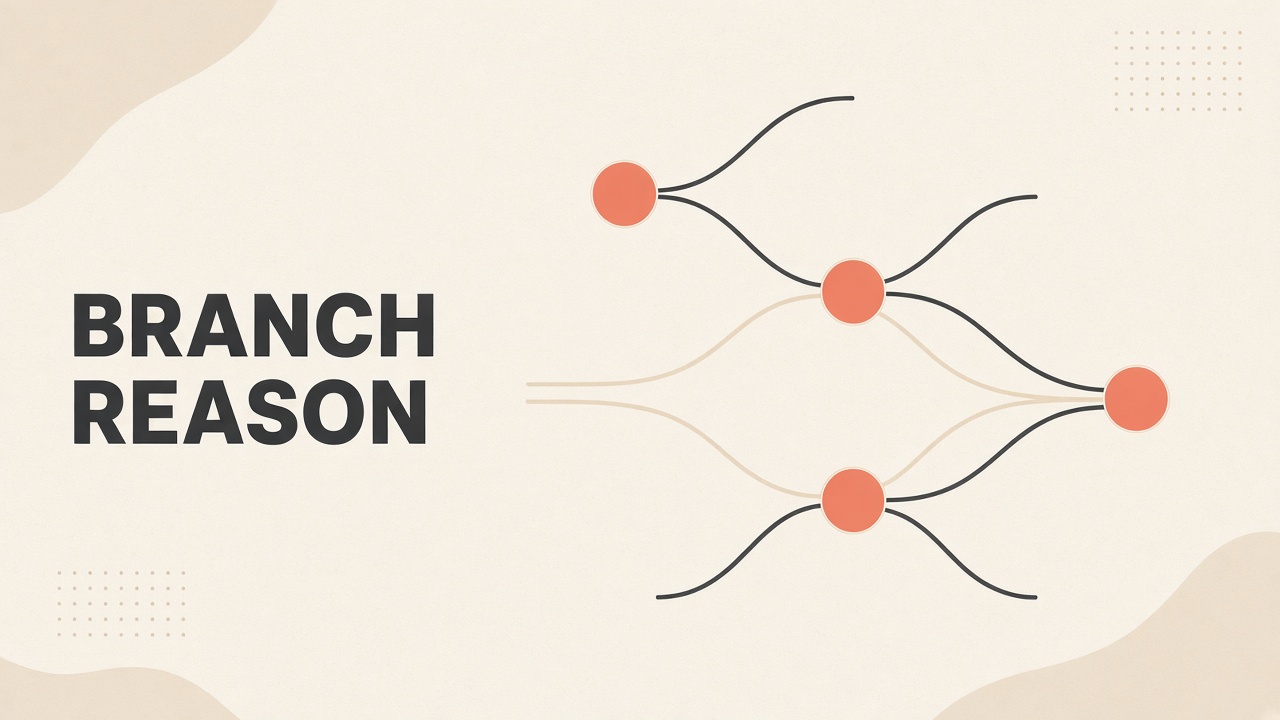
Chain-of-thought prompting asks a model to think step by step in a single linear sequence. That works for arithmetic word problems and straightforward logic puzzles. It breaks down when the first wrong step poisons everything downstream, when multiple valid strategies exist, or when the model must backtrack. Tree of Thoughts (ToT) treats reasoning as search: generate several candidate thoughts, score them, expand the promising ones, and discard dead ends before synthesizing an answer.
Tree of Thoughts (ToT) is a prompting and orchestration framework where a language model explores multiple reasoning branches, evaluates intermediate states, and selects the best path before producing a final response. Introduced by Yao et al. and extended in follow-on research, ToT generalizes chain-of-thought by adding deliberate branching and pruning. This guide compares ToT to chain-of-thought, walks through the generate-evaluate-select loop, identifies problem types where branching wins, shares prompt patterns you can adapt in AI chatbot and AI writing workflows, and covers the cost and latency tradeoffs that make ToT impractical for every query.
Chain-of-Thought vs Tree of Thoughts
Chain-of-thought (CoT) follows one reasoning trail; Tree of Thoughts maintains a tree of partial solutions and searches across branches before finalizing an answer. CoT is cheaper and faster because it issues one sequential generation. ToT issues multiple generations per depth level, plus evaluation calls that score each branch. CoT fits tasks with a clear procedural path. ToT fits tasks where exploration, lookahead, and backtracking improve success rates.
| Aspect | Chain-of-thought | Tree of Thoughts |
|---|---|---|
| Structure | Single linear reasoning chain | Branching tree with pruning |
| Error recovery | Early mistakes propagate | Weak branches discarded |
| API cost | One extended completion | Multiple generations + evaluations |
| Best for | Procedural math, simple logic | Planning, puzzles, strategic decisions |
The Generate-Evaluate-Select Loop
ToT repeats three steps at each depth: generate candidate next thoughts, evaluate each partial state, and select which branches to expand further. Generation can produce k alternatives per node. Evaluation may use the same model with a scoring prompt, a separate critic model, or deterministic checks when ground-truth constraints exist (for example, Game of 24 arithmetic targets). Selection keeps the top-scoring branches up to a beam width and prunes the rest. The loop continues until a terminal state is reached or a depth limit triggers final aggregation.
- Generate: Propose multiple next reasoning steps from the current partial solution.
- Evaluate: Score each candidate on progress toward the goal, validity, or likelihood of success.
- Select: Keep the highest-scoring branches; discard or deprioritize the rest.
- Expand or terminate: Repeat from selected nodes until a solution is found or budgets exhaust.
Implementations differ in search strategy. Breadth-first exploration evaluates many shallow branches early. Depth-first variants dive deep on the most promising path first. Monte Carlo Tree Search hybrids sample rollouts to estimate branch value. Production agent frameworks often wrap ToT-like loops in orchestration code rather than asking users to hand-write tree prompts.
When Tree of Thoughts Helps
ToT delivers the largest gains on problems with combinatorial search spaces, reversible intermediate states, and verifiable partial progress. Classic benchmarks include Game of 24, creative writing with constraint satisfaction, mini crosswords, and strategic planning tasks where the first intuitive approach often fails.
| Use case | Why ToT helps | CoT alternative |
|---|---|---|
| Multi-step planning | Compare competing plans before execution | Single plan may miss better structure |
| Constraint puzzles | Backtrack when constraints violated | Linear chain locks into dead ends |
| Strategic writing | Explore outlines before drafting | First outline may be structurally weak |
| Code architecture | Evaluate design alternatives | CoT often sufficient for localized bugs |
ToT is a poor default for high-volume chat support, email summarization, or FAQ retrieval where latency budgets are tight and answers do not require search. Reserve branching reasoning for workflows where a wrong answer is expensive: legal strategy memos, complex spreadsheet modeling, or multi-constraint scheduling.
Prompt Patterns for Tree of Thoughts
Effective ToT prompts define the state representation, branch generation rules, evaluation criteria, and stopping conditions explicitly. Vague instructions to "think harder" rarely produce reliable trees. Structured templates outperform free-form exploration.
State and Branch Template
Ask the model to output partial states in a fixed schema: current facts, remaining constraints, and proposed next action. Require k distinct branches per step, not paraphrases of the same idea. Example instruction fragment: "Generate three different next moves. Each move must change the state in a meaningfully different way."
Evaluation Rubric
Provide scoring dimensions: feasibility (1-5), progress toward goal (1-5), constraint satisfaction (pass/fail). A separate evaluation call with the rubric reduces self-grading bias compared to asking the generator to score its own branches in the same completion.
Aggregation Step
After search completes, run a synthesis prompt that takes the best terminal states and produces the user-facing answer. This separation keeps exploratory reasoning out of the final customer-visible text when using AI writing tools for deliverables.
Cost and Latency Tradeoffs
ToT multiplies token usage by branch factor, depth, and evaluation passes; a five-depth tree with three branches per node can exceed fifty model calls before synthesis. Latency grows with sequential evaluation unless you parallelize branch scoring across workers. Cost control techniques include limiting beam width, capping depth, using a smaller model for evaluation while reserving a larger model for final synthesis, and triggering ToT only when a cheaper CoT pass fails confidence checks.
| Control lever | Effect on quality | Effect on cost |
|---|---|---|
| Reduce branch factor k | May miss optimal paths | Linear savings per depth |
| Lower max depth | Truncates long plans | Exponential savings |
| Smaller evaluator model | Coarser branch ranking | Major evaluation savings |
| CoT-first fallback | ToT only on hard cases | Average cost near CoT |
Agent products marketed as "deep reasoning" often implement ToT-like loops internally. When evaluating AI chatbot platforms, ask whether branching is automatic, configurable per workflow, and metered separately from standard chat tokens.
Worked Example: Strategic Planning
Consider a product manager asking an AI to choose between three launch strategies with conflicting constraints: budget cap, engineering capacity, and regulatory deadline. Chain-of-thought might defend the first plausible plan. ToT generates three distinct strategies in branch one, scores each on feasibility and risk, expands the top two into quarterly milestones in branch two, and selects the plan with the highest cumulative score before writing the executive summary.
The evaluation rubric might include: Does the plan respect the budget? Does engineering headcount support the timeline? Does the plan trigger known regulatory review? Each branch receives numeric scores. Low-scoring branches prune before deeper expansion burns tokens. The final synthesis prompt receives only the winning branch state, keeping the user-facing memo focused.
ToT vs Self-Consistency and Best-of-N
Self-consistency samples multiple independent CoT completions and majority-votes the final answer; best-of-N picks the highest-scoring single completion from N samples. Both are cheaper than full ToT because they lack structured intermediate state scoring. They work when the final answer is easy to verify (multiple choice, numeric result) but struggle when partial plans must be compared before execution. Use self-consistency for math drills; use ToT for multi-stage planning with reversible intermediate decisions.
| Method | Structure | Relative cost |
|---|---|---|
| Chain-of-thought | One path | Lowest |
| Self-consistency | N independent paths, vote | N × CoT cost |
| Best-of-N | N paths, pick best final | N × CoT + scoring |
| Tree of Thoughts | Branching tree with pruning | Highest (depends on depth × width) |
ToT and Modern Agent Frameworks
Frameworks like LangGraph, AutoGen, and vendor agent builders encode ToT patterns as graph nodes rather than raw prompts. Nodes represent generate, critique, and select steps; edges define branching policies. This abstraction helps teams version reasoning workflows and attach observability to each branch. The underlying idea remains the same: treat LLM reasoning as search, not monologue.
Frequently Asked Questions
How is ToT different from ReAct or tool-using agents?
ReAct interleaves reasoning with tool calls in a mostly linear trace; ToT explicitly maintains and compares multiple reasoning branches before committing. Agents can combine both: ToT for planning, ReAct for executing tool steps along the chosen branch.
Can I use ToT without writing orchestration code?
Manual ToT in a single chat prompt is possible for small trees but becomes unwieldy beyond two depths. For production use, orchestration code or agent frameworks that manage branch state are more reliable than asking users to paste multi-branch transcripts.
Does ToT require GPT-4 class models?
Stronger models produce better branch diversity and evaluation scores, but smaller models can run ToT on narrow domains with tight rubrics. Match model capability to task difficulty; do not run expensive trees on trivial queries.
When does ToT fail?
ToT fails when evaluation criteria are ambiguous, branch generation lacks diversity, or the problem has no meaningful intermediate states to score. Open-ended creative tasks without constraints are poor fits unless you define explicit quality dimensions upfront.
Is self-consistency the same as ToT?
Self-consistency samples multiple independent CoT chains and votes on the final answer; ToT explicitly links and scores intermediate thoughts in a structured search. Self-consistency is simpler and cheaper; ToT provides more control when partial progress matters.
What depth and branch width should I start with?
Start with depth 2 and branch width 3 for pilots; increase only when measured quality gains justify multiplied cost. Log branch scores and final outcomes to see whether extra depth changes decisions or only burns tokens.
Should humans review ToT branches?
High-stakes workflows benefit from human review of the selected branch summary before execution, especially when ToT feeds automated actions like code deployment or financial trades. Keep full branch trees in audit logs even if users see only the synthesized answer.
ToT for Legal and Compliance Analysis
Legal and compliance teams use ToT-style workflows to compare interpretive paths before recommending a position, though human attorneys must validate every conclusion. A contract review prompt might branch on whether a clause is enforceable under jurisdiction A vs B, score each interpretation against known case patterns, and prune branches that violate explicit policy constraints. ToT does not replace counsel; it structures exploratory analysis so fewer obvious dead ends reach senior reviewers.
Regulated industries should log branch trees as audit artifacts when AI assists drafting regulatory filings or internal policy updates. Pair ToT with citation requirements: each branch must reference source documents, not only model speculation.
Building ToT Into Product Workflows
Product teams should gate ToT behind explicit user intent or confidence thresholds rather than running trees on every chat message. Practical patterns include: a "deep analysis" button that triggers branching, automatic ToT when CoT self-check scores low confidence, and scheduled batch runs for planning tasks where latency is acceptable. Instrument token spend per workflow so finance can compare ToT-assisted features against simpler alternatives.
When integrating with AI writing products, expose outline exploration as a separate step from final drafting. Users appreciate seeing alternative structures before committing to a long article. Hide raw branch dumps behind a collapsible "reasoning trace" for power users who need auditability without cluttering default UX.
Conclusion
Tree of Thoughts AI reasoning extends chain-of-thought by searching across branches instead of committing to the first plausible line of thought. The generate-evaluate-select loop improves results on planning, puzzles, and constrained decisions at the cost of multiplied latency and token spend. Use ToT selectively in chatbot and writing workflows where wrong answers are costly, cap branch budgets aggressively, and prefer orchestration frameworks over hand-rolled mega-prompts when depth exceeds two levels.