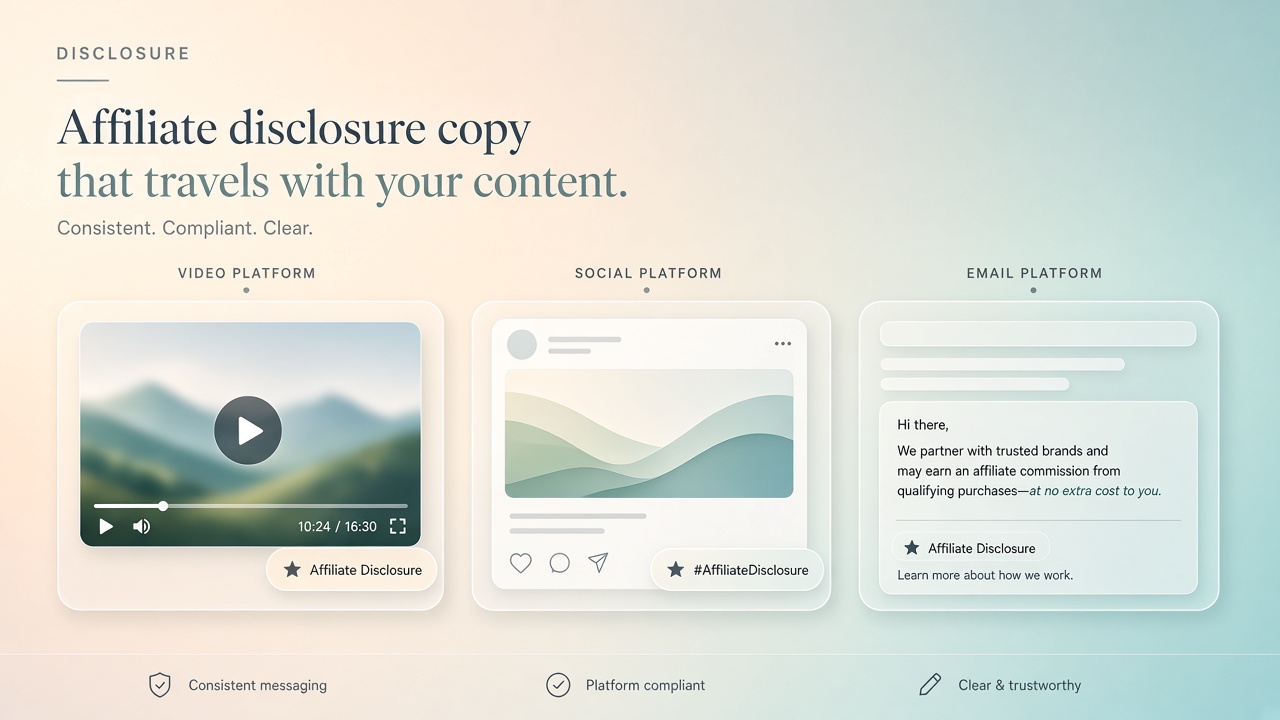
Affiliate revenue funds many creator businesses, but disclosure copy scattered across video descriptions, pinned comments, Instagram captions, and newsletter footers creates compliance gaps when AI paraphrases "affiliate link" into invisible fine print. An ai workflow affiliate disclosure copy pipeline maps requirements by platform and region, maintains a template library for video, caption, and email, adapts placement per format without minimizing visibility, distinguishes sponsor from affiliate relationships, and keeps an audit trail for published disclosures. AI accelerates format adaptation; you verify legal language, relationship type, and that disclosures appear where viewers actually see them.
This guide fits YouTubers, bloggers, newsletter writers, and podcasters with Amazon Associates, SaaS affiliate programs, or multi-brand deal stacks. Pair disclosure workflows with AI code tools when you automate disclosure insertion in CMS templates and private AI chatbot tools for internal policy Q&A, not for generating one-off hidden disclaimers that skip your template library.
Disclosure Requirements by Platform and Region
Document disclosure requirements for each platform you publish on (YouTube, Instagram, TikTok, podcast hosts, email ESP) and each region your audience materially includes (US FTC, UK ASA, EU consumer rules) before AI adapts any snippet. Requirements overlap but are not identical; a single "#ad" habit may fail on long-form video or email.
- US FTC: clear and conspicuous disclosure of material connection before affiliate link influence.
- YouTube: paid promotion checkbox plus verbal and description disclosure for many deals.
- Instagram/TikTok: branded content tools when platform provides them; caption disclosure still needed.
- Email: disclosure near top for commercial content, not only footer.
- EU/UK: avoid misleading omissions; localized phrasing may be required for DE/FR audiences.
| Platform | Minimum disclosure practice | Common gap |
|---|---|---|
| YouTube long-form | Verbal plus description above fold | Disclosure only in pinned comment |
| YouTube Shorts | On-screen text or spoken early | Assuming link in bio is enough |
| Instagram feed | First lines of caption before "more" | Hashtag only at bottom |
| Newsletter | Near mention of product or top block | Footer-only on affiliate-heavy issue |
Consult qualified counsel for your niche (finance, health, children's content) when programs impose extra rules. AI summarizes public FTC guides; AI does not replace legal advice for your entity structure.
Template Library for Video, Caption, Email
Maintain approved disclosure templates per format (15-second verbal script, on-screen lower third, Shorts overlay, Instagram caption opener, email paragraph) so AI adapts from locked base text instead of inventing softer language. The ai workflow affiliate disclosure copy library is version-controlled; bump version when counsel or platform policy updates.
- Video verbal: "Some links in this video are affiliate links; I may earn a commission at no extra cost to you."
- On-screen: same meaning in 12 words max for Shorts safe zone.
- Description block: paste above product links, standardized emoji optional per brand.
- Caption: first line before hook continues; include #affiliate or #ad if brand style allows.
- Email: bold disclosure sentence before first affiliate CTA button.
| Format | Template field | Max length |
|---|---|---|
| Long video verbal | Full sentence plus timing note (first 30 sec) | 20 to 30 words |
| Shorts overlay | "Affiliate links" plus icon | 3 to 6 words on screen |
| Description | FTC-style plain English block | 2 to 4 sentences |
| Newsletter | Commercial relationship paragraph | 1 to 2 sentences above fold |
Multi-Language Disclosures
When you publish in multiple languages, translate approved templates with human review; do not rely on AI alone for legal-adjacent phrasing in regulated markets. Store locale tags on each template row (en-US, en-GB, de-DE).
AI Adaptation Without Minimizing Visibility
Prompt AI to adapt disclosure to character limits and tone while forbidding tactics that hide terms: gray-on-gray text suggestions, burying after dozens of hashtags, or replacing "affiliate" with vague "partner" when commission applies. Run a visibility checklist on every AI output before publish.
- Banned outputs: "see description for details" without on-platform disclosure.
- Require disclosure in first 25 percent of caption or above first link in description.
- Contrast check for on-screen text (WCAG-aware when possible).
- Shorts: disclosure visible before swipe-away; not final frame only.
- Human approves any wording change from master template.
| Adaptation task | Allowed | Not allowed |
|---|---|---|
| Shorten for TikTok | "Paid link; I earn commission" | Remove commission mention |
| Brand voice soften | Friendly tone, same facts | Imply editorial-only when paid |
| Email design | Bold disclosure line | 6px footer gray text |
Sponsor vs Affiliate Distinction
Sponsored integrations (flat fee, creative control, product supplied) use different disclosure templates than passive affiliate links (commission on qualifying purchases); AI must tag relationship type per link or segment so templates do not mix. Some videos contain both; segment disclosures at each transition.
- Sponsor: "This video is sponsored by [Brand]" near start; follow brief requirements.
- Affiliate: commission language when you earn per sale but brand did not direct script.
- Gifted product without payment: disclose gift; affiliate tag if link earns commission.
- Own product: no affiliate disclosure, but commercial intent should be clear.
- Editorial pick with no compensation: optional transparency, not FTC affiliate rule.
| Relationship | Disclosure template ID | Typical placement |
|---|---|---|
| Paid sponsorship | SPON-VERBAL-01 | First 30 seconds verbal plus description |
| Affiliate links only | AFF-DESC-01 | Description top plus verbal mention |
| Hybrid segment | SPON-01 then AFF-01 | Before each segment starts |
Program-Specific Affiliate Rules
Amazon Associates, software SaaS affiliates, and finance brokers each publish required phrase snippets; store program addenda in your template library. AI pulls the correct addendum by program ID when generating description blocks for multi-link roundups.
Audit Trail for Published Disclosures
Log every published piece with URL, publish date, template version, relationship tags, screenshot or archive link, and approver name so disputes or platform audits reconstruct what viewers saw. Retention of 2 to 3 years matches common FTC inquiry windows for active creators.
- CMS or Notion row per asset: video ID, platforms, template versions used.
- Archive description text the day of publish (not after later edits).
- Note YouTube paid promotion checkbox state.
- Track re-edits: if disclosure moved, log correction reason.
- Quarterly audit sample: 10 random posts for placement compliance.
| Audit field | Why store it | Tool example |
|---|---|---|
| Template version | Prove approved language | Git tag or doc version |
| Screenshot | Visual placement evidence | Archive.today or local PNG |
| Link manifest | Which URLs were affiliate | Spreadsheet export |
Workflow Integration With Publishing
Insert disclosure steps into your publish checklist after final edit and before scheduling: verbal recorded, description block pasted, platform toggles set, caption opener generated from template, audit row created. AI batch-generates caption and email variants from one video metadata form to reduce copy-paste errors across five platforms.
- Input form: title, sponsor yes/no, affiliate link list, regions targeted.
- Output pack: all format adaptations plus compliance checklist PDF.
- Block publish button in team tools until checklist signed.
Training Team and VA on Disclosure Standards
Virtual assistants who draft descriptions or schedule social posts need the same template library access and a short certification quiz before they publish affiliate content without your review. Quarterly refresh training when Amazon, YouTube, or FTC guidance updates prevents drift back into buried hashtag disclosures.
- Onboarding doc: relationship types, template IDs, banned minimization tactics.
- Practice exercise: fix three bad AI disclosure drafts.
- Escalation path: anything outside template library goes to you or counsel.
- Random monthly audit of VA-published posts against audit trail.
Frequently Asked Questions
Is description-only disclosure enough on YouTube?
FTC guidance stresses clear and conspicuous disclosure where viewers will notice it; many creators use verbal plus prominent description placement because description-only alone is often challenged as easy to miss. Follow your counsel's read for your content type.
Do #affiliate or #ad hashtags satisfy Instagram rules?
Hashtags can supplement but should not replace plain-language disclosure in the visible caption opening; burying hashtags below the fold fails the conspicuous standard. Use platform branded content tools when the partnership qualifies.
Must I update disclosures on old videos?
When template or law changes materially, prioritize high-traffic affiliate videos for description updates; archive the change in your audit log. Verbal-only old videos may need pinned comments or re-edits if risk is high.
What if my audience is mostly outside the US?
Maintain region-specific template rows and apply the strictest rule you materially trigger, or geo-split descriptions when platforms allow. AI adapts locale; legal review confirms which markets you target commercially.
Disclose Clearly on Every Format
A practical ai workflow affiliate disclosure copy practice maps platform and region rules, keeps versioned templates for video, caption, and email, adapts copy without hiding terms, separates sponsor from affiliate relationships, and audits what published. AI speeds multi-format output; your template discipline and placement checks protect compliance and audience trust. Build the template library before your next affiliate roundup goes live.