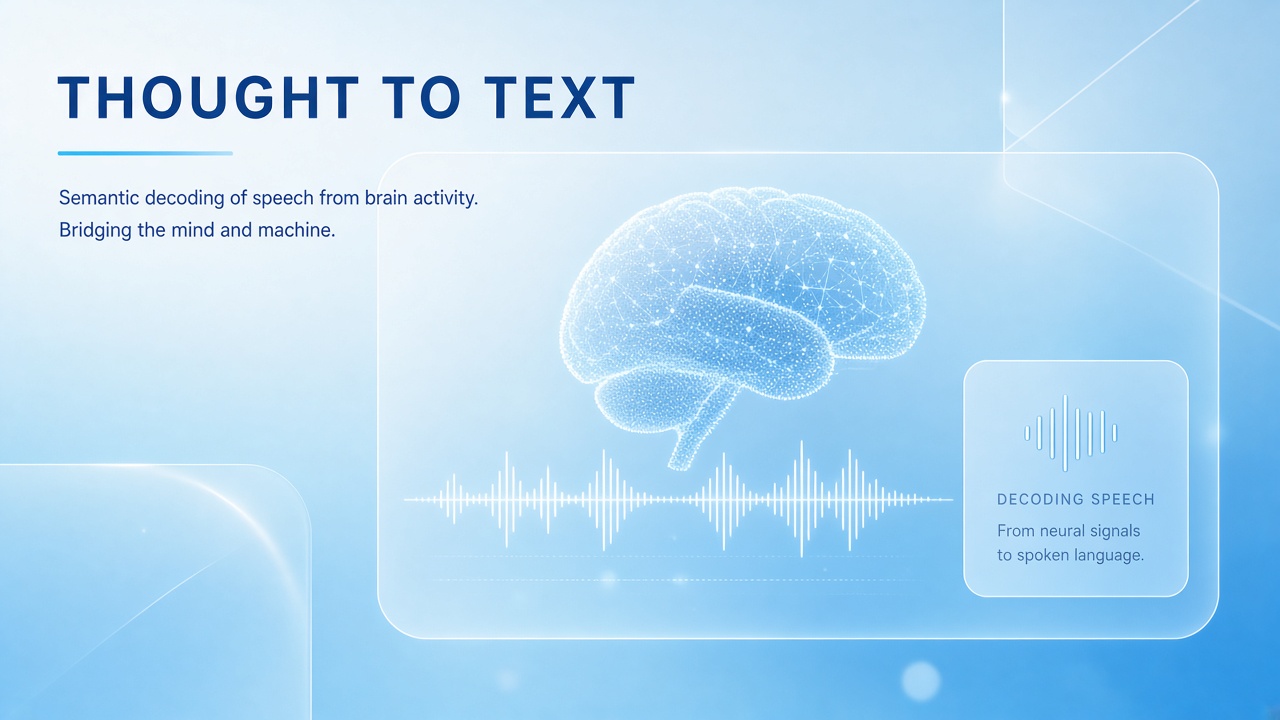
Semantic decoding uses machine learning to translate neural activity patterns into words or sentences that recover the meaning of perceived, imagined, or internally generated speech, distinct from phoneme-level reconstruction of acoustic form. Landmark work in Nature Neuroscience (Tang et al., 2023) demonstrated continuous language reconstruction from fMRI, while 2025 studies extend generative large language model conditioning and non-invasive word decoding across hundreds of participants. These systems are laboratory demonstrations requiring cooperative subjects, not covert mind-reading headsets. Teams following AI research at the brain-computer interface frontier should separate scientific progress from sensational headlines.
What Semantic Decoding Reconstructs
Semantic decoders aim to recover what a person means or hears, not the exact acoustic waveform or muscle articulation trajectory. Phoneme decoding targets speech sounds and articulatory gestures. Semantic decoding operates on cortical representations aligned with word meaning, narrative content, and sentence-level context. The Tang et al. decoder generated intelligible word sequences that captured the gist of perceived stories, imagined speech, and even silent videos with spoken narratives, showing that semantic representations generalize across stimulus modalities when training data are rich enough.
Early non-invasive systems classified among small closed vocabularies. Modern pipelines produce open-vocabulary continuations by coupling brain embeddings to large language models (LLMs). BrainLLM (Communications Biology, 2025; arXiv:2311.09889) feeds fMRI-derived semantic vectors directly into autoregressive LLM generation, reconstructing up to ten minutes of continuous perceived language without selecting from a fixed candidate list. Performance improves most on semantically surprising passages where text prompts alone would hallucinate generic continuations.
Invasive semantic decoding during natural conversation has progressed on intracranial electrodes, decoding word-level semantics in real time for paralyzed participants, but those systems remain research implants with hours of calibration per user. Non-invasive semantic decoding therefore trades spatial precision for safety and scalability, accepting blurrier temporal alignment between neural samples and individual words.
Invasive vs Non-Invasive Recording Tradeoffs
fMRI offers whole-brain spatial coverage at slow temporal resolution; EEG and MEG offer millisecond timing at limited spatial precision; intracranial EEG delivers both for clinical populations at surgical risk. fMRI blood-oxygen-level-dependent signals integrate neural activity over several seconds, smearing fast speech into overlapping windows. That limitation motivated complementary fast-imaging approaches. A 2025 Nature Communications study (doi:10.1038/s41467-025-65499-0) decoded individual words from EEG and MEG across 723 participants and five million words in three languages, reporting consistent gains with more training data and trial averaging at test time.
Device and protocol choices dominate benchmarks: MEG and silent reading tasks decode more reliably than EEG and listening tasks in that analysis. BrainECHO (ACL Findings 2025, doi:10.18653/v1/2025.findings-acl.142) targets EEG/MEG-to-text with vector-quantized spectrogram reconstruction and Whisper-enhanced generation, reporting 74% to 89% decoding BLEU scores under sentence, session, and subject-independent conditions after a three-stage training pipeline.
| Modality | Spatial resolution | Temporal resolution | Semantic decoding status (2025) |
|---|---|---|---|
| fMRI | Millimeter voxels | Seconds (BOLD lag) | Continuous gist reconstruction demonstrated |
| MEG | Centimeter sources | Milliseconds | Word-level decoding scaling with data volume |
| Scalp EEG | Low, volume-conducted | Milliseconds | Harder than MEG; improving with deep models |
| Intracranial (sEEG/ECoG) | Millimeter contacts | Milliseconds | Highest fidelity for clinical BCI prototypes |
Hybrid EEG-fMRI systems attempt to fuse fast temporal dynamics with spatial maps for inner speech classification, but hardware cost and motion constraints limit home use. Consumer EEG headsets marketed for "thought typing" rarely approach peer-reviewed semantic decoding benchmarks because channel count, electrode contact quality, and experimental protocol rigor fall short of laboratory standards.
Training Data and Participant Consent
Semantic decoders require hours of paired brain recordings and language stimuli per participant, collected under informed consent with explicit cooperation during both training and inference. Tang et al. tested whether decoding succeeds without subject cooperation and found that passive resistance breaks reconstruction: models trained on cooperative sessions fail when participants intentionally think unrelated content. That finding is central to mental privacy claims but does not eliminate coercion risks if subjects are compelled to cooperate in institutional settings.
Training corpora include audiobook passages, silent reading of text, imagined speech tasks, and open conversational prompts. LLM-augmented decoders inherit biases present in text pretraining data, potentially skewing reconstructions toward dominant language varieties and cultural references even when brain data come from diverse participants. Dataset consent forms must clarify whether reconstructed text can be stored, published in papers, or used to fine-tune commercial models.
Cross-subject generalization remains weak. Decoders tuned to one person's cortex rarely transfer to another without substantial retraining because functional neuroanatomy varies. Clinical BCIs therefore plan per-user calibration days in epilepsy monitoring units or dedicated research visits, not plug-and-play headset pairing.
Accuracy Benchmarks and Failure Cases
Reported metrics include word error rate, BLEU overlap with ground-truth transcripts, and correlation between predicted and measured voxel responses, but no single score captures subjective intelligibility. fMRI semantic reconstructions are evaluated by human raters judging whether decoded paragraphs match stimulus stories, supplemented by encoding model correlation maps across cortical parcels. MEG/EEG word decoders report top-k accuracy for held-out vocabulary items, with performance rising as more trials are averaged at test time to boost signal-to-noise ratio.
Failure modes are informative. Homophones, rare proper nouns, and sarcasm challenge LLM-guided decoders that lean on language priors. Fast speech and code-switching strain alignment between neural windows and word boundaries. Visual-only semantic decoding from silent films works when narrative structure is stereotyped but degrades for abstract imagery without spoken language correlates. Adversarial cooperation tests show decoders are not omniscient: they read cooperating brains, not locked secrets.
Retrieval-based decoders that require ground-truth speech segments at test time achieve higher top-10 accuracy (~70% in prior EEG/MEG speech retrieval work cited by the 2025 Nature Communications authors) but are impractical for communication BCIs because the correct segment is unknown a priori. Generative semantic decoding trades some metric peak performance for open-ended output usable in assistive scenarios.
Ethics of Covert Neural Surveillance
Current semantic decoders do not enable silent mass surveillance, yet improving LLM coupling and wearable neuroimaging justify proactive regulation of neural data as sensitive biometric information. Chile's 2021 constitutional neuro-rights debate and OECD neurorights guidance influenced discourse on cognitive liberty. Researchers emphasize purpose limitation: medical communication BCIs differ ethically from employer mood monitoring or courtroom "brain evidence" without robust science.
Reconstruction outputs can misattribute meaning when models confabulate plausible sentences not intended by the participant, creating false evidence if misused in legal or security contexts. Dual-use publication norms encourage reporting cooperation requirements and failure under adversarial conditions, as Tang et al. did, rather than obscuring limits.
Equity matters. Non-invasive semantic decoding studies disproportionately enroll university students in wealthy countries with access to fMRI and MEG facilities. Global South participation and low-resource language coverage lag English audiobook paradigms. Without diverse training data, assistive BCIs risk excluding the patients who need them most. Readers comparing AI research ethics frameworks should watch how neural data governance evolves alongside generative model regulation.
Phoneme Decoding vs Semantic Pathways
Phoneme decoders reconstruct articulatory and acoustic speech units; semantic decoders skip surface form and target meaning vectors aligned with language models. Intracranial speech BCIs for paralysis often chain phoneme or syllable classifiers to text or speech synthesizers, optimizing for communication rate measured in words per minute. Semantic decoders instead ask whether a reconstructed paragraph captures what a person heard on a podcast, even if word choice differs. The Tang et al. encoder-decoder architecture maps fMRI patterns to semantic embeddings before language generation, explicitly prioritizing gist fidelity.
Hybrid systems may combine fast phonetic features from motor cortex with slower semantic integration in temporal and prefrontal areas. LLM conditioning introduces a strong language prior that rescues decoding when neural signal-to-noise is low but also risks inserting plausible words the participant never perceived. Evaluators therefore score both semantic similarity and literal word overlap, reporting where models paraphrase versus hallucinate.
For assistive technology roadmaps, phoneme pipelines suit face-to-face conversation with audible feedback, while semantic pipelines help locked-in users inferring meaning from internal narrative when articulation is impossible. Hardware choices follow: high-channel ECoG for phonetics, whole-brain fMRI for semantic narrative tasks in research settings. Neither path is ready for always-on consumer earbuds without breakthroughs in sensor fusion and participant training burden.
Regulation of neural data will likely converge with biometric privacy statutes. Illinois BIPA and emerging state laws require informed consent before collecting identifiers derived from physiology. EU GDPR classifies health data as special category, demanding explicit consent and data protection impact assessments for decoding research migrating to products. Institutional review boards already prohibit deceptive decoding experiments; commercial vendors must adopt similar transparency about when devices record and decode language-related brain states.
Frequently Asked Questions
Is semantic decoding mind reading?
No in the science-fiction sense. Systems recover language-linked semantic content from cooperative participants during structured tasks with extensive training. They do not read arbitrary hidden thoughts on demand.
How is phoneme decoding different from semantic decoding?
Phoneme pipelines reconstruct speech sounds and articulation. Semantic pipelines target meaning and narrative content, often using LLMs to generate fluent text that may differ in wording from the original while preserving gist.
Can fMRI decoders work outside the lab?
Not practically. fMRI requires large scanners, head immobilization, and cooperative stillness. Portable semantic BCIs will likely rely on intracranial or improved EEG/MEG hardware, not clinical MRI sessions.
Do decoders work without a person's permission?
Published fMRI decoders fail when participants withhold cooperation during training or testing. That constraint reduces covert use but does not replace legal protections for neural data.
What regulation applies?
Research falls under institutional review boards and informed consent. Future clinical communication implants would face FDA or equivalent medical device pathways. Consumer neural gadgets may trigger biometric privacy laws in Illinois, Texas, and the EU depending on data handling.
When will thought-to-text headsets ship?
Clinical intracranial communication BCIs are in trials for paralysis, not general consumers. Non-invasive semantic decoding remains laboratory-bound with hours of data collection per user. Commercial timelines measured in years, not months, are realistic.
Which 2025 paper shows word decoding at scale?
The Nature Communications article "Towards decoding individual words from non-invasive brain recordings" evaluates deep learning on 723 participants across public and newly collected EEG/MEG datasets, outlining remaining challenges for natural language brain-computer interfaces.
Tang et al. published semantic reconstruction in Nature Neuroscience in May 2023 (doi:10.1038/s41593-023-01304-9), establishing cooperation requirements and continuous language recovery from fMRI. BrainLLM generative extensions appeared in Communications Biology in 2025. Together these papers define the current frontier: semantic fidelity is improving faster than portability, and ethics must keep pace with model capability.