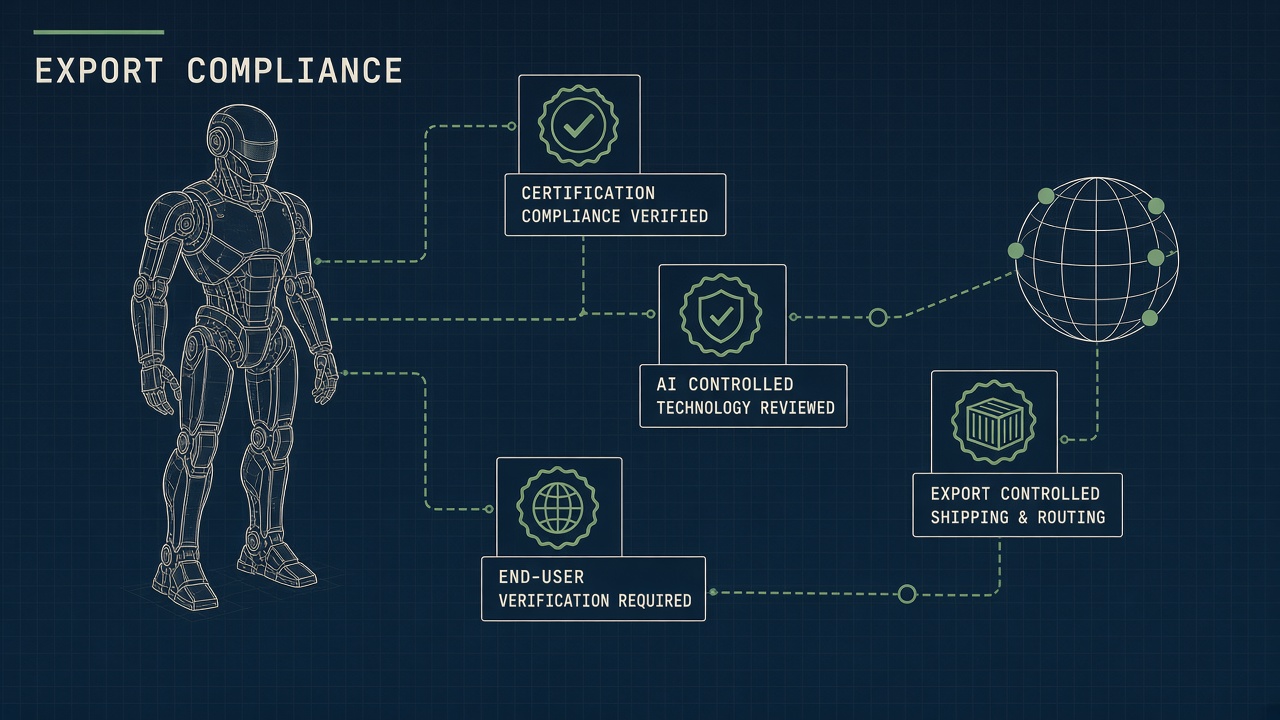
China's national embodied AI standards system is no longer a domestic-only framework. As MIIT expands certification themes for humanoid robots, dexterous manipulators, and edge inference modules, hardware OEMs must map how china embodied ai export rules intersect US semiconductor controls, EU product safety law, and customer due diligence questionnaires from Fortune 500 buyers.
This analysis covers standard certification themes, export control intersections, OEM compliance strategies for dual-market products, and the questions US and EU procurement teams now ask robotics suppliers. Policy signals come from MIIT/TC08 releases, China's HEIS framework, and parallel Western export regimes updated through 2026. Verify final published standards before locking production designs.
Standard Certification Themes for Export Markets
China's embodied AI certification stack spans six pillars: basic commonality, brain-like computing, limbs and components, complete machines, applications, and safety ethics, each with test methods OEMs must document before shipping certified units abroad. The Standard System for Humanoid Robots and Embodied Intelligence (2026 Edition) requires manufacturers to declare capability grades, unique device identifiers, and scenario-specific safety envelopes for industrial, logistics, healthcare, and service deployments.
Export-facing certification differs from domestic market approval in three ways. First, foreign buyers demand English test reports mapped to IEC and ISO robotics safety references, not only GB/T equivalents. Second, firmware and model update channels must be auditable: regulators and customers want to know whether over-the-air patches can alter locomotion limits or manipulation force without re-certification. Third, data residency declarations for perception pipelines (camera feeds, lidar logs, operator biometrics) increasingly appear in cross-border contracts even when hardware passes mechanical safety tests.
| Certification theme | Domestic focus | Export buyer expectation |
|---|---|---|
| Interface interoperability | Unified limb and sensor bus specs under MIIT | Compatibility matrix with Western actuators and safety PLCs |
| Embodied intelligence grading | Capability tiers for manipulation and navigation | Risk classification aligned to EU Machinery Regulation annexes |
| Data lifecycle | Training data provenance and collection rules | GDPR and US state privacy impact summaries |
| Safety and ethics | Social impact assessment for public deployments | Human oversight modes and emergency stop documentation |
Component suppliers exporting actuators, harmonic drives, and vision modules into China face reciprocal pressure: foreign parts must integrate with domestic embodied AI stacks or lose design-win status at leading Chinese OEMs. Teams tracking AI robotics vendors should request certification roadmaps from suppliers participating in MIIT working groups.
Export Control Intersections for Robotics OEMs
Embodied AI hardware sits at the intersection of robotics export rules, advanced computing controls, and dual-use sensor regulations, so a single humanoid platform can trigger multiple jurisdiction reviews. US Bureau of Industry and Security updates in 2026 tightened controls on high-performance inference accelerators, certain lidar configurations, and software that enables autonomous navigation in denied environments. China's own export catalog revisions cover rare-earth magnet assemblies and precision reducers used in humanoid joints.
OEMs shipping from China to Europe must also navigate the EU AI Act's high-risk classification for robotics in certain safety-critical roles, plus CE marking under the Machinery Regulation. A robot certified under HEIS does not automatically satisfy EU conformity assessment. Conversely, a CE-marked cobot re-exported into China may require local type approval and embodied AI grading before factory deployment.
Software-defined capabilities amplify control risk. Navigation models trained on military-adjacent terrain datasets, swarm coordination logic, or facial recognition tuned for crowd analytics can reclassify an otherwise industrial platform. Export compliance teams should maintain a bill of materials for both hardware and model weights, not only mechanical subassemblies. Developers using AI code assistants for embedded firmware should log which modules touch perception, planning, and actuator control for audit trails.
OEM Compliance Strategies for Dual-Market Products
Leading OEMs adopt dual-market architectures: a China-certified stack for domestic sales and a export-variant stack with Western components, segregated firmware channels, and separate training data provenance. This approach costs engineering overhead but avoids single-SKU lock-in when geopolitical rules shift mid-production.
Practical steps for hardware OEMs include maintaining a compliance register that maps each SKU to certification IDs, export license references, and end-user statements. Contract manufacturing partners in Southeast Asia need the same documentation as wholly owned Chinese fabs. Cloud inference dependencies should be region-pinned: a robot that phones home to a Shanghai model endpoint may fail US federal customer reviews even if the mechanical unit is assembled in Mexico.
- Segment SKUs by destination market before tooling commitments.
- Publish customer-facing conformity packets in English and Chinese.
- Run annual red-team reviews on OTA update paths for control circumvention.
- Train sales engineers on prohibited end-use screening for defense and surveillance buyers.
- Establish a regulatory liaison function that tracks MIIT, BIS, and EU AI Office updates monthly.
Joint ventures between Chinese and Western robotics firms increasingly use technology escrow and source-code inspection clauses so foreign partners can verify export-variant builds do not contain controlled subcomponents. Insurance underwriters for product liability now ask whether embodied AI systems underwent third-party penetration testing on wireless command channels.
US and EU Customer Questions About Embodied AI
Enterprise buyers in the US and EU now send embodied AI due diligence questionnaires covering certification status, supply chain nationality, model update governance, and workplace safety integration. Procurement teams borrow language from semiconductor vendor reviews and extend it to physical AI platforms.
Common US buyer questions include: Which BIS categories apply to onboard compute? Can firmware disable cloud telemetry for federal facilities? Does the platform support NIST AI RMF logging for incident response? EU buyers add: Is the system a high-risk AI system under Annex III? Where is personal data from cameras processed? Can the vendor provide an EU authorized representative and technical documentation in English?
| Question theme | US emphasis | EU emphasis |
|---|---|---|
| Hardware origin | EAR99 vs controlled ECCN classification | CE marking and EU declaration of conformity |
| AI model governance | Executive order compliance attestations | AI Act transparency and human oversight |
| Operational safety | OSHA integration and lockout/tagout | Machinery Regulation essential requirements |
| Cybersecurity | CISA cross-sector guidance alignment | Cyber Resilience Act and RED cybersecurity |
Vendors that answer these questions with structured evidence packets win RFP shortlists faster than competitors offering marketing slides alone. Maintain a living data room with test reports, export licenses, model cards, and incident response contacts updated quarterly. Reference china robotics export rules and embodied ai certification timelines in executive summaries so legal reviewers grasp scope without reading hundreds of pages of MIIT drafts.
Frequently Asked Questions
Does HEIS certification allow automatic export to the US and EU?
No. HEIS certification governs China's domestic embodied AI standards system. US and EU market access still requires separate export licenses, conformity assessments, and customer-specific due diligence. Treat HEIS as one input to a multi-jurisdiction compliance program.
Are Chinese actuator and sensor components restricted for Western robot builders?
Most industrial components remain on general export schedules, but certain high-precision reducers, rare-earth magnet assemblies, and dual-use vision modules may require licenses depending on performance thresholds and end use. Map each component to applicable control lists before designing export variants.
When should OEMs split domestic and export software stacks?
Split stacks when cloud inference regions, training data sources, or controlled algorithms differ by market. A unified stack works only if every dependency is licensable globally and update channels can be segregated without cross-contamination.
What documents should vendors prepare for buyer due diligence?
Provide certification summaries, BOM nationality reports, model update policies, cybersecurity test results, data processing agreements, and export classification letters. Update the packet whenever MIIT or Western regulators publish new embodied AI or robotics rules.