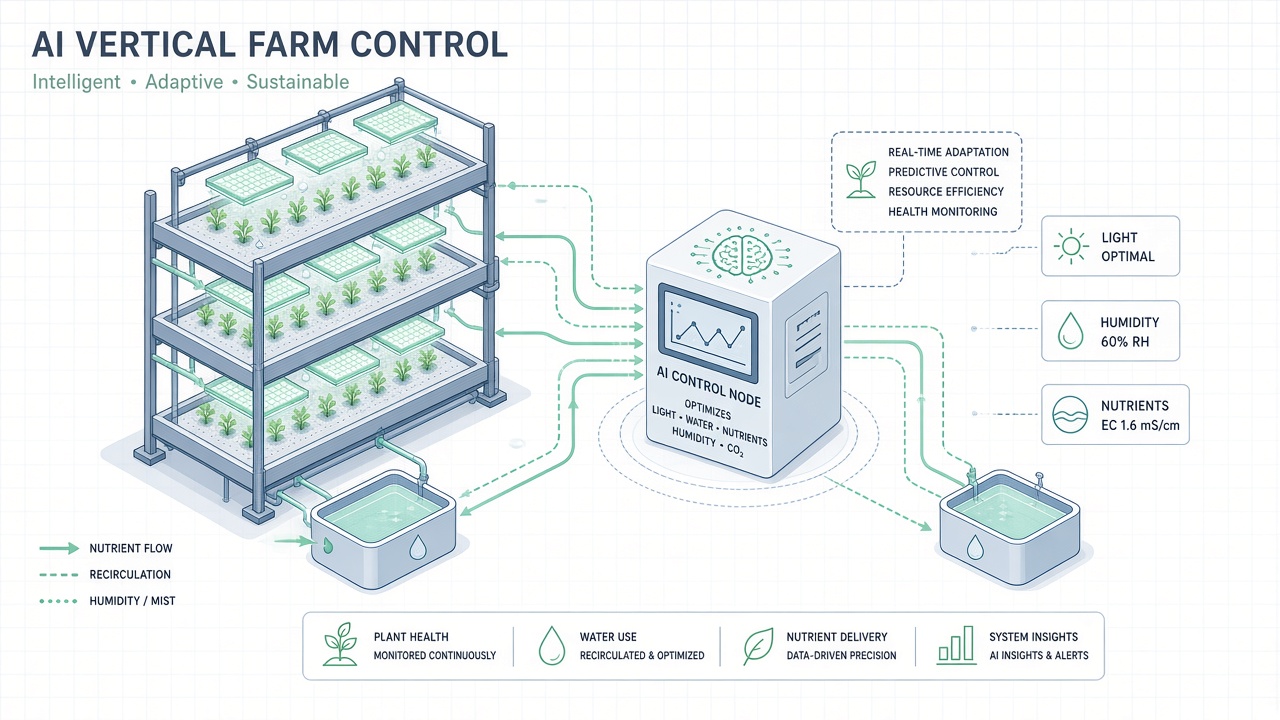
AI vertical farm control systems use reinforcement learning and predictive models to adjust LED spectra, temperature, humidity, CO2, pH, and electrical conductivity in real time, cutting energy use by roughly 23 to 31 percent in reported plant-factory trials while lifting lettuce yield up to 25 percent versus rule-based PID controllers. Container farms and warehouse-scale operators both deploy IoT sensor meshes, but differ in whether control runs on edge PLCs or cloud training pipelines with human override. Neither approach eliminates agronomist oversight on cultivar recipes and food-safety limits. Engineers tracking AI research on embodied control or evaluating AI research infrastructure for closed-loop horticulture should compare simulation maturity against field-validated safety constraints.
What Vertical Farm AI Controls
Modern indoor farms coordinate lighting photon flux and spectrum (red, blue, far-red ratios), HVAC for temperature and vapor-pressure deficit, CO2 enrichment, irrigation volume, nutrient EC and pH, and sometimes airflow between rack tiers. Each variable interacts with photosynthesis rate, transpiration, and tip burn risk. Static recipe tables tuned for one lettuce cultivar fail when germination density, rack height, or seasonal electricity tariffs change. AI controllers treat the grow room as a continuous decision process: observe sensor state, act on actuators, receive reward from growth sensors or proxy models.
Deep reinforcement learning (DRL) agents learn implicit crop-environment dynamics without hand-written differential equations. A Cornell-led shipping-container plant factory study in Ithaca, New York, reported 31 percent summer and 23 percent winter energy savings versus conventional setpoint control while keeping climate variables inside operating bands. GymHydro simulation work comparing PPO and DDPG to PID showed 12.5 percent higher crop yield with 10 to 12.5 percent lower water, energy, and nutrient use over a six-month simulated cycle.
Reinforcement Learning vs PID Baselines
PID controllers chase fixed setpoints and struggle when plant response lags, LED heat loads shift, or root-zone EC drifts nonlinearly; RL agents optimize long-horizon rewards such as harvest weight per kilowatt-hour. Proximal Policy Optimization (PPO) suits discrete decisions like irrigation pulses. Deep Deterministic Policy Gradient (DDPG) handles continuous actions such as dimming multiple LED channels simultaneously. Q-learning variants appear in nutrient-film technique (NFT) testbeds where a 45-day lettuce trial logged 24.8 percent yield gain and 37.6 percent water reduction against rule-based dosing.
Safety wrappers remain mandatory. RL policies without constraint layers can drive humidity or temperature outside pathogen-friendly ranges during exploration. Production deployments cap action deltas, require human-approved recipe bounds, and fall back to PID when sensor dropout exceeds thresholds. Most published RL vertical-farm results remain simulation-heavy or small-scale; warehouse operators should demand third-party validation on commercial cultivars before replacing incumbent climate computers.
| Control method | Strength | Limitation |
|---|---|---|
| PID setpoint | Simple, auditable, vendor-supported | Poor multi-variable coupling |
| Model predictive control | Explicit greenhouse physics | Model maintenance cost |
| Reinforcement learning | Adapts to unmodeled dynamics | Needs safe exploration bounds |
| Bayesian + RL spectral tuning | Targets biomass and nutrients | Sensor fusion complexity |
LED Spectrum and Growth Stage Optimization
Spectral tuning adjusts red-to-blue ratio and optional far-red by growth phase: seedling establishment favors moderate blue for compact morphology, while bulking phases increase red photons for leaf expansion. Predictive spectral RL with Bayesian calibration reported 15 to 20 percent biomass increases and 10 to 12 percent higher vitamin C and beta-carotene in vertical-farm lettuce compared with static LED recipes. Multi-modal pipelines ingest chlorophyll fluorescence, leaf temperature, and hyperspectral reflectance when available, though many commercial racks rely on time-in-stage schedules plus daily weight sampling.
Energy cost dominates opex. DRL that co-optimizes DLI (daily light integral) with tariff windows can shift supplemental lighting to off-peak hours without starving morning photosynthesis if buffer humidity and CO2 are managed. Operators should verify cultivar-specific responses: butterhead and romaine cultivars diverge in far-red sensitivity, and AI recipes trained on one genotype need recalibration before variety switches.
Container Farms vs Warehouse-Scale Operators
Container farms (40-foot shipping modules) prioritize plug-and-play deployment, fast commissioning, and local food miles; warehouse-scale vertical farms optimize cost per kilogram across tens of thousands of square feet of racking. Container units often ship with vendor-supplied climate computers and optional AI upgrade tiers. Single-module DRL trials map cleanly to one reward signal (harvest weight per kWh). Warehouse operators juggle multiple cultivars, staggered planting dates, and shared chiller plants, pushing control toward hierarchical RL or centralized model predictive layers with zone-specific agents.
Capital intensity differs. Containers suit hospital campuses, military bases, and urban micro-distribution. Warehouses target retail salad mix contracts requiring weekly volume stability. AI value scales when sensor density is high enough to detect zone microclimates: a hot aisle behind LED drivers may need local fan commands invisible to a single room sensor. Edge inference on rack gateways reduces cloud latency for irrigation pulses measured in seconds.
Sensor Fusion and Digital Twin Pipelines
Typical IoT stacks stream temperature, relative humidity, CO2, EC, pH, flow rate, and power draw into time-series databases; computer vision on tray images estimates leaf area index and stress flags in advanced installations. Digital twins simulate counterfactual actions before actuators move, reducing risky RL exploration on live crops. Few commercial vertical farms publish open twin APIs; integration usually flows through Priva, Argus, or custom MQTT bridges into Python training clusters. Data labeling links environmental trajectories to harvest outcomes weeks later, creating delayed-reward training that benefits from offline RL and experience replay buffers.
Cybersecurity and uptime matter as much as algorithm choice. A misconfigured nutrient pump causes crop loss faster than a mis-tuned LED channel. Role-based access, actuator interlocks, and manual override switches should sit outside the learned policy layer regardless of vendor AI marketing claims.
Nutrient EC, pH, and Root-Zone Control
Electrical conductivity and pH drift drive tip burn, root rot, and delayed harvest in hydroponic stacks; AI dosing agents adjust acid, base, and concentrate pumps based on predicted uptake curves rather than fixed timers. Reinforcement learning nutrient trials on NFT lettuce reported statistically significant yield and water-use improvements when EC targets shifted with photoperiod and vapor-pressure deficit. Ion-selective probes and inline flow meters feed state vectors every few minutes; lag between dose and sensor response forces models to learn transport delay in pipe runs and grow-media buffers.
Warehouse operators running multiple cultivars on one nutrient skid need recipe isolation: shared tanks risk cross-contamination when AI policies optimized for butterhead lettuce raise EC beyond basil tolerance. Software zoning assigns one policy per rack tier with hardware interlocks preventing pump valves from crossing zones during maintenance windows.
Deployment Checklist for Operators
Operators evaluating AI control should verify sensor calibration schedules, cultivar-specific reward definitions, fallback PID recipes, and measurable KPIs (kg/kWh, liters/kg, tip-burn rate) before granting autonomous actuator authority. Start with advisory mode: the RL agent recommends setpoint changes that growers approve via dashboard. Move to supervised autonomy on one rack tier for a full crop cycle. Document divergence between predicted and actual harvest mass to retrain or constrain policies. Contract SLAs with AI vendors should specify liability when environmental excursions cause total crop loss.
Benchmark against incumbent PID performance for at least two full crop cycles before signing multi-year AI control subscriptions. Document kilowatt-hours per kilogram harvested, liters per kilogram, and labor hours per rack turn. Vendors promising double-digit savings should provide reference customers willing to share utility bills under NDA.
CO2 Enrichment and Climate Coupling
Supplemental CO2 raises photosynthetic rate when light and temperature allow, but enrichment without coordinated humidity control increases transpiration and tip-burn risk on sensitive cultivars. Humidity setpoints interact with CO2 setpoints: raising enrichment without dehumidification invites foliar disease on dense lettuce canopies. AI controllers that jointly optimize CO2 injection, vent cycles, and LED intensity avoid wasting bottled gas during dark periods or when vents flush enriched air to control heat. Night-shift operators should review anomaly dashboards because learned policies may exploit tariff windows that differ from daytime staffing patterns. Container farms with limited vent capacity benefit most from learned schedules that anticipate afternoon thermal loads rather than reactive PID overshoot.
Data Privacy and Multi-Site Operations
Multi-facility operators aggregate anonymized grow-room telemetry to train fleet-wide policies while keeping cultivar recipes and yield figures confidential per site. Federated learning pilots let regional farms contribute gradient updates without shipping raw sensor streams to a central vendor cloud, addressing grower concerns about competitive leakage. Contract review should clarify who owns trained model weights when a customer switches climate-hardware vendors mid-lease.
Frequently Asked Questions
Is RL ready for production vertical farms?
Partially. Energy and nutrient optimization show strong published results, but many studies are simulated or small-scale. Treat RL as an upgrade path with PID fallback, not a day-one replacement for certified climate hardware.
Which crops benefit most from AI control?
Leafy greens (lettuce, basil, arugula) dominate because growth cycles are short and environmental response is well studied. Strawberry and vine crops add flowering complexity; vendors offer cultivar-specific models at premium pricing.
How much energy can AI save?
Reported plant-factory trials cite roughly 23 to 31 percent energy reduction versus conventional control in seasonal comparisons. Your savings depend on tariff structure, LED efficiency, and insulation quality.
Do container and warehouse systems share software?
Core RL principles transfer, but scaling requires zone management, shared utility constraints, and multi-crop scheduling absent in single-container deployments. Expect customization fees from integrators.
What skills does staff need?
Horticulturists still set quality targets. Maintenance techs calibrate sensors. Data or automation engineers monitor training pipelines if policies update from cloud platforms. Vendor-managed SaaS reduces in-house ML needs at ongoing subscription cost.
Where should I follow indoor farming AI?
Academic venues include Computers and Electronics in Agriculture and ASABE annual meetings. For general adaptive control research, follow AI research on reinforcement learning and IoT edge deployments.