AI DJ transition matching analyzes beatgrids, musical keys, and tempo to suggest the next track that will blend cleanly, grading each hop on harmonic distance, BPM delta, and energy flow while leaving final mixing decisions to the performer. Standalone optimizers such as SetFlow and HarmonySet import Rekordbox XML, Serato crates, or Traktor NML exports, then reorder playlists using Camelot wheel logic and traveling-salesman-style path finding. Native DJ software offers related-track panels and automated beatgrid analysis, but rarely builds a full runnable set with narrative energy. Club DJs use these assistants to shrink prep time; festival DJs still improvise when crowd response diverges from the plan. Explore AI chatbot workflows for creative prep or scan popular AI tools when evaluating library-side helpers versus in-deck features.
Harmonic Mixing and the Camelot Wheel
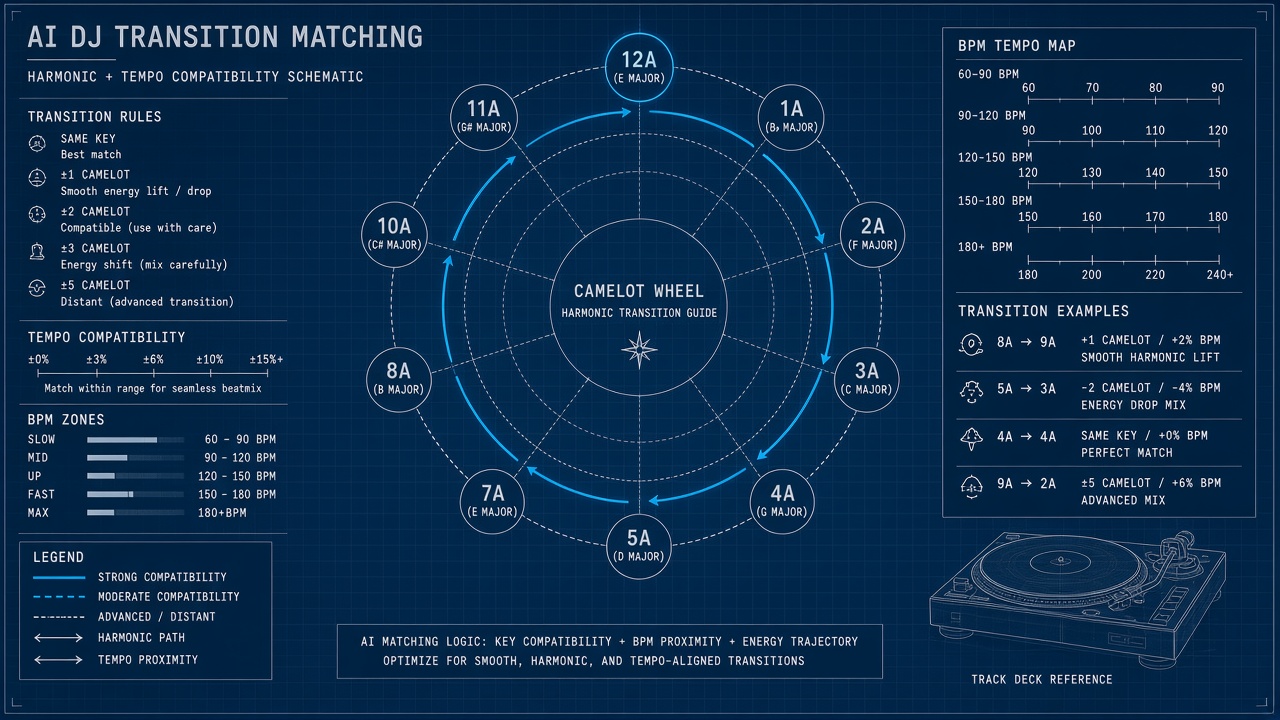
Harmonic mixing pairs tracks whose keys sit in compatible positions on the Camelot wheel or circle of fifths, reducing dissonance when two songs overlap during a transition. Adjacent numbers on the wheel, such as 8A to 9A, often mix smoothly. Relative major and minor pairs, like 8A and 8B, provide emotional shifts without harsh clashes. Expert DJs break rules intentionally for tension, but baseline compatibility keeps long blends listenable in house, techno, and open-format rooms.
AI transition tools encode these rules as distance metrics. HarmonySet normalizes more than 56 key notation variants from different export formats before scoring. SetFlow grades every transition and exposes the reasoning, so a DJ can accept a slightly bolder key jump when the energy profile demands a peak-time lift.
BPM and Key Detection Algorithms
Beatgrid and key detection rely on onset detection, autocorrelation for tempo, and chroma feature analysis or deep classifiers trained on labeled DJ libraries. Rekordbox and Serato analyze imported audio to place beat markers and estimate key, though live edits, syncopated percussion, and half-time drops confuse naive detectors. SetSculptor and similar tools re-check double-time and half-time relationships so a 70 BPM downtempo track is not mistaken for 140 BPM drum and bass.
Export quality matters. Rekordbox XML carries rich metadata when libraries are maintained. Serato crate exports may omit fields unless analysts re-tag consistently. AI optimizers cannot fix missing keys; they flag gaps and skip or penalize uncertain transitions.
| Signal | Typical method | Common failure |
|---|---|---|
| BPM | Onset peaks, tempo histogram | Double-time halving errors |
| Musical key | Chroma vectors, classifier heads | Ambiguous atonal or percussive tracks |
| Beatgrid | Transient alignment, downbeat search | Live drummers drifting off grid |
| Energy | Loudness, spectral centroid, ML proxies | Quiet but intense minimal techno |
Real-Time Suggestion UX in DJ Software
In-deck UX surfaces related tracks beside the playing song, while standalone planners generate full ordered sets offline for import before the gig. Rekordbox Related Tracks filters by key and tempo around the current deck. Serato offers similar library intelligence tied to analyzed files. These panels help mid-set pivots when the floor stalls. They do not automatically sequence a two-hour journey with warm-up, peak, and cooldown unless the DJ manually drags results.
SetFlow targets prep: import a crate, pick an energy archetype such as Journey or Peak Time, set BPM tolerance near plus or minus three percent between adjacent tracks, pin anchor records, then export back to Rekordbox XML or M3U8. HarmonySet uploads a playlist and returns an optimized order with per-transition match or clash labels. SetSculptor offers three AI-sculpted sequences with bar-count mix notes, including parallel key suggestions and halftime jump warnings.
Underground vs Festival DJ Needs
Underground selectors prize obscurity, long blends, and reactive programming; festival closers need reliable peak energy and broadcast-safe transitions on massive PA systems. AI suggestions trained on mainstream harmonic rules may steer underground DJs toward predictable paths. Conversely, a festival slot with fixed duration benefits from pre-graded sets that guarantee a drop before the fireworks cue.
Configure energy profiles explicitly. Warm Up modes bias toward gradual BPM climbs. Chill or Cool Down archetypes prevent accidental peak-time bangers during opening hours. Underground DJs might disable energy targeting entirely and optimize only key distance, accepting wider tempo swings handled manually with pitch faders.
Phrase Mixing and Bar Counts
Harmonic compatibility means little if you mix vocals over vocals; phrase-aware tools suggest entering the next track at an eight- or sixteen-bar boundary aligned with breakdowns. SetSculptor surfaces ideal bar counts and warns about halftime jumps where one track sits at 128 BPM and the next effective groove is 64 BPM. Manual DJs learn to loop outgoing intros while waiting for the phrase reset; AI notes reduce guesswork during prep even when live execution stays hands-on.
Acapella overlays and stem separation tools complicate transition scoring because isolated vocals may carry different perceived keys than the full mix. Re-analyze stems before trusting library metadata exported from the original purchase file. Bootleg edits with DJ-friendly intros shorten mix windows but may lack accurate beatgrids until you tap tempo live.
Preserving Human Improvisation
The sync button and AI suggestions share one risk: muscle atrophy when DJs stop listening critically because software declared a transition safe. Treat optimized playlists as sketches. Rehearse transitions, mark phrase boundaries, and keep a crate of emergency tracks that break harmonic rules but always move the room. Live improvisation includes reading hands in the air, not only metadata.
Document overrides. When you reject an AI swap because the crowd requested reggae during a techno hour, log that outcome. Personal performance history eventually beats generic harmonic averages. Teams experimenting with AI chatbot prompts for crowd notes can attach qualitative tags venues care about: university town, tourist bar, after-hours warehouse.
Serato and Rekordbox Native Features
Serato DJ Pro and Rekordbox analyze files on import, storing BPM, key, and beatgrid markers that power sync, quantize, and related-track filtering inside the booth. Rekordbox Performance mode can suggest tracks harmonically compatible with the deck that is playing, useful when a promoter hands you a USB with ten minutes notice. Serato's history and crate tools help you study which transitions actually worked on prior weekends, though neither platform automatically sequences a full narrative set the way SetFlow or HarmonySet do offline.
Beatgrid editing remains a human task for tracks with live drummers, acapella intros, or DJ edits with extended breakdowns. AI key detection mislabels tracks about five to ten percent of the time in dense electronic libraries; quarterly audit sessions where you reanalyze suspicious transitions pay dividends. Stems and mashup workflows add complexity because isolated vocals may carry a different perceived key than the full mix.
Energy Archetypes and Crowd Reading
SetFlow defines energy archetypes such as Journey, Peak Time, Warm Up, Chill, and Cool Down; each biases transition scoring toward climbing, flat intensity, or descending BPM curves. A Warm Up arc for 11 p.m. openers tolerates wider harmonic leaps because the floor is still sparse. Peak Time mode penalizes energy dips that would clear a packed room during main hours. Underground selectors may reject archetypes entirely and optimize key distance only, accepting manual tempo rides. Festival closers often pre-build two versions: a safe harmonic set and a wildcard crate if the headliner before them ran long.
HarmonySet's Held-Karp optimizer finds exact harmonic paths for playlists up to 20 tracks, switching to greedy heuristics for longer crates. That mathematical rigor helps radio DJs and wedding planners who must hit fixed milestones at fixed clock times. Club residents trade optimality for flexibility, keeping three compatible next-track options pinned rather than one ordained sequence.
Beatgrid Analysis Workflow
Reliable transition matching starts with clean beatgrids: verify downbeats on imports, fix drift on live recordings, and reanalyze versions when labels release remasters.
- Batch-analyze new downloads in Rekordbox or Serato before export.
- Manually adjust grids on tracks with tempo rides or breakdowns.
- Normalize key tags using one notation system across the library.
- Export XML or crates to the AI planner with consistent folder paths.
- Import the returned set, audition flagged clashes, tweak bar entry points.
- Save the final set as a recorded mix reference for future tours.
Transition notes exported from SetFlow or HarmonySet explain why 8A to 9A scored higher than 8A to 3A, building ear training over time. DJs who read those notes before gigs internalize harmonic movement faster than DJs who only follow ordered lists blindly. The AI becomes a tutor, not an autopilot.
Open-format wedding DJs face unique constraints: mother-of-the-bride requests, explicit-language policies, and sudden genre pivots when the dance floor skews older after dinner. Maintain parallel crates tagged by energy and content rating, then let the optimizer run inside each crate rather than across the entire library at once. When the planner suggests a harmonic techno track during the dollar dance, you will know to override before the bride notices.
Recording every gig and tagging timestamped transitions creates private training data. Six months of history reveals which harmonic shortcuts you actually use versus which the software prefers. Personal transition libraries outperform generic models for residents who play the same room every Saturday because crowd memory matters as much as key distance.
Frequently Asked Questions
Does AI transition matching work for vinyl DJs?
Vinyl DJs gain less from library optimizers unless they maintain digital catalogs of the same records with analyzed metadata. Real-time key detection on analog playback remains experimental; harmonic planning for vinyl is still largely ear-trained.
Is using sync alongside AI cheating?
Sync and AI are tools; audiences judge whether the set felt cohesive and responsive, not which buttons were enabled. Many professionals use sync for complex layering while manually riding EQ and effects.
How do tools handle genre blending?
Genre-blend sets need custom BPM tolerance and energy masks, because harmonic rules alone cannot bridge drum and bass into hip-hop without manual EQ work. Pin genre anchor tracks and let the optimizer fill compatible neighbors inside each segment.
Rekordbox XML or Serato crates for AI import?
Rekordbox XML typically preserves the richest key and BPM fields for third-party optimizers. Serato workflows often require CSV exports or folder scans; verify metadata completeness before trusting clash scores.
Can AI suggest transitions during a live set?
Native related-track panels offer live suggestions; full-set replanning mid-gig is rare because reordering breaks muscle memory. Use live panels for the next two tracks, not wholesale set regeneration.
What do transition grades actually measure?
Grades combine harmonic distance on the Camelot wheel, BPM delta as a percentage, optional energy delta, and sometimes genre compatibility flags. A yellow grade might mean acceptable with a quick EQ dip; red means expect a clash unless you mix on drums only.
Is there a minimum library size for optimizers?
Most tools need at least a few dozen analyzed tracks to build meaningful paths; tiny crates are faster planned by ear. SetFlow's free tier supports hundreds of tracks, enough for resident DJs testing the workflow on one genre crate.