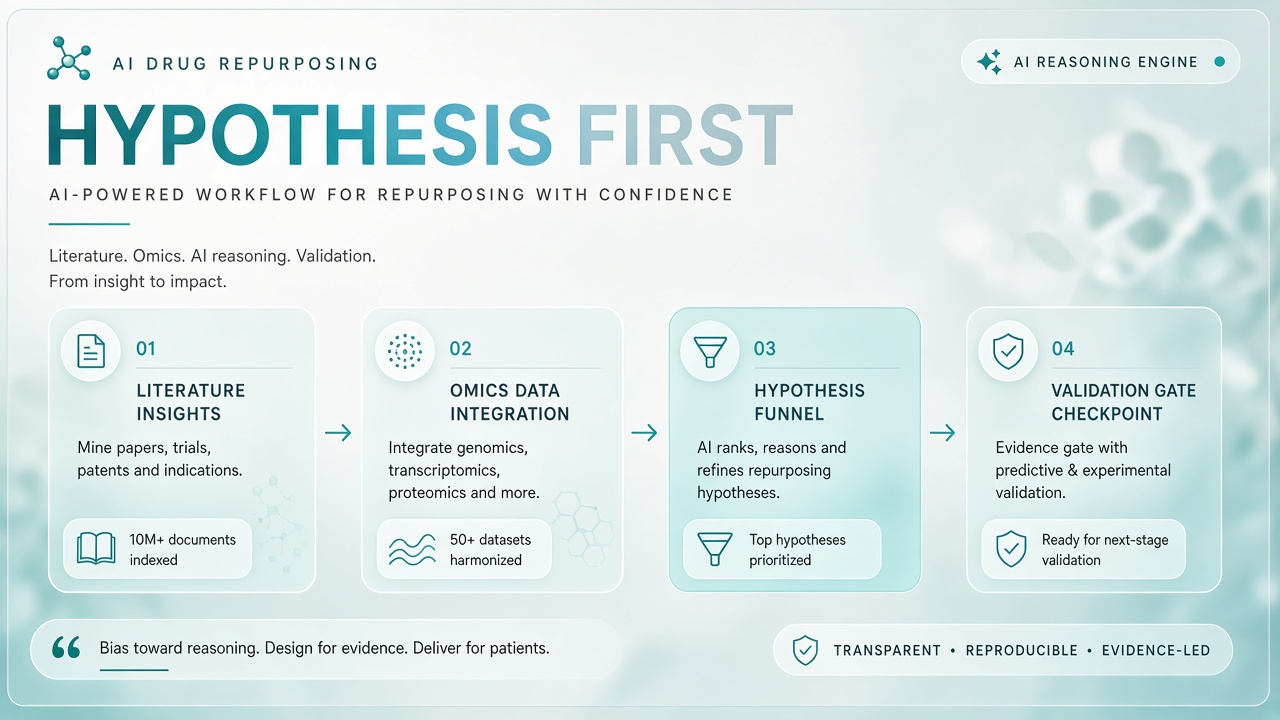
Drug repurposing finds new therapeutic uses for approved molecules, skipping early safety screens because human exposure history already exists. Artificial intelligence can scan millions of abstracts, expression profiles, and real-world evidence tables faster than any literature review team, but AI cannot replace randomized trials or regulatory sign-off. The productive frame is hypothesis-first: models propose mechanistic links; scientists gate each stage with experiments. This AI drug repurposing workflow guide walks researchers and biotech teams through data inputs, multi-agent tools like RepurAgent and Robin, validation gates, and FDA reality, with links to AI research infrastructure and AI writing assistants for protocol drafting.
Why Hypothesis-First Matters
Hypothesis-first repurposing ranks mechanistic plausibility before capital spend, using AI to narrow search space rather than to declare cures. Teams that start with trials or off-label anecdotes without structured gates rediscover known failures. The workflow below keeps humans accountable at every transition from computation to bench to clinic.
What Drug Repurposing Means
Drug repurposing (drug repositioning) applies an existing pharmaceutical compound to a disease indication different from its original approval, leveraging known pharmacokinetics and safety profiles to shorten development timelines. Famous examples include thalidomide's pivot to multiple myeloma and sildenafil's shift from hypertension research to erectile dysfunction. The economic appeal is clear: Phase I safety work is largely done; teams focus on efficacy for the new indication.
AI enters upstream of trials, ranking compound-disease pairs by plausibility. Downstream, humans still run in vitro screens, animal models where ethically required, and registrational studies. The FDA requires adequate and well-controlled trials for new indications even when the drug is already marketed for another use.
Repurposing timelines compress discovery but not confirmatory evidence. A statin studied for cardiovascular risk does not automatically gain an oncology label because an LM linked HMG-CoA reductase to a tumor pathway. The hypothesis-first workflow exists to kill bad pairs cheaply while funneling scarce wet-lab bandwidth toward pairs that survive pathway enrichment, phenotypic correlation, and safety re-review. AI that skips gates creates expensive false starts, not faster cures.
Data Inputs: Literature, Omics, and Clinical Scale
Repurposing AI pipelines ingest structured and unstructured sources: PubMed and patent text, gene expression signatures (GEO, TCGA), protein interaction networks, adverse event databases (FAERS), electronic health record cohorts where accessible, and compound property tables (ChEMBL, DrugBank). Quality beats quantity: a curated pathway map outperforms raw abstract embeddings if entity linking errors propagate.
| Data type | Repurposing signal | Common pitfall |
|---|---|---|
| Literature graphs | Mechanistic paths drug-target-disease | Hallucinated citations |
| Transcriptomics | Inverse disease signature matching | Batch effects across studies |
| Real-world evidence | Off-label outcome correlations | Confounding by indication |
| Knowledge graphs | Multi-hop reasoning | Stale drug-target edges |
What Repurposing Is Not
Repurposing is not off-label promotion, not compassionate-use substitution for trials, and not AI-generated prescription advice. It is a structured R&D program to gather evidence for a new indication on an existing molecule. Marketing and medical affairs teams must stay aligned so literature-mining hypotheses do not leak into patient-facing claims before regulatory clearance.
LinkD and Phenotypic Clinical Scales
LinkD binds phenotypic clinical scales to molecular features, helping models align patient-level outcome measures with compound mechanisms rather than treating diseases as monolithic labels. Scale-aware matching reduces false positives where a drug helps a biomarker subgroup but not the broad ICD code.
Data Governance and Privacy
EHR-linked repurposing requires IRB approval, de-identification standards, and data use agreements that AI vendors often omit from marketing slides. Federated learning and secure enclave inference reduce raw data movement but add engineering cost. Literature-only workflows avoid PHI but miss phenotypic signals LinkD targets. Document which tier your program uses before purchasing multi-agent licenses.
Hypothesis Generation: Multi-Agent Systems
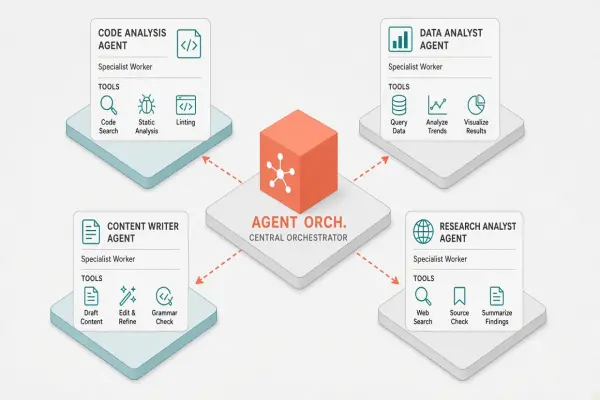
2026 systems such as RepurAgent (multi-agent, human-in-the-loop) and Robin (Nature multi-agent therapeutics platform) decompose repurposing into specialized agents: literature miners, pathway reasoners, contradiction checkers, and report writers coordinated by an orchestrator. Each agent emits structured hypotheses with evidence pointers, not prose conclusions alone.
RepurAgent Workflow (Conceptual)
- Query intake: Define disease phenotype, exclusion criteria (e.g., CNS penetration required), and approved drug universe.
- Evidence retrieval: Agents pull papers, trials, and omics contrasts with source IDs.
- Mechanism assembly: Graph agents link targets to pathways implicated in the disease.
- Adversarial review: Critic agents search for null results and conflicting trials.
- Human checkpoint: Scientist accepts, modifies, or rejects each ranked pair before wet lab.
Robin extends similar patterns to broader therapeutic design, integrating synthesis feasibility and competitive landscape agents. Treat these as decision support, not autonomous prescribers.
Validation Gates Before Trials
Every AI-ranked repurposing hypothesis should pass explicit validation gates: in vitro functional assays, pathway enrichment statistics, and clinical correlation checks on independent cohorts before IND-enabling work. Skipping gates produces pretty slide decks and failed Phase II programs.
| Gate | Pass criterion | Typical owner |
|---|---|---|
| In vitro activity | Dose-response in disease-relevant cells | Biology team |
| Pathway enrichment | FDR-corrected p below threshold on independent data | Bioinformatics |
| Clinical correlation | Replication in hold-out EHR or trial registry cohort | Clinical epidemiology |
| Safety re-review | Label contraindications acceptable for new population | Regulatory affairs |
| IP/FTO screen | Freedom to operate for new indication claims | Legal |
Documentation and Audit Trail
Store agent prompts, retrieved document versions, and model checkpoints used for each hypothesis so regulatory and publication reviewers can reproduce rankings. AI writing tools draft protocols, but principal investigators remain accountable for submissions. Version-control evidence packages alongside traditional study reports.
Prioritization Scoring Rubric
Rank compound-disease pairs with a weighted rubric: mechanistic plausibility (AI score), unmet medical need, competitive landscape, formulation feasibility, and safety margin on-label. AI excels at the first factor; humans must own the rest. Publish rubric weights before running agents to prevent post-hoc justification. A pair with stellar omics inverse signature but black-box warning for hepatotoxicity in the target population should fail early regardless of model enthusiasm.
| Rubric dimension | Weight (example) | Primary source |
|---|---|---|
| Mechanistic AI score | 25% | RepurAgent / Robin output |
| Independent literature support | 20% | Curator-reviewed DOIs |
| Omics replication | 20% | Hold-out GEO studies |
| Safety / label fit | 20% | FDA label, FAERS |
| Commercial / IP | 15% | FTO analysis |
Regulatory Reality: FDA and New Indications
The FDA still requires substantial evidence of efficacy for new indications, typically randomized controlled trials, even when the molecule is already approved elsewhere. 505(b)(2) pathways and supplemental NDAs can reduce duplicate safety work, but they do not eliminate clinical proof. AI-generated hypotheses are not substitutable for GLP tox updates when route or population changes materially.
- Label expansion: Sponsor submits trial data specific to the new use; AI supports site selection and endpoint modeling, not approval by itself.
- Off-label use: Physicians may prescribe off-label, but AI marketing claims suggesting efficacy without approval invite enforcement.
- Real-world evidence: FDA RWE frameworks accept some observational data, but provenance and bias controls must exceed LLM-summarized charts.
Team Roles in a Hypothesis-First Program
Computational scientists own pipelines and gates one through three. Medicinal chemists assess formulation changes. Clinicians define meaningful endpoints on phenotypic scales. Regulatory leads map the shortest lawful path to supplemental filing. AI accelerates handoffs; it does not collapse roles.
Week-by-Week Starter Plan
- Week 1: Define disease scope, drug universe, and rubric weights; stand up literature and omics data connectors with entity resolution QA.
- Week 2: Run RepurAgent or Robin exploratory pass; human curators reject hallucinated edges; shortlist top 20 pairs.
- Weeks 3-4: Pathway enrichment and clinical correlation on hold-out cohorts; cut list to five pairs.
- Weeks 5-8: In vitro gates on lead pairs; document negative results; select one candidate for IND planning.
- Ongoing: Feed assay outcomes back into rerankers; refresh literature graphs monthly.
AI writing assistants draft the week-one charter and gate protocols, but sign-off stays with the program lead. Templates reduce blank-page friction without automating scientific judgment.
Frequently Asked Questions
Can AI replace medicinal chemists in repurposing?
No; AI narrows search space and surfaces contradictions early, but experimental design, tox interpretation, and go/no-go decisions stay human. RepurAgent explicitly positions human-in-the-loop review.
What is the highest-ROI data source?
Depends on indication: rare diseases favor literature and omics; common chronic diseases add EHR-scale correlation with careful confounding control. No single corpus wins everywhere.
How do we catch hallucinated mechanisms?
Require DOI-backed citations, run contradiction agents, and fail hypotheses that lack primary assay evidence. Never advance a pair based on LLM summary alone.
How long from AI hypothesis to clinic?
Repurposing saves years versus novel entities, but confirmatory trials still span multiple years; AI shaves weeks to months off discovery, not off Phase III.
How do Robin and RepurAgent differ?
Both use multi-agent orchestration; Robin targets broader therapeutic design in Nature-reported workflows, while RepurAgent emphasizes repurposing-specific human checkpoints in 2026 literature. Evaluate on your indication's data availability, not brand alone.
Why emphasize phenotypic clinical scales?
Diseases present heterogeneously; LinkD-style scale binding aligns molecular hypotheses with measurable patient outcomes instead of coarse ICD buckets. This reduces false positives in AI ranking.
Should we feed negative results back to models?
Yes; failed in vitro gates are valuable training signal for rerankers and prevent repeated expensive mistakes on the same mechanisms. Maintain a structured negative evidence library with assay metadata.
Where do AI writing tools fit?
Draft protocols, IND sections, and literature summaries after hypotheses pass human review; never auto-file regulatory submissions from raw agent output. Principal investigators edit every submission paragraph.
What order should validation gates run in?
Run cheapest gates first: computational pathway enrichment and clinical correlation on existing cohorts, then in vitro assays on survivors, then tox and regulatory review before IND-enabling spend. Skipping early gates wastes wet-lab budget on AI false positives.
Does FDA waive trials for repurposed drugs?
No waiver for efficacy; supplemental indications still need adequate and well-controlled studies, though safety databases from prior approvals may reduce duplicate work. AI hypotheses do not substitute for trial protocols accepted by regulators. Budget regulatory affairs time into every repurposing program from week one, not only after positive in vitro reads.
Systems Landscape in 2026
RepurAgent exemplifies multi-agent human-in-the-loop repurposing with explicit contradiction agents; Robin (Nature) broadens multi-agent therapeutics design; LinkD anchors phenotypic clinical scales to molecular features. None bypass FDA evidentiary standards. Successful programs combine these tools with internal knowledge graphs, FAERS signal review, and structured negative-result libraries. Vendor selection should prioritize audit trails and exportable evidence graphs over glossy natural-language reports alone.
Conclusion
AI drug repurposing works when teams treat models as hypothesis generators bounded by validation gates and FDA rules. Ingest literature, omics, and clinical-scale phenotypes; orchestrate multi-agent systems like RepurAgent and Robin with mandatory human review; pass in vitro, pathway enrichment, and clinical correlation gates before trials. LinkD-style phenotypic scales keep rankings aligned with patient outcomes. The workflow compresses discovery timelines without trading away evidentiary standards. Pair computational ranking with AI writing tools for protocols, but keep scientists in the proof path at every gate. Machines propose; scientists prove.