Enterprise fairness reviews ask what bias tests you ran on deployed AI tools, not whether vendors claim their models are unbiased. A AI writing assistant that generates job descriptions can introduce discriminatory language. A AI productivity tool that ranks tasks or suggests meeting attendees can skew outcomes across demographic groups. "We trust the vendor" is not documentation.
AI bias testing documentation defines which protected attributes matter for each use case, describes test datasets and synthetic scenarios, records metrics and thresholds, and links to remediation and monitoring plans. This guide helps compliance, data science, and product owners produce defensible fairness evidence when vendor tooling is thin or opaque.
Define Protected Attributes Per Use Case
Protected attributes for bias testing should reflect legal protected classes in your operating jurisdictions and contextual harm pathways for the specific AI use case, not every demographic variable globally. Employment assists focus on gender, race, age, disability, and religion where applicable. Credit-related tools add nationality and socioeconomic proxies. Document why each attribute is in scope.
| Use case domain | Typical protected attributes | Proxy variables to watch |
|---|---|---|
| Hiring and HR | Gender, race, age, disability, religion | University names, gap years, name ethnicity signals |
| Customer support routing | Language, geography, perceived accent in voice | Ticket sentiment, customer tier as wealth proxy |
| Content generation | Gender, race in personas, cultural stereotypes | Default pronouns, occupational role assumptions |
| Accessibility assists | Disability, age-related capability | Reading level, dialect penalization |
Legal and Ethical Scoping
Work with legal counsel to align attribute lists with EEOC, EU equality directives, and sector rules; ethics reviews may add attributes beyond legal minimums when brand harm is material. Document attributes you explicitly exclude from testing and why (e.g., unavailable labels, privacy constraints).
Sensitive Attribute Handling
Bias tests often require sensitive labels; use synthetic personas, public benchmark datasets, or internally labeled research sets with access controls rather than mining protected attributes from production logs without legal basis. Minimize retention of labeled test artifacts.
Test Datasets and Synthetic Scenarios
Document every dataset used for bias testing: source, license, size, label quality, known limitations, and version hash; supplement real data with synthetic counterfactual pairs that swap protected attributes while holding qualifications constant. Counterfactual testing on a AI writing assistant might compare job ad drafts for identical roles with names associated with different gender or ethnic backgrounds.
- Golden counterfactual pairs: minimally edited inputs across attribute values.
- Scenario library: edge cases from past incidents, regulator examples, academic benchmarks.
- Adversarial prompts: attempts to elicit stereotyping or exclusionary language.
- Production samples: de-identified stratified samples with oversight review, not blind bulk export.
Scenario Library Maintenance
Version the scenario library when policies, locales, or model versions change; link library version to each test run record. Community-sourced scenarios from affected employee resource groups improve realism compared to purely synthetic sets.
Vendor Benchmark Limitations
Vendor-supplied fairness cards or benchmarks rarely cover your exact use case; document gaps when relying on vendor materials and describe supplemental tests you ran locally. Request model cards and system cards under EU AI Act transparency expectations where applicable.
Metrics Recorded and Thresholds
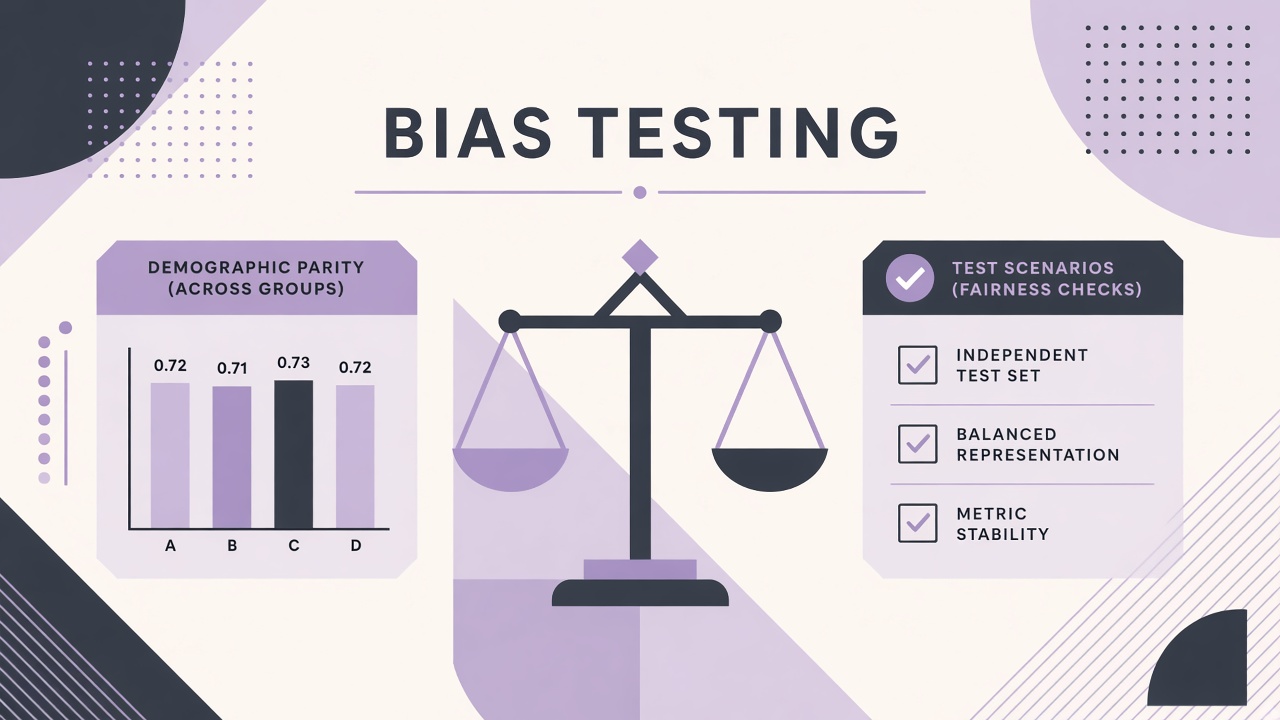
Record fairness metrics appropriate to the task: demographic parity differences, equalized odds gaps, calibration by group, stereotype association scores for generative outputs, and qualitative rubric scores from human reviewers. Define thresholds before testing to avoid post-hoc rationalization. Document metric limitations openly.
| Metric family | Best suited for | Caveat to document |
|---|---|---|
| Demographic parity | Selection rates across groups | Ignores qualification differences; can conflict with merit goals |
| Equalized odds | Binary classification with ground truth | Needs reliable labels per group |
| Calibration | Risk scores and confidence outputs | Small groups produce unstable curves |
| Rubric-based qualitative | Generative text and creative outputs | Reviewer training and inter-rater agreement matter |
Threshold Governance
Set thresholds with legal and business input: maximum allowable disparity percentage, minimum rubric score, or zero-tolerance categories for slurs and exclusionary phrases. Failed thresholds trigger remediation workflows, not silent waiver. Exception approvals require executive and compliance sign-off with compensating controls documented.
Test Run Records
Each test run log should include date, model version, dataset version, scenario library version, metric results, pass or fail against thresholds, tester identity, and links to raw outputs stored under access control. Re-run after every major model change per your change management policy.
Remediation and Monitoring Plan
When tests fail or borderline results appear, document remediation actions: prompt changes, output filters, human review gates, workflow restrictions, vendor escalation, or decommissioning. Pair remediation with ongoing monitoring: production disparity dashboards, user complaint taxonomy, and periodic re-testing cadence.
- Root cause analysis: data, prompt, model, or process failure mode.
- Short-term mitigation deployed with change ticket reference.
- Re-test to confirm metric movement toward threshold.
- Long-term fix owner and target date if mitigation is temporary.
- Monitoring alert thresholds updated to detect regression.
Monitoring in Production
Production monitoring for AI productivity tools may track outcome distributions by available proxy segments, escalation rates, and qualitative feedback tags. Where direct demographic labels are unavailable, document proxy limitations and combine quantitative signals with sampled human review.
Vendor Escalation
Escalate systematic model bias to vendors with reproducible prompts, metric evidence, and business impact statement; track vendor ticket IDs in remediation records. Contract reviews should address fairness defect response SLAs for enterprise AI APIs.
Documentation Package for Audits
Assemble a bias testing evidence package per high-risk or customer-facing AI system: attribute scoping memo, scenario library excerpt, test run logs for last 12 months, remediation tickets, monitoring dashboard screenshots, and reviewer training records for qualitative rubrics. Internal audit samples one system per quarter before external assessors arrive.
Cross-Functional Roles
Product owns use case context, data science or ML engineering owns metric execution, legal owns protected class alignment, compliance owns evidence retention, and business owners accept residual risk after remediation. RACI clarity prevents bias testing from stalling in ambiguous ownership.
Frequently Asked Questions
What if sample sizes are too small for statistical tests?
Document small-sample limitations explicitly; rely on qualitative rubrics, counterfactual pairs, and wider confidence intervals rather than inventing precise parity percentages. Combine multiple testing waves to accumulate evidence over time. State in reports that results are directional, not definitive hypothesis tests, when N is below agreed minimums.
How do we address intersectionality?
Test intersectional subgroups where sample size permits; where it does not, document the constraint and prioritize scenarios with compounded harm potential identified by affected communities. Intersectional analysis (e.g., gender and race jointly) requires more data than single-attribute tests; plan scenario libraries that represent intersectional personas even when aggregate metrics cannot be computed.
We lack demographic labels in our data. Can we skip testing?
No. Use synthetic counterfactuals, public benchmarks, and structured human review rubrics instead of production labels. Skipping tests because labels are missing is a documentation gap auditors flag; describe alternative methods in your scoping memo.
Does generative AI need different documentation than classifiers?
Yes. Generative tools emphasize rubric-based stereotype checks, toxicity classifiers, and counterfactual output comparison rather than confusion matrices. A AI writing assistant bias pack focuses on language inclusivity and role stereotyping, not false positive rates alone.
Human Review for Qualitative Bias
Generative tools require trained human reviewers scoring outputs against rubrics for stereotyping, exclusionary language, tone by demographic persona, and factual errors that disproportionately harm protected groups. Document inter-rater agreement targets and adjudication process when reviewers disagree. Store reviewer IDs and rubric version with each scored batch.
A AI writing assistant fairness review might score ten variants of the same job posting prompt with names signaling different backgrounds. Reviewers record whether compensation language, requirement strictness, or culture-fit phrasing diverges materially. Aggregate rubric scores supplement automated toxicity detectors that miss subtle bias.
Reviewer Diversity
Where feasible, include reviewers with lived experience relevant to tested scenarios; document reviewer panel composition without exposing individual demographic data in external reports. Homogeneous review panels miss cultural nuance that customers and regulators expect you to consider.
Regulatory and Customer Alignment
Map bias testing documentation to EU AI Act high-risk data governance expectations, EEOC uniform guidelines on employee selection procedures where applicable, and enterprise customer fairness addenda in contracts. When customers request algorithmic impact assessments, reuse attribute scoping memos and test run logs rather than rebuilding narratives per deal.
- EU deployers: link tests to risk management system updates after material findings.
- US employers: document job-relatedness analysis when selection assists are tested.
- Financial services: fair lending statistical tests where credit language is generated or scored.
- Public sector: transparency publications may reference testing methodology at summary level.
Productivity Tool Outcome Tracking
AI productivity tools that prioritize tasks, suggest meeting attendees, or allocate work should track outcome distributions by team and role as proxy fairness signals when demographic labels are unavailable. Document proxy limitations in monitoring reports. Sudden shifts after model updates trigger re-testing under change management policy.
Tooling and Reproducibility
Store test scripts, random seeds, and environment configuration so third parties can reproduce results within reasonable bounds. Containerize eval runners pinned to model versions. Reproducibility breaks when vendors retire models; export representative outputs when models sunset.
Open-source fairness libraries help, but documentation must explain metric choices and why they fit the use case. A confusion-matrix metric inappropriate for generative text undermines credibility faster than admitting qualitative methods with clear rubrics.
Negative Results
Document failed tests and inconclusive runs, not only passes. Selective publication of favorable bias results is an audit red flag. Remediation tickets linked to failures demonstrate mature governance. Annual fairness reports to leadership should include open issues and timeline.
Implementation Roadmap
Month one: scope attributes and build scenario library for top three AI use cases; month two: run baseline tests and set thresholds; month three: integrate re-test triggers into model change management and publish monitoring dashboards. Expand library coverage as new tools enter the inventory register. Fairness documentation is iterative, not a one-time legal deliverable.
Year two: automate regression fairness suites in CI for custom prompts, establish rotating review panel for qualitative rubrics, and publish internal fairness standards referenced in vendor RFPs. Mature programs treat bias documentation as living evidence tied to every major release, not an annual slide deck.
Fairness Testing in Vendor Selection
Include bias testing expectations in RFPs and security questionnaires: request model cards, prior fairness evaluations, and commitment to notify on changes affecting protected groups. During pilot, run your scenario library against finalist vendors before contract signature. Document vendor gaps you accept with compensating controls versus gaps that disqualify the tool.
When evaluating AI writing assistant vendors, test inclusive language suggestions across role types and geographies. Vendors optimizing for US English may perform poorly on global inclusivity requirements your brand demands.
Continuous Monitoring Thresholds
Production monitoring should alert when disparity metrics exceed rolling baselines by agreed percentages, not only absolute thresholds. Seasonal hiring or campaign cycles shift distributions; baseline windows prevent false alarms while catching real drift. Document alert tuning decisions when on-call teams adjust sensitivity.
Stakeholder Communication
Share bias testing summaries with leadership in plain language: what was tested, what passed, what failed, what mitigations are live, and what residual risk remains. Legal and DEI partners should review external communications before publication. Transparency builds trust; hiding failed tests until leaks damages credibility more than documented remediation.
Employee and Affected Community Input
Solicit structured feedback from employee resource groups and customer advisory boards on scenario realism; document how feedback changed your test library. Community input does not replace quantitative tests but catches harms metrics miss. Record meeting summaries as evidence of participatory governance where appropriate.
Linking Bias Tests to Change Management
Model change management policy should require fairness regression as a gate for major promotions on systems affecting protected groups or generating customer-facing content. Link bias test run IDs to change tickets the same way functional evals link. Failed fairness gates block promotion until remediation or documented exception with executive approval.
Teams using AI productivity suites for workflow routing should re-run disparity checks after prompt template changes even when the underlying model is unchanged. Prompt changes alter outcomes without vendor version bumps.
Annual Fairness Review Cycle
Schedule annual comprehensive fairness reviews even when no major model changes occur: language drift, user population shifts, and new regulations can change risk without vendor updates. Annual reviews revalidate thresholds, refresh scenario libraries, and confirm monitoring alerts still route to accountable owners. Link review completion to AI inventory attestation dates.
Independent Review
Internal audit or external fairness reviewers should periodically reperform a sample of documented bias tests to verify methodology integrity and result accuracy. Independent review catches optimistic threshold setting and cherry-picked scenarios. Schedule annual independent sample for high-risk systems at minimum.
Document Tests, Not Assumptions
Bias testing documentation succeeds when teams define relevant protected attributes per use case, maintain versioned datasets and scenarios, record metrics with pre-set thresholds and known caveats, execute remediation with monitoring, and address small-sample and intersectional limits honestly. Vendors may assist, but deployers own the evidence that fairness risks were identified and managed.