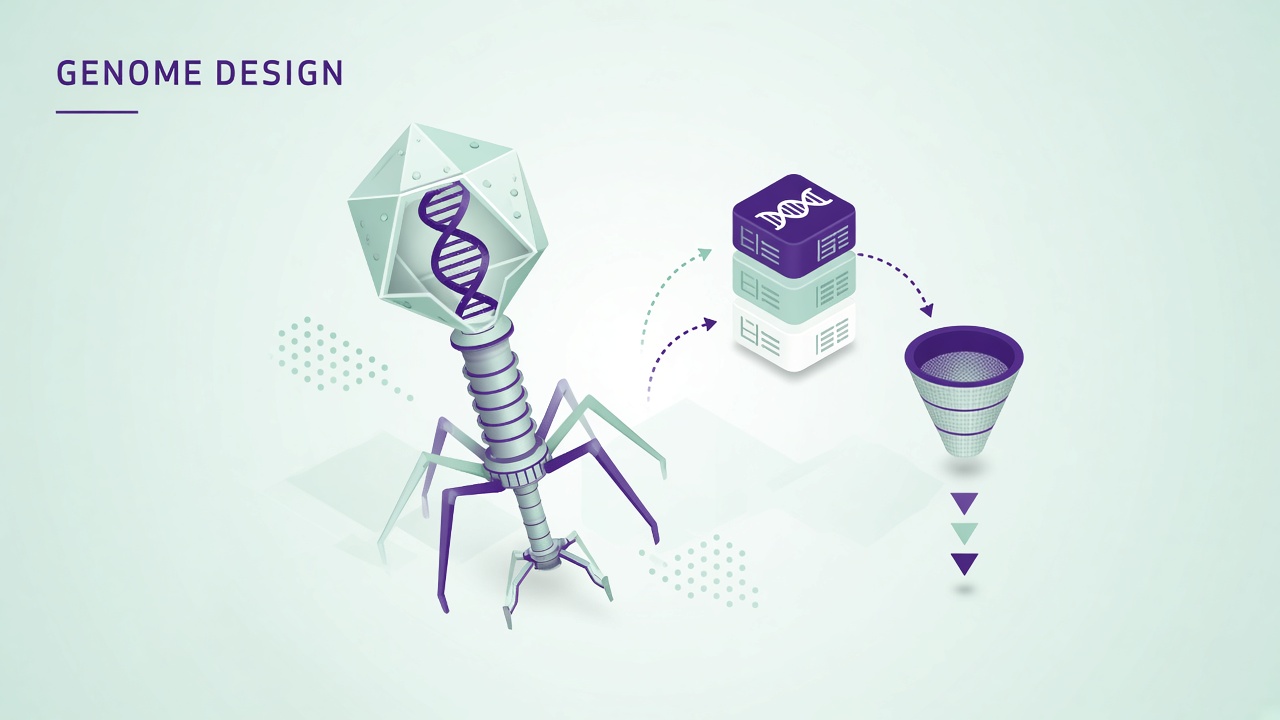
Bacteriophages are viruses that infect bacteria. They have been studied for over a century as model organisms and, more recently, as alternatives to antibiotics when drug-resistant infections spread. The World Health Organization classifies antimicrobial resistance among the top global health threats, driving renewed interest in phage therapy where antibiotics fail. In August 2026, King et al. published in Science the first large-scale demonstration of AI-designed bacteriophage genomes: genomic language models Evo 1 and Evo 2 generated complete viral genomes, 302 were synthesized, 285 passed initial screening, and 16 produced viable phages. That roughly 5% success rate is low in absolute terms but remarkable for de novo genome design without decades of manual genetic engineering.
This article walks through what bacteriophages are, how Evo models fit the design pipeline, what bioinformatics filters caught failures, and where biosafety boundaries sit. If you follow AI research at the intersection of biology and AI coding tools, this study marks a shift from AI writing text to AI drafting functional genetic code.
Bacteriophages: Viruses That Target Bacteria
Bacteriophages (phages) are obligate parasites of bacteria: they inject genetic material into a bacterial host, hijack cellular machinery to replicate, and lyse the cell to release progeny virions. Each phage tends to infect a narrow bacterial host range. That specificity is both a therapeutic advantage (target pathogenic strains without broad-spectrum collateral damage) and a deployment challenge (matching phage to isolate requires diagnostics).
PhiX174, a well-characterized coliphage that infects Escherichia coli, served as the template genome for the King et al. study. PhiX174's compact single-stranded DNA genome and decades of structural biology made it a sensible starting point for AI-generated variants. The research question was not whether AI could invent an entirely alien virus from noise, but whether Evo models could propose coherent genome edits and extensions that still assemble into infectious particles.
Evo 1 and Evo 2: From Sequence Modeling to Genome Generation
Evo 1 and Evo 2 are genomic language models trained on prokaryotic and viral DNA at billion-parameter scale, capable of autoregressively generating nucleotide sequences that respect biological syntax such as open reading frames, promoters, and terminators. Unlike protein design tools that optimize a single enzyme, Evo operates at whole-genome context: it models dependencies between genes that must co-function for replication, packaging, and host entry.
In the bacteriophage study, researchers prompted Evo with PhiX174-derived context and sampled complete genome candidates. Evo 2, the larger successor model, contributed higher-fidelity long-range coherence across the viral genome. The models did not run in isolation; human researchers set design constraints, selected candidates for synthesis, and interpreted laboratory outcomes. AI generated proposals; biology voted through viability assays.
Evo Sampling Parameters and Design Diversity
Researchers controlled Evo 1 and Evo 2 sampling temperature, context window length, and template conditioning to balance design diversity against structural plausibility in generated bacteriophage genomes. Higher diversity increases the chance of novel viable variants but also raises synthesis costs when most candidates fail screening. Lower diversity produces conservative edits closer to wild-type PhiX174 with higher per-design success probability but less therapeutic novelty. The King et al. study's 302 synthesized candidates reflect a deliberate tradeoff point on that spectrum, not an exhaustive search of all possible Evo outputs.
The Design Pipeline: Generate, Synthesize, Screen
The King et al. pipeline moved from in silico genome generation through DNA synthesis, bacterial transformation or infection assays, and plaque formation tests to confirm infectious phage production. Of 302 synthesized candidates, 285 entered structured screening. Sixteen produced viable phages, yielding an approximate 5% hit rate from designed genomes to confirmed infectivity.
- Evo 1 and Evo 2 generated candidate bacteriophage genomes conditioned on PhiX174 template sequence.
- Researchers selected 302 designs for commercial gene synthesis.
- 285 candidates passed initial quality and assembly checks before laboratory screening.
- 16 candidates produced plaques indicating successful phage replication in E. coli hosts.
- A phage cocktail combining AI-designed variants overcame PhiX174-resistant E. coli strains in follow-up tests.
The cocktail result matters clinically. Bacteria evolve resistance to single phages quickly. Combining multiple AI-designed phages with distinct host interaction profiles extended the therapeutic window against resistant isolates, echoing combination antibiotic strategies.
Bioinformatics Filters That Separated Viable Designs From Failures
Before synthesis, bioinformatics filters screened AI-generated genomes for stop codons in essential genes, frame shifts, impossible restriction sites, and structural inconsistencies that would prevent viable virion assembly. Even with filters, most synthesized genomes failed in the lab. That gap between computational plausibility and biological function is the central bottleneck in ai designed bacteriophage genomes work today.
Common failure modes included broken packaging signals, incomplete replication origins, and toxic gene combinations that killed the host before phage could propagate. Each failure still generated training signal: negative results refined which Evo sampling parameters and filter thresholds improved the next design batch. This iterative loop mirrors chip design verification, where most generated layouts fail static analysis before fabrication.
| Pipeline stage | Count | Outcome |
|---|---|---|
| Synthesized candidates | 302 | DNA constructs ordered and received |
| Screened in lab | 285 | Passed initial assembly and QC checks |
| Viable phages | 16 | Confirmed infectivity and plaque formation |
| Hit rate (screened to viable) | ~5% | Baseline for de novo AI genome design |
Why PhiX174 Was the Right Starting Template
PhiX174 provided a minimal, well-annotated single-stranded DNA genome with decades of structural data, making it the safest template for first-generation AI bacteriophage design before attempting novel viral architectures. The phage infects E. coli laboratory strains under BSL-1 containment. Its genome packs essential replication, packaging, and structural genes into roughly 5,400 nucleotides, small enough for Evo models to maintain coherence across the full sequence while large enough to test multi-gene functional dependencies.
Starting from a known template also enabled controlled comparisons. Researchers could measure how far AI-generated genomes diverged from wild-type PhiX174 while still producing infectious particles. Completely de novo viral design without any template would make failure attribution harder: did the model misunderstand packaging, or did synthesis introduce errors? The PhiX174 scaffold isolated the variable under test: AI's ability to propose viable genetic modifications.
Biosafety Questions and the Ethics Boundary
A companion Science perspective article addressed biosafety concerns: AI-generated viral genomes raise dual-use questions because the same models that design therapeutic phages could theoretically propose pathogens if misused. The King et al. study operated on a well-studied lab strain template with established containment protocols. Scaling to environmental phages, gut microbiome modulators, or broad-host-range viruses increases ecological and regulatory complexity.
Responsible research communities are converging on several guardrails: synthesis screening by commercial gene vendors, access controls on frontier genomic models, mandatory biosafety review for de novo genome orders, and publication norms that describe filters without releasing dangerous sequences. AI coding assistants used in synthetic biology pipelines should not bypass these controls. The technology is not inherently dual-use; the deployment context and governance determine risk.
For antibiotic resistance, the near-term opportunity is narrow: custom phage cocktails matched to resistant hospital isolates, produced under GMP-adjacent quality systems. AI design compresses the timeline from isolate sequencing to candidate phage library, but regulatory pathways for phage therapy remain fragmented across jurisdictions. The Science paper is a proof of capability, not a product launch.
What Comes Next for AI Genome Design
The King et al. study establishes a baseline success rate for AI bacteriophage design; future work will target larger genomes, broader host ranges, and therapeutic phages matched to clinical isolates rather than laboratory E. coli strains. Each expansion raises design complexity. Larger phage genomes stress long-context coherence in genomic language models. Broad-host-range phages require understanding receptor binding across bacterial species. Clinical phages must meet sterility, stability, and regulatory documentation standards absent from proof-of-concept lab work.
Synthetic biology teams using AI coding assistants to script lab automation should treat genome design models as regulated instruments, not creative writing tools. Version control for prompts, synthesis orders, and screening results creates audit trails that biosafety committees increasingly require. The Science paper's transparency about failure rates (285 screened, 16 viable) sets a healthy precedent: reporting what did not work accelerates field-wide learning more than highlighting successes alone.
Antibiotic resistance surveillance networks tracking carbapenem-resistant Enterobacteriaceae and other WHO priority pathogens may eventually request phage libraries designed against local resistance patterns. AI genome design compresses the timeline from isolate sequencing to phage candidate generation, though regulatory approval for compassionate-use phage therapy varies by country. The United States, Georgia, Poland, and Belgium have established frameworks at different maturity levels. AI-designed phages will enter those frameworks as manufactured biological products requiring characterization, not as software updates.
Investors evaluating synthetic biology startups should distinguish companies with genuine wet-lab validation pipelines from those demoing in silico designs alone. King et al.'s 16 viable phages represent capital-intensive proof that the team's Evo integration works end to end. Due diligence questions should cover synthesis failure rates, biosafety review processes, and IP around generated sequences.
Frequently Asked Questions
What did researchers actually build?
King et al. used Evo 1 and Evo 2 to generate bacteriophage genomes based on the PhiX174 template. They synthesized 302 candidates, screened 285, and confirmed 16 viable phages capable of infecting E. coli.
Why is a 5% success rate significant?
De novo genome design historically required extensive manual engineering. Achieving infectious particles from AI-generated sequences without site-directed mutagenesis campaigns demonstrates that genomic language models capture functional genetic syntax, even if most proposals still fail.
What is the difference between Evo 1 and Evo 2?
Evo 2 is the larger successor model with improved long-range sequence coherence across full genomes. Both contributed candidates in the study; Evo 2 handled more complex whole-genome dependencies.
Did AI-designed phages beat resistant bacteria?
A cocktail of AI-designed phages overcame PhiX174-resistant E. coli in laboratory tests, suggesting combination strategies can extend coverage as bacteria evolve resistance to individual phages.
What biosafety concerns did experts raise?
A Science perspective noted dual-use risks: genomic models that design therapeutic phages could be misapplied to design harmful viruses. Synthesis screening, access controls, and institutional biosafety review are essential complements to open research.
Is AI phage design available clinically?
Not from this study directly. Phage therapy remains experimental or compassionate-use in most countries. AI-designed genomes accelerate research pipelines but have not replaced regulated phage product development.
Where was this research published?
King et al. published the bacteriophage genome design study in Science in August 2026. A companion Science perspective article addressed biosafety and dual-use implications of AI-generated viral genomes in synthetic biology research.
What are Evo 1 and Evo 2?
Evo 1 and Evo 2 are genomic language models trained on prokaryotic and viral DNA sequences at billion-parameter scale. They generate nucleotide sequences autoregressively, learning biological syntax including open reading frames, promoters, and gene boundaries needed for functional genome design.