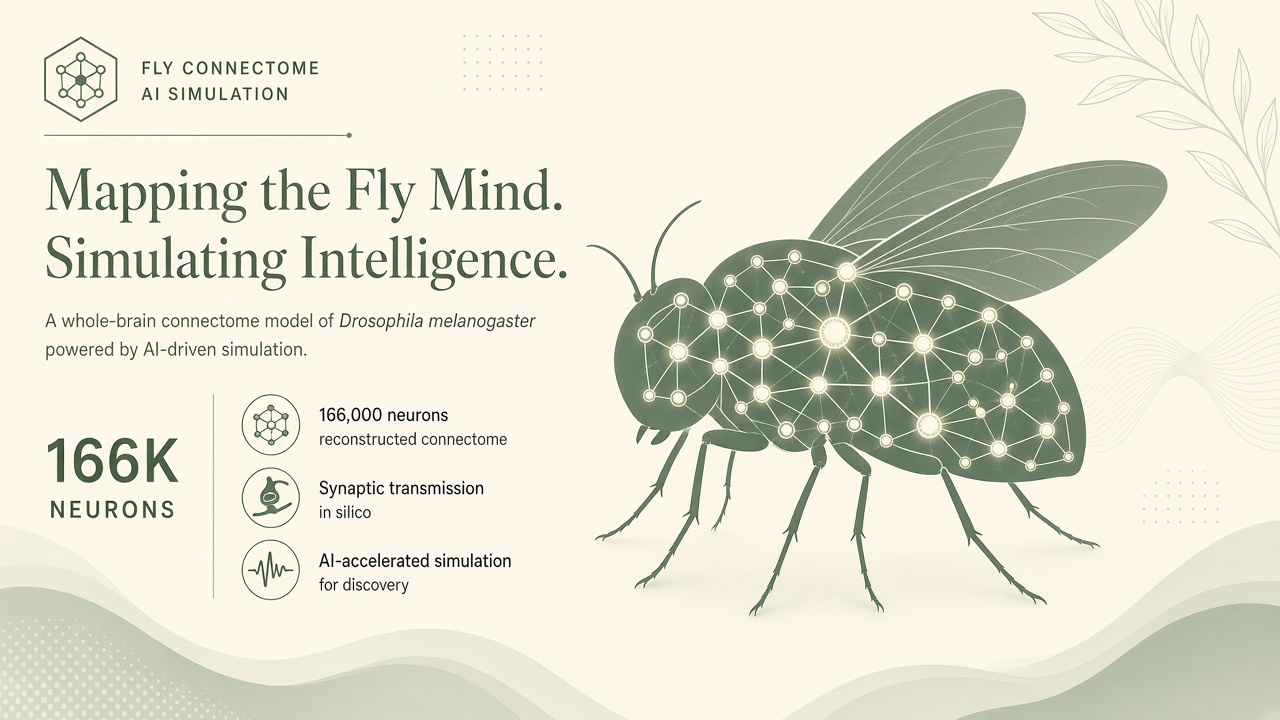
In September 2026, Berg and colleagues published the complete connectome of the adult male fruit fly brain in Cell, mapping 166,691 neurons, roughly 125 million synapses, and 11,691 morphological cell types. Within months, teams at Google and independent labs began simulating subsets of that wiring diagram inside game environments and spiking neural network frameworks. The result is not a fly that passes the Turing test. It is a living benchmark for sparse, efficient computation that AI research teams and AI coding architects can stress-test against trillion-parameter dense transformers.
Connectome Milestone: What Changed in 2026
A connectome is a wiring diagram: which neurons connect to which, with synaptic weights and morphology, not a record of how those circuits fire in behavior. Previous fly datasets covered hemispheres or developmental stages; the 2026 Cell release completes the adult male central brain and ventral nerve cord at synaptic resolution. Google contributed flood-filling network segmentation pipelines that scaled electron-microscopy reconstruction across terabytes of imagery.
The milestone matters for AI because it is the largest fully mapped brain tractable for end-to-end simulation experiments today. Mouse brains contain on the order of 70 million neurons; human brains roughly 86 billion. The fly sits in a sweet spot: complex enough for interesting behavior, small enough to load on a research GPU cluster.
| Organism | Neurons (approx.) | Connectome status | Simulation feasibility |
|---|---|---|---|
| Fruit fly (male, 2026) | 166,691 mapped | Complete at synaptic level | Active experiments |
| Mouse | ~70 million | Partial volumes | Limited regions only |
| Human | ~86 billion | Fragmentary | Not holistic |
| GPT-class LLM (analogy) | Billions of parameters | Trained weights, not anatomy | Different paradigm |
What Was Simulated: Games and LIF Models
Current fly connectome AI simulations combine anatomically grounded graphs with simplified neuron dynamics, often leaky integrate-and-fire (LIF) models in the open-source flybrain Python package. Researchers embed sensory inputs from virtual environments (odor gradients, visual motion in game engines) and read motor neuron outputs to steer locomotion. The connectome supplies topology; engineers still choose time constants, noise models, and learning rules because anatomy alone does not specify physiology.
Berg et al. Cell 2026 Dataset Highlights
The published connectome includes typed synapses, neuron skeletons, and brain region annotations enabling targeted ablations of circuits known to control navigation, olfaction, and courtship behavior in Drosophila. Researchers can ask whether a simulated agent still chemotaxes when mushroom body output neurons are silenced, mirroring classic optogenetics experiments but in software. That closed loop between anatomy and behavior is what attracts AI architects: you can test architectural hypotheses with ground-truth wiring, not random graph samples.
Google Flood-Filling Pipeline
Google's flood-filling networks segmented electron microscopy volumes into consistent neuron identities across slices, enabling the graph export that simulations consume. Without automated segmentation at this scale, manual tracing would take decades. The AI lesson is familiar: perception models enable scientific datasets that become training grounds for the next generation of agents.
Anatomy vs Physiology Reminder
The connectome is anatomy, not physiology: knowing synapses exist does not specify firing dynamics, neuromodulator context, or developmental plasticity. Simulations therefore require parameter fitting that can overfit behavior unless constrained by independent experiments. AI readers should not quote fly sim demos as proof that wiring alone equals intelligence; they demonstrate how much machinery is still missing when only structure is known.
flybrain Python Package
flybrain exposes connectome subgraphs, synapse lists, and LIF simulation hooks so researchers can ablate pathways and measure behavioral deficits in silico. Typical workflows load a region of interest (optic lobe, central complex), attach environment sensors, and run millions of timesteps to compare wild-type wiring against randomized controls.
Lessons for Sparse Efficient Networks
Fly circuits achieve sophisticated navigation and learning with extreme sparsity: most neurons connect to few partners, and regional specialization beats uniform depth. AI architects notice three transferable patterns:
- Modular routing: Information flows through named pathways (mushroom body, central complex) analogous to mixture-of-experts layers, but with hard anatomical boundaries instead of learned softmax gates.
- Event-driven sparsity: Spiking models activate small subsets per timestep, suggesting energy budgets for edge AI and datacenter inference scheduling.
- Sensory bottlenecks: Early compression in optic and antennal lobes mirrors learned patch embedders; ablation studies show which bottlenecks are lossless versus destructive.
Neuromorphic chip vendors cite fly-scale graphs as validation targets: if hardware cannot emulate 10^5 neurons in real time, it is not yet insect-competitive despite marketing claims about brain-scale capacity.
Sparse efficient networks learned from fly studies differ from unstructured pruning of dense transformers. Biological sparsity is structured: specific interneuron classes gate information flow between compartments. Randomly dropping attention heads does not reproduce that routing discipline. AI teams experimenting with mixture-of-experts should study which experts correspond to sensory versus memory versus motor subgraphs in fly simulations, then test whether analogous modularization improves robustness on their own embodied or robotics tasks.
Efficiency Metrics from Biology
| Metric | Fly connectome insight | LLM design parallel |
|---|---|---|
| Connection density | Highly sparse, local | MoE, sparse attention |
| Cell type diversity | 11,691 types | Specialized submodules |
| Energy per decision | Milliwatts total organism | KV-cache, quantization goals |
| Learning signal | Local plasticity rules | RLHF, online adapters |
Game Engine Integration Patterns
Game engines supply standardized physics, rendering, and input APIs so fly simulations remain comparable across research groups. A typical loop samples virtual odor fields, encodes them as receptor neuron firing rates, propagates activity through the connectome subgraph, and maps motor neuron spikes to wheel velocities. Latency budgets force engineers to decide which brain regions run at full resolution versus compressed surrogate models. Those engineering tradeoffs directly inform edge AI deployments where only part of a large model can run on-device per frame.
Open Research Questions
Which connectome motifs are necessary versus sufficient for goal-directed navigation? Random graph controls with matched degree distributions help isolate topology effects. How sensitive are behaviors to synaptic weight uncertainty? Electron microscopy captures connectivity; synaptic strength often requires separate inference. Can learned plasticity rules close the physiology gap without violating anatomical constraints? These questions keep fly simulations scientifically productive rather than mere demos.
Limits of Insect-to-LLM Analogies
The connectome is anatomy, not physiology: synapse existence does not tell you firing rates, neuromodulator context, or developmental plasticity windows. Simulations therefore under-constrain behavior; matching real fly trajectories requires fitting parameters science has not fully measured. LLM proponents should not claim flies "prove" small models suffice for language; flies do not read. The fair comparison is efficiency under embodied sensorimotor tasks, not benchmark trivia.
Scale gaps remain enormous. A fly brain fits in working memory; a frontier LLM does not. Techniques that help 10^5-node graphs (explicit graph databases, regional caching) do not trivially transfer to 10^12 parameter tensors without different sparsity profiles.
Evolution optimized flies for survival in odor gradients, not for zero-shot reasoning. Borrow architectural motifs (sparse routing, sensory bottlenecks) while rejecting teleological arguments that biology already solved AGI in miniature.
When Simulations Mislead
- Overfitting LIF parameters until behavior matches, then claiming anatomical necessity.
- Ignoring glia, peptides, and gap junctions absent from synaptic graphs.
- Comparing best-case fly sim FPS to worst-case LLM batch latency without equal task difficulty.
Practical Takeaways for AI Engineers
Three engineering takeaways ship without building a full fly sim: (1) hard modular boundaries between sensory encoding, memory, and motor policy layers; (2) activation sparsity budgets per inference step; (3) ablation-first debugging where components can be silenced to localize failures. Fly connectome experiments offer ground-truth ablation lists; LLM teams can approximate with layer freezing and expert routing disablement. The habit of asking "which circuit is necessary?" beats debating parameter counts in isolation.
Collaboration between neuroscientists and ML engineers accelerates when both sides share graph formats. Connectome exports as adjacency lists and typed edge tables map cleanly to graph neural network research code, even when the biological simulation uses LIF dynamics instead of message passing. Cross-disciplinary tooling (flybrain, neuromorphic SDKs) lowers the barrier for AI shops to run sanity checks on sparsity claims before betting product roadmaps on them.
Frequently Asked Questions
Can developers download the fly connectome?
Yes, reconstructed graphs and companion tools are released through the Cell paper supplements and community repositories such as flybrain. Check license terms for commercial use before embedding in products.
Why put fly brains in game engines?
Games supply reproducible sensory streams and physics, standardizing behavioral benchmarks across labs. Unity and similar engines already integrate with robotics simulators; flies are a lighter-weight test organism.
Do neuromorphic chips implement fly connectomes?
Some prototypes map fly-inspired subgraphs, but full 166k-neuron real-time emulation remains a research milestone, not a shipping product feature. Expect incremental region-of-interest chips first.
How is a connectome different from neural network weights?
Connectomes describe structural connectivity discovered by imaging; ANN weights are learned parameters optimizing a loss function. Fly simulations often freeze topology and tune dynamics, whereas LLMs learn both structure (architecture hyperparameters) and weights from data.
When will human connectomes enable similar AI work?
Not soon at full-brain synaptic resolution; ethical sampling limits and data volume exceed current pipelines by orders of magnitude. Fly work is the template for methods, not the scale.
Should LLM teams switch to spiking models?
Not wholesale; borrow sparsity and routing ideas while keeping task-appropriate architectures for language. Fly simulations justify MoE and event-driven inference research, not a mandate to abandon transformers for chat.
What hardware reproduces published fly simulations?
Region-of-interest simulations run on single high-end GPUs; full-brain real-time loops may need multi-GPU or neuromorphic accelerators depending on timestep resolution. Consult flybrain documentation for memory footprints per subgraph.
Why 166,691 neurons matter for AI benchmarks
166,691 neurons and 125 million synapses define the largest complete connectome runnable in holistic agent experiments today, with 11,691 cell types providing natural mixture-of-experts metaphors. Benchmarks derived from this graph test whether sparse routing algorithms survive real biological topology instead of random graphs.
Scale Comparison Sidebar
Remember the orders of magnitude: fruit fly 166,691 mapped neurons and 125 million synapses; mouse roughly 70 million neurons; human roughly 86 billion; frontier LLMs billions of trained parameters with dense connectivity unlike biological sparsity. Fly connectome AI simulation sits at the only scale where full wiring diagrams meet affordable emulation today. Use that scale to benchmark efficiency claims, not to argue insects outreason GPT-class models on language.
Conclusion
The 2026 male fruit fly connectome turns neuroscience's favorite model organism into an AI systems benchmark. Berg et al. in Cell delivered 166,691 neurons, 125 million synapses, and 11,691 cell types reconstructed with Google flood-filling networks. Simulations in flybrain and game environments test sparse routing, event-driven compute, and modular agents under anatomically real graphs. Fly connectome AI simulation lessons inform efficient architecture, but anatomy is not physiology, and insects are not language models. Use the fly as a disciplined counterexample to dense scaling narratives, not as proof that bigger transformers are biologically wrong.