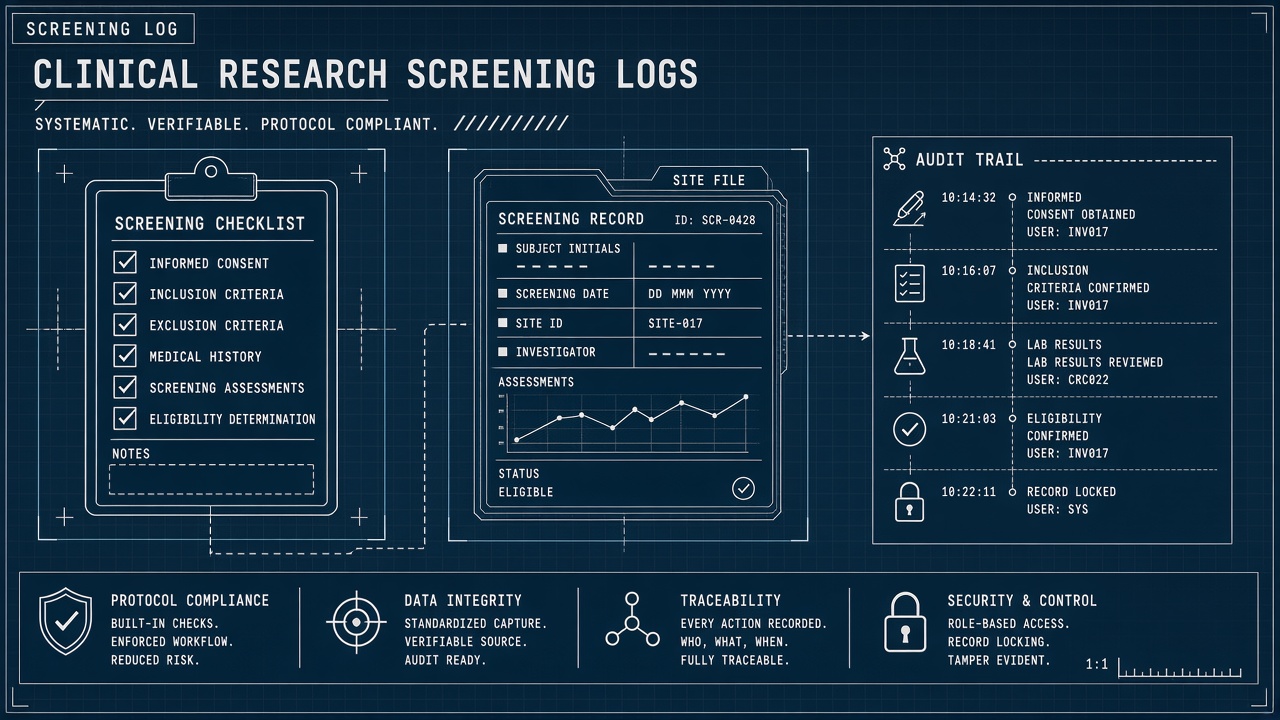
Clinical research coordinators document prescreening calls, eligibility assessments, and visit findings in screening logs that must align with the approved protocol and later match electronic data capture entries. Handwritten notes and fragmented EHR exports slow entry and introduce inconsistencies monitors flag during audits.
An ai workflow clinical research coordinator approach ingests screening criteria checklists, drafts log entries from de-identified visit notes, routes PI review before EDC entry, and maintains an audit trail for AI-assisted edits. Protocol deviations and adverse events always require human reporting on defined pathways, never AI auto-submission. Teams evaluating tooling should review AI API options for EDC-adjacent integrations and AI image generator tools only for approved participant-facing materials, not source documentation.
Screening Log Compliance Context
Screening logs are part of the trial record; they must trace eligibility decisions to protocol criteria with enough detail for sponsor monitors and regulators to reconstruct the coordinator's reasoning. AI accelerates drafting from structured inputs but does not determine eligibility. The principal investigator retains medical judgment on borderline cases.
Site SOPs should define which fields AI may suggest, which require coordinator attestation, and which prohibit AI entirely: serious adverse events, suspected unexpected serious adverse reactions, protocol deviations, and unblinding events.
Screening Criteria Checklist Ingestion
Load the current protocol inclusion and exclusion criteria into a structured checklist the AI references on every draft, with version control tied to IRB-approved amendments. When criteria change, retire prior checklist versions so drafts do not cite outdated lab thresholds or medication washout periods.
- Export criteria from the protocol appendix into numbered checklist items with citation anchors.
- Map each item to EDC field names and screening log section headers.
- Record IRB approval date and protocol version on the checklist metadata.
- Train coordinators on delta summaries when amendments alter eligibility language.
- Block AI prompts that reference checklist versions marked inactive.
| Checklist element | AI usage | Human required |
|---|---|---|
| Age and diagnosis inclusion | Draft pass or fail with source note | Coordinator confirms against records |
| Lab value exclusions | Suggest comparison to thresholds | Coordinator verifies lab date and unit |
| Concomitant medication review | Flag potential conflicts from note text | Coordinator and PI on borderline cases |
| Protocol deviation | Not automated | Coordinator reports per SOP |
Amendment Handling
When a protocol amendment alters screening windows, re-ingest criteria before coordinators run AI on new participants. Participants mid-screening may fall under prior criteria per transition rules in the amendment; document which checklist version applies per subject ID.
Draft Log Entries From Visit Notes
Coordinators paste or dictate de-identified visit notes into AI with the active checklist attached; the model drafts screening log prose mapped to criteria items without adding clinical findings not present in the source notes. Coordinators edit every line before PI review. PHI stays in approved systems; redact identifiers before any external model unless BAA-covered enterprise AI is in place.
- Prescreening phone calls: document responses per checklist item with call date and time.
- Screening visits: tie vitals, labs, and assessments to criteria with source document references.
- Screen failures: state which exclusion applied and whether rescreen is allowed per protocol.
- Pending items: list outstanding labs or records with follow-up dates, not assumed pass.
- Coordinator signature block ready for attestation after PI approval.
Never use AI to infer eligibility from incomplete records. Draft language should say pending or not assessed when data is missing rather than defaulting to eligible.
Source Document Alignment
Each log statement should reference source documents coordinators can produce on monitoring visits: EHR printouts, lab reports, consent forms, and screening worksheets. AI drafts omitting source pointers fail audits. Coordinators add file names or medical record locations during edit.
PI Review Before EDC Entry
The principal investigator or delegate reviews AI-assisted screening logs for medical eligibility judgment before data entry into EDC. PI review focuses on borderline exclusions, concurrent conditions, and whether documentation supports enrollment or screen failure. Coordinators incorporate PI edits and obtain dated sign-off per site SOP.
| Review stage | Reviewer | Outcome |
|---|---|---|
| Coordinator edit | CRC | Draft aligned to source docs |
| PI eligibility review | PI or sub-investigator | Approve enroll, fail, or pending |
| EDC entry | CRC | Match approved log verbatim |
| Query resolution | CRC plus data manager | Amend log if source updated |
EDC entry must match the PI-approved log. If EDC picklists force shorter text, attach the full log PDF in the trial master file per sponsor requirements. API integrations via validated AI APIs still require the same human gates before transmission.
Delegation Log and Training
Only staff on the delegation log with documented training may attest screening logs or enter EDC fields. AI tooling training is a separate module covering prohibited uses, PHI handling, and audit trail expectations. Retrain when checklist versions or vendor models change materially.
Audit Trail for AI-Assisted Edits
Maintain an audit trail capturing the AI model identifier, prompt checklist version, coordinator edits, PI approval timestamp, and final EDC submission user. Monitors should reconstruct what text AI suggested versus what humans approved. Store trails in the trial master file or validated QMS per sponsor contract.
- Save AI output as read-only draft with generation timestamp.
- Track coordinator edits with version diff, not overwrite silently.
- Attach PI sign-off record linked to subject screening ID.
- Log EDC user, entry date, and any post-entry corrections with reason.
- Retain records per protocol retention schedule and local regulations.
When sponsors audit AI use, produce the trail for sampled subjects without exposing other participants' PHI. Redaction follows sponsor and IRB guidance.
Monitoring Visits and AI Documentation
Prepare a site AI SOP summary for monitors describing checklist ingestion, prohibited automations, and audit fields. Proactive transparency reduces finding severity compared to ad hoc tool use discovered during source review.
Human-Only Reporting Paths
Adverse events, protocol deviations, and unblinding follow site and sponsor reporting timelines with human initiation; AI may help coordinators organize timestamps from notes after the human decision to report. Never prompt AI to classify adverse event seriousness or expectedness without pharmacist or medical monitor review on the official form.
Screening logs should cross-reference safety reports when eligibility changes due to events but must not substitute for safety report content.
Prescreening to Enrollment Handoff
Treat prescreening logs and enrollment visit logs as linked records with consistent subject identifiers but separate checklist sections per protocol schedule. AI drafts for prescreening should not assume labs or assessments occurred until coordinators attach results. When a subject converts from prescreen fail to rescreen per protocol, start a new log version rather than editing prior fail narratives silently.
Enrollment handoff meetings between coordinators and study nurses review PI-approved screening text before first dosing visits. Any eligibility correction discovered after EDC entry triggers documented amendment per sponsor query management rules, with audit trail entries for AI-assisted and manual edits alike.
Regulatory Inspection Readiness
During inspection readiness drills, sample screening logs that used AI assistance and verify auditors can follow checklist version, source documents, and PI sign-off without extra explanation. Gaps found in drills update the site AI SOP before real inspections. Keep drill findings separate from live trial records per quality system rules.
Sponsor Query Response With AI Drafts
When data managers issue queries on screening fields, coordinators may use AI to draft response text from source documents, but responses must match PI-approved logs and never introduce new clinical facts. Query closure timestamps remain a monitor-facing metric; rushing AI replies without source checks creates repeat queries and findings.
Frequently Asked Questions
Can AI draft adverse event narratives for screening visits?
Coordinators may use AI to format chronology from approved notes into draft narrative only after they classify the event and confirm reporting obligation with PI and medical monitor guidance. Seriousness, causality, and expectedness fields on official forms require human and medical authority completion. Submit reports through sponsor-defined channels on required timelines without AI auto-send.
How does blinding affect AI screening workflows?
In blinded trials, screening logs must not include treatment assignment hints or unblinded lab results coordinators should not see. Configure prompts and note templates to exclude unblinded fields. If unblinding occurs for safety, follow emergency unblinding SOP separately from routine screening AI drafts. Pharmacy and unblinded roles maintain parallel documentation outside coordinator AI workflows when required.
Do multisite trials share one AI checklist?
Share protocol version and checklist content across sites but allow site-specific SOP attachments for local lab reference ranges or consent language. Central trial management owns checklist versioning; sites cannot edit criteria text locally. Harmonize AI prompt templates during investigator meetings to reduce monitor variance across sites.
Should CRCs use AI image tools for participant handouts?
Participant-facing materials require IRB approval; AI-generated images or simplified eligibility explainers are not screening log substitutes. If sites use AI image generators for approved recruitment flyers, keep that workflow separate from source documentation with its own approval trail. Screening logs remain text tied to individual subjects.
Faster Logs, Unchanged Accountability
Clinical research coordinators benefit from AI when checklist versions govern drafts, visit notes stay de-identified in approved tools, PI review precedes EDC entry, and audit trails capture every assisted edit. Patient safety and protocol integrity depend on human reporting paths that AI never bypasses.