Vendors ship marketing PDFs labeled "model cards" that read like product brochures. Procurement teams need technical documentation to evaluate training data claims, benchmark limitations, bias disclosures, and safety mitigations before approving a third-party AI tool. Without a structured review process, organizations accept vendor assertions at face value and discover gaps only after deployment or during enterprise security questionnaires.
A model card review process defines required fields, pass-fail criteria, supplemental documentation triggers, scoring rubrics, and re-review rules when vendors change model versions. This guide helps procurement, risk, and technical evaluators assess vendor model cards for AI chatbot platforms and AI research tools before contract signature.
What Model Cards Must Contain in 2026
Model cards in 2026 must document model identity, intended and prohibited uses, training and evaluation data characteristics, performance metrics with demographic breakdowns where applicable, known limitations, bias and safety assessments, environmental impact where material, and version lineage. The Google Model Card framework and Hugging Face model card conventions remain common baselines. EU AI Act technical documentation expectations for high-risk systems and GPAI Annex XI fields push vendors toward richer disclosure. NVIDIA Model Card++ extensions add generative AI risk fields enterprises increasingly expect.
| Section | Minimum content | 2026 expectation |
|---|---|---|
| Model details | Name, version, architecture family, release date | Parameter scale, modality, license terms |
| Intended use | Approved use cases and users | Explicit out-of-scope and prohibited uses |
| Training data | Sources described at high level | Data collection period, filtering, PII handling |
| Evaluation | Benchmark scores | In-domain evals, red team summaries, failure modes |
| Limitations | Known weaknesses acknowledged | Hallucination rates, language coverage gaps |
| Ethics and safety | Bias testing summary | Protected attribute results, mitigation techniques |
Version Specificity
Model cards must describe a specific model version, not a product family; reject cards that omit version strings or reference "latest" without a pinned identifier. Your inventory register should store the exact card version linked to each approved deployment.
Multimodal and Agent Cards
Multimodal and agentic systems need cards covering each modality and tool permission surface, not only text benchmark scores. Ask vendors how agent cards document excessive agency mitigations.
Review Checklist: Training Data, Evals, Limitations, Safety
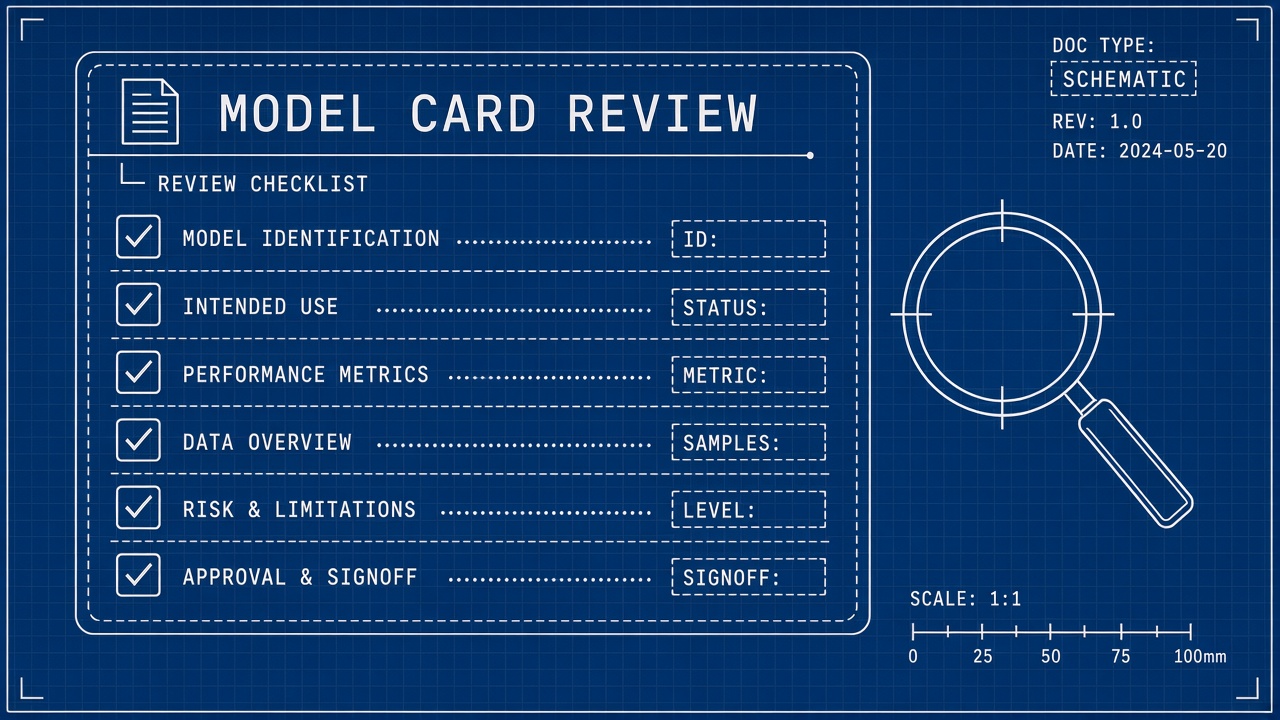
Reviewers score each model card field as pass, conditional pass, or fail using a standardized checklist with evidence citations, not subjective impressions. Technical reviewers validate metric methodology; legal reviewers check regulatory alignment; ethics reviewers assess fairness disclosures; business reviewers confirm intended use matches procurement scope.
| Field | Pass criteria | Fail triggers |
|---|---|---|
| Training data | Sources, date range, opt-out and PII handling described | "Proprietary" with no substance; no copyright policy reference |
| Evaluation metrics | Benchmarks match your use case; methodology disclosed | Only vendor cherry-picked public benchmarks |
| Limitations | Concrete failure modes and geographic or language gaps | Generic "may produce inaccurate information" only |
| Bias and fairness | Protected groups tested with results or honest gaps stated | No testing claimed; dismissive language on bias risk |
| Safety mitigations | Red team or adversarial eval summary with OWASP alignment | Safety claims without test evidence |
| Integration guidance | Input limits, latency, recommended guardrails | Missing Annex XII equivalent for GPAI downstream use |
Chatbot-Specific Review
For AI chatbot vendors, verify cards address conversational safety, content moderation tiers, and customer data isolation in multi-tenant SaaS. Request tenant isolation architecture if the card is silent.
Research Tool Review
AI research tools that summarize literature or generate hypotheses need cards documenting citation accuracy limitations and hallucination rates on factual claims. Academic use does not eliminate enterprise liability when outputs inform decisions.
When to Require Supplemental Technical Documentation
Require supplemental technical documentation when model cards lack training data detail, omit evaluation for your use case, cover high-risk deployment contexts, involve fine-tuning on your data, or vendor is GPAI provider without Annex XII downstream package. Supplements may include system cards, data sheets, independent audit reports, penetration test summaries, and architecture diagrams. Treat marketing one-pagers as insufficient for conditional pass resolution.
- High-risk EU AI Act classification or equivalent internal tier.
- Processing of confidential or regulated personal data.
- Vendor refuses demographic breakdown in fairness section.
- Material capability change between card version and demo.
- Embedded AI in existing SaaS where model card was never offered.
- Open-weight model with incomplete provenance chain.
Independent Validation
NIST AI RMF and banking model risk guidance (SR 11-7) recommend independent validation separate from the team that selected the vendor. Your review process should assign reviewers who did not run the pilot demo for final approval on high-risk systems.
Vendor Refusal Escalation
When vendors refuse supplemental documentation, escalate to procurement with written risk assessment; default decision is no-go for high-risk use cases. Document refusal in vendor risk register.
Scoring Rubric and Approval Gates
Convert checklist results into a weighted score with mandatory fail gates: any fail on safety, data handling, or prohibited use alignment blocks approval regardless of total score. Conditional passes require remediation plans with dates before production deployment.
| Score band | Range | Gate outcome |
|---|---|---|
| Approve | 85 to 100, no mandatory fails | Add to approved vendor catalog |
| Conditional approve | 70 to 84, remediable gaps only | Deploy with documented compensating controls |
| Hold | 50 to 69 or missing critical fields | Request supplement; no production use |
| Reject | Below 50 or mandatory fail | Do not procure; document rationale |
Approval Roles
Define quorum approvers by risk tier: low-risk may need technical owner only; high-risk requires security, privacy, legal, and business sponsor sign-off with immutable audit log. Store approvals in GRC or procurement systems, not email threads.
Evidence Retention
Archive the reviewed card PDF, reviewer worksheets, score calculation, and approval record with checksum of vendor document version. Auditors sample approvals; missing worksheets undermine the process.
Re-Review Triggers on Model Version Change
Re-review model cards when vendors release new major versions, change training data or safety mitigations, expand modalities, alter licensing, or your deployment context shifts to higher-risk data classes. Contract clauses should require advance notice of model changes and updated cards. Minor patch versions may use expedited diff review if vendor provides change summary.
- Major version bump: full checklist re-review.
- Minor version: diff review against prior card within 10 business days.
- Silent SaaS upgrade: trigger review when release notes mention model change.
- Fine-tune on customer data: new card or addendum required.
- Incident linked to model behavior: expedited safety section re-review.
- Annual: lifecycle review even without vendor changes per GCHQ Bailo-style practice.
Automated Version Monitoring
Subscribe to vendor API deprecation webhooks and changelog feeds; compare production model strings weekly against approved registry pins. Drift without review is a policy violation.
Customer Notification
When re-review downgrades approval status, assess whether contractual customer notification obligations apply for downstream AI features you ship. Legal should sign change communications.
Operationalizing the Review Workflow
Integrate model card review into procurement gates before PO issuance, parallel to security questionnaires and DPIA triggers. Standard turnaround SLAs: five business days low-risk, fifteen business days high-risk with supplemental doc requests. Publish internal templates so vendors know what you expect upfront.
Registry Integration
Link approved review IDs to AI inventory register entries and foundation model policy registry so operations teams see approval status at deploy time. CI/CD metadata should reference review ID for model API calls.
Comparative Review Across Vendors
When evaluating multiple vendors for the same use case, run parallel model card reviews with identical checklist weights so scores are comparable across proposals. Procurement should not award based on marketing claims when one vendor supplied a complete card and another supplied a brochure. Document why the selected vendor's limitations are acceptable for your risk tier.
Post-Deployment Validation
Model card review does not end at procurement: validate vendor claims with internal evals on your data within 90 days of production launch. Discrepancies between card claims and observed behavior trigger vendor escalation and potential re-review downgrade. Store internal eval reports alongside the original card in evidence attachments.
Frequently Asked Questions
What if the vendor has no model card?
Issue a model card request template listing required fields; if vendor cannot deliver within SLA, treat as hold or reject based on risk tier. Some SaaS vendors offer system cards or security whitepapers that partially substitute; map gaps explicitly rather than assuming equivalence.
How do we separate marketing docs from technical model cards?
Technical model cards include versioned metrics, limitations, and methodology; marketing docs use superlatives without reproducible evals. Reject marketing PDFs labeled as model cards when required checklist fields are absent. Ask for Hugging Face-style structured cards or vendor portal technical downloads.
How do we review AI embedded in existing SaaS tools?
Request model or feature cards from your existing vendor account team; escalate contractually if AI features lack documentation equal to standalone AI procurement. Embedded AI still requires deployer due diligence for your data classes.
Are community model cards on Hugging Face sufficient?
Community cards are a starting point; verify checksum, license, maintainer identity, and run internal evals before production approval. Supplement with your own bias and security testing evidence.
Implementation Roadmap
Week one: publish checklist and rubric; week two: pilot review on two pending vendors; month two: integrate with procurement workflow and registry; ongoing: quarterly rubric updates for regulatory changes. Train procurement liaisons to reject incomplete submissions early, saving reviewer time.
Conclusion
Model card review succeeds when 2026 field expectations are defined, checklists produce pass-fail evidence on training data, evaluations, limitations, and safety, supplemental documentation triggers are enforced for high-risk gaps, scoring rubrics gate approvals, and version changes force re-review. Procurement and risk teams who treat model cards as due diligence artifacts, not marketing collateral, avoid costly deployments on undocumented foundation models.