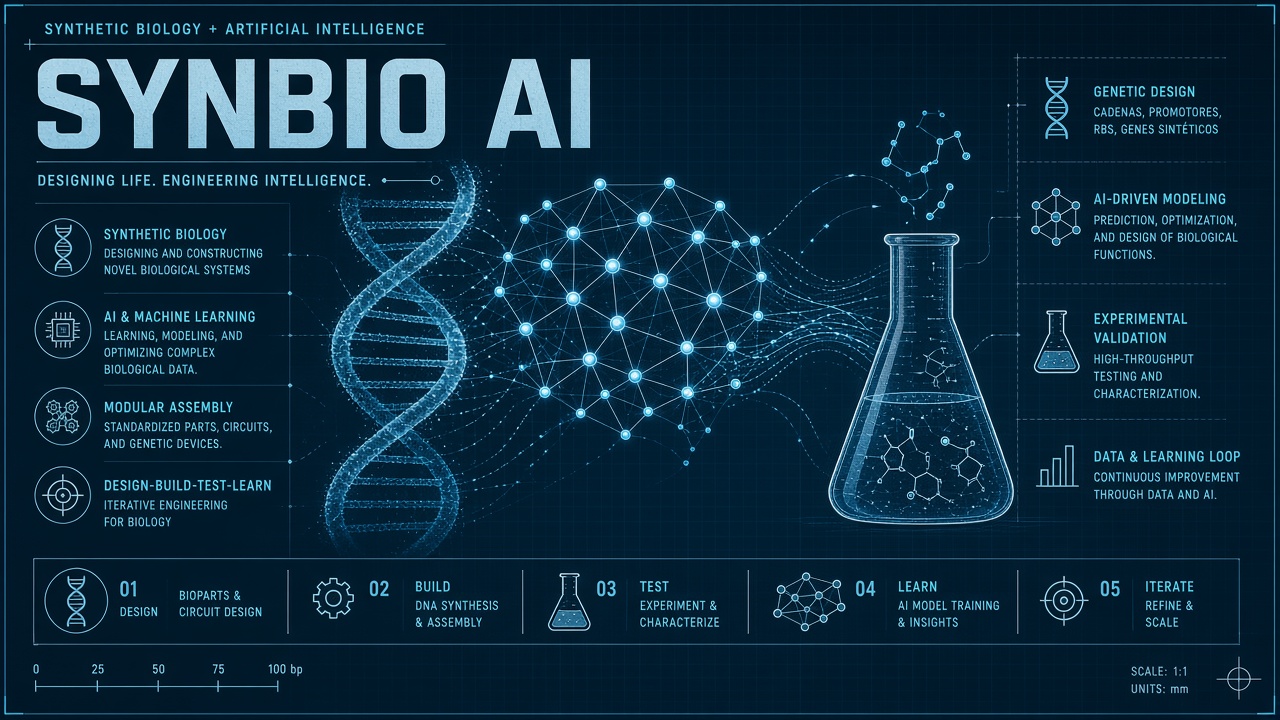
A genome language model proposes a complete bacteriophage sequence. A protein design stack invents a binder against a pathogen target. Synthetic biology turns genetic parts into engineered function in living cells, while machine learning compresses search spaces that would take human teams years to explore manually. The intersection is not one tool but a pipeline: predict, generate, filter, synthesize, test. Teams working in AI research and AI coding for bioinformatics face the same split as software engineers: design in silico is cheap; responsible build in the lab is expensive and regulated. This article maps model types, biosafety tiers, dual-use risks, and norms that separate legitimate research from what hobbyists cannot do safely at home.
What Is the Synthetic Biology and AI Intersection?
Synthetic biology engineers living systems from standardized genetic parts; machine learning predicts which parts to assemble and flags sequences likely to fail before wet-lab work begins. The intersection is not a single product category but a stack spanning data curation, generative models, laboratory robotics, and regulatory review. Protein designers speak in angstroms and binding affinities; genome designers speak in kilobases and regulatory motifs; metabolic engineers speak in flux balances and titer yields. Shared infrastructure includes sequence databases, cloud GPUs, and electronic lab notebooks that log which model version proposed each construct.
What Is the Difference Between AI Design and Building in the Lab?
AI design proposes genetic sequences, structures, or regulatory architectures; building requires DNA synthesis, cloning, containment facilities, and experimental validation that no model replaces. A 2025 Science paper reported generative design of bacteriophage genomes using Evo 1 and Evo 2: roughly 285 synthesized candidates yielded 16 viable phages infecting nonpathogenic Escherichia coli C. The headline is generative success; the footnote is attrition. Most generated genomes failed. Every viable phage still passed synthesis vendors, biosafety cabinets, and specialist review. Hobbyists cannot replicate that stack on a kitchen bench. Gene synthesis companies screen orders against pathogen databases. Institutional labs require biosafety training and approved protocols.
Protein-level design follows the same pattern. RFdiffusion and ProteinMPNN-class tools invent backbones and sequences; AlphaFold-style predictors filter plausibility; wet labs express proteins and measure binding or catalysis. GPN-Star, developed at Berkeley, sits on a different branch: phylogeny-aware genome modeling for variant effect prediction rather than whole-genome phage generation. Both branches illustrate how AI research encodes biological priors, but outputs remain hypotheses until experiments confirm them.
Which AI Model Types Touch Synthetic Biology?
Four model families dominate the synthetic biology and AI intersection: protein structure and design models, genome language models, metabolic pathway predictors, and lab automation agents that script protocols. Each family addresses a different scale of biological organization.
| Model type | Example systems | Typical output | Build step |
|---|---|---|---|
| Protein design | RFdiffusion, ProteinMPNN, Chai-1 | Binder sequences, enzyme scaffolds | Gene synthesis, expression, assays |
| Genome language models | Evo 1, Evo 2, GPN-Star | Whole genomes, variant effect scores | Synthesis, cloning, infection assays |
| Pathway / metabolic ML | GEM models with learned parameters | Flux predictions, chokepoints | Strain engineering, fermentation |
| Lab automation agents | Protocol scripting, LIMS integration | Liquid handling scripts, QC logs | Robotic workcells, human oversight |
Evo-class models trained on millions of genomes can generate realistic gene arrangements and regulatory elements. Template-based phage design conserved spike proteins to maintain host specificity for laboratory E. coli strains while allowing evolutionary novelty elsewhere. GPN-Star focuses on reading genomes: predicting how variants affect function across phylogenetic context. Buyers should not conflate "genome model" marketing with a single capability. Ask whether the product generates, scores, or both, and which organisms the training data represent.
What Biosafety Levels Apply to AI-Designed Organisms?
Biosafety levels (BSL) classify laboratory containment by pathogen risk; AI-designed constructs inherit the tier of the host organism and inserted functions, not the method used to design them. BSL-1 covers agents unlikely to cause disease in healthy adults, typical for nonpathogenic E. coli K-12 derivatives used in the Evo phage work. BSL-2 adds restrictions for moderate-risk agents. BSL-3 and BSL-4 escalate for airborne or exotic pathogens. Designing a phage on a laptop does not change the tier; growing it in culture does.
- BSL-1: Basic practices, open bench work for well-characterized nonpathogens.
- BSL-2: Limited access, biological safety cabinets for agents with moderate human risk.
- BSL-3: Controlled airflow, specialized training for serious or treatable pathogens.
- BSL-4: Maximum containment for dangerous and exotic agents.
The Arc Institute team behind the synthetic phage study reported dedicated biosafety cabinets, specialized disposal, and equipment that never left containment. Evo training excluded eukaryotic viral sequences as a deliberate safeguard against pathogen design misuse. Those layers sit beside institutional review, not instead of it. iGEM undergraduate teams learn parallel lessons: project safety forms, chassis organism restrictions, and advisor sign-off before bench work. AI accelerates design iterations; it does not waive iGEM or institutional biosafety committees.
What Are Dual-Use and DURC Concerns?
Dual-use research of concern (DURC) describes legitimate life-science knowledge or tools that could be misapplied to cause harm; generative viral genome design intensifies that debate because synthesis and AI now sit on the same timeline. Johns Hopkins Center for Health Security commentators noted in 2025 that the question is no longer whether AI can compose viral genomes but whether governance can steer benefits while preventing serious harm. National frameworks (United States DURC policies, WHO guidance, synthesis screening standards) predate Evo-style models but apply to outputs: if a designed genome resembles a regulated pathogen sequence, synthesis vendors should block the order.
Model-level mitigations include training data exclusions, output filters, and template constraints that anchor designs to nonpathogenic scaffolds. Process mitigations include expert review throughout the project lifecycle, as King et al. recommended in Science. No single layer suffices. A hobbyist downloading open weights cannot safely bypass synthesis screening, containment, or ethics review by claiming research curiosity.
What Norms Govern Responsible AI-Synthetic Biology Research?
Responsible groups pair open science with staged release, institutional biosafety review, synthesis screening compliance, and security consultation before whole-genome design experiments. Practical norms include:
- Document design intent, templates, and filtering rules before ordering DNA.
- Use nonpathogenic chassis organisms unless a regulated facility authorizes higher risk.
- Publish methods and safety protocols alongside results, as the phage paper did.
- Consult biosafety and biosecurity officers early, not after synthesis orders ship.
- Separate generative exploration from production-scale synthesis without human gates.
- Train students in iGEM-style safety review before granting GPU clusters or bench access.
Code-heavy teams should treat bio pipelines like production software: version control for AI coding scripts, audit logs for who approved each construct, and reproducible containers for environment parity. A Jupyter notebook that generates ten thousand genomes is trivial to run; the ethical weight sits in the approval step before well plates enter the incubator.
Lessons from the 2025 Synthetic Phage Study
The Science publication led by Samuel King and colleagues at Stanford and the Arc Institute generated hundreds of thousands of candidate genomes, filtered for spike protein similarity to the well-studied ΦX174 template, and synthesized fewer than three hundred. Sixteen produced infectious particles in laboratory conditions. Cryo-EM confirmed structural novelty, including one phage packaging DNA with a protein borrowed from a distant evolutionary relative. A cocktail of designed phages overcame bacterial resistance that natural ΦX174-like phages could not. Those results advance phage therapy research but also demonstrate how quickly generative models explore genomic space beyond natural variation. Governance must scale with generative breadth.
What Can Hobbyists Not Do Safely?
Hobbyists without BSL-trained facilities should not attempt culture of AI-designed viruses or bacteria, order synthetic pathogen-like sequences, or treat open genome models as toys isolated from screening and law. DIY bio communities thrive on education, but generative whole-genome design raised the stakes. Synthesis providers remain the primary checkpoint, yet social pressure to "just try" a downloaded model persists. Safe participation for non-specialists means computational exploration on public datasets, contributing curated annotations to community databases, or supporting iGEM teams under faculty oversight. Not hands-on pathogen work.
How Are Governments Responding?
National biosecurity offices, funding agencies, and journals are updating oversight templates for AI-assisted genome design, but no single global standard yet matches the speed of model releases. The United States maintains DURC review for select pathogens and toxins. DNA synthesis screening frameworks from the International Gene Synthesis Consortium remain the practical front line. AI developers increasingly publish responsible scaling policies and red-team biological outputs, yet enforcement is voluntary. Academic publishers may require safety and security statements for whole-genome design papers, following the Science model. Industry labs should treat generative biology like cloud security: threat models, access controls, and incident response playbooks updated quarterly.
Frequently Asked Questions
How do Evo and GPN-Star differ?
Evo 1 and Evo 2 are large genome language models used for generative design at genome scale, including the 2025 bacteriophage study. GPN-Star is a phylogeny-aware model focused on variant effect prediction across genomes, useful for interpreting mutations rather than inventing whole phages from scratch. Both advance computational biology but serve different workflows.
Does AI phage design mean custom phage therapy is ready?
Not yet for routine clinical use. The Science study demonstrated viable laboratory phages and resistance overcoming in controlled E. coli strains. Clinical phage therapy requires regulatory approval, manufacturing quality, patient-specific safety testing, and hospitals equipped to administer biologicals. AI shortens design exploration; translation to bedside remains a multi-year path.
Can I run BSL-1 experiments at home?
Even BSL-1 work benefits from institutional training, waste disposal, and emergency plans most homes lack. Many jurisdictions regulate genetically modified organism disposal. AI-designed constructs are still GMOs. Home experimentation with synthesized DNA introduces legal, safety, and neighbor risk without professional oversight.
How does iGEM relate to AI design?
iGEM teams engineer biological systems in standardized competitions with mandatory safety forms, white papers, and advisor review. Teams increasingly use machine learning for part selection or pathway prediction, but competition rules still require documented containment and chassis restrictions. iGEM is a training ground for responsible design-discipline pairing.
Do synthesis companies block dangerous AI outputs?
Reputable vendors screen orders against pathogen and toxin sequence databases. Screening is imperfect but remains a critical gate. Researchers should never assume a model filter replaces vendor review or institutional biosafety approval.
Are open genome models safe to release?
Open weights accelerate academic replication but lower the skill floor for misuse attempts. Responsible releases pair weights with usage policies, output monitoring recommendations, and synthesis screening reminders. Closed API access trades openness for gatekeeping that determined actors may still circumvent. The community debate continues; institutions should not wait for consensus before implementing local access controls on GPU clusters.
Synthetic biology and AI intersect at every scale from proteins to whole genomes. Models like Evo and GPN-Star compress design search; BSL containment and DURC governance define what may be built. Treat generative output as a proposal, not a product, until validated biology and ethics review say otherwise.