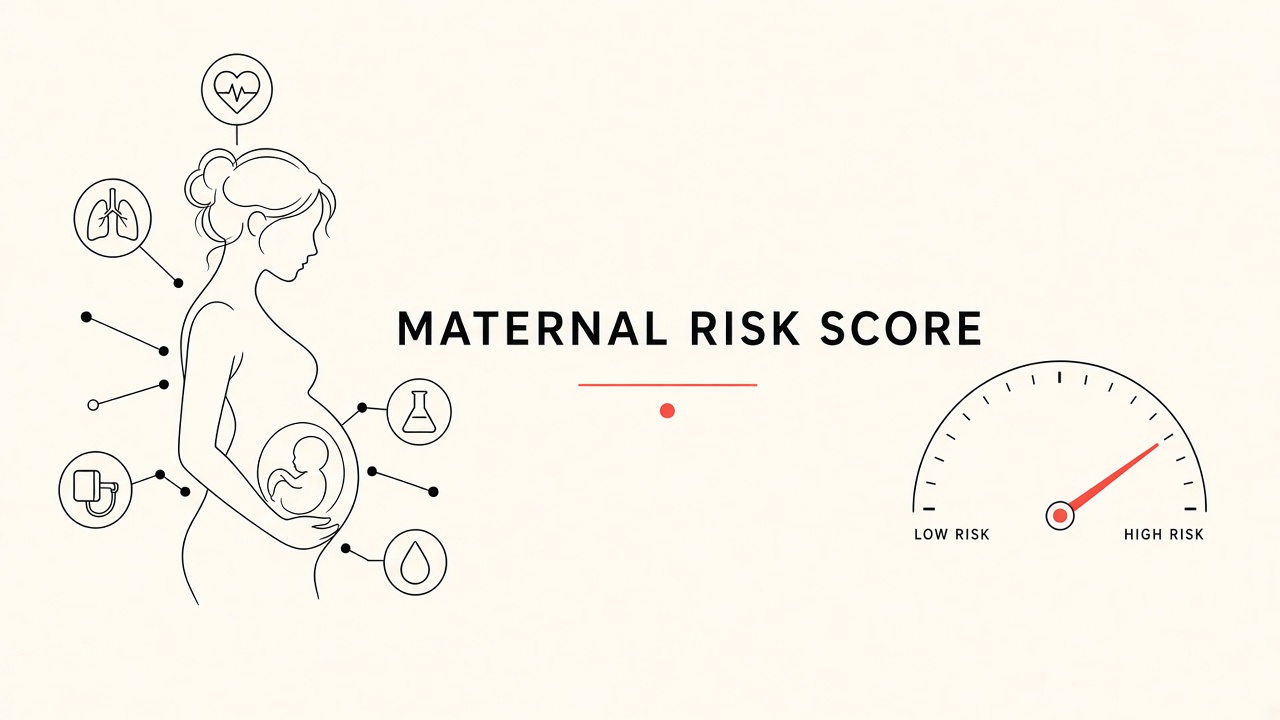
A labor and delivery nurse notes rising blood pressure, headache, and proteinuria in a 28-week pregnant patient. The obstetric team must decide whether to monitor on the antepartum unit, initiate magnesium sulfate, or expedite delivery. In the United States, 669 women died of maternal causes in 2023, a rate of 18.6 deaths per 100,000 live births, with Black women dying at 50.3 per 100,000 compared with 14.5 for White women according to CDC National Vital Statistics System data. Maternal mortality risk AI scores estimate probability of death or severe maternal morbidity within hours to days, helping teams allocate ICU beds, blood products, and specialist consults before catastrophic decompensation.
Health systems deploying obstetric early warning scores should audit models for racial and socioeconomic bias, validate on local populations, and pair predictions with actionable care pathways rather than alert fatigue. Consumers encountering AI chatbot pregnancy advice should not treat chat output as clinical risk stratification. More women's health AI explainers are on the EliteAI.tools blog index.
What Maternal Mortality Risk AI Means in Plain Language
Maternal mortality risk AI refers to machine learning models that estimate the chance a pregnant or postpartum patient will die or experience severe morbidity (such as stroke, eclampsia, or uncontrolled hemorrhage) within a defined time window, using clinical, laboratory, and sometimes social data available at the bedside. Traditional early warning scores like MEOWS or CAEWS use threshold rules on vital signs; AI versions learn nonlinear interactions (platelet fall plus rising creatinine plus gestational age) from thousands of prior deliveries. Outputs may be continuous probabilities, five-tier risk categories, or triage colors integrated into obstetric EMR dashboards.
Risk scoring is not the same as causation attribution. A high score flags need for escalation; it does not explain whether systemic racism, delayed transport, or clinician dismissal drove prior near-miss events. CDC defines maternal death as death during pregnancy or within 42 days of pregnancy end from pregnancy-related causes, excluding accidental injury. Models typically predict composite severe morbidity endpoints because death is rare enough that pure mortality prediction requires multi-site datasets and long follow-up.
| Endpoint | Time horizon | Example use |
|---|---|---|
| Maternal death | Pregnancy through 42 days postpartum | Population surveillance, rare event modeling |
| Severe maternal morbidity (SMM) | During admission or 48 hours | ICU transfer triggers |
| Preeclampsia progression | 24 to 48 hours after assessment | Magnesium, delivery timing |
| Postpartum hemorrhage | Intrapartum to 24 hours postpartum | Blood bank activation, balloon readiness |
How Risk Scoring Pipelines Work
Obstetric risk AI ingests structured EMR fields (vitals, labs, comorbidities, fetal status), optionally unstructured note embeddings, and outputs calibrated risk tiers with likelihood ratios clinicians can map to order sets. Training cohorts span health systems or national registries; external validation on demographically distinct hospitals tests transportability.
PIERS-ML random forest for preeclampsia
PIERS-ML, published in eClinicalMedicine (doi:10.1016/S2589-7500(23)00267-4), is an 18-variable random forest model predicting maternal mortality or severe morbidity within 48 hours of preeclampsia assessment. Development used 8,843 patients from 11 low-, middle-, and high-income countries; external validation included 2,901 inpatient women in south-east England. PIERS-ML random forest stratified eighty-four hundred preeclampsia cases with AUROC 0.80 (95% CI 0.76 to 0.84), outperforming the logistic fullPIERS model (AUROC 0.68). Data-driven risk categories used likelihood ratios: very low risk (0% events in 48 hours), low (2%), moderate (5%), high (26%), very high (91%). External validation preserved stratification: 0%, 1%, 4%, 33%, and 67% event rates across tiers.
Early pregnancy severe preeclampsia screening
A 2024 BMC Pregnancy and Childbirth study built racial bias-aware models predicting severe preeclampsia or eclampsia at 6 to 13 weeks gestation in nulliparous cohorts, achieving AUROC up to 0.77 using biomarkers, blood pressure, and ultrasound features. Initial models overpredicted risk for non-Hispanic Black participants with a predictive equality ratio of 1.31; algorithmic debiasing reduced the ratio to 1.14, lowering false positives in that group. The predictive equality ratio dropped from one point three one after correction, illustrating that fairness metrics must be reported alongside AUROC when marketing screening tools to diverse populations.
National mortality registry machine learning
Researchers in Oman applied ten machine learning algorithms to 402 maternal deaths recorded nationally from 1991 to 2023, predicting high versus low risk level with random forest accuracy of 75.2% after principal component analysis. While retrospective mortality registry studies differ from real-time bedside scoring, they highlight parity, gravida, and prior live births as persistent features across geographies. SMOTE oversampling addressed class imbalance because death is rare relative to survivors in training splits.
Integration with early warning and response bundles
- Capture vitals and labs at admission, triage, and every shift on antepartum units.
- Compute AI risk score automatically when preeclampsia criteria or postpartum hemorrhage triggers fire.
- Display tier with recommended bundle (magnesium, betamethasone, ICU consult, massive transfusion protocol).
- Require nurse acknowledgment and physician review within defined minutes for high and very high tiers.
- Log overrides with reason codes for quality review and model retraining.
- Feed outcomes back to model governance committee including race-stratified calibration quarterly.
Severe maternal morbidity CDC codes
CDC severe maternal morbidity (SMM) indicators include eclampsia, acute renal failure, sepsis, and transfusion of four or more units of blood, among 21 ICD-10 diagnosis and procedure codes. Training labels derived from billing codes miss events documented only in nursing flowsheets, while overcapturing comorbidities inflates apparent model performance. Chart review gold standards on random samples calibrate whether AI alerts precede SMM codes or merely correlate with chronic complexity present at admission.
Real Deployments and Published Evidence
Peer-reviewed obstetric AI focuses on preeclampsia time-to-event prediction with multinational external validation, early-pregnancy screening with explicit bias correction, and national mortality registry post-hoc analyses. Few U.S. health systems publish prospective implementation studies linking AI scores to mortality reduction; most deployments remain pilot quality-improvement initiatives.
CDC's 2023 maternal mortality report documents persistent racial disparities: Black women at 50.3 deaths per 100,000 live births versus 14.5 for White women, with women age 40 and older at 59.8 per 100,000. AI cannot fix structural inequities in access, dismissal of pain, or postpartum follow-up gaps, but miscalibrated scores that over-flag Black patients may increase unnecessary interventions while under-flagging true crises if training data reflect biased clinician documentation. ACOG and SMFM guidelines on severe hypertension in pregnancy emphasize treat-to-target protocols; AI should accelerate guideline concordance, not replace clinical judgment on delivery timing.
California Maternal Quality Care Collaborative (CMQCC) hemorrhage and preeclampsia toolkits reduced maternal morbidity through bundle compliance before widespread AI adoption; hospitals layering AI on top should measure incremental benefit over bundle adherence alone. WHO maternal mortality estimates globally at roughly 301,000 deaths in 2017, concentrated in sub-Saharan Africa and South Asia, reminding that models trained in high-income EMRs may fail when applied without local validation in low-resource settings lacking lab turnaround.
| Model or study | Population | Key result |
|---|---|---|
| PIERS-ML | 8,843 preeclampsia patients, 11 countries | AUROC 0.80; five-tier 48-hour morbidity stratification |
| Nulliparous sPE screening (2024) | Early gestation U.S. cohort | AUROC 0.77; predictive equality ratio 1.31 to 1.14 after debiasing |
| Oman national mortality ML | 402 deaths 1991 to 2023 | RF accuracy 75.2% with PCA features |
| CDC NVSS 2023 | U.S. national vital statistics | 18.6 maternal deaths per 100,000 live births; Black rate 50.3 |
Limits, Risks, and Ethical Guardrails
Maternal risk AI can amplify documentation bias, trigger unnecessary cesareans or ICU admissions in over-predicted groups, and create alert desensitization when scores fire constantly without actionable workflows. Social determinants (housing instability, intimate partner violence) may be absent from EMR data yet dominate true risk; omitting them produces falsely reassuring scores for vulnerable patients. Using race as a model input remains ethically contested: some algorithms adjust for race citing epidemiology; others remove race and redistribute error differently.
- Calibration drift: Post-COVID obstetric populations may differ from pre-2020 training data.
- Liability: Ignoring a high score is discoverable; so is harm from score-driven delivery without consent discussion.
- Privacy: Reproductive health data face heightened state-level legal scrutiny in the U.S.
- Autonomy: Patients deserve transparency when algorithms influence delivery timing.
- Equity metrics: Report false positive and false negative rates by race, ethnicity, and insurance status.
Ethical deployment follows FDA guidance on clinical decision support, institutional review for quality improvement, doula and patient advocate inclusion in design reviews, and binding escalation protocols so scores never sit unread in nursing inboxes during overnight shifts.
Who Should Use This and Who Should Wait
Hospital labor and delivery units with high preeclampsia volume, established hypertension bundles, and data science support should validate PIERS-ML-class models on local charts before live alerting. Rural critical access hospitals without 24-hour anesthesia should focus on transport protocols and tele-obstetrics before AI scores they cannot act upon. Payers and policymakers should fund prospective equity studies rather than mandating proprietary black-box scores statewide.
| Stakeholder | Action | Caution |
|---|---|---|
| Maternal-fetal medicine | Pilot PIERS-ML with external validation metrics | Do not auto-schedule delivery on score alone |
| Nursing leadership | Integrate scores into MEOWS escalation pathways | Cap alert volume to prevent fatigue |
| Health equity officer | Mandate stratified fairness reporting | Reject models without debiasing plan |
| Pregnant patients | Ask how scores influence care plans | Scores do not replace symptom advocacy |
Frequently Asked Questions
Can AI alone reduce U.S. maternal mortality?
No. Mortality reflects systemic access, racism, and postpartum coverage gaps that algorithms do not solve. AI may accelerate recognition of severe hypertension when embedded in actionable bundles.
How does PIERS-ML compare to fullPIERS?
PIERS-ML is a random forest with AUROC 0.80 versus 0.68 for the logistic fullPIERS model in the same international cohort. Both predict 48-hour severe outcomes in preeclampsia, not entire pregnancy mortality.
Should race be a model input?
Institutions disagree; including race may improve statistical fit but risks encoding structural racism into clinical decisions. Report predictive equality and equalized odds across groups when evaluating either approach.
Are consumer pregnancy apps accurate for mortality risk?
Consumer apps lack validation on severe morbidity endpoints and may use marketing language instead of calibrated probabilities. Acute symptoms require emergency obstetric evaluation regardless of app output.
Do scores cover postpartum hemorrhage after discharge?
Many inpatient models stop at delivery unit transfer; postpartum day 1 to 42 deaths require outpatient monitoring tools and Medicaid extension policies. Extend validation if deploying beyond admission window.
Social determinants missing from EMR scores
Housing instability, food insecurity, and lack of transportation to postpartum appointments elevate mortality risk but rarely appear as structured EMR fields feeding models. Partnerships with community organizations can capture social needs screening results as optional model inputs when patients consent, improving calibration for marginalized groups without using race as a proxy for social risk.
Is obstetric risk AI regulated by FDA?
Some decision support qualifies as non-device CDS if clinicians can independently review underlying data; others require SaMD clearance. Legal review per product feature set is necessary.
Postpartum follow-up and the fourth trimester
More than half of pregnancy-related deaths occur after delivery, yet inpatient risk models often deactivate at discharge. Extending scoring to postpartum telehealth visits, blood pressure home monitoring programs, and Medicaid extension through 12 months postpartum (where policy allows) closes a window where patients with rising scores lack obstetric oversight. Community health workers and doulas can re-enter vitals into portals that feed the same model, but only if consent and broadband access disparities are addressed first.
Simulation training for high-risk alerts
Obstetric teams should run quarterly simulations where AI high-risk alerts fire during mock eclampsia or hemorrhage drills, measuring time-to-magnesium and time-to-transfusion protocol activation. Simulation exposes whether alerts reach the right pager role or vanish in notification overload before real patients depend on the workflow.
Conclusion
Maternal mortality risk AI offers statistically meaningful stratification for preeclampsia severe morbidity through models like PIERS-ML, early-pregnancy screening with explicit bias correction, and registry-based mortality predictors, but benefits materialize only when scores connect to hypertension bundles, hemorrhage protocols, and equitable care teams. CDC data remind us that Black birthing people still face mortality rates more than three times higher than White peers; deploying scores without fairness auditing risks amplifying harm. Health systems with obstetric quality infrastructure should validate and monitor models locally; those without bundle discipline should fix workflows before buying algorithms that predict crises their staff cannot yet respond to at 2 a.m.