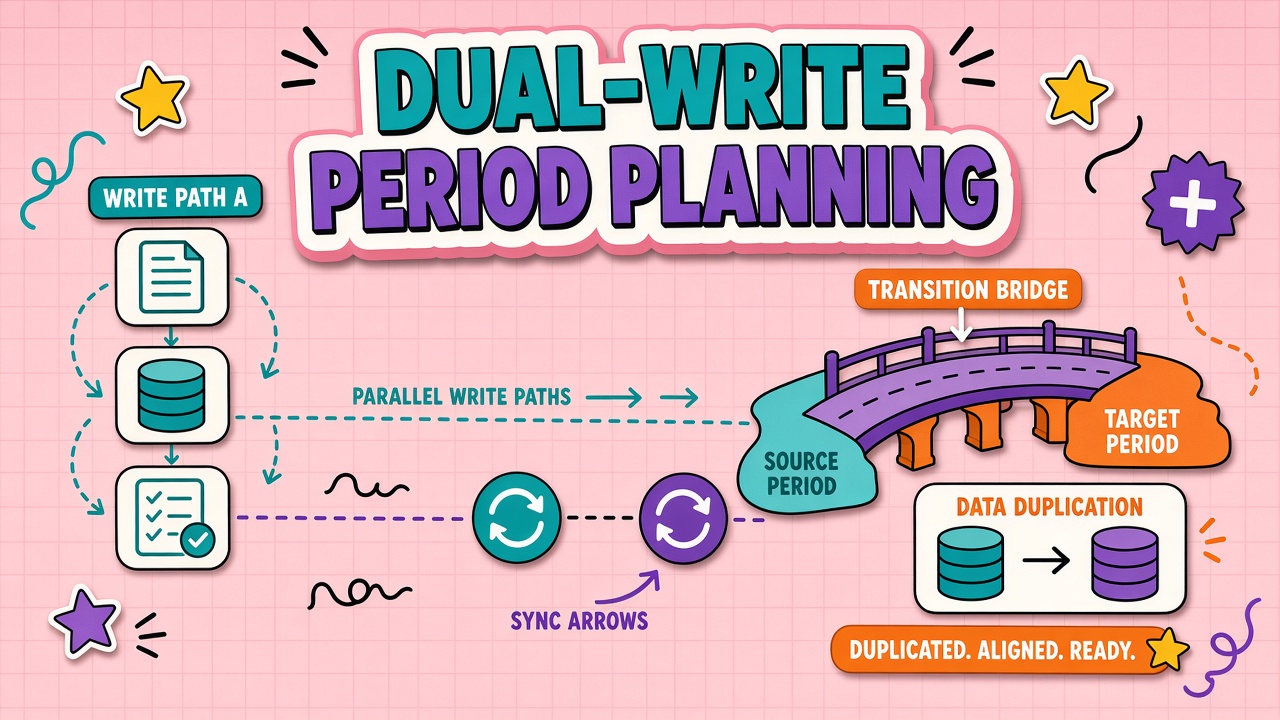
Replacing an AI workflow is not a flip-switch event. Summaries land in the wrong CRM field, API payloads change shape, and customer-facing drafts pick up a new tone overnight. A dual-write period sends outputs to both the old system and the new one so teams can compare results before decommissioning anything. Planned well, dual-write prevents silent data loss. Planned poorly, dual-write doubles cost and confusion without buying confidence.
This guide covers when parallel runs are worth the expense, how long they should last, reconciliation checks before cutover, and rollback triggers if the new path fails validation. Teams wiring AI automation flows or swapping models behind an AI API integration will use the same cutover checklist whether the change is a prompt library move or a full vendor migration.
When Dual-Write Is Necessary During AI Workflow Changes
Dual-write is necessary when downstream systems depend on stable fields, IDs, or formatting that an AI change might alter. If humans eyeball every output before it ships, a shadow run in a spreadsheet may suffice. If outputs feed billing, compliance records, or customer portals automatically, parallel writes are the safer default.
Common scenarios that justify dual-write:
- Model or vendor swap: New model returns longer JSON or different enum values than the old parser expects.
- Prompt library migration: Consolidated prompts change section order in exports your CMS ingests.
- Automation replatform: Moving from one orchestration tool to another while keeping the same business triggers.
- Regulated summaries: Medical, legal, or financial snippets where a missing disclaimer is a compliance event.
- Customer-visible content: Support macros, product descriptions, or email templates published without a human reread every time.
Skip dual-write when the workflow is exploratory, fully human-reviewed before publish, or when the new path writes to a disposable sandbox with no production readers. Treat those as pilot environments, not cutover events. The decision should be documented in the change ticket so finance and ops know whether duplicate spend is intentional.
Planning Duration and Cost of Running Parallel Systems
Most dual-write windows last two to six weeks, bounded by transaction volume and reconciliation confidence, not by calendar convenience. Short windows save money but may miss weekly or monthly edge cases. Long windows burn credits and train teams to ignore duplicate alerts.
| Workflow type | Suggested dual-write length | Primary cost driver |
|---|---|---|
| High-volume API classification | 2 to 3 weeks at full traffic sample | Token or request doubling |
| Weekly report generation | 4 to 6 weeks (cover month-end) | Seat time for diff review |
| Support macro drafting | 3 to 4 weeks across shift patterns | Agent training on two UIs |
| Low-volume executive briefings | 6 to 8 briefing cycles | Calendar drag, not API cost |
Build a cost model before approval: duplicate API calls, extra storage for comparison logs, and analyst hours for weekly reconciliation. Finance should see dual-write as a fixed migration line item with a hard end date, not an open-ended subscription. Cap traffic sampling if full duplication is prohibitive: run dual-write on ten percent of requests stratified by customer segment, plus one hundred percent on regulated categories.
Reconciliation Checks Before Cutover
Cutover happens only when reconciliation proves field-level parity on agreed samples, not when stakeholders feel ready. Define pass criteria in writing before the dual-write window opens so optimism does not shorten validation.
- Schema match: Required JSON keys, CSV columns, or CRM field mappings identical or explicitly mapped with transforms tested.
- Semantic equivalence: Sample of outputs scored by domain reviewers using a rubric (not vibes). Target agreement rate is set per risk tier.
- Latency and error rate: New path within agreed SLO; error spikes block cutover even if text quality looks fine.
- Idempotency and deduplication: Replayed events do not create duplicate customer records when both paths briefly write.
- Audit trail: Logs tie each production ID to old and new outputs for post-cutover disputes.
Run reconciliation on a standing agenda: daily during the first week, twice weekly thereafter. Store diff reports where ops and engineering share access. Unresolved diffs become tickets with owners, not footnotes in a slide deck. Only when open diffs hit zero (or accepted exceptions are signed) should you schedule the single-write cutover window.
Building a Dual-Write Cutover Checklist
A cutover checklist turns dual-write from a vague parallel run into a gated release. Treat it like a production deployment: prerequisites, execution steps, verification, and communication templates in one document owned by the migration lead.
Minimum checklist sections:
- Scope: Named workflows, environments, and customer segments in scope for this migration.
- Owners: Engineering, ops, legal or compliance reviewer, and business sponsor with phone and chat handles.
- Pre-cutover gates: Reconciliation report signed, rollback tested in staging, on-call roster confirmed.
- Execution window: Start time, expected duration, freeze on unrelated prompt edits during cutover.
- Verification: Smoke tests on ten production-like samples within thirty minutes of switch.
- Communication: Internal status channel update and customer-facing hold language if external outputs pause briefly.
Store the checklist next to runbooks for AI automation jobs so the next migration does not reinvent the format. Version the checklist when you learn something during reconciliation: missing fields, surprise latency, or a diff tool that lied about semantic parity.
Rollback Triggers During Dual-Write Periods
Dual-write exists partly so rollback is boring: flip read traffic back to the legacy path without reconstructing lost data. Document rollback triggers before launch so midnight pages follow a script instead of improvisation.
- Critical field regression: New path drops mandatory compliance language in more than one percent of sampled outputs.
- Parser failure rate: Downstream ingestion errors exceed baseline for two consecutive business days.
- Cost overrun: Duplicate spend crosses the pre-approved migration budget before reconciliation completes.
- Security finding: New integration sends data to an unapproved region or retention policy.
- Vendor incident: Provider outage on the new stack with no acceptable failover while legacy still runs.
Rollback steps should name who disables the new writer, who confirms legacy is sole source of truth, and who communicates to customer-facing teams. After rollback, hold a short post-incident review: extend dual-write, fix the new path, or cancel the migration. Do not leave both paths half-active without owners.
Stakeholder Communication During Dual-Write
Parallel systems confuse people who only see customer-facing output. Publish a short stakeholder map at dual-write start: who receives daily diff summaries, who approves cutover, and who can authorize rollback during business hours versus after hours.
Customer support needs a holding statement if response latency doubles while two summarization paths run. Finance needs the duplicate cost line explained before month-end close. Engineering needs a single channel for reconciliation blockers instead of side threads in three tools. A fifteen-minute kickoff with those groups prevents the dual-write window from becoming a silent technical experiment that surprises everyone at cutover.
Weekly status during dual-write should fit one slide: open diff count, spend versus budget, next reconciliation milestone, and cutover date confidence (green, yellow, red). Yellow means a known gap with owner and date; red means cutover moves until resolved. Stakeholders tolerate delay when status is honest; they do not tolerate surprise outages on the day legacy writes stop.
Finally, archive dual-write comparison logs for the retention period your compliance team requires. Logs prove which path served customers on disputed dates and shorten future migration planning because reconciliation criteria inherit real diff examples instead of theoretical ones.
Data Reconciliation Playbook
Reconciliation is where dual-write earns or wastes its cost. Assign a reconciliation owner who is not the same person who built the new path. Bias hides in self-review. Weekly reconciliation pack includes side-by-side exports for a stratified sample: high-value accounts, edge locales, longest inputs, and historically problematic categories.
Classify diffs into four buckets: cosmetic (ignore), acceptable semantic drift (document), fix before cutover (engineering ticket), and blocker (stop cutover clock). Cosmetic versus semantic judgment needs written rubric examples so Monday's reviewer matches Friday's. Store diff decisions in the ticket; auditors and future you will ask why a blocker became acceptable six months later.
Automate mechanical comparisons where possible: field presence, string length bounds, numeric totals, enum membership. Reserve human review for language quality and policy phrases automation cannot score. Mixed automation plus human review scales dual-write beyond what a single analyst can eyeball.
Implementation Checklist for Dual-Write
Start dual-write only after a written scope names every workflow, integration endpoint, and customer segment affected. Scope creep during parallel run doubles cost without adding confidence. Freeze unrelated prompt experiments for the dual-write window so diffs attribute to the migration, not random edits.
Week zero tasks: create reconciliation ticket template, assign reconciliation owner, configure logging on both paths with shared correlation IDs, notify stakeholders using the communication map, and schedule weekly status until cutover or rollback. Week zero also validates that legacy path still meets current SLO; migrating away from a broken baseline hides problems.
Mid-window tasks: run automated field comparisons daily on sample batch, human semantic review weekly on stratified set, update diff bucket counts in status slide, and revisit cutover date confidence with finance if duplicate spend trends over budget. If open blockers exceed agreed threshold, move cutover date publicly rather than hoping silent heroics close gaps.
Cutover week tasks: execute dry-run cutover in staging with production traffic replay, confirm rollback tested within last thirty days, send customer-facing hold notices if latency may spike, perform cutover in agreed window with war room chat, run smoke tests within thirty minutes, and keep legacy write path warm but disabled forty-eight hours for fast revert.
Post-cutover tasks: archive comparison logs, close reconciliation tickets with sign-offs, document lessons in migration playbook, remove duplicate integrations billing twice, and schedule six-month retrospective to verify single-write stability. Successful dual-write ends with boring operations, not permanent parallel spend.
Frequently Asked Questions
How do we dual-write customer-facing outputs without showing duplicates?
Write both paths internally; publish only the approved path to customers. Compare drafts in a review queue or staging CMS. Never send two live emails because you are migrating summarization tools.
Can we dual-write at the API layer only?
Yes. A gateway or middleware fan-out call is a common pattern for AI API migrations. Log responses from both providers, return only the legacy response to callers until cutover, and use async comparison jobs for heavy diffs.
What if reconciliation never finishes?
That signals scope creep or mismatched success criteria. Pause new feature work on the new path, narrow the sample, or split the migration into smaller workflows. Indefinite dual-write is a budget leak, not a strategy.
Does dual-write apply to Zapier-style automations?
It applies whenever an automation writes to systems of record. Clone the trigger, route outputs to a shadow destination, and compare. Turn off the legacy Zap or flow only after the same reconciliation checklist passes.
The Bottom Line
Plan dual-write when AI workflow changes touch automated downstream systems. Set a bounded window, model duplicate cost upfront, reconcile on samples with written pass criteria, and define rollback triggers before go-live. Parallel runs should buy evidence, not indefinite comfort.