AI dermatology skin check apps use convolutional neural networks on smartphone photos to estimate melanoma and skin cancer risk, guiding users toward dermatologist referral while falling short of clinical diagnosis. More than 60% of U.S. counties lack dermatologist access, pushing primary care and consumers toward phone-based screening. A prospective 2021 to 2023 study of 1,904 lesions reported CNN sensitivity 82.5% and specificity 76.8% under optimal clinic photography, but only 28.9% capture success when users photographed lesions themselves. Teams evaluating AI healthcare dermatology tools should understand ABCDE warning signs, CNN limits, Fitzpatrick bias, and why FDA cleared DermaSensor as a physician adjunct device, not a consumer app.
ABCDE Melanoma Signs for Lay Readers
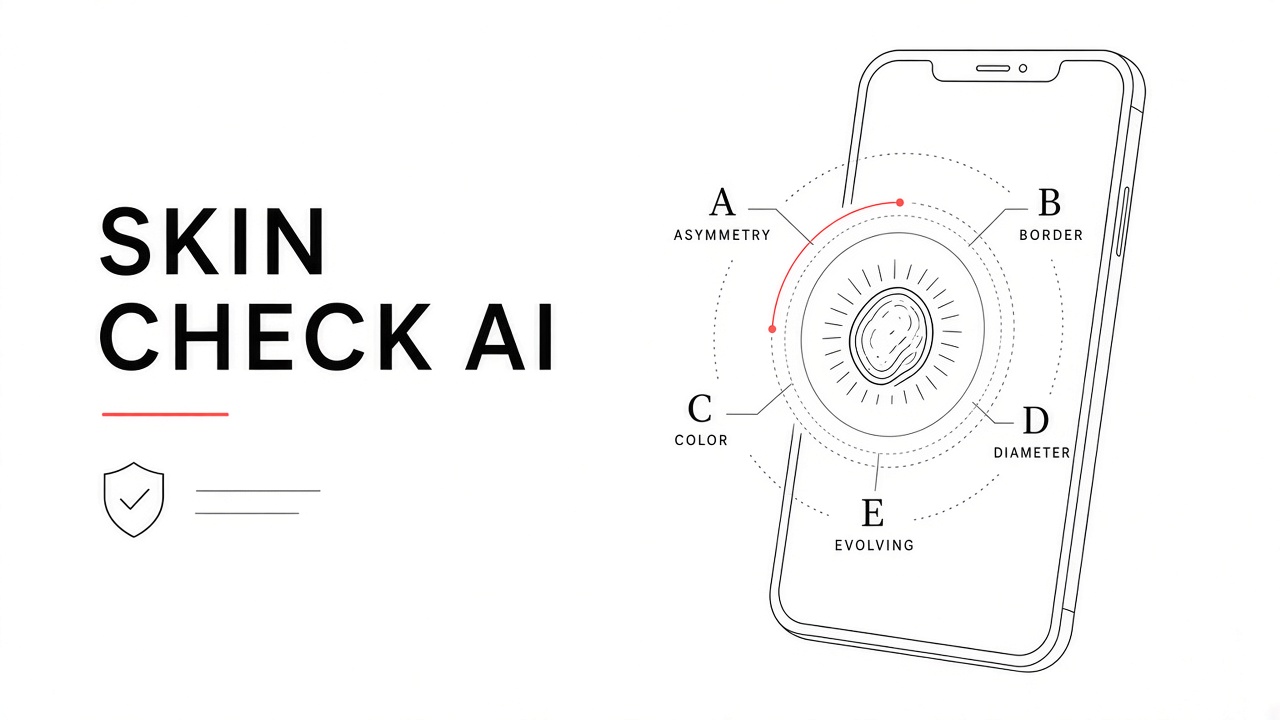
The ABCDE rule helps lay readers spot suspicious moles: Asymmetry, Border irregularity, Color variation, Diameter larger than roughly 6 mm, and Evolution or change over weeks. Melanoma may violate one or more criteria while benign nevi can look irregular, so ABCDE is a triage mnemonic, not a diagnosis. The "E" for evolution is often the strongest primary care signal: a lesion changing size, shape, color, bleeding, or itching warrants professional exam regardless of static ABCDE score.
Apps and patient education should emphasize whole-body skin checks with partner assistance for back and scalp lesions. Sun exposure history, family melanoma, and fair skin increase baseline risk but do not exclude melanoma in darker skin tones, where acral and subungual presentations are more common and public datasets underrepresent them.
AI apps attempt to encode ABCDE-like visual patterns into CNN features automatically, but users should not assume algorithmic scores replace dermatologist dermoscopy. Apps work best as prompts to seek care when combined with clear referral messaging for high-risk outputs.
The ugly duckling sign complements ABCDE: one mole that looks unlike others on the same patient warrants scrutiny even if it meets no single ABCDE criterion sharply. Apps rarely instruct users to compare lesions against personal baseline nevi patterns, focusing instead on isolated uploads. Education modules embedding whole-body mapping encourage serial photography of the same nevus monthly to detect evolution, a workflow some teledermatology platforms support with lesion registration overlays.
Non-melanoma skin cancers (basal cell, squamous cell) appear frequently in primary care referrals triggered by apps tuned heavily on melanoma labels. Users should understand that persistent scaly patches, non-healing sores, and tender pink nodules also require biopsy even when CNN melanoma scores are low.
CNN Classifiers on Phone Photos
Skin check apps capture lesion images with smartphone cameras, preprocess color and scale, then run convolutional neural network classifiers trained on dermatologist-labeled clinical photo archives to output binary or multi-class risk scores. The Europe PMC prospective diagnostic accuracy study (NCT05246163) evaluated a widely used consumer app on 1,458 participants with 1904 lesions, finding 9.7% skin cancer prevalence including 32 melanomas. Despite optimal clinic capture conditions, 16.6% of images failed app processing. User-operated photography succeeded only 28.9% in substudies, with performance varying across smartphone models due to white balance, resolution, and autofocus differences.
CNN architectures (ResNet, EfficientNet, ViT variants) learn texture, color variegation, and border patterns correlated with malignancy in training sets dominated by dermoscopic and clinical images from tertiary centers. Deployment on phones requires model compression and on-device inference for privacy, or secure cloud upload with HIPAA-compliant storage when teledermatology review follows. Combined CNN plus in-app teledermatology review raised specificity to 86.8% while sensitivity dropped to 75.3%, illustrating the sensitivity-specificity tradeoff when human reviewers filter false positives.
Melanocytic lesion sensitivity lagged nonmelanocytic lesions in the same study (71.0% vs 76.3%), a critical limitation because melanoma carries highest mortality. Apps should label outputs as risk stratification, not histopathology results, and instruct users to photograph in indirect daylight with a ruler or coin for scale when possible.
| Tool class | Input | Typical user | Regulatory snapshot |
|---|---|---|---|
| Consumer CNN app | Smartphone photo | Self-screening public | Often CE marked; not FDA-cleared as of 2026 review |
| DermaSensor | Elastic scattering spectroscopy | Primary care physician | FDA De Novo DEN230008, January 2024 |
| Google DermAssist | Clinical photo search | Information triage (limited markets) | CE class I EU; not FDA-evaluated |
| Research CNN (DeepDerm) | Clinical photos | Study settings | Not commercially cleared |
Performance Across Skin Tones
CNN skin cancer models trained on light-skin-dominated datasets show degraded sensitivity and specificity on Fitzpatrick types V and VI, risking missed melanomas in populations already facing diagnostic delays. A 2026 JAAD Reviews literature synthesis noted only 2.1% of public dermatology images include Fitzpatrick typing, and algorithms such as DeepDerm and consumer tools exhibit substantially worse AUROC on darker skin in subgroup analyses. FDA imposed post-market testing requirements on DermaSensor because 97.1% of pivotal trial patients were White and only 13% were Fitzpatrick V/VI, despite company sub-analyses reporting similar sensitivity across tone groups on 1,005 patients.
Melanoma in skin of color often appears on palms, soles, nails, and mucosal sites underrepresented in phone selfie workflows. Training data imbalance encodes color constancy failures: models learn spurious correlations between pink erythema and malignancy. Mitigation requires stratified collection, dermatoscopy across tones, synthetic augmentation (insufficient alone), and reporting disaggregated metrics before public deployment.
Meta-analytic evidence cited in JAAD Reviews 2026 suggests AI assistance can raise primary care sensitivity by about 13 percentage points and specificity by 11 when used as decision support, but gains depend on equitable training data. Researchers publishing AI research on dermatology CNNs should treat Fitzpatrick stratification as a primary endpoint, not a supplemental table.
Dermatoscopy attachment lenses for smartphones improve CNN inputs by revealing submillimeter pigment networks invisible in snapshot photos. Few consumer apps require dermoscopic capture, limiting performance on early melanoma in situ. Primary care adoption of FDA-cleared spectroscopy (DermaSensor) sidesteps phone camera variability but still demands suspicious lesion preselection by clinicians trained in basic skin exam courses.
Socioeconomic access gaps persist when apps require latest flagship phones with advanced cameras. Community screening programs lending standardized imaging devices to patients produce more reproducible CNN inputs than bring-your-own-device models. Public health deployments should report stratified outcomes by device tier and photography assistance level, not only aggregate AUROC.
Regulatory Status by Market
Regulatory status diverges by market: FDA authorized one AI-enabled device for non-dermatologist skin lesion evaluation (DermaSensor) in January 2024, while dozens of smartphone apps remain outside U.S. device clearance with wellness or CE markings elsewhere. DermaSensor (DEN230008) uses elastic scattering spectroscopy plus ML on lesions physicians already deem suspicious, outputting Monitor versus Investigate Further with similarity scores. FDA labeling restricts use to patients 40 and older, forbids standalone screening of unexamined lesions, and requires physician integration with visual clinical assessment. Pivotal sensitivity for malignancy was about 95.5% with specificity near 20.7%, meaning most positive device results are false alarms necessitating dermatology referral load.
European CE-marked apps operate under different conformity routes; CE class I devices face lighter scrutiny than FDA De Novo pathways. Australia authorized DermaSensor before U.S. clearance. Consumer CNN apps marketed directly to patients may classify as medical devices if they claim diagnosis, yet enforcement varies. FTC and state attorneys general may pursue deceptive cancer detection claims without FDA action.
Post-market surveillance conditions on DermaSensor include performance testing in underrepresented populations, a model for how FDA treats algorithmic dermatology equity. Smartphone apps without U.S. clearance should avoid language implying FDA approval. Health systems piloting apps must verify institutional review, liability coverage, and teledermatology backup capacity.
EU Medical Device Regulation transitions reclassified software as a medical device (SaMD) with notified body review for diagnostic claims, affecting apps sold across member states. UK MHRA post-Brexit pathways differ; multinational vendors maintain separate label libraries. Australian TGA authorized DermaSensor before FDA, demonstrating asynchronous clearance timelines consumers may misread when apps cite foreign registrations as U.S. equivalence.
Apple App Store and Google Play policies require health app disclaimers but do not substitute for FDA review. Platform removals after media reports of missed melanomas highlight reputational risk beyond regulatory fines. Enterprise hospital deployments should require vendor indemnification and proof of clinical validation peer review before white-labeling apps in patient portals.
When Apps Mandate Professional Referral
Responsible skin check apps mandate dermatologist or primary care referral when CNN scores exceed high-risk thresholds, when image quality fails, or when users report bleeding, rapid growth, or symptomatic lesions regardless of algorithm output. Low-quality captures (blur, glare, out of focus) should block scoring and instruct retake rather than defaulting to benign labels. High-risk outputs should display urgent referral language with timeframe (within days, not months) and avoid false reassurance from probabilistic percentages lay users misinterpret. Apps offering teledermatology handoff should disclose review turnaround and cost.
Negative app results must state that melanoma can be missed, especially on acral sites and dark skin, and recommend periodic full-skin clinical exams for high-risk individuals. Pediatric lesions and immunosuppressed patients need lower referral thresholds because CNN training underrepresents these groups. Integration with primary care should generate structured reports primary care physicians can attach to e-consults.
Liability frameworks treat apps as decision aids; manufacturers disclaim diagnosis while users may assume certainty from green checkmarks. Ethical design uses mandatory referral prompts for inconclusive cases and logs audit trails when users override referral advice. Combined CNN plus human teledermatology review in the prospective study improved specificity but reduced sensitivity, showing human layer tradeoffs product managers must communicate transparently.
Worklist integration routes high-risk app cases to dermatology e-consult queues with SLA timers. Primary care physicians receiving DermaSensor Investigate Further outputs should document visual exam findings alongside device scores in referral letters to avoid biopsying every false positive when specificity sits near 20%. Shared decision aids explain that positive spectroscopy results mean further specialist evaluation, not immediate cancer confirmation.
Pediatric and young adult melanoma, though rare, demands lower referral thresholds because apps undertrain on age-extreme lesions. Immunosuppressed transplant patients develop aggressive skin cancers CNNs trained on immunocompetent cohorts may miss. Mandatory referral rules should accept clinician overrides but flag suppressed referrals for quality review when histology later confirms malignancy.
Frequently Asked Questions
Can apps diagnose melanoma?
No. Apps estimate risk from photos. Diagnosis requires dermatologist examination and often biopsy histopathology.
What is the ABCDE rule?
Asymmetry, Border irregularity, Color variation, Diameter about 6 mm, Evolution over time. A mnemonic for suspicious moles, not a definitive test.
Is there an FDA-cleared smartphone melanoma app?
As of 2026 literature reviews, no smartphone CNN app holds FDA clearance for standalone consumer screening. DermaSensor is a physician-operated spectroscopy device, not a phone app.
Why do dark skin tones matter for CNN performance?
Training data skew toward lighter skin, causing models to miss or misclassify lesions on Fitzpatrick V and VI. Melanoma patterns differ on acral sites common in skin of color.
How accurate are consumer apps?
One prospective study reported 82.5% sensitivity under clinic photography but much lower user capture success. Performance varies by device and lesion type; melanocytic sensitivity was lower than nonmelanocytic.
When should I see a dermatologist?
Immediately for changing, bleeding, or symptomatic lesions, high app risk scores, or failed image quality with persistent concern. High-risk individuals need regular full-body exams even after negative app screens.
What is DermaSensor?
FDA De Novo authorized 2024 handheld device using optical spectroscopy and ML as a primary care adjunct for lesions already deemed suspicious, not for mass phone screening.
Skin check apps occupy a narrow lane: accelerating referral for suspicious lesions when photography succeeds and models are calibrated, while dermatoscopy, histology, and equitable datasets remain the standard of care. Users should treat CNN outputs as conversation starters with clinicians, not as clearance to ignore evolving moles on palms, soles, or nails where phone-based melanoma screening fails most often.