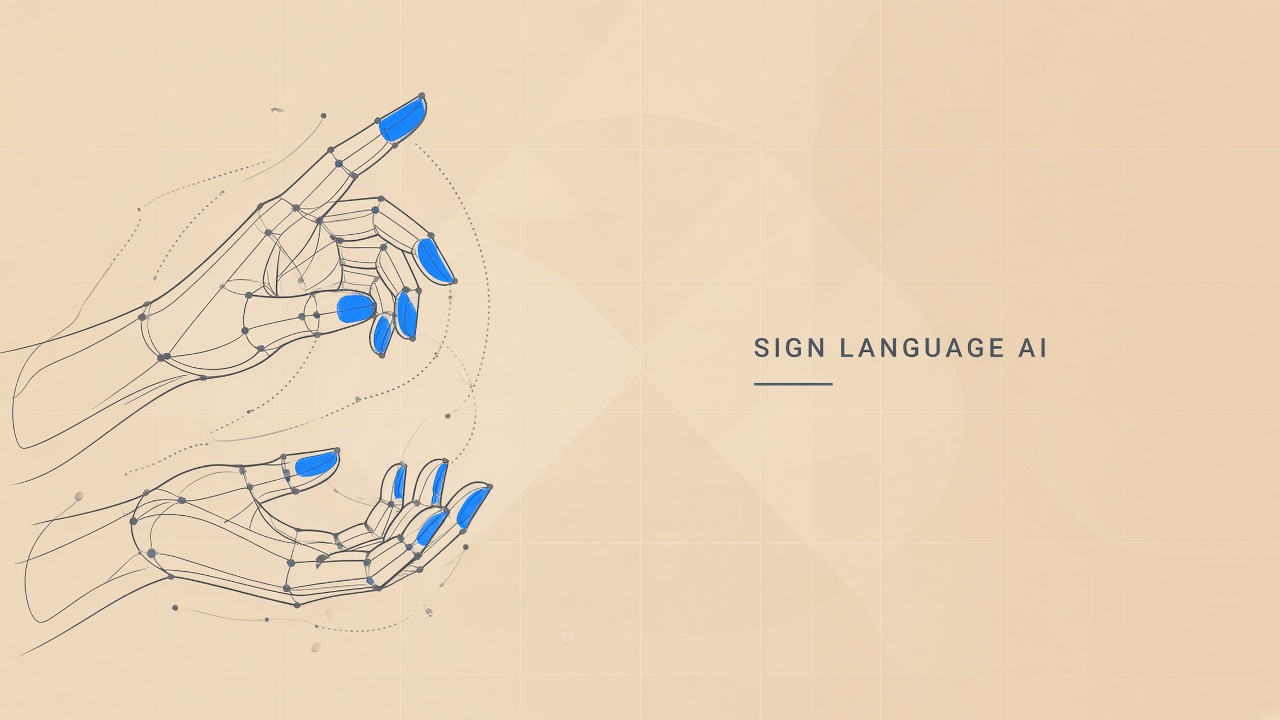
A hospital posts an AI signing avatar on its intake kiosk. A Deaf patient taps through registration, but the avatar flattens facial grammar, drops classifier handshapes, and signs in a dialect nobody in the room uses. The technology looked accessible on a marketing slide; in practice it introduced confusion at a moment that demanded precision. AI sign language translation limitations are not a footnote. They shape whether a product helps or harms. Sign language is a full visual-gestural language with regional variation, non-manual markers on the face and torso, and discourse rules that differ sharply from spoken English word order.
Product teams, broadcast engineers, and accessibility leads evaluating AI chatbot interfaces with camera input need a sober map of what works today, what research systems like SignLLM demonstrate in labs, and where Deaf community feedback draws hard lines. More accessibility explainers appear on the EliteAI.tools blog index.
What AI Sign Language Translation Limitations Mean in Plain Language
AI sign language translation limitations refer to the gap between marketing claims of real-time bidirectional signing and what current computer vision, pose estimation, and avatar rendering can reliably deliver for natural, continuous discourse in a specific sign language variety. Most production demos handle isolated signs (a single letter, a vocabulary word) or short scripted phrases. Continuous sign language recognition (CSLR) must segment fluent signing into gloss units, model co-articulation between signs, and interpret eyebrow raises, head tilts, and mouth morphemes that change meaning. Facial grammar is not decorative; it marks questions, negation, topic boundaries, and adverbial nuance.
Translation also runs in two directions with unequal difficulty. Sign-to-text (recognition) must perceive fine handshape changes at video frame rates. Text-to-sign (production) must choose correct signs, respect spatial grammar, and animate a believable human signer. Systems like SignLLM generate skeletal pose sequences from text prompts across multiple national sign languages, but authors caution accuracy is not high enough to be fully trusted without human review.
| Task type | Typical AI capability today | Primary bottleneck |
|---|---|---|
| Isolated sign classification | Moderate accuracy on limited vocabularies | Dataset size, signer diversity |
| Continuous sign recognition | Research benchmarks; fragile in the wild | Segmentation, temporal modeling |
| Text-to-sign avatar | Scripted content, pilot deployments | Facial grammar, natural prosody |
| Real-time bidirectional dialog | Early proof-of-concept only | Latency, error compounding, liability |
Isolated signs versus continuous signing
Isolated sign language recognition classifies one discrete gesture at a time, often from a fixed vocabulary list; continuous recognition must decode unbroken video streams where signs blend together and fingerspell mid-sentence. Academic prototypes built on MediaPipe Holistic extract 543 keypoints (body, face, hands) per frame, then feed CNNs or LSTMs for static letters and short dynamic gestures. Reported accuracies above ninety percent on curated alphabet sets drop sharply for two-handed signs, face-assisted constructions, and noisy backgrounds. Continuous systems such as HyperSign use graph neural networks to model salient hand and face regions across frames, but they still train on benchmark datasets far smaller than real-world signing diversity.
Facial grammar and non-manual markers
In American Sign Language and many other sign languages, meaning lives on the face and in head movement. A raised eyebrow can turn a statement into a yes/no question; puffed cheeks mark adverbial intensity; mouthings sometimes disambiguate homophonous handshapes. Pose pipelines capture some facial landmarks, but compression for real-time inference often undersamples subtle muscle movement. Avatar systems frequently animate hands convincingly while leaving the face stiff, which Deaf viewers describe as grammatically incomplete or outright wrong.
How the Underlying AI Pipeline Works
Modern sign language AI stacks combine video capture, pose estimation, temporal sequence models, gloss or text alignment, and optional avatar rendering, with each stage introducing latency and error that compounds downstream. Consumer prototypes often start with MediaPipe Hands or Holistic running on CPU at fifteen to twenty frames per second, exporting normalized landmark coordinates per frame. Researchers store these as NumPy arrays or JSON trajectories for training.
Pose estimation and feature extraction
MediaPipe Holistic integrates hand, face, and body trackers without specialized gloves. Finger-focused multi-stream models apply PCA and MobileNet variants to pose-derived finger images, reaching high accuracy on isolated word datasets when lighting and camera angle stay controlled. Real rooms add motion blur, occlusions, and signers who sit off-center. Depth cameras and multi-view rigs help in labs but rarely ship in public kiosks.
Sequence modeling and alignment
Dynamic signing uses LSTMs, Transformers, or Conformer encoders to model temporal dependencies. Connectionist temporal classification (CTC) aligns frame-level predictions to gloss sequences without explicit segmentation boundaries. Translation models may map glosses to spoken language text, then optionally to speech synthesis. SignLLM reverses the direction: large language model prompts map to LangGloss tokens, then to skeletal pose video via reinforcement-learning-weighted training across eight sign languages. Authors note manual preprocessing remains for pose extraction, video editing, and transcript alignment, so the pipeline is not end-to-end industrial ready.
Avatar rendering bottleneck
Pose skeletons are not watchable signing. Style transfer models convert stick figures into photorealistic or cartoon avatars, adding another failure surface for handshape fidelity and facial expression timing. Latency budgets for broadcast captioning tolerate pre-rendered segments; conversational turn-taking needs sub-second response, which current production stacks rarely meet without trimming grammatical detail.
| Pipeline stage | Common tooling | Typical failure mode |
|---|---|---|
| Capture | Webcam, MediaPipe Holistic | Low light, off-angle hands |
| Recognition | CNN, LSTM, Transformer + CTC | Homophone handshapes confused |
| Translation | Gloss-to-text, LLM prompting | English word order imposed on ASL |
| Production | SignLLM, skeletal avatars | Missing non-manual markers |
| Delivery | WebRTC, kiosk display | Latency breaks eye gaze timing |
Typical workflow steps for responsible pilots
- Define scope: isolated vocabulary demo, one-way announcement, or full dialog (most teams should start with the first).
- Select sign language variety and document which regional signs the model was trained on.
- Benchmark recognition on in-house video from diverse signers, not only public datasets.
- Route high-stakes utterances to human video relay interpreters or in-person staff.
- Log errors with signer consent and feed corrections back to retraining queues.
- Publish accuracy limits, latency, and escalation paths beside every public-facing interface.
Real Deployments and Published Evidence
Research systems demonstrate progress on multilingual sign language production and continuous recognition benchmarks, while commercial pilots focus on narrow, low-risk scenarios where human interpreters are scarce. SignLLM (ICCV 2025 workshop) reports strong results on Prompt2Sign subsets across eight sign languages using Multi-Language Switching Framework and Prompt2LangGloss modes, yet explicitly warns users to remain cautious because accuracy is insufficient for blind trust. Derived work evolved into demo apps such as Stable Signer, still dependent on DWPose preprocessing pipelines.
Sorenson Communications, a long-standing video relay provider, describes AI sign language translation as a proof-of-concept pilot for short everyday interactions when live interpreters are not immediately feasible. Their framing keeps professional interpreters essential for complex, context-rich communication while exploring one-way English-to-ASL avatar translation for faster content turnaround. Deaf professionals participate in development and quality review, reflecting community expectations that vendors co-design rather than ship hearing-led prototypes.
Academic MediaPipe plus CNN frameworks achieve real-time inference on CPU for limited Indian Sign Language alphabets and single-hand dynamic gestures, but authors report two-handed and face-assisted categories suffer from scarce training data. MP-GestLSTM combines MediaPipe landmarks with LSTM classifiers for gesture detection, noting expansion requires more signers and vocabularies plus multimodal depth or audio for continuous sequences.
Global survey research published under the title "Nothing about us without us" finds most Deaf and hard-of-hearing participants favor developing sign language technologies overall, yet worry about hearing developers profiting without Deaf contributors and about technologies replacing interpreters where interpretation is the only viable access path. Participants in regions with interpreter shortages sometimes welcome supplementary tools; those with established interpreter access emphasize augmentation over substitution.
Limits, Risks, and Ethical Guardrails
The deepest risk is not a misclassified handshape alone; it is deploying automated signing in medical, legal, educational, or mental health settings where errors carry bodily, financial, or liberty consequences. Deaf community advocates and researchers repeatedly stress that AI must be a tool, not a wholesale replacement for certified interpreters, especially when nuance, cultural mediation, and accountability matter.
- Standardization erasure: Global models may privilege one dialect, erasing local signs and cultural context.
- Privacy: Continuous video of signing in public kiosks raises surveillance concerns if footage is stored without clear consent.
- Liability: When an avatar mistranslates dosage instructions or legal rights, unclear responsibility falls on Deaf users.
- Labor devaluation: Substituting AI for interpreters to cut costs reduces wages and access quality.
- False equity: Installing an avatar kiosk can let institutions claim accessibility while Deaf users still cannot participate equally.
Ethical guardrails include Deaf-led governance boards, published error rates by scenario, mandatory human escalation for regulated domains, opt-in data collection, and contractual language that prevents AI-only access plans. Products should cite the World Federation of the Deaf principle that Deaf people must lead decisions affecting their languages.
Who Should Use This and Who Should Wait
Broadcasters pre-rendering news segments, museums offering supplemental exhibit clips, and researchers building vocabulary tutors with Deaf co-designers can pilot AI signing with clear disclaimers. Hospitals, courts, schools, and employers scheduling high-stakes meetings should default to qualified human interpreters, including video relay when in-person staff are unavailable, until independent evaluations prove domain-specific accuracy.
| Scenario | Recommendation | Guardrail |
|---|---|---|
| Airport wayfinding clip | One-way avatar with human-reviewed script | Deaf reviewer signs off on final render |
| Doctor-patient intake | Certified interpreter or VRI | No AI-only diagnosis discussions |
| Deaf-led language learning app | Isolated sign feedback with limits stated | Do not claim fluency certification |
| Live town hall Q&A | Wait or hybrid with human catch-up | Real-time error correction protocol |
Frequently Asked Questions
Can AI replace sign language interpreters?
Deaf community surveys and industry pilots converge on no for high-stakes communication; AI may supplement interpreters for short, scripted, low-risk content when accuracy limits are disclosed. Interpreters provide cultural mediation, register shifts, and accountability that avatars lack.
Is MediaPipe enough for production sign recognition?
MediaPipe is a strong pose estimation front end, but production quality requires larger signer-diverse datasets, continuous sequence models, and domain testing beyond benchmark accuracy scores. Holistic landmarks alone do not encode all grammatical facial detail.
Is SignLLM ready for broadcast?
SignLLM advances multilingual sign language production research, yet its authors state manual preprocessing and avatar styling steps remain before industrial-scale deployment. Treat outputs as drafts requiring Deaf expert review.
How do regional ASL variations affect AI?
Models trained on one corpus often misrecognize or omit signs used in other regions, analogous to dialect failure in speech systems. Document training provenance and offer human fallback when confidence scores drop.
Can cameras detect facial grammar reliably?
Current face meshes capture coarse landmarks; subtle non-manual markers remain a known weak point for both recognition and avatar animation. Systems that ignore the face should not claim grammatical completeness.
What data is needed to train responsibly?
Ethical training requires consenting Deaf signers paid fairly, transparent licensing, and governance over how video is stored and reused. Scraping social media signing clips without permission violates community trust and copyright norms.
What latency is acceptable for real-time translation?
Conversational turn-taking tolerates roughly one to two seconds for supplementary suggestions; grammatical signing avatars often need longer rendering pipelines unsuitable for unscripted dialog. Pre-render when possible.
Conclusion
AI sign language translation limitations stem from isolated-sign accuracy that does not generalize to continuous discourse, incomplete facial grammar modeling, avatar pipelines that are not end-to-end, and community mistrust when hearing-led vendors skip Deaf co-design. SignLLM, MediaPipe Holistic research stacks, and cautious commercial pilots show where progress is real and where marketing runs ahead of safety. Teams should scope narrow use cases, keep human interpreters central in regulated settings, publish failure modes, and treat AI as a supplement that fills gaps rather than a cheap substitute for language rights. Built with those guardrails, sign language technology can widen access without narrowing dignity.