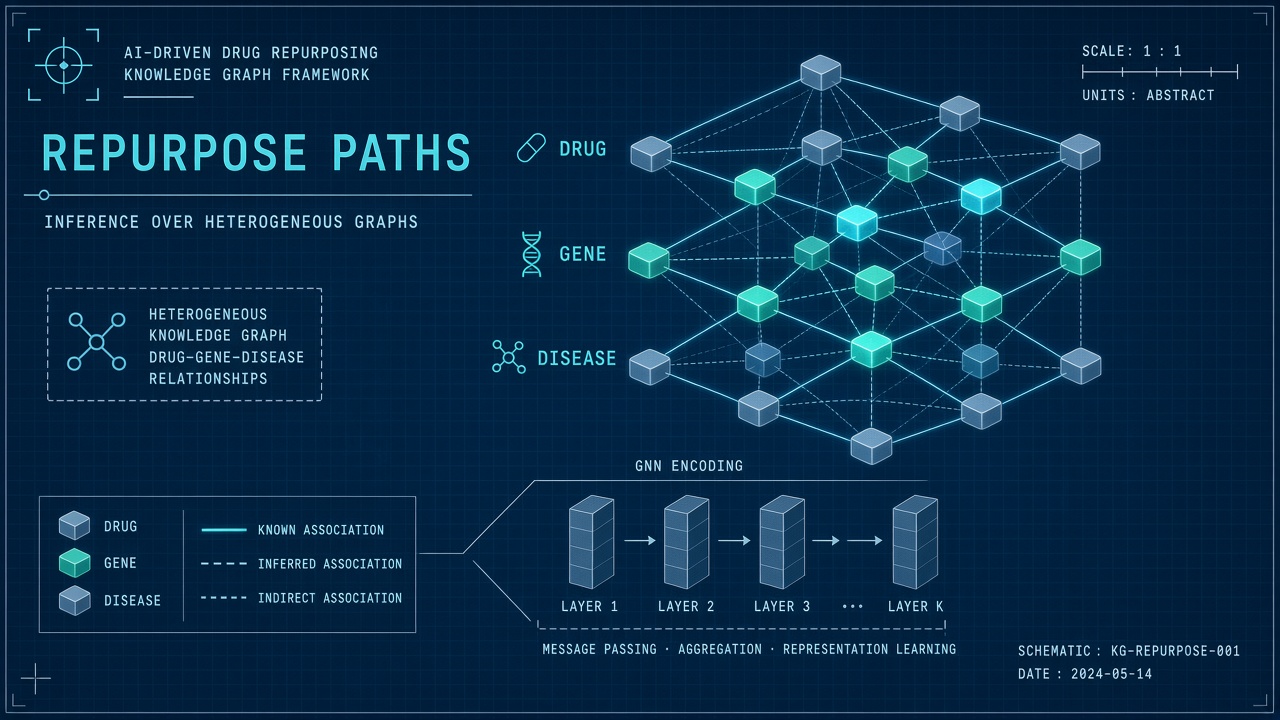
AI drug repurposing with knowledge graphs integrates drugs, genes, proteins, diseases, and pathways into linked networks, then applies graph neural networks and embedding models to rank existing compounds for new indications during outbreaks and rare disease crises. Novel small-molecule synthesis can take a decade and billions of dollars. When COVID-19 emerged, researchers needed therapeutic hypotheses in weeks. Knowledge graph methods such as TransRGNN, TxGNN, and attention-enhanced TransE variants recovered clinically used antivirals and immunomodulators by traversing disease-gene-drug edges rather than screening empty chemical space. Clinicians exploring AI healthcare discovery pipelines should treat graph predictions as hypothesis generators requiring graded evidence before trials or off-label use.
Why Repurposing Beats Novel Synthesis in Crises
Drug repurposing repositions approved or shelved compounds with known manufacturing, pharmacokinetics, and safety profiles, compressing the timeline from hypothesis to compassionate use or trial enrollment. During infectious disease surges, regulatory agencies and hospital formularies favor molecules already produced at scale. Remdesivir, dexamethasone, and numerous investigational antivirals entered COVID-19 protocols after mechanistic plausibility and retrospective signals, not after fresh de novo discovery campaigns. Repurposing also addresses rare and neglected diseases where commercial incentives for new chemical entities are weak but existing drugs may modulate shared pathways.
Novel synthesis still matters for resistance-breaking antimicrobials and precision oncology, but outbreak response prioritizes speed and supply chain certainty. A 2024 Nature Medicine TxGNN foundation model demonstrated zero-shot predictions across 17,080 diseases, including conditions without approved drugs, by learning on a unified medical knowledge graph rather than training disease-specific models from scratch. That scale matches crisis needs: one pretrained system adapts to emerging pathogens when new nodes and edges are injected from viral protein interaction studies.
Repurposing failures still occur when graph links reflect statistical association without causal mechanism or when in vitro activity does not translate to human pharmacology. Crisis urgency must not skip dose, drug-drug interaction, and contraindication review. Graph AI narrows search space; it does not replace randomized trials for efficacy claims.
Manufacturing and supply chain data belong in crisis graphs. A molecule may score highly on mechanism yet lack active pharmaceutical ingredient suppliers at pandemic scale. Graphs that annotate global production sites, cold-chain requirements, and formulation patents help committees prioritize feasible candidates. Dexamethasone success in severe COVID-19 reflected both immunomodulatory plausibility and ubiquitous hospital formulary availability, a constraint pure binding affinity rankings ignore.
Intellectual property and licensing affect deployment speed. Repurposed generics enable broad access; patented oncology drugs face royalty barriers even when graphs suggest new antiviral activity. Legal teams should review graph-derived proposals before public preprint amplification creates patient demand for unavailable compounds.
Building Biomedical Knowledge Graphs
Biomedical knowledge graphs merge heterogeneous sources into typed nodes (drug, gene, disease, pathway, symptom) and edges (targets, treats, associated_with, interacts_with) with provenance metadata. Common sources include DrugBank, ChEMBL, SIDER side-effect profiles, DisGeNET disease-gene associations, STRING protein interactions, Hetionet integrative graphs, and outbreak-specific repositories such as Open Targets releases used in Long COVID repurposing work at Oxford. Entity resolution aligns synonyms (acetaminophen versus paracetamol). Edge weights may reflect publication frequency, curated confidence, or effect sizes from genome-wide association studies.
Quality control determines downstream prediction trust. Duplicate edges, outdated drug withdrawals, and confounded disease comorbidity links inject noise. Temporal validation splits graphs by publication year so models predict future approvals from past knowledge, mimicking real outbreak discovery. The Oxford LongCOVID_GNN project used Open Targets snapshots from 2021, 2023, and 2024 for temporal holdouts, reporting thousands of drug-disease associations in training and hundreds in forward-time test sets.
Complication-aware graphs extend beyond single-disease nodes. TransRGNN (2023) linked COVID-19 to complication subgraphs so candidates address both viral replication and downstream thrombotic or renal injury pathways. Multi-hop paths (drug targets protein X, protein X interacts with pathway Y, pathway Y implicated in disease Z) become features for both GNN message passing and human-readable explanations.
Literature mining NLP pipelines extract new edges from PubMed and preprint servers during outbreaks, but false relations from hyped in vitro studies pollute graphs unless curator review gates ingestion. Confidence scores on edges should propagate to final drug ranks so committees weight curated DrugBank targets above single-abstract co-mention links. Versioned graph snapshots enable reproducibility: a March 2020 rank list differs from August 2020 after trial failures retire candidates.
Protein structure graphs augmented by AlphaFold models add binding-site similarity edges linking drugs to novel viral proteins without historical co-occurrence in literature. Structure-aware repurposing complements interaction networks when pathogens lack extensive disease-gene literature. Compute cost and structural confidence (pLDDT) thresholds prevent low-quality folds from spawning spurious recommendations.
| Source type | Example databases | Edge semantics |
|---|---|---|
| Drug-target | DrugBank, ChEMBL | Compound inhibits or binds protein |
| Disease-gene | DisGeNET, OMIM | Genetic association or causality |
| Pathway | Reactome, KEGG | Gene participates in pathway |
| Clinical | Open Targets, FAERS | Known indication or adverse event |
| Outbreak | Viral PPI, literature mining | Host-virus protein interaction |
Ranking Candidates With Graph Neural Nets
Graph neural networks propagate information across neighboring nodes to score drug-disease pairs, while knowledge graph embedding models (TransE, TransR, DistMult, RotatE) represent entities in vector space for link prediction. TxGNN (Nature Medicine 2024) combines GNN layers with metric learning to rank both indications and contraindications, improving zero-shot indication accuracy by 49.2% over eight baseline methods in stringent evaluations. Its Explainer module surfaces multi-hop paths clinicians can audit, aligning predictions with known off-label use in large healthcare systems.
Hybrid architectures integrate TransR with GNNs (TransRGNN) to embed relations separately from entities, capturing that "treats" and "causes" differ geometrically. Scientific Reports 2025 attention-enhanced TransE, DistMult, and RESCAL ensembles validated COVID-19 candidates against seven clinically approved drugs. SEAL subgraph extraction (Oxford LongCOVID_GNN) classifies enclosing subgraphs around candidate pairs, competing with global GraphSAGE, GAT, and Transformer GNN variants under leave-one-out and temporal splits.
K-Paths (2025) extracts diverse multi-hop paths for LLM or GNN consumption, improving Tx-Gemma 27B F1 on drug repurposing tasks by 4.0 points while shrinking effective graph size 90% for EmerGNN training. Path-based reasoning helps outbreak teams explain why an antiparasitic surfaced for an RNA virus (shared host pathway modulation) before wet-lab confirmation.
Ensemble strategies matter. No single embedding captures all relation types. Production pipelines often merge ranks from multiple models, then apply medicinal chemistry filters (blood-brain barrier, hERG liability, oral bioavailability) before proposing trials.
Negative sampling strategy shapes GNN training. Random non-edges are easy negatives; hard negatives ( chemically similar drugs without indication) sharpen decision boundaries. Oxford LongCOVID_GNN compared random, hard, and mixed negative sampling with Bayesian Optuna tuning, reporting sensitivity to sampling choice in temporal validation. Teams should publish negative sampling protocols alongside AUC claims because leaderboard gains sometimes reflect easier negatives rather than biological insight.
Explainability modules translate embedding math into curator-readable paths. TxGNN Explainer highlights multi-hop gene mediators; K-Paths feeds LLMs concise chains for committee slides. Human pharmacologists still reject paths that traverse promiscuous hub proteins with thousands of interactions unless supported by independent assay data. Explanation is hypothesis support, not proof.
Evidence Grading Before Clinical Trials
Graph predictions should pass staged evidence grading: in silico plausibility, in vitro assay, animal model, observational cohort, then randomized trial, with explicit stop rules when any stage fails. In silico hits face confirmation bias if teams cherry-pick top-ranked drugs with post hoc mechanistic narratives. Pre-registered prioritization lists locked before lab work reduce hindsight rationalization. In vitro panels should include cytotoxicity, viral replication, or pathway reporter assays matched to hypothesized mechanism. Animal models must reflect relevant human physiology; many COVID-19 candidates failed translation despite graph support.
Observational real-world evidence from electronic health records can support trial prioritization when propensity scoring addresses confounding. TxGNN validation compared predictions to off-label prescriptions clinicians already made, a pragmatic concordance test. Discordance flags either novel opportunities or model errors. Randomized trials remain the arbiter for regulatory approval; graph AI accelerates which candidates enter those trials, not whether trials are needed.
Evidence grading frameworks from infectious disease consortia (WHO R&D Blueprint, ACTIV) integrate computational tiers with committee review. Teams publishing AI research on repurposing should report temporal validation, contraindication prediction performance, and failure cases where high graph scores did not replicate in vitro.
Regulatory Off-Label Considerations
Repurposed drugs used for new indications may be prescribed off-label by licensed physicians, but manufacturers cannot promote off-label uses without regulatory approval, and outbreak compassionate use pathways impose separate reporting duties. FDA Emergency Use Authorizations and similar mechanisms temporarily authorize unapproved uses during declared emergencies when no adequate alternatives exist. Off-label prescribing in routine care remains legal in the U.S. when medically appropriate, yet payers may deny coverage without trial evidence. Graph-derived hypotheses do not create new labeled indications automatically.
Contraindication prediction is as clinically important as indication ranking. TxGNN explicitly models drugs to avoid in specific diseases because of adverse pathway overlap. Ignoring contraindication edges caused harm in historical repurposing attempts when immunosuppressants worsened active infections. Pharmacovigilance integration with FAERS adverse event graphs updates risk after deployment.
Global regulatory divergence matters. A drug approved for one indication in the EU may lack approval elsewhere; outbreak stockpiles must respect national formularies. AI teams should document data provenance for graph edges supporting institutional review board submissions and compassionate use packets, translating multi-hop paths into plain-language mechanism summaries for ethics committees.
Pharmacogenomic subgraphs add allele-specific edges when repurposing immunomodulators or antivirals whose toxicity varies by CYP450 metabolizer status. Graphs integrating CPIC guidelines and population allele frequencies help avoid recommending standard doses in poor metabolizers during rushed outbreak protocols. Pediatric and pregnancy contraindications require explicit node types because adult outbreak trials rarely capture these subpopulations unless graphs encode developmental toxicity databases such as ToxCast.
Compassionate use registries should log graph rank, committee vote, and outcome for each patient to close the learning loop ethically. Post-market surveillance after emergency authorization feeds adverse events back into graph edge weights, down-ranking candidates whose real-world harm signals exceed predicted benefit. Transparency reports published after outbreaks (as NIH ACTIV did for COVID-19 candidates) build public trust in computational prioritization.
Frequently Asked Questions
What is an AI drug repurposing knowledge graph?
A linked network of biomedical entities plus machine learning (often graph neural networks) that scores existing drugs for new disease indications by analyzing multi-hop relationships.
Why use graphs during outbreaks?
Graphs reuse existing drug safety and manufacturing knowledge, ranking candidates in days instead of years required for de novo drug design.
What is TxGNN?
A 2024 Nature Medicine foundation model trained on a medical knowledge graph covering 17,080 diseases, using GNNs for zero-shot repurposing and explainable multi-hop rationales.
Do high graph scores mean proven efficacy?
No. Scores prioritize hypotheses for lab and clinical validation. Randomized trials still determine treatment benefit.
How is evidence graded?
Typical stages: computational rank, in vitro assay, animal model, observational data, randomized trial, with stop rules after failed replication.
Can companies promote off-label uses from AI predictions?
No in the U.S. without regulatory approval for the new indication. Physicians may prescribe off-label independently based on clinical judgment.
What about contraindications?
Modern models predict both indications and drugs to avoid. Contraindication edges are critical during infectious disease repurposing when immunomodulation risks worsen outcomes.
COVID-19 repurposing literature converged on graph methods validating against seven approved antivirals in Scientific Reports 2025 ensemble work, illustrating how crisis benchmarks anchor computational hype to clinical reality. Outbreak teams should treat knowledge graphs as living infrastructure: each new pathogen release updates nodes, reruns temporal validation, and refreshes candidate lists while preserving audit trails for regulators and the public.