A bloodstream infection turns critical while the microbiology lab waits 48 to 72 hours for final antimicrobial susceptibility testing (AST). Clinicians start broad-spectrum empiric antibiotics that may be wrong, accelerating resistance selection pressure. Antibiotic resistance prediction AI models estimate which drugs will fail before phenotypic results return, using genomic markers, proteomic spectra, prior admission data, and institutional antibiograms. The goal is not to replace AST or infectious disease judgment, but to narrow empiric choices earlier so patients receive effective therapy sooner and hospitals preserve last-line agents.
Hospital antimicrobial stewardship teams evaluating decision support should understand how prediction models are trained, which organisms they cover, and how outputs integrate with EUCAST or CLSI breakpoints. Clinicians exploring AI chatbot assistants for drug information should treat unconstrained large language model answers as educational only, not as resistance forecasts tied to a specific isolate. More research explainers on medical AI appear on the EliteAI.tools blog index.
What Antibiotic Resistance Prediction AI Means in Plain Language
Antibiotic resistance prediction AI refers to machine learning systems that estimate whether a bacterial or fungal isolate will grow in the presence of specific antibiotics, using patterns learned from past cultures, gene sequences, or laboratory instrument outputs. Traditional AST exposes the organism to antibiotic disks or automated panels and measures growth inhibition after incubation. AI shortcuts that wait by inferring resistance from faster inputs: whole-genome sequencing can flag blaKPC or mecA within hours; matrix-assisted laser desorption ionization time-of-flight (MALDI-TOF) mass spectrometry can classify species in minutes and, in research settings, predict susceptibility from protein spectral fingerprints.
Resistance prediction sits on a spectrum from rule-based expert systems (if gene X is present, report resistant to drug Y) to deep neural networks trained on millions of isolates. WHO's Global Antimicrobial Resistance and Use Surveillance System (GLASS) still relies primarily on phenotypic reporting, but its 2024 dashboard update and technical manuals describe a gradual path toward molecular and whole-genome sequencing submissions that complement culture-based surveillance. Prediction models trained on GLASS-aligned data can help hospitals anticipate local resistance trends, while isolate-level models guide individual patient therapy.
| Input signal | Typical turnaround | AI output |
|---|---|---|
| Whole-genome sequencing | 12 to 24 hours | Resistome gene calls, lineage typing |
| MALDI-TOF MS spectra | Minutes to hours | Species ID plus susceptibility probability |
| Clinical risk scores (DRIP) | Real time at bedside | Empiric resistance risk for pneumonia |
| Phenotypic AST (reference) | 24 to 72 hours | Definitive S/I/R category per drug |
How the Underlying AI Pipeline Works
Production resistance prediction pipelines ingest structured laboratory and clinical features, encode them into model-ready tensors, and output calibrated probabilities per antibiotic class that stewardship pharmacists review before changing orders. Genomic pipelines align reads to reference genomes, call single-nucleotide variants and acquired resistance genes via tools such as ResFinder or AMRFinderPlus, then map gene presence to predicted phenotypes using curated genotype-to-phenotype rules. Machine learning layers can refine those rules when gene presence alone is insufficient, as with efflux pump expression or porin loss in Pseudomonas aeruginosa.
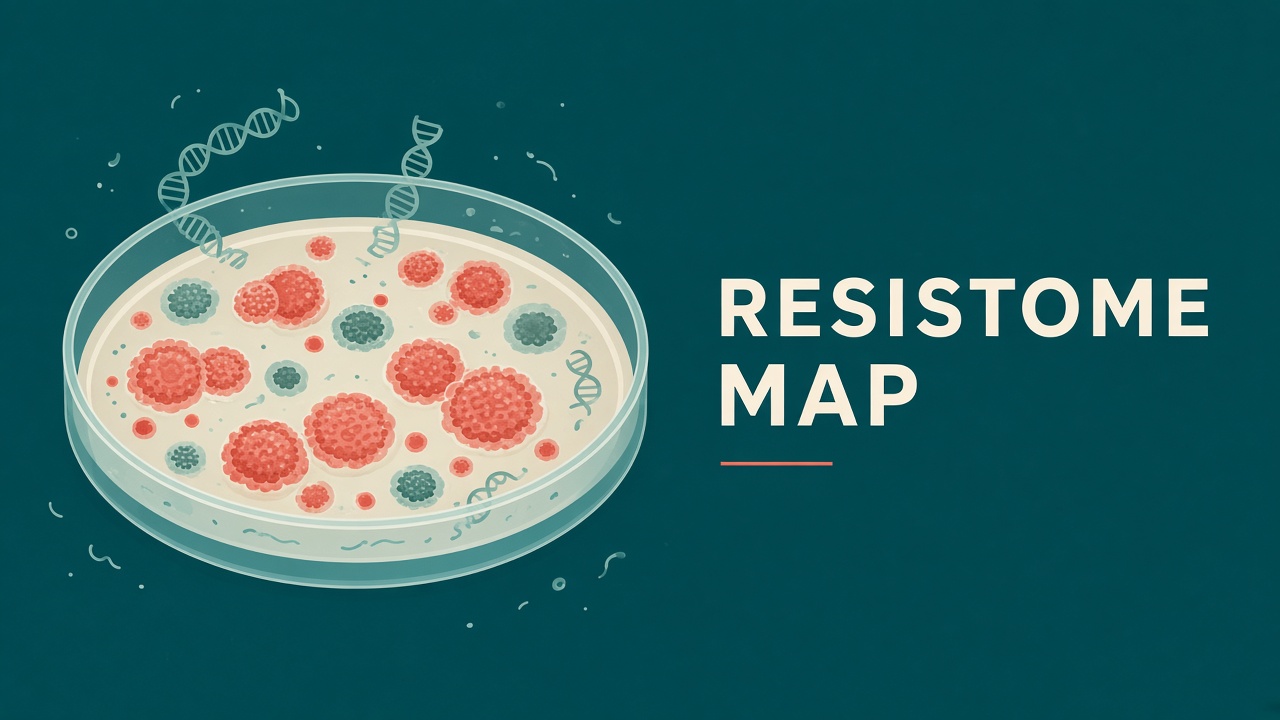
Genomic resistome cartography
Resistome cartography layers genomic k-mers, plasmid replicon typing, and mobile genetic element annotations so models distinguish chromosomal from horizontally transferred resistance. Convolutional or transformer architectures trained on public repositories such as NCBI Pathogen Detection or PATRIC learn co-occurrence patterns: carbapenemase genes with specific sequence types, or erm genes with macrolide exposure history. Outputs are typically multi-label classifiers across drug classes, with attention weights highlighting which genes drove each prediction for microbiologist review.
MALDI-TOF mass spectrometry fingerprints
MALDI-TOF mass spectrometry fingerprints can flag levofloxacin resistance in Stenotrophomonas maltophilia before conventional AST completes, according to a 2025 randomized controlled trial published in Implementation Science (doi:10.1186/s13012-025-01453-4). Researchers trained random forest models on MALDI-TOF protein spectral data, achieving area under the curve values of 0.95 for levofloxacin and trimethoprim-sulfamethoxazole resistance prediction. In the trial of 1,600 simulated infections, AI-enhanced clinical decision support predicted resistance one day earlier than standard practice; mortality was 11.5% in the intervention arm versus 15.1% in control (p = 0.03). This demonstrates that proteomic AI can change prescribing confidence and outcomes when integrated into workflow, not merely achieve high offline AUC on retrospective data.
Clinical risk scores before culture returns
The Drug Resistance in Pneumonia (DRIP) score, developed at Intermountain Healthcare and embedded in the ePNa electronic pneumonia navigator, uses ten clinical factors to estimate risk for resistant pathogens in community-acquired pneumonia. A stepped-wedge cluster trial across 6,848 encounters found that ePNa deployment was associated with reduced mortality, though effect size was modest and confounded by concurrent guideline updates. DRIP is not deep learning, but it illustrates how ordinal risk models gate empiric broad-spectrum therapy before any AI genomic layer arrives. Hybrid systems may combine DRIP-style clinical scores with incoming culture AI predictions as results stream in.
EUCAST and CLSI breakpoint alignment
Resistance predictions must map to institutional breakpoint tables from the European Committee on Antimicrobial Susceptibility Testing (EUCAST) or Clinical and Laboratory Standards Institute (CLSI). A genomic call for blaOXA-48 implies carbapenem resistance under most interpretive tables, but MIC values near the susceptible breakpoint still demand phenotypic confirmation before reporting "resistant" to regulators. Stewardship dashboards should display both predicted phenotype and gene evidence so pharmacists understand whether the model used rules or learned embeddings. When hospitals switch breakpoint versions after EUCAST annual updates, prediction services must revalidate or risk systematic misclassification of borderline isolates.
Integration with antimicrobial stewardship workflows
- Collect blood, urine, or respiratory specimen; perform Gram stain and rapid diagnostics where available.
- Run MALDI-TOF for species identification; optionally trigger spectral susceptibility model if validated for that organism.
- Order whole-genome sequencing for high-risk isolates (carbapenem-resistant Enterobacterales, recurrent S. maltophilia).
- Feed genomic, proteomic, and clinical features into resistance prediction model; display ranked antibiotic options with confidence intervals.
- Pharmacist and infectious disease physician review prediction against local antibiogram and patient allergies.
- Adjust empiric therapy; de-escalate when phenotypic AST confirms susceptibility.
- Log prediction versus AST outcome for continuous model retraining and GLASS-aligned surveillance reporting.
Real Deployments and Published Evidence
Peer-reviewed evidence spans proteomic random forests with mortality endpoints, pneumonia clinical decision support with cluster-randomized designs, and genomic surveillance frameworks endorsed by WHO GLASS. Randomized and quasi-experimental studies are still rare compared with retrospective AUC benchmarks, which limits generalizability to every hospital antibiogram.
WHO's September 2024 GLASS dashboard release visualizes national resistance proportions for 23 antibiotics across eight priority pathogens using 2022 phenotypic data from participating countries. The GLASS whole-genome sequencing technical note (ISBN 978-92-4-001100-7) documents how sequencing can detect emerging resistance mechanisms earlier than phenotypic trends alone, supporting policy decisions on last-line agent stewardship. National reference laboratories in Denmark, the United Kingdom, and Australia publish routine WGS-based resistance surveillance that feeds public health alerts; hospital-facing AI tools increasingly mirror those pipelines at isolate granularity.
Commercial antimicrobial stewardship platforms incorporate rule engines for MRSA, VRE, and extended-spectrum beta-lactamase detection from PCR panels, which are deterministic cousins of ML predictors. Research groups at Johns Hopkins, the University of Oxford, and the Broad Institute publish open-source genomic resistance classifiers benchmarked on holdout isolates from multi-center cohorts. Regulatory pathways vary: some outputs are laboratory-developed tests under CLIA in the United States, while European hospitals deploy them as decision support without standalone device clearance.
| Study or system | Design | Key finding |
|---|---|---|
| MALDI-TOF AI-CDSS (S. maltophilia) | RCT, n = 1,600 infections | AUC 0.95; 14-day mortality 11.5% vs 15.1% |
| ePNa / DRIP pneumonia | Stepped-wedge cluster trial | Mortality reduction with embedded resistance logic |
| WHO GLASS WGS guidance | Technical surveillance framework | Molecular data complement phenotypic AST |
| Genomic AMR classifiers | Retrospective multi-site benchmarks | High sensitivity for common resistance genes; variable for novel mechanisms |
Limits, Risks, and Ethical Guardrails
Resistance prediction AI can misclassify novel resistance mechanisms, overfit to single-hospital antibiograms, and encourage inappropriate broad-spectrum continuation when clinicians trust probabilistic outputs over pending AST. Genotype-phenotype discordance is common: a gene may be present but not expressed, or resistance may arise from mutations not in training labels. Models trained predominantly on high-income country isolates underperform on pathogens prevalent in low-resource settings, widening global AMR inequity if deployed uncritically.
- False susceptibility calls: Treating a resistant organism as susceptible delays effective therapy and worsens outcomes.
- Automation bias: Junior prescribers may accept AI recommendations without reviewing allergy history or source control needs.
- Data governance: Genomic sequences are identifiable and may reveal hospital outbreak clusters.
- Regulatory clarity: Research-use-only classifiers must not enter patient charts without laboratory validation.
- One Health spillover: Agricultural antibiotic use shapes resistance genes that hospital models may not capture.
Ethical stewardship requires human-in-the-loop review, transparent confidence scores, mandatory AST reconciliation, and public reporting aligned with GLASS standards. Hospitals should audit prediction-versus-phenotype discordance monthly and pause models that drift after local outbreak clones emerge.
Who Should Use This and Who Should Wait
Academic medical centers with MALDI-TOF, molecular diagnostics, and active antimicrobial stewardship programs should pilot validated resistance prediction models for priority organisms such as carbapenem-resistant Enterobacterales and S. maltophilia. Small community hospitals without sequencing infrastructure should focus on antibiogram-driven empiric guidelines and rapid PCR panels before adopting opaque deep learning black boxes. Public health agencies should contribute anonymized isolate data to GLASS while investing in WGS capacity described in WHO technical guidance.
| Stakeholder | Recommendation | Prerequisite |
|---|---|---|
| Stewardship pharmacist | Pilot proteomic or genomic predictors for targeted organisms | Local validation against AST gold standard |
| Microbiology laboratory | Integrate WGS resistome calls into LIS reports | Bioinformatics pipeline and CLIA validation |
| Critical care team | Use predictions to narrow empiric spectrum, not replace ID consult | Documented override pathway when AST disagrees |
| Outpatient clinics | Wait for point-of-care validated tools | Most outpatient UTIs still rely on culture AST |
Frequently Asked Questions
Can AI replace phenotypic susceptibility testing?
No. Phenotypic AST remains the reference standard for clinical reporting under EUCAST and CLSI guidelines. AI predictions accelerate empiric decisions but must be reconciled with definitive culture results.
How accurate is MALDI-TOF resistance prediction?
Published random forest models for S. maltophilia reached AUC 0.95 for specific drugs in controlled trials, but accuracy varies by organism, drug class, and local strain prevalence. External validation on your antibiogram is mandatory before clinical use.
How does WHO GLASS relate to hospital AI tools?
GLASS aggregates national surveillance data; hospital AI models consume similar phenotypic and emerging genomic inputs at isolate level. Contributing de-identified outcomes to public health strengthens both local and global resistance forecasting.
Should clinicians ask chatbots which antibiotic to use?
General-purpose large language models lack access to the patient's isolate and may hallucinate susceptibility patterns. Use institution-validated decision support tied to live laboratory data instead.
What happens when a novel resistance mechanism appears?
Models trained on known gene catalogs may predict false susceptibility until retrained on the new mechanism. GLASS Emerging Antimicrobial Resistance Reporting and rapid WGS outbreak investigations are the public health backstop.
Which metrics prove stewardship value?
Track time to effective therapy, days of broad-spectrum exposure, mortality in targeted infections, and prediction-AST concordance rates. AUC alone does not justify deployment without workflow outcome data.
Antibiogram feedback loops and model drift
Hospital antibiograms summarize institutional resistance prevalence by unit and organism. Prediction models trained on national repositories may disagree with a unit-specific antibiogram during outbreak years when a novel clone sweeps the neonatal ICU. Monthly reconciliation between predicted resistance distributions and phenotypic antibiogram trends triggers retraining or temporary model suspension. Pharmacy informatics teams should treat resistance AI like any other LIS instrument: calibration logs, quality control strains, and documented corrective action when discordance exceeds agreed thresholds.
Conclusion
Antibiotic resistance prediction AI compresses the window between specimen collection and informed empiric therapy by fusing genomic resistome signals, MALDI-TOF proteomic fingerprints, and clinical risk scores. Randomized evidence from S. maltophilia decision support and pneumonia navigator trials shows mortality and prescribing benefits when predictions arrive days before conventional AST. WHO GLASS frameworks increasingly embrace molecular surveillance that complements phenotypic gold standards. Hospitals with stewardship maturity should validate models locally; others should strengthen culture-based workflows before chasing algorithmic shortcuts that cannot see novel resistance emerging in real time.