Google launched the Fairwind Program in September 2026 with Gemini 3.8 Flash Cyber and CodeMender for vetted defenders. Microsoft countered with Secure AI, a bundled initiative tying Copilot for Security, Defender for Cloud, Sentinel, and gated OpenAI cyber models on Azure to enterprise agreements. CISOs evaluating fairwind vs microsoft secure ai need a feature-level comparison of scope, certifications, pricing, and when running both programs makes sense in multi-cloud environments.
Neither program is a consumer product. Both restrict frontier cyber capabilities to organizations with operational security maturity. Compare offerings against your existing AI code security stack and cybersecurity AI investments before committing cloud spend.
Program Scope: Fairwind vs Microsoft Secure AI
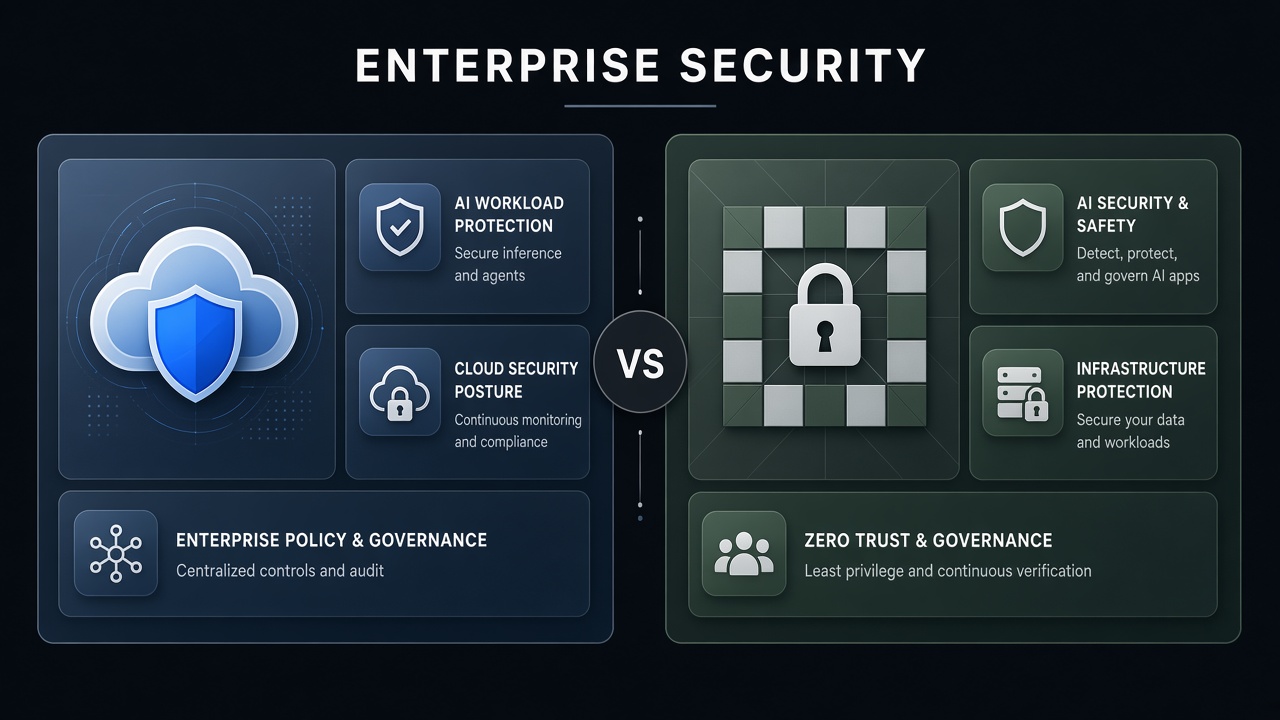
Google Fairwind centers on autonomous vulnerability remediation with a cyber-tuned Gemini model and CodeMender agent harness inside Google Cloud, while Microsoft Secure AI emphasizes SOC copilots, cloud workload protection, and incident response orchestration across Azure and hybrid estates. Fairwind prioritizes patch velocity; Microsoft Secure AI prioritizes detection, investigation, and guided response at enterprise scale.
| Dimension | Google Fairwind | Microsoft Secure AI |
|---|---|---|
| Primary outcome | Find, verify, patch flaws in customer repos | Detect, investigate, respond across cloud and identity |
| Flagship model | Gemini 3.8 Flash Cyber | GPT-5.6-Cyber class models via Azure (gated) |
| Agent harness | CodeMender (first-class) | Copilot for Security plus Defender automation |
| Eligibility | Fairwind application, critical infra priority | Enterprise agreement, security SKUs, usage review |
| Public sector | Explicit government and grid operator focus | Azure Government, NATO cloud, FedRAMP paths |
Fairwind reported more than 650 partner organizations at launch, with Chrome and Google Cloud security teams citing faster patch generation using Flash Cyber. Microsoft positions Secure AI as the umbrella for customers already standardized on Entra ID, Defender XDR, and Sentinel data lakes. Choose Fairwind when patch mean-time-to-remediate is the bottleneck on GCP. Choose Microsoft Secure AI when alert fatigue and cross-product correlation dominate.
Certifications and Audits Offered by Each Program
Both vendors inherit parent cloud compliance portfolios (ISO 27001, SOC 2, FedRAMP variants, CSA STAR) but package program-specific attestations and customer audit support differently. Microsoft Secure AI customers typically leverage existing Defender and Azure compliance documentation plus Microsoft-generated penetration test summaries for Copilot data flows. Fairwind participants receive architecture guides for isolating CodeMender workloads and logging agent actions for internal audit.
| Certification theme | Google Fairwind | Microsoft Secure AI |
|---|---|---|
| Cloud platform certs | Google Cloud ISO/SOC/FedRAMP High paths | Azure ISO/SOC/FedRAMP Moderate/High |
| AI-specific documentation | Fairwind security boundary whitepaper | Copilot for Security data handling docs |
| Customer audit support | Agent action logs in customer GCP project | Sentinel workbooks, Defender audit events |
| Third-party pen test | Vendor-reported Chrome/Cloud results | Microsoft red team publications, customer-led tests |
Regulated buyers should map program logs to their own SOC 2 or PCI evidence requests. Neither program removes customer responsibility for secure coding, secrets management, or change control on agent-generated patches.
Pricing and Cloud Bundling Comparison
Fairwind access does not carry a separate list price beyond Google Cloud consumption and approved model usage, while Microsoft Secure AI bundles Copilot for Security units, Defender SKUs, and Azure OpenAI cyber model credits into enterprise agreements with minimum commits. Exact pricing varies by region, sector, and existing EAs; treat public list prices as anchors only.
Google Fairwind economics:
- No standalone Fairwind license fee announced at launch.
- Customers pay GCP compute, storage, and Gemini 3.8 Flash Cyber inference.
- CodeMender available outside Fairwind on public models with lower capability ceilings.
- Migration costs matter if security workloads are not already on GCP.
Microsoft Secure AI economics:
- Copilot for Security priced per security operator seat.
- Defender for Cloud and Sentinel ingestion drive variable data costs.
- Gated cyber models billed through Azure OpenAI meters with approval gates.
- EA true-ups may bundle Secure AI credits for committed Azure spend.
Finance teams should model three-year TCO including SIEM data retention, not only headline AI fees. A cheaper model tier loses value if log volume doubles. For google microsoft ai security comparisons, run parallel pilots on non-production repositories (Fairwind) and a Sentinel-heavy workload (Microsoft) before signing multi-year commits.
When Enterprise Teams Use Both Programs
Large enterprises with multi-cloud estates often enroll in Fairwind for GCP-centric patching acceleration while keeping Microsoft Secure AI for identity-centric detection and M365-integrated response. The programs overlap philosophically but not operationally if roles are split clearly.
Use both when:
- Development ships primarily on Google Cloud but corporate identity and email live in Microsoft 365.
- Critical infrastructure units need Fairwind patch agents while the group SOC standardizes on Sentinel.
- Mergers left you with heterogeneous repos spanning GitHub, Azure DevOps, and GitLab.
- Regulators require best-of-breed tooling with independent audit trails per cloud.
Avoid both when budget or staffing cannot support dual runbooks. Agent-generated patches and copilot-guided investigations each need human reviewers trained on vendor-specific failure modes (hallucinated CVE IDs, false positive containment suggestions). Document which team owns each program in your RACI matrix.
Enterprise ai cyber strategy in 2026 treats these programs as force multipliers atop fundamentals: MFA, privileged access management, software supply chain scanning, and incident response playbooks. Neither replaces secure SDLC practices or architecture review for AI inference pipelines feeding production data.
Frequently Asked Questions
Who qualifies for Google Fairwind?
Governments, critical infrastructure operators, healthcare, telecom, energy, financial network defenders, and mature security partners. Applicants need phishing-resistant MFA and role-based access controls. Google restricts accounts to cybersecurity job functions.
How do we get Microsoft Secure AI cyber models approved?
Work through your Microsoft account team with a use case statement, security maturity evidence, and planned logging architecture. Approval gates mirror other restricted Azure OpenAI capabilities.
Can these programs be used for offensive security?
Both vendors frame offerings as defender programs. Misuse triggers termination and potential legal exposure. Red teams should use contracted scopes and customer-owned environments only.
What about AWS?
AWS offers GuardDuty, Security Hub, and Bedrock-governed models but lacks a single branded Fairwind or Secure AI equivalent at launch. Multi-cloud shops may run AWS native tooling alongside one of these two programs.