After a stroke, Maria knows the story she wants to tell about her garden. She sees the red tomatoes and hears her granddaughter's laugh, but the nouns arrive late or vanish mid-sentence. Traditional spell-check helps spelling, not semantics. A blank page feels like a locked door. AI aphasia writing support applies predictive text, large language model prompting, and clinician-designed workflows to help people with aphasia express ideas in writing and creative formats without replacing the cognitive work of authorship.
Speech-language pathologists, rehabilitation engineers, and caregivers evaluating AI chatbot assistants for clinic or home use need realistic expectations about word-finding apps, progressive web apps (PWAs), and when human oversight is mandatory. Additional accessibility research appears on the EliteAI.tools blog index.
What AI Aphasia Writing Support Means in Plain Language
AI aphasia writing support refers to software that helps people with acquired language disorders draft, revise, or complete written text by suggesting words, sentences, or creative prompts based on partial input, context, or spoken utterances that may be telegraphic or disordered. Aphasia affects reading, writing, speaking, and listening in different combinations depending on lesion location. Broca-type profiles often struggle with grammar and function words while retaining comprehension; Wernicke-type profiles may produce fluent but erroneous text. Writing support must adapt to heterogeneous profiles rather than assume one "simplify" button fits all.
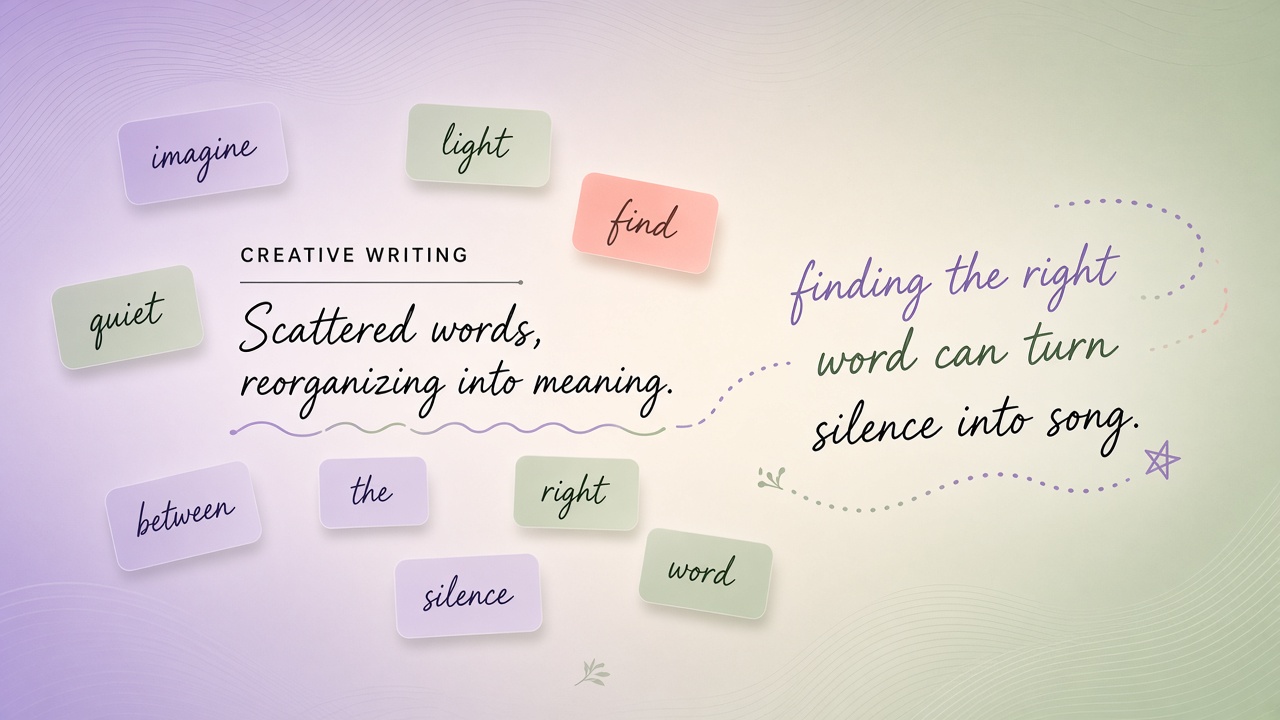
Creative writing adds another layer. Poetry, memoir, and journaling motivate practice when drill worksheets do not. AI can offer rhyme or metaphor suggestions, expand a three-word seed into a stanza, or rephrase a clumsy sentence while preserving the author's intent. The goal is participation and confidence, not polished publication without the writer's agency.
| Support mode | What AI does | Clinical fit |
|---|---|---|
| Word prediction | Ranks next words from partial typing | Mild anomic aphasia, fatigue |
| Utterance reformulation | Turns disordered speech into fluent lines | AAC conversations, journaling |
| Prompted expansion | Grows keywords into paragraphs or poems | Creative therapy groups |
| Collaborative editing | LLM revises drafts with user approval | Structured homework with SLP review |
Word-finding versus grammar support
Word-finding tools target anomia, the tip-of-the-tongue experience where meaning is clear but lexical retrieval fails; grammar support addresses missing function words, verb inflection, and sentence scaffolding. Classic assistive apps used frequency-ranked dictionaries and semantic feature analysis cues (category, action, association). Modern systems embed transformer language models that predict likely continuations from context. The risk is the model substitutes its own phrasing for the user's intended word, reducing therapeutic benefit unless the person selects among options rather than accepting the first suggestion blindly.
Why creative writing belongs in therapy
Narrative and poetry tasks recruit personal motivation, episodic memory, and emotional processing pathways that decontextualized naming drills may not. Writing a birthday card for a spouse or a haiku about weather ties language practice to identity. AI lowers the activation energy to start: supply three topic words, receive a rough stanza, edit two lines manually. The editing step is where aphasia therapy often lives.
How the Underlying AI Pipeline Works
Typical stacks combine speech or text input, automatic speech recognition tuned for disordered speech, large language model inference for suggestion ranking, and a clinician-configurable interface layer delivered as mobile web PWAs or tablet apps. Latency and button size matter as much as model quality because many users have co-occurring motor or cognitive fatigue after brain injury.
Speech recognition for aphasic speech
General-purpose ASR models trained on typical speakers mis-transcribe paraphasias, neologisms, and halting prosody. Research fine-tunes Whisper and similar models on aphasic speech corpora to improve word error rates, but performance remains below clinical perfection. Systems like Aphasia-GPT accept spoken input from users with aphasia, then generate lists of well-formed utterance suggestions grounded in the disordered source rather than ignoring it. That design respects that the user's broken speech still carries semantic signal.
LLM prompting and guardrails
Large language models complete text statistically. Without constraints, they hallucinate facts, shift tone to generic assistant voice, or overwrite personal details. Clinical deployments wrap models with structured prompts: preserve named entities, offer three ranked options, forbid medical advice, and log selections for session review. A Frontiers in Rehabilitation Sciences case report (2025) documented ChatGPT-assisted editing for an adult with aphasia using visual flowcharts and structured prompts, reporting gains in sentence productivity and complexity alongside survey-measured attitude improvements toward writing.
PWA delivery and interface design
Progressive web apps run in browsers without app store friction, important when hospital IT locks devices. Large tap targets, high contrast, text-to-speech readback of incoming messages, and photo tiles for contacts reduce navigation load. Products such as Tendly and Broca AI Speech emphasize tablet-first layouts where caregivers start conversations and aphasic users select AI-generated reply cards instead of typing from scratch. Bobbai listens to ambient dialogue and surfaces context-aware word suggestions aligned with therapist-configured profiles.
| Component | Purpose | Known limitation |
|---|---|---|
| ASR (Whisper fine-tunes) | Capture spoken drafts | Errors on severe dysarthria |
| LLM suggestion ranker | Generate fluent candidates | May drift from user intent |
| Semantic feature cues | Therapy-aligned word finding | Slower than one-tap accept |
| Clinician dashboard | Review logs, adjust prompts | Requires training time |
| On-device cache | Offline session continuity | Smaller models, weaker suggestions |
Typical workflow steps in clinic or home
- Speech-language pathologist assesses reading, writing, and typing ability; sets creativity goals (journal, poem, email).
- Choose interface mode: typing with prediction, speech-to-suggestion cards, or collaborative LLM editing.
- Co-create a personal word bank (family names, hobbies) to bias model context.
- Run short writing sprints: user supplies seed words; AI proposes options; user selects and edits manually.
- Review session transcript together; note which suggestions were accepted versus rejected.
- Gradually reduce AI assistance as retrieval improves; document progress for insurance or care plans.
Real Deployments and Published Evidence
Published evidence mixes small pilot studies, case reports, and commercial beta products; large randomized trials of generative AI for aphasia writing remain scarce. Aphasia-GPT, developed as a mobile web app at Brigham Young University, piloted with three participants who provided spoken input and received predicted fluent utterances. Qualitative interviews captured user perspectives; authors positioned the system within augmentative and alternative communication (AAC) rather than autonomous authorship.
Scoping reviews of AI in aphasia management (Adikari et al., 2024; Azevedo et al., 2023) find most studies address assessment, subtyping, and therapy response prediction. Few apply AI directly to treatment or assistive communication. Among treatment-oriented work, automatic speech recognition for naming feedback and word prediction for writing appear most often. Generative large language models represent a newer branch with limited peer-reviewed outcome data.
The 2025 Frontiers case report on ChatGPT for written expression showed improved sentence counts and complexity metrics when an adult with aphasia combined self-generated content with AI-assisted editing under visual scaffolding. Authors note this is single-case evidence, not population-level proof. Broca AI Speech, Tendly, and Bobbai market real-time conversation and writing support with caregiver involvement; formal efficacy trials are still emerging as private betas expand.
Traditional computer writing aids with spell-check and grammar tools already help some people with aphasia revise surface forms. LLMs extend that by proposing content, not just correcting orthography. The therapeutic question is whether shortcutting word retrieval accelerates recovery or bypasses the cognitive routes clinicians want to strengthen. Many SLPs favor selectable suggestions and timed independence goals rather than full paragraph autogeneration.
Life participation approaches align well with creative AI writing when goals are stated in everyday terms: compose a text to a friend, draft a holiday newsletter paragraph, or finish a stanza started in group therapy. Measuring success by words per minute alone misses whether the person felt heard. Session videos and self-rating scales ("I said what I meant") complement automated metrics. Rehabilitation centers piloting PWAs report higher homework completion when assignments feel personal rather than worksheet-like, though formal publication of those operational outcomes is still catching up to anecdotal clinic reports.
Limits, Risks, and Ethical Guardrails
AI writing support can fabricate biographical details, homogenize voice, leak private health information to cloud APIs, and create dependency if users never practice retrieval without suggestions. Creative contexts lower some stakes relative to medical documentation, but emotional harm from wrong words in a memoir or message to family is real.
- Intent drift: Models substitute plausible but incorrect words, especially for low-frequency personal terms.
- Over-automation: Accepting AI paragraphs may satisfy homework quotas without engaging word-finding strategies.
- Privacy: Uploading journal entries to public chatbots may violate HIPAA or personal boundaries.
- Equity: Subscription apps and newest phones exclude patients who need support most.
- Attribution: Published creative work should clarify human versus machine contribution when relevant.
Guardrails include on-device or enterprise-hosted models, informed consent forms explaining cloud processing, therapist approval gates before sending emails, audit logs, and training caregivers to pause and ask "Is this your word?" instead of tapping the first card. FDA regulation may apply if vendors claim diagnostic or therapeutic outcomes; most current tools position as wellness or communication aids pending clearer policy.
Who Should Use This and Who Should Wait
Outpatient speech clinics, stroke support groups, and motivated individuals with mild-to-moderate anomia should experiment with therapist-supervised AI writing pilots, especially for journaling and creative homework. Acute inpatients with severe comprehension deficits, users who cannot verify suggestion accuracy, or teams without SLP oversight should wait or restrict to offline word banks without generative expansion.
| User profile | Recommendation | Guardrail |
|---|---|---|
| Mild anomic aphasia, tablet user | Word prediction plus creative prompts | Weekly SLP review of samples |
| Caregiver-mediated conversation | Selectable reply card apps | User must confirm before speak-aloud |
| Severe comprehension impairment | Defer generative LLM editing | Risk of misunderstanding suggestions |
| Creative writing group | Seed-word expansion with group critique | Celebrate human edits, not AI fluency |
Frequently Asked Questions
Does AI replace speech-language therapy?
No. AI supports practice between sessions; licensed SLPs diagnose profiles, set cues, and monitor whether tools help or hinder recovery. Automation without clinical framing risks reinforcing errors.
Is ChatGPT safe for private journaling with aphasia?
Consumer chatbots may store prompts on vendor servers; patients should use HIPAA-aligned or on-device alternatives when content is sensitive. Therapists can provide institutional accounts with data processing agreements.
Should therapy focus on creative or functional writing first?
Functional tasks (appointments, messages) address daily needs; creative tasks boost motivation and long-form retrieval practice. Many plans alternate both once basic safety skills exist.
How accurate is word prediction for aphasia?
Accuracy depends on personal word banks and aphasia subtype; generic models rank common words that may not match the user's intended niche vocabulary. Custom biasing improves relevance.
Are PWAs good enough versus native apps?
PWAs reduce install friction and ease clinic deployment; native apps may offer better offline ASR and OS-level accessibility hooks. Choose based on IT policy and motor needs.
What evidence level exists today?
Most generative AI writing studies are pilots or case reports; large randomized controlled trials are still rare as of 2025. Treat marketing claims cautiously and collect local outcome data.
How much clinician oversight is needed?
Weekly review of writing samples and suggestion acceptance rates is a practical minimum for new adopters; high-stakes external communication needs per-message approval. Oversight scales down as accuracy and confidence improve.
Conclusion
AI aphasia writing support combines word-finding apps, predictive text, disordered-speech-aware ASR, LLM suggestion ranking, and PWA interfaces designed for fatigue and motor limits. Pilot systems like Aphasia-GPT and emerging conversation apps show promise for lowering the barrier to creative and functional writing when speech-language pathologists stay in the loop. Limits include intent drift, privacy exposure, weak evidence at scale, and the temptation to skip the hard work of retrieval. Used as a scaffold rather than a ghostwriter, AI can help people with aphasia tell the stories they already carry while preserving agency, dignity, and therapeutic intent.